.avif)
All About Heat Pump Efficiency in Extreme Heat
Discover how to maximize heat pump efficiency in extreme heat and mild winters with expert tips for year-round Sacramento comfort.
Discover how to maximize heat pump efficiency in extreme heat and mild winters with expert tips for year-round Sacramento comfort.

Why Heat Pump Efficiency in Extreme Heat and Mild Winters Matters for Sacramento Homeowners
Heat pump efficiency in extreme heat and mild winters is one of the most practical things to understand before choosing an HVAC system for your Sacramento-area home. Here is a quick snapshot of what you need to know:
| Condition | Typical Heat Pump COP / Efficiency |
|---|---|
| Mild weather (above 40°F) | COP 2.0 – 4.0 (up to 400% efficiency) |
| Moderate cold (14°F – 41°F) | Average COP ~2.7 |
| Extreme cold (around -13°F) | COP ~1.5 (still 50% better than electric resistance) |
| Hot summer cooling | Roughly 50% more efficient than standard AC |
Sacramento's climate sits in a sweet spot for heat pumps. Summers regularly push past 100°F, and winters are mostly mild — with only occasional cold snaps. That combination means a properly sized heat pump can handle both seasons efficiently, without the energy waste of a traditional furnace or the limitations of older cooling-only systems.
The problem many homeowners run into is outdated information. There is a widespread belief that heat pumps struggle in the heat or lose too much ground in cold weather to be worth it. The data tells a different story. Studies tracking over 2,700 real-world data points across hundreds of installations show that modern heat pumps consistently outperform both fossil-fuel systems and electric-resistance heating — even below freezing.
For Sacramento homeowners, that means year-round comfort, lower energy bills, and a system that earns its keep in every season.
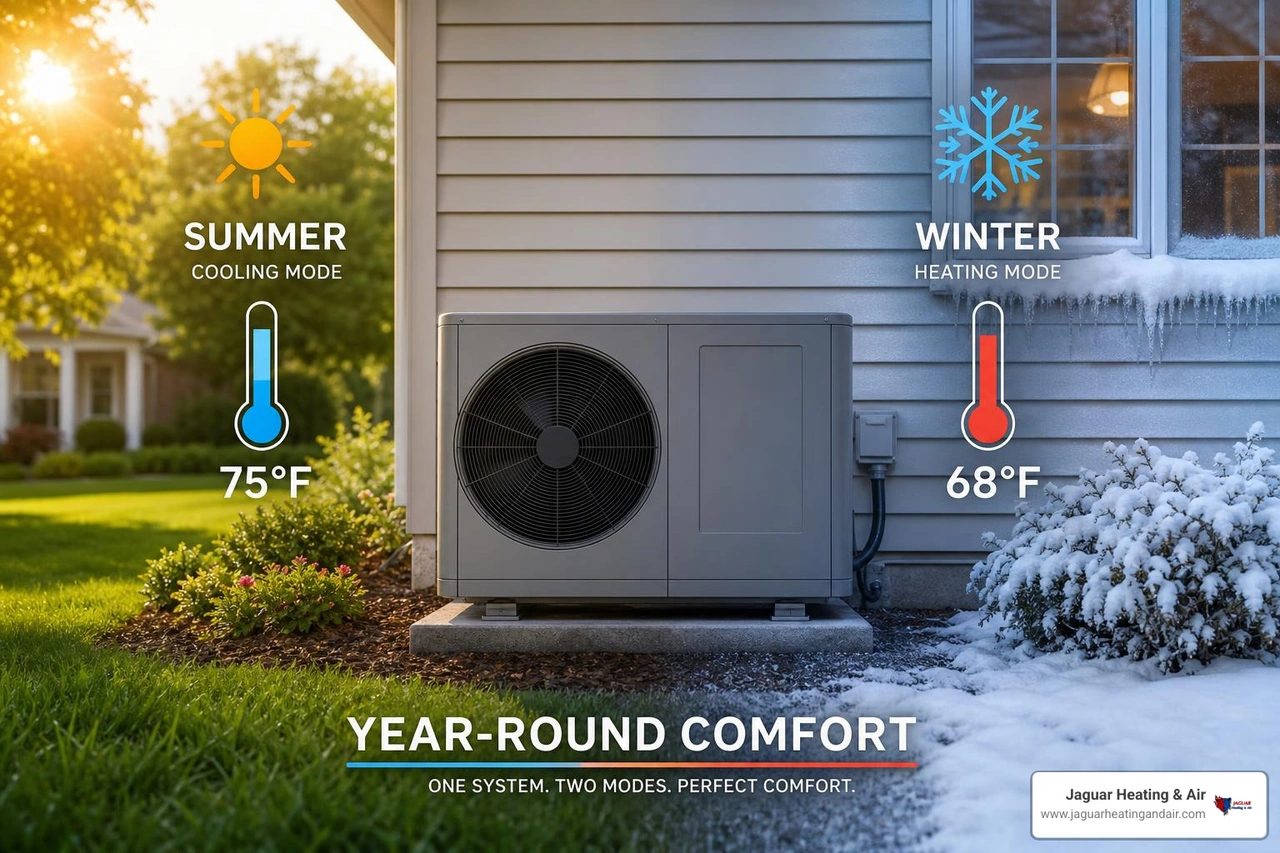
Learn more about heat pump efficiency in extreme heat and mild winters:
Understanding Heat Pump Efficiency in Extreme Heat and Mild Winters
To understand how a heat pump works so well in Northern California, we have to look at the unique climate patterns of the Sacramento Valley. In places like Roseville, Elk Grove, and Folsom, our weather is characterized by intense, dry summer heat waves followed by relatively mild, wet winters. This specific climate profile makes the debate over HVAC configurations highly relevant.
When we talk about heat pump efficiency in extreme heat and mild winters, we are looking at a system's ability to transfer heat rather than generate it. Unlike a traditional gas furnace that burns fuel to create warmth, or a standard air conditioner that only operates in one direction, a heat pump is a reversible thermal vacuum cleaner. In the summer, it pulls heat from inside your home and dumps it outdoors. In the winter, it extracts thermal energy from the outdoor air—yes, even cold air contains significant thermal energy—and pumps it inside.
To evaluate how these systems perform throughout our distinct seasons, homeowners need to understand the industry-standard metrics used to measure performance. These include SEER2 (Seasonal Energy Efficiency Ratio 2) for cooling and HSPF2 (Heating Seasonal Performance Factor 2) or COP (Coefficient of Performance) for heating. If you want to dive deep into what these acronyms mean for your monthly utility bills, check out our guide on Efficiency Ratings Explained For Homeowners.
When comparing a modern heat pump to traditional split systems (a separate gas furnace and air conditioner), the efficiency differences are stark. To see how these systems stack up in our local climate, we have put together a comparison of their real-world operational characteristics:
| Performance Metric | Modern Variable-Speed Heat Pump | Traditional Gas Furnace + Standard AC |
|---|---|---|
| Cooling Efficiency (Extreme Heat) | Extremely High (Up to 50% more efficient than older ACs during peak summer) | Standard to High (Highly dependent on the AC's fixed-speed stage) |
| Heating Efficiency (Mild Winters) | 200% to 400% (COP of 2.0 to 4.0; transfers up to 4 times the energy it consumes) | 80% to 98% (Never exceeds 100% because it must burn fuel to generate heat) |
| Energy Source | 100% Electricity (Perfect for pairing with home solar systems) | Electricity for cooling; Natural Gas/Propane for heating |
| Operational Consistency | Continuous, low-speed adjustments that maintain exact thermostat setpoints | Single or two-stage cycling (frequent on/off cycles that cause temperature swings) |
For a comprehensive look at choosing the ultimate system for our local climate, refer to our detailed analysis on Beating The Heat The Best HVAC Setup For Sacramento Area Weather.
Maximizing Heat Pump Efficiency in Extreme Heat and Mild Winters During Summer Peaks
When July and August arrive in Sacramento, Citrus Heights, or Rancho Cordova, outdoor temperatures frequently climb past 100°F. A common misconception is that heat pumps lose their cooling efficiency when subjected to these extreme summer peaks. In reality, a heat pump operates on the exact same thermodynamic cycle as a standard central air conditioner. However, because modern heat pumps are engineered with highly sophisticated components to handle both heating and cooling, they are often roughly 50% more efficient at cooling homes than traditional, older air conditioners.
During extreme heat, the cooling mode performance of your heat pump relies heavily on its SEER2 rating. The higher the SEER2, the less electricity the system requires to move a specific amount of heat out of your home.
The secret weapon of a high-efficiency heat pump during a Sacramento heatwave is the variable-speed inverter compressor. Traditional air conditioners are either "all on" or "all off." When they turn on, they draw a massive spike of electricity, run at 100% capacity until the thermostat is satisfied, and then shut off.
A variable-speed heat pump, on the other hand, can ramp down to run at just 20% or 30% capacity. It runs almost continuously at a low, quiet hum, matching the exact heat load entering your home. This eliminates the frequent, energy-guzzling start-stop cycles of older systems. To understand how upgrading to a high-efficiency unit changes your home's energy dynamics, read our Standard Efficiency Vs High Efficiency HVAC Comparison.
Maintaining Heat Pump Efficiency in Extreme Heat and Mild Winters During Cooler Months
When winter arrives in the Sacramento Valley, we rarely experience the sub-zero blizzards of the Midwest. Instead, our winter days typically hover between 40°F and 55°F, with overnight lows occasionally dipping into the 30s. This is the absolute ideal operating envelope for a heat pump.
In moderate winter weather, cold-climate and high-efficiency heat pumps can operate at up to 400% efficiency, producing four times as much thermal energy as they consume in electricity. Even when the temperature drops into that transitional zone between 14°F and 41°F, the average COP of a modern heat pump remains around 2.7. This means that for every single kilowatt of electricity you put into the system, you get 2.7 kilowatts of heat out of it. Compare that to electric resistance heating (like wall heaters or space heaters), which has a maximum COP of 1.0 (100% efficiency), or a top-tier gas furnace, which tops out around 95% to 98% efficiency.
To make sure you are getting the absolute most out of your system when the tule fog rolls in, we have compiled the best operational strategies in our guide on Ways Use Heat Pump Efficiently During Cooler Months.
Technological Advancements in Modern Heat Pumps
The heat pumps of May 2026 are light-years ahead of the systems installed twenty years ago. Historically, air-source heat pumps were criticized for blowing lukewarm air and losing their heating capacity as soon as the outdoor temperature dropped below freezing. Today, those engineering limitations have been solved through major breakthroughs in compressor design, microprocessor controls, and chemical engineering.
Modern systems utilize variable-speed inverter compressors, electronic expansion valves (EEVs), and advanced refrigerants to maintain incredible capacity retention. These advancements ensure that even if a rare, extreme weather event strikes Northern California, your system will keep your family comfortable without relying on expensive backup heat strips.
If you are curious about how these modern eco-friendly systems can transform your home's carbon footprint and monthly utility bills, take a look at our article on how to Enjoy Efficiency Eco Friendliness New Heat Pump.
Variable-Speed Inverter Compressors
At the heart of every high-performing heat pump is the variable-speed inverter compressor. Think of a standard compressor as a light switch—it is either fully bright or completely dark. An inverter-driven compressor behaves like a dimmer switch, adjusting its speed in tiny increments to match the exact heating or cooling load of your home.
This continuous operation provides several major benefits:
- Precise Temperature Control: Because the system doesn't cycle on and off constantly, indoor temperatures remain within a fraction of a degree of your thermostat setting.
- Enhanced Dehumidification: In cooling mode, the continuous low-speed operation allows the indoor coil to maintain a steady temperature, extracting more moisture from the air than a system that cycles rapidly.
- Reduced Electrical Wear and Tear: The highest stress on an HVAC system occurs during startup. By ramping up slowly rather than slamming on at full speed, inverter systems experience less mechanical wear.
To learn more about how small adjustments to your system's operation can yield massive energy savings, check out our Tips Boost HVAC Efficiency.
Advanced Refrigerants and Defrost Cycles
Another critical area of technological advancement involves the refrigerants flowing through the copper lines of your system. As part of the ongoing environmental transition in 2026, the HVAC industry is shifting away from older refrigerants like R-410A toward next-generation, low-Global Warming Potential (GWP) alternatives such as R-32 and R-454B. These advanced refrigerants are thermodynamically superior, allowing the heat pump to carry more heat per pound of refrigerant and operate more efficiently in both extreme heat and low-temperature conditions.
Additionally, modern heat pumps feature highly sophisticated defrost controls. When outdoor temperatures drop close to freezing and there is moisture in the air, frost can begin to accumulate on the outdoor coil. Older systems used simple mechanical timers that initiated a defrost cycle every 30, 60, or 90 minutes, regardless of whether frost was actually present. This wasted significant energy.
Today's micro-channel coils and demand-defrost algorithms monitor the temperature difference between the outdoor air and the refrigerant coil. The system only initiates a defrost cycle when it detects actual ice restriction. This minimizes the time the system spends reversing itself to melt ice, preserving your indoor comfort and protecting the system's overall seasonal COP.
Sizing, Installation, and Maintenance Best Practices
Even the most advanced, high-tech heat pump in the world will underperform if it is sized incorrectly, installed poorly, or neglected over time. Achieving rated performance requires a professional, detailed approach from the very beginning.
To ensure your system operates at peak efficiency for its entire lifespan, we recommend following the comprehensive steps outlined in our guide on Tips Adding Years Heat Pump Installation.
Proper Sizing and Airflow Commissioning
Many legacy HVAC systems in Sacramento were sized using quick, inaccurate rule-of-thumb estimates based solely on square footage. For modern heat pumps, this approach is a recipe for efficiency loss and premature system failure.
To size a heat pump correctly, a NATE-certified technician must perform a full Manual J load calculation. This calculation takes into account:
- The exact orientation of your home relative to the sun
- Insulation values in your attic, walls, and floors
- The type and performance ratings of your windows
- Local climate data for your specific ZIP code (whether you are in El Dorado Hills, Lincoln, or Woodland)
If a system is oversized, it will cycle on and off too quickly, ruining its dehumidification capability in the summer. If it is undersized, it will struggle to keep up on the hottest days and will rely too heavily on backup heating elements on chilly winter nights.
Furthermore, proper airflow commissioning is non-negotiable. Laboratory testing by organizations like the National Renewable Energy Laboratory (NREL) has shown that low indoor unit airflow rates can reduce heating capacity at mild outdoor temperatures and lower the COP during cold snaps. Technicians must measure external static pressure and set the indoor blower fan speed to match the manufacturer's exact specifications.
To understand the specific factors that dictate how well a system runs in our local area, read our breakdown of Things Determine Heat Pump Efficiency Folsom CA.
Dual-Fuel Systems and Balance Points
For some homeowners, the ultimate peace of mind comes from a dual-fuel (or hybrid) system. A dual-fuel setup pairs an electric air-source heat pump with a high-efficiency gas furnace.
In this configuration, the system uses a calculated "balance point" to decide which heating source to use:
- Above the Balance Point: The heat pump handles 100% of the heating duty, operating at maximum efficiency (often between 300% and 400% efficiency) using electricity.
- Below the Balance Point: If outdoor temperatures drop below the point where the heat pump can efficiently meet the home's heating load (typically between 30°F and 40°F depending on the home's insulation), the system automatically shuts off the heat pump and fires up the gas furnace.
This ensures you are always heating your home using the most cost-effective and energy-efficient source available at any given temperature. To see if a hybrid setup or a fully electric system is the right fit for your home's layout, read about the Heat Pump Advantages Over Traditional HVAC.
Frequently Asked Questions About Heat Pump Performance
Adjusting to a new heating and cooling technology can bring up a lot of questions. We believe in keeping our clients fully informed so they can make the best decisions for their families.
How do heat pumps perform in extreme cold compared to fossil fuels?
Even though Sacramento winters are mild, homeowners often wonder how these systems hold up if a massive cold front sweeps through Northern California. The technical feasibility of modern heat pumps in freezing temperatures is no longer a question.
While a gas furnace is limited to a maximum thermal efficiency of around 95% to 98%, a cold-climate heat pump can maintain a Coefficient of Performance (COP) well above 1.5 even at extremely cold temperatures approaching -22°F. In fact, a field-tested ultra-low temperature air-source heat pump recently achieved a COP of 1.83 at -25°C (-13°F). This means that even in sub-zero conditions, a heat pump is still nearly twice as efficient as electric resistance heating and highly competitive with fossil-fuel combustion, all while completely eliminating on-site carbon emissions. To learn more about how these systems keep your indoor air clean and cozy, read How Heat Pump Keep You Comfortable.
What is the ENERGY STAR Cold Climate certification?
The ENERGY STAR Cold Climate certification is a designation established to help consumers and contractors identify air-source heat pumps designed to excel in harsh winter environments. To earn this certification, a heat pump must meet strict performance criteria, including:
- Maintaining a COP of 1.75 or higher at 5°F
- Demonstrating a heating capacity retention of at least 70% at 5°F compared to its rated capacity at 47°F
By choosing an ENERGY STAR Cold Climate certified system, homeowners in transition zones or higher-elevation areas near El Dorado Hills can be certain their system will deliver strong, reliable heat without relying heavily on auxiliary heating elements.
Do heat pumps lose efficiency during Sacramento's hot summers?
While heat pumps have to work harder when outdoor temperatures rise above 100°F, they do not suffer sudden, dramatic efficiency drops. Because they utilize variable-speed inverter technology, they can adjust their cooling capacity dynamically.
On a 105°F afternoon in Sacramento, a high-efficiency heat pump will ramp up its compressor speed to maintain comfort, and then ramp back down as the evening delta breeze cools the outdoor air. To keep your cooling efficiency as high as possible during these intense summer stretches, we highly recommend enrolling in a regular maintenance plan to keep your outdoor coils clean, your air filters fresh, and your refrigerant charge at the perfect level.
Conclusion
Understanding heat pump efficiency in extreme heat and mild winters is the key to unlocking year-round comfort and energy savings in Northern California. Whether you live in Sacramento, Elk Grove, Folsom, Roseville, or any of our surrounding communities, today's advanced heat pumps are perfectly suited to handle our blistering summers and chilly winters with unmatched efficiency.
At Jaguar Heating & Air, we are proud to be a family-owned HVAC company serving our local community. As a certified Trane Comfort Specialist, our NATE-certified technicians are committed to providing flat-rate pricing, same-day service, and a 100% customer satisfaction guarantee. We never cut corners on sizing, installation, or maintenance, ensuring your new system delivers its rated performance for years to come.
Ready to upgrade your home's comfort and start saving on your monthly utility bills? Schedule your professional heat pump installation with Jaguar Heating & Air today!
Recent Posts
Fall Home Maintenance Tips and Troubleshooting
Smelling burning dust during your first fall heating cycle? See what is normal versus a safety risk with our home maintenance tips and troubleshooting.

Navigating the October Heating Startup: A Guide to Fall HVAC Maintenance
Is your first fall heating startup causing strange odors? Rely on our local service expertise and area tips to know when to call a pro on this in Sacramento.

Why Your Furnace Smells Like Burning Dust: Essential HVAC Maintenance Questions Answered
Smelling burning dust this fall? Have common homeowner questions answered about your furnace. Decide with confidence on when to call a pro before winter.