.avif)
How to Compare HVAC Efficiency Ratings Like a Pro
Master HVAC efficiency ratings explained for homeowners: Decode SEER2, AFUE, HSPF2 & save on energy bills in 2026!
Master HVAC efficiency ratings explained for homeowners: Decode SEER2, AFUE, HSPF2 & save on energy bills in 2026!

What Efficiency Ratings Explained for Homeowners Actually Means
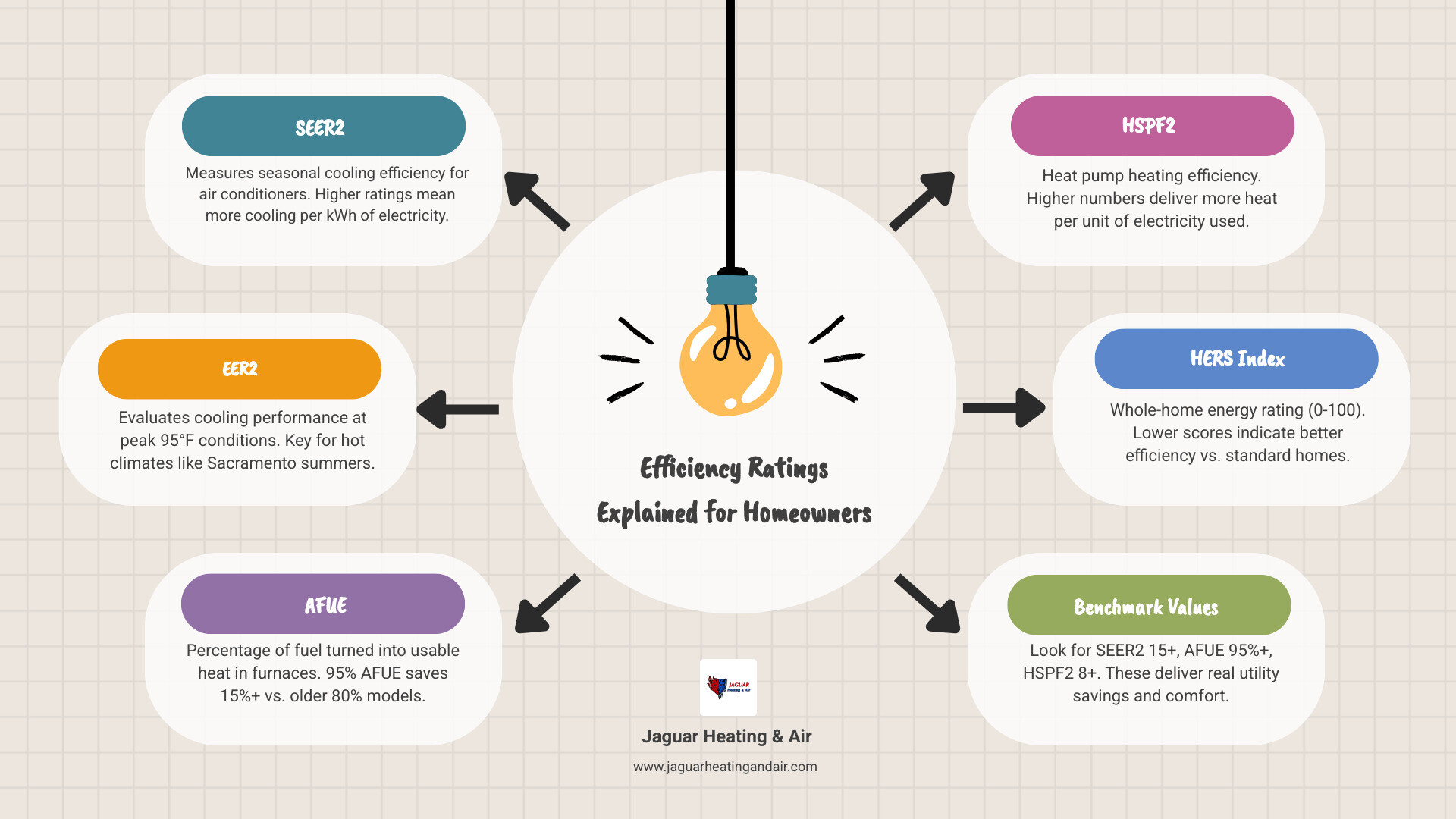
Efficiency ratings explained for homeowners comes down to one simple idea: these numbers tell you how much useful heating or cooling you get for every dollar of energy you spend. Here's a quick breakdown of the most important ratings you'll see:
| Rating | System Type | What It Measures | Higher = Better? |
|---|---|---|---|
| SEER2 | Air Conditioner | Seasonal cooling output vs. electricity used | Yes |
| EER2 | Air Conditioner | Cooling efficiency at peak (95°F) conditions | Yes |
| AFUE | Furnace | Percentage of fuel converted to heat | Yes |
| HSPF2 | Heat Pump | Heating output vs. electricity used | Yes |
| HERS | Whole Home | Overall home energy use vs. a reference home | No (lower = better) |
Over 85% of American homes rely on HVAC systems year-round. Yet most homeowners have no idea what the numbers on their equipment actually mean — or how much money those numbers could save them.
Think of it like the MPG sticker on a car. A vehicle rated at 38 MPG costs far less to run than one rated at 15 MPG, even if the sticker price is similar. HVAC efficiency ratings work the same way. A furnace with a 95% AFUE rating converts 95 cents of every dollar of fuel into actual heat. An older 80% AFUE model wastes 20 cents of every dollar straight out the flue.
For Sacramento homeowners dealing with scorching summers and cool winters, these numbers aren't just technical trivia — they directly affect your monthly utility bill, your home's comfort, and even what your home is worth when you sell it.
This guide breaks down every major efficiency rating in plain language so you can shop smarter, maintain your system better, and stop guessing.
Why Efficiency Ratings Explained for Homeowners Matter in 2026
As we navigate through 2026, the importance of understanding these ratings has never been higher. With energy costs fluctuating and California's environmental standards becoming more rigorous, your home's efficiency is a major financial factor.
Utility Savings and Financial Impact
The most immediate benefit is the impact on your wallet. An ENERGY STAR certified heat pump water heater, for example, uses 70% less energy than a standard electric model, potentially saving a family of four over $550 a year. When you apply those kinds of savings across your entire HVAC system, the numbers get even more impressive. A SEER 16 system compared to an older SEER 13 model can reduce cooling costs by 20–25% annually.
Property Resale Value
Efficiency is an investment that pays off when it’s time to move. Research shows that residential properties with an efficiency rating sell for roughly 2.7% more than those without one. Even better, homes with high-tier ratings often see selling prices 3–5% higher than average. If you're wondering How Homeowners in California Can Save Energy and Money, starting with high-efficiency equipment is a primary step toward long-term equity.
Comfort and Indoor Air Quality
High-efficiency systems don't just save money; they provide better comfort. Units with variable-speed compressors run longer at lower speeds, which means fewer "cold spots" and better humidity control during those humid Sacramento nights. If you find yourself asking, "Energy Bills Too High? Consider an Energy Audit," you might discover that your current system is working too hard to compensate for poor efficiency, leading to drafts and inconsistent temperatures.

Decoding HVAC Metrics: SEER2, AFUE, and HSPF2
In 2023, the Department of Energy (DOE) updated its testing standards to better reflect real-world conditions, giving us the "2" series of ratings (SEER2, EER2, and HSPF2). These are now the gold standard for comparing equipment. When you browse Mitsubishi High-Efficiency Systems, these labels help you see exactly how the technology translates into performance.
Cooling Efficiency Ratings Explained for Homeowners (SEER2 & EER2)
SEER2 (Seasonal Energy Efficiency Ratio 2) measures how efficiently an air conditioner cools your home over an entire season. It’s an average that accounts for the mild days of spring and the heatwaves of August. In California, the minimum SEER2 for new AC units is currently 14.3 (equivalent to the old 15 SEER).
EER2 (Energy Efficiency Ratio 2) is slightly different. It measures efficiency at a specific, peak temperature (usually 95°F). For those of us in Sacramento and Elk Grove, where summer temperatures regularly soar past 100°F, EER2 is incredibly important. It tells you how well the system performs when it's working its hardest.
Understanding Why AC Sizing Matters in Sacramento, CA is crucial here. An oversized unit with a high SEER2 won't actually reach its rated efficiency because it will "short cycle" (turn on and off too quickly), which prevents it from properly dehumidifying your home.
Heating Efficiency Ratings Explained for Homeowners (AFUE & HSPF2)
AFUE (Annual Fuel Utilization Efficiency) is the metric for gas and oil furnaces. It’s expressed as a percentage. A 95% AFUE furnace is considered high-efficiency, meaning only 5% of the fuel is lost through the chimney. Modern high-efficiency models can reach up to 98.5%.
HSPF2 (Heating Seasonal Performance Factor 2) is used for heat pumps in heating mode. It calculates the total heating output compared to the electricity consumed. A "good" value is typically anything above 7.5 under the new standards. Because heat pumps move heat rather than creating it, they are incredibly efficient. You can Enjoy Efficiency & Eco-Friendliness with a New Heat Pump while significantly lowering your carbon footprint. In fact, Why Heat Pump Installation is Perfect for Californian Homeowners often comes down to our moderate winters, which allow these systems to operate at peak efficiency almost year-round.
Whole-Home Performance: HERS, ENERGY STAR, and Building Envelopes
While HVAC ratings tell you about the machine, whole-home ratings tell you how the "envelope" (your walls, windows, and roof) performs as a system.
The HERS Index
The HERS (Home Energy Rating System) Index is like a golf score: the lower, the better.
- 100: The score of a "standard" new home built to 2006 codes.
- 0: A Net Zero Energy Home that produces as much energy as it consumes.
- Typical New Home: Usually scores around 60–70, meaning it's 30–40% more efficient than the 2006 benchmark.
Getting a professional to perform Energy Savings Audits can give you a clear picture of where your home sits on this scale.
ENERGY STAR and Windows
An ENERGY STAR certified home is at least 10% more efficient than those built to standard code, though they often average a 20% improvement. Part of this certification involves the building envelope, specifically windows and doors.
- U-factor: Measures non-solar heat flow. A lower number means better insulation.
- SHGC (Solar Heat Gain Coefficient): Measures how much solar radiation comes through. In Sacramento, we generally want a lower SHGC to keep the summer sun from baking our interiors.
It’s always a smart move to Schedule an Energy Savings Audit Before Turning On Your Heater or AC for the season to ensure your home's envelope isn't leaking the expensive air your HVAC system just worked so hard to condition.
Factors That Influence Real-World Efficiency Beyond the Label
A high SEER2 rating is just a "potential." Think of it like a race car; if the tires are flat and the driver doesn't know how to shift, that high-performance engine won't do much.
Installation Quality
The Importance of Correct HVAC Installation cannot be overstated. If a SEER2 20 unit is installed with leaky ducts or the wrong refrigerant charge, it might only perform like a SEER2 12 unit. Our NATE-certified technicians ensure that every system is calibrated to hit its rated efficiency from day one.
Ductwork and Landscaping
Even your yard matters! Knowing How Landscaping Boosts HVAC Efficiency can save you a bundle. Providing shade for your outdoor condenser (without blocking airflow) helps it shed heat more easily. Similarly, if your ductwork is uninsulated or leaking in a hot attic, you’re losing efficiency before the air even reaches your living room.
Smart Technology
Modern efficiency is also about control. There are many Ways to Take Advantage of Smart HVAC Technology to ensure you aren't cooling an empty house. Learning All About Smart Thermostats is one of the fastest ways to see a drop in your monthly bills, as these devices can reduce energy waste by 10–20% through smart scheduling and occupancy sensors.
Frequently Asked Questions About Home Efficiency
Does a higher SEER2 rating mean the air coming from my vents will be colder?
No. This is a common misconception! Every air conditioner, regardless of its rating, aims to drop the air temperature by about 15–20 degrees as it passes over the coils. A higher SEER2 rating simply means the system uses less electricity to achieve that temperature drop. It's about how much "work" the compressor has to do to get the job done.
What is the difference between a HERS rating and an ENERGY STAR certification?
Think of HERS as the ruler and ENERGY STAR as the gold medal. HERS is a scoring system used to measure a home's energy performance. ENERGY STAR is a government-backed program that uses HERS scores (along with other requirements like specific HVAC standards and insulation checks) to certify that a home meets a high level of efficiency.
How does regular maintenance protect my system's efficiency rating?
A system’s efficiency rating is calculated when it is brand new and perfectly clean. Over time, dust on the coils and clogged filters force the motor to work harder, which "drags down" the efficiency. There are 3 Benefits of Signing Up for an HVAC Maintenance Membership, but the biggest one is maintaining that "as-rated" performance. Between the Key Benefits of AC Maintenance and the Reasons an HVAC Maintenance Agreement is a Good Choice, keeping your system clean is the only way to ensure you're actually getting the SEER2 or AFUE you paid for.
Conclusion: Taking the Next Step Toward a More Efficient Home
Navigating efficiency ratings explained for homeowners doesn't have to be a solo mission. Whether you are in Roseville, Folsom, or right here in Sacramento, understanding these metrics is the first step toward a more comfortable, affordable home.
At Jaguar Heating & Air, we specialize in helping our neighbors decode these numbers and find the perfect balance between upfront investment and long-term operational savings. Don't let your hard-earned money vanish through inefficient equipment or poor home performance. Start the Year Off Right with an Energy Savings Audit to see where you stand.
Ready to upgrade your comfort and lower your bills? From high-efficiency furnaces to the latest in heat pump technology, our team is here to provide professional assessments and guaranteed satisfaction.
Recent Posts
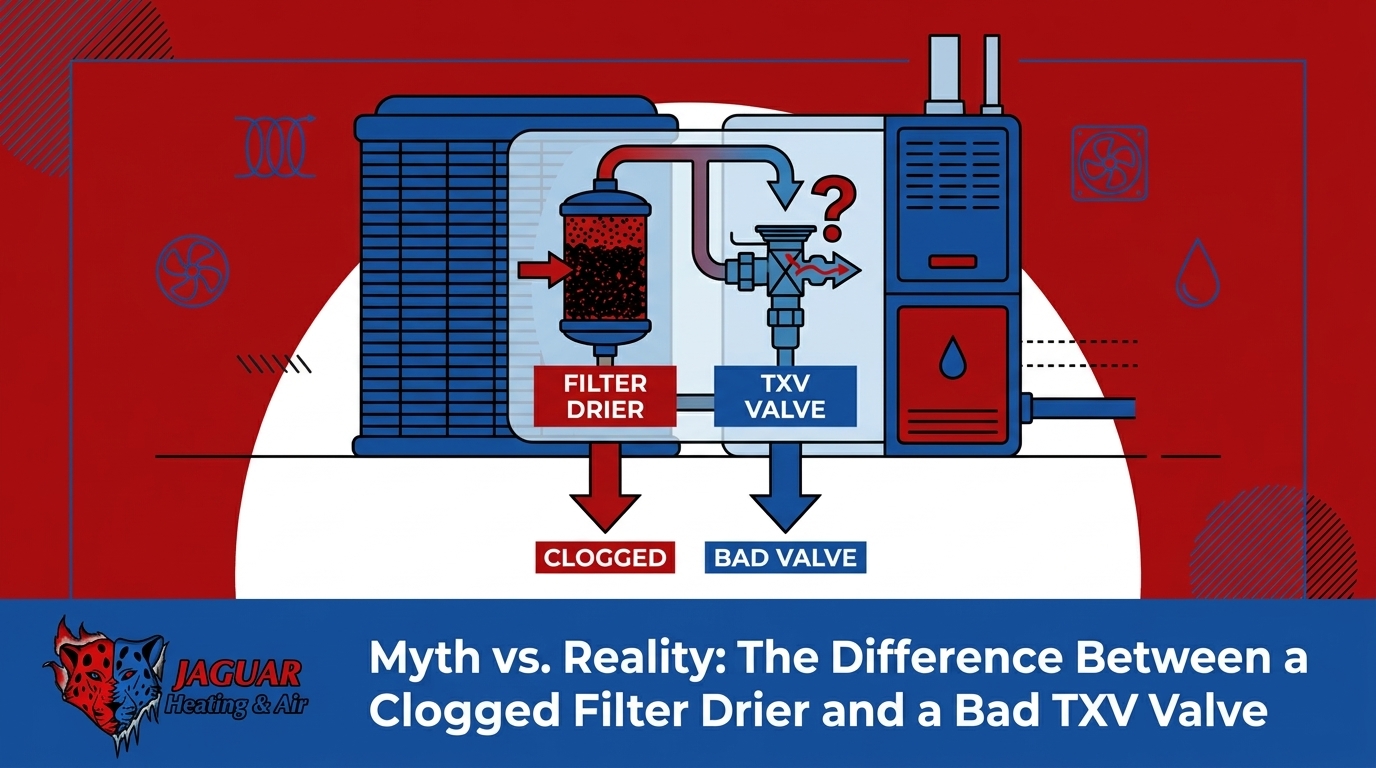
The Difference Between a Clogged Filter Drier and a Bad TXV Valve
An AC that blows warm air isn't always leaking refrigerant—it might be suffering from a flow restriction. Find out how technicians trace the bottleneck to restore your cooling.

How Sacramento's Hard Water Affects Your Evaporative Cooler Pads
By September, Sacramento's heavy mineral content often turns swamp cooler pads into rock-hard blocks. See why airflow drops drastically and weigh your end-of-season options.
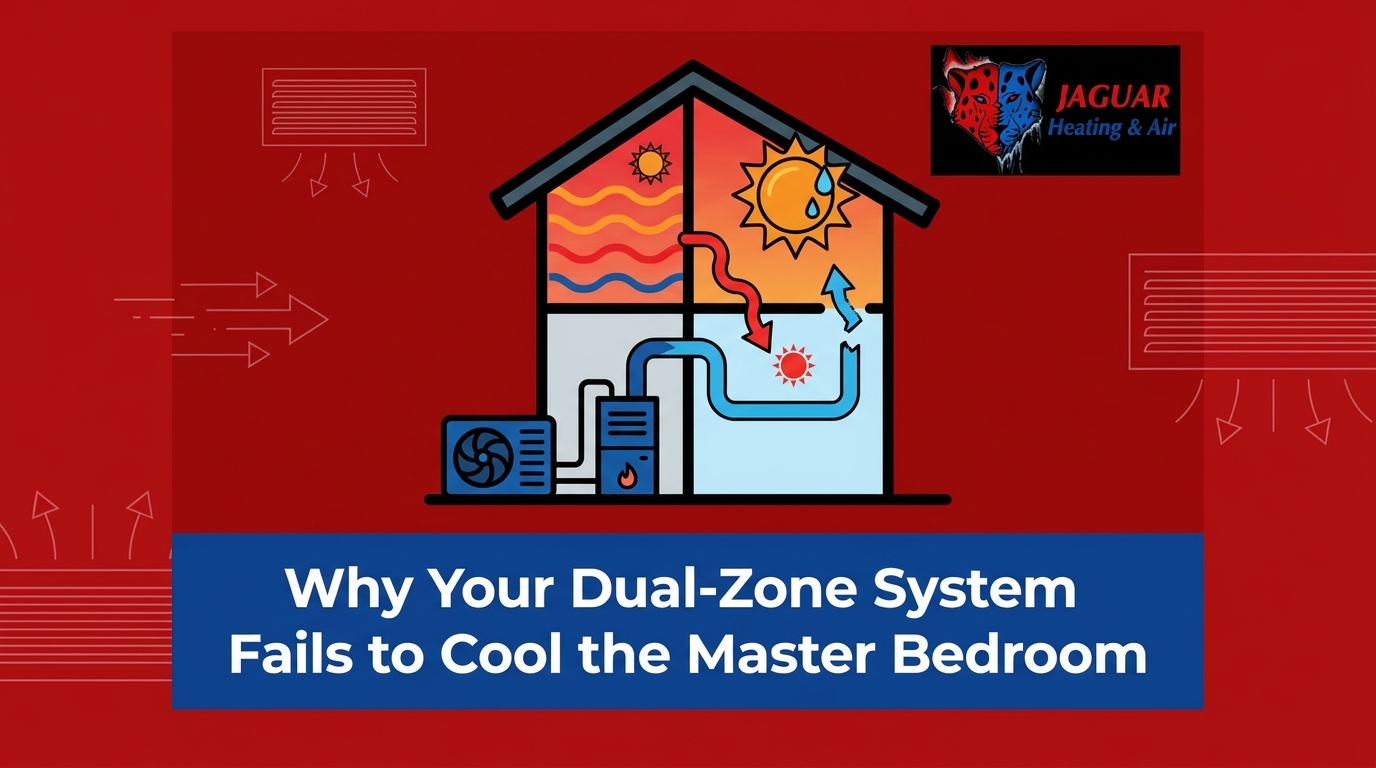
Why Your Dual-Zone System Fails to Cool the Master Bedroom
Persistent temperature imbalances in your master suite are rarely a main AC capacity issue. Discover how stuck motorized zone dampers disrupt airflow and why a pre-season diagnostic is crucial.