Navigating Early Winter HVAC Maintenance: A Safety-First Diagnostic Guide
Why your furnace smells like burning dust. Decide when to wait it out versus calling a pro with our home maintenance tips and troubleshooting.
Why your furnace smells like burning dust. Decide when to wait it out versus calling a pro with our home maintenance tips and troubleshooting.

The First Cold Snap: Facing Unexpected Heating Hurdles
You flip your thermostat to "heat" on the first genuinely freezing night of November, and instead of a comforting wave of warm air, your vents emit a harsh burning smell—or worse, blow completely cold. When you are looking for reliable home maintenance tips and troubleshooting, navigating this exact seasonal transition is usually at the top of the list. In our years of servicing Sacramento homes, the team at Jaguar Heating & Air has seen firsthand how that initial startup after months of inactivity can be incredibly stressful, leaving you wondering if your home is safe or if you are about to face a massive repair bill in the dark.
Before you panic, it helps to understand the distinct difference between normal seasonal start-up behavior and a genuine system malfunction. Heating systems go through a harsh adjustment period during late fall, and knowing what to expect can save you from a late-night emergency call. Establishing a baseline of care with comprehensive AC maintenance and heating tune-ups prevents these sudden surprises from catching you off guard.
The key to a stress-free winter is proactive diagnostics. When you know exactly what your furnace is doing behind the scenes, you can make informed decisions about your home's comfort and safety.
Understanding the Shift: Why Idle Systems Struggle in Late Fall
Our team knows all too well that Sacramento's climate features a sudden shift from triple-digit summer heat to damp, chilly November nights. That aggressive temperature swing puts immense stress on HVAC systems that have been sitting completely idle or operating in a completely different mode for the last six months. When a complex mechanical system sits unused, the environment takes a toll on its internal components.
During the long summer cooling season, your furnace is essentially just acting as a fan to push conditioned air through your home. The heating components—specifically the heat exchanger, the burners, and the igniter—remain dormant. Over those months, household dust, pet dander, and airborne particulates settle directly onto these inactive metal surfaces. When the sudden drop in outdoor temperatures finally forces the heating sequence to activate, all of that accumulated debris is immediately subjected to intense heat.
The Anatomy of Dust Accumulation
The physical process of a furnace waking up from its summer hibernation is jarring to the equipment. Here is a breakdown of why idle systems struggle and how that impacts your home:
• Temporary Burning Odor — The Mechanical Cause: Dust and dander have coated the cold heat exchanger over the summer. The first ignition burns this debris off instantly. — The Expected Solution: Allow the system to run for 30 to 60 minutes with a window cracked. The smell should dissipate completely.
• Delayed Airflow — The Mechanical Cause: The blower motor has been operating at cooling speeds and now must adjust to heating parameters, while the plenum warms up. — The Expected Solution: Wait 3 to 5 minutes after the thermostat clicks. The fan delays starting so it doesn't blow cold air into the room.
• Stiff Moving Parts — The Mechanical Cause: Lubricants in the inducer draft motor and blower assembly have settled during the idle months, causing initial friction. — The Expected Solution: A professional tune-up to lubricate bearings and moving parts before the first major freeze hits.
This transition period exposes degraded parts that may have been slowly failing since last winter. The rapid thermal expansion of a cold heat exchanger suddenly blasted with fire can cause weak metal to crack. This is why our technicians always emphasize that the first heating cycle of the year is the most critical test of your system's integrity.
Decoding Furnace Odors and Noises: What Is Normal?
Your heating system communicates its health primarily through smells and sounds. Providing a clear framework for distinguishing harmless dust burn-off from potentially dangerous electrical or gas issues is the most important step in home troubleshooting. While you might already know what it means when an AC blower motor sounds like a jet engine during the summer, winter heating noises are an entirely different language.
The typical "burning dust" smell is entirely normal. It smells similar to a space heater that has just been pulled out of the closet. This odor should be relatively faint, somewhat dry-smelling, and it must dissipate within a few hours of continuous operation. If the smell changes character or persists for days, it is no longer a simple dust issue.
When to Wait and When to Worry
Monitoring your system during the first 24 hours of operation requires you to use your senses. Here are the specific warning signs that indicate you should stop waiting and take immediate action:
• Electrical Ozone Odors: If you smell something resembling melting plastic, burning wires, or a sharp, metallic "ozone" scent, shut the system down at the thermostat immediately. This indicates an overheating blower motor or melting wire insulation.
• Rotten Egg or Sulfur Smells: This is the universal warning sign for a natural gas leak. Do not wait. Turn off the heating system, do not switch on any lights, evacuate the home, and call your utility provider or a licensed professional immediately.
• Loud Grinding or Screeching: While a soft click or a low hum is a normal part of the startup sequence, harsh metal-on-metal grinding indicates failing bearings in the blower motor. Continuing to run the system will destroy the motor entirely.
• Repeated Clicking Without Ignition: A single click followed by a "whoosh" of flames is normal. A continuous, rapid clicking sound means the spark igniter is failing to light the gas, which can lead to a dangerous buildup of unburned fuel in the combustion chamber.
If you detect gas or electrical burning, the immediate action is always to shut down the system at the breaker panel if it is safe to do so, and wait for professional intervention.
Safe Homeowner Troubleshooting Steps Before Calling a Pro
Before you schedule a service call, there are several safe, basic diagnostic steps you can perform to resolve minor issues without risking injury or system damage. Often, what appears to be a total system failure is actually a minor communication error between the thermostat and the furnace.
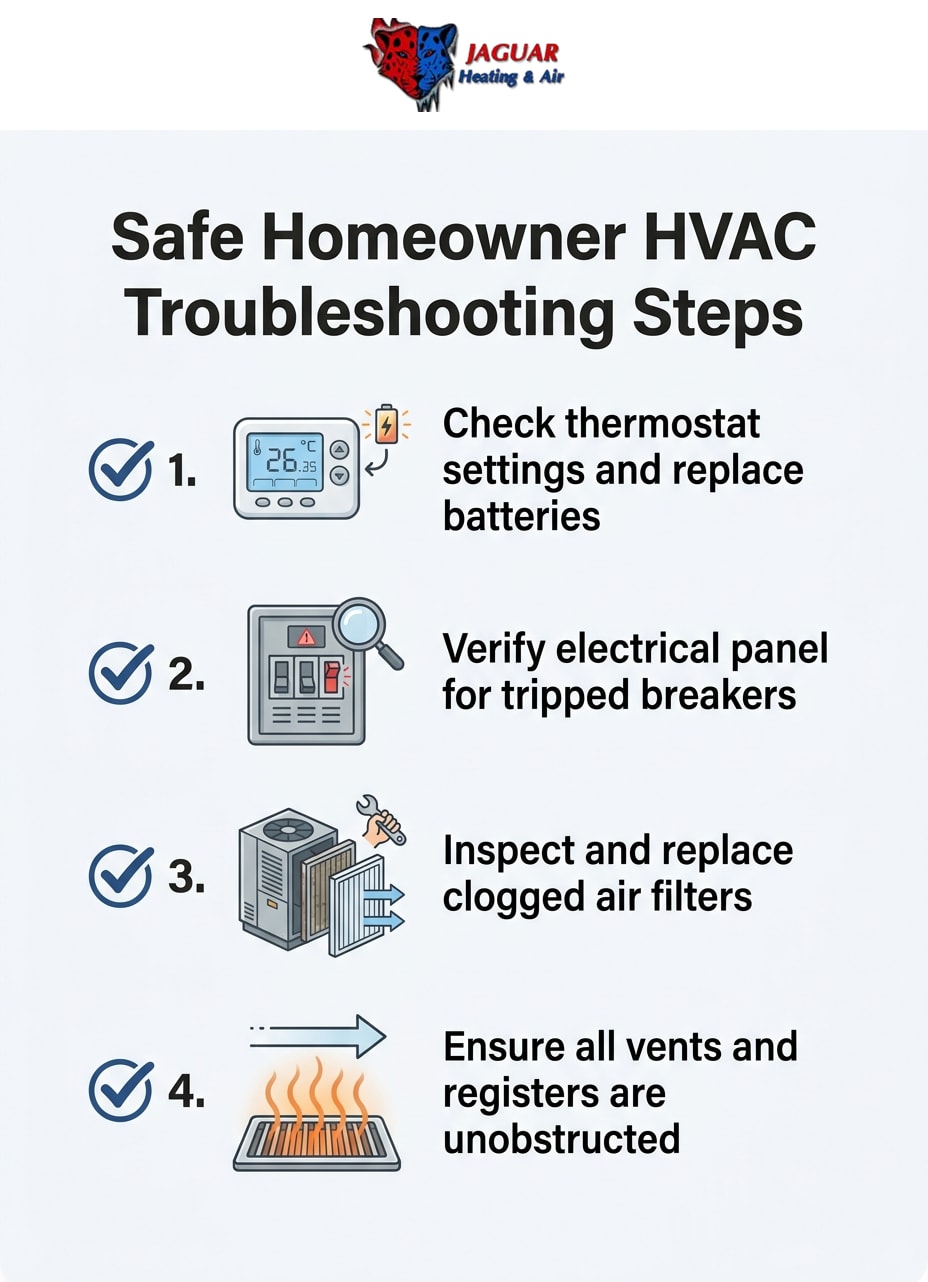
Follow these steps to establish a safe baseline before reaching out for routine heating maintenance:
1. Verify thermostat settings and power: Ensure the thermostat is explicitly set to the "Heat" position. We see it incredibly often during the seasonal transition: thermostats accidentally left on "Cool" or "Off." Next, check the set temperature to ensure it is at least three degrees higher than the current room temperature. Finally, replace the batteries with fresh ones, even if the screen is still visible; low voltage can cause erratic behavior.
2. Check the electrical panel for tripped breakers: Your heating system requires a dedicated circuit. Locate your home's main electrical panel and look for the breaker labeled "Furnace" or "HVAC." If it is in the middle or "tripped" position, push it firmly to the "Off" position, then back to "On." If it trips again immediately, do not reset it a second time—this indicates a dead short that requires a professional.
3. Inspect and replace clogged air filters: According to data from the U.S. Department of Energy, restricted airflow from dirty filters is a primary cause of HVAC system inefficiency and failure. A heavily soiled filter acts like a wall, suffocating the furnace. This lack of airflow causes the heat exchanger to rapidly overheat, triggering an automatic safety shutdown. Pull the filter out and hold it up to a light; if you cannot see light shining through the media, it must be replaced immediately.
4. Ensure all vents and return registers are unobstructed: Walk through every room in your home and verify that the supply vents (where warm air comes out) and the return grilles (where air is pulled back to the system) are wide open. Ensure that heavy winter rugs, couches, or bookshelves have not been pushed over the vents during summer rearranging. Closing vents in unused rooms actually increases static pressure and damages the blower motor.
5. Check the furnace power switch: Most furnaces have a power switch located on the wall or on the side of the unit itself that looks identical to a standard light switch. Ensure this switch is flipped to the "On" position. It is frequently bumped "Off" by accident when retrieving items from the attic or garage.
Strict Boundaries: When to Rely on a Licensed Technician
While basic airflow and power checks are perfectly safe for homeowners to perform, modern heating systems are complex appliances that harness combustible gas and high-voltage electricity. Establishing strict safety-first boundaries is critical to protecting your home and your family. There are specific repairs and diagnostics that absolutely require a licensed professional.
Attempting DIY repairs on gas lines, heat exchangers, or high-voltage electrical components is incredibly dangerous. A simple mistake with a gas valve can lead to explosive consequences, and bypassing a safety switch to force a furnace to run can easily cause a devastating house fire. If your initial troubleshooting steps do not resolve the issue, it is time to step back.
Specific symptoms mandate immediate professional intervention. If your furnace experiences continuous ignition failure—meaning it tries to light, fails, shuts down, and tries again in an endless loop—the system is locking itself out for your protection. Short-cycling, where the furnace runs for only two or three minutes before shutting off, indicates a severe overheating issue or a failing flame sensor. Persistent gas odors are an absolute emergency. Relying on professional heat pump maintenance or furnace servicing ensures these complex issues are caught before they escalate into mid-winter emergencies.
The Risks of Ignoring Ignition Failures
When a heating system fails to ignite properly, the internal sequence of operations is interrupted. Repeated failed startups damage the system's relays and control board. More importantly, if a furnace fails to light but continues to pump natural gas into the combustion chamber, it relies on a safety mechanism called a flame sensor to shut the gas valve off.
If a homeowner attempts to clean or bypass this sensor improperly, the gas valve may remain open without a flame present. This allows raw gas to flood the heat exchanger and potentially the ductwork. When the system finally sparks, the resulting delayed ignition can cause a localized explosion that blows the front panel off the furnace and cracks the heat exchanger. Never attempt to manipulate the internal safety mechanisms of your heating equipment.
The Value of Honest Inspections Over Quick Fixes
When you do call a professional, the quality of the diagnostic process matters just as much as the repair itself. There is a vast difference between a superficial visual check and comprehensive diagnostic testing that prioritizes system health over unnecessary upsells.
A thorough, transparent inspection involves tools and metrics, not just a flashlight. A licensed technician will use a multimeter to check the exact electrical draw of the inducer motor, a manometer to measure the precise gas pressure entering the burners, and a combustion analyzer to ensure no carbon monoxide is bleeding into the airstream. This level of detail provides homeowners with a clear, factual understanding of their unit's true status.
For example, one of our Sacramento customers recently scheduled a routine inspection after experiencing some erratic behavior from their system. Our technician arrived and performed an incredibly informative and honest evaluation, taking the time to explain the testing process and the solutions available. They provided a reliable check of the entire system, resolved the customer's questions clearly, and confirmed the equipment's health without pushing any unnecessary sales or immediate replacements. This approach ensures that you receive accurate preventive maintenance advice, which extends the lifespan of the equipment without unwarranted pressure.
When our team takes the time to explain the "why" behind a failing component, it empowers you as a homeowner. Honest inspections focus on identifying the root cause—like a restricted duct causing a motor to burn out—rather than just slapping a band-aid on the symptom by repeatedly replacing the motor.
How Proactive Upkeep Impacts Your Monthly Energy Usage
Routine maintenance is not just about preventing breakdowns; it is directly connected to tangible benefits like energy efficiency and utility cost management. According to industry data, heating and cooling account for roughly half of a typical home's total energy usage. When your furnace or heat pump is struggling against dirty blowers, clogged burners, or failing capacitors, it has to run significantly longer to reach the temperature set on your thermostat.
This optimized performance directly influences your winter utility rates. A furnace that is covered in idle-season dust cannot transfer heat efficiently into the air passing over it. The heat stays trapped in the metal, the limit switch trips, the system shuts down, and the house remains cold—all while the meter continues to spin. By ensuring the heat exchanger is clean and the gas pressure is calibrated perfectly, the system transfers maximum heat with minimum fuel consumption.
Our thorough inspection process at Jaguar Heating & Air specifically helps homeowners optimize their system performance to lower their monthly SMUD utility bills. By addressing minor inefficiencies before the deep freeze sets in, your equipment operates at its peak design specifications. Furthermore, maintaining this peak efficiency may also align with requirements for generally applicable utility incentive programs or energy rebates. Readers should always verify current programs locally with their utility provider, as well-maintained, high-efficiency systems often qualify for ongoing operational savings.
Securing Peace of Mind Before Winter Temperatures Drop
Navigating the transition into late fall doesn't have to be a source of anxiety. By learning to distinguish between normal seasonal start-up quirks—like a temporary burning dust smell—and genuine hazards like electrical odors or ignition failures, you take control of your home's comfort.
Establishing a baseline of system health through a professional evaluation is the most effective way to protect your investment. When you invest in an HVAC maintenance membership, you are securing priority service and comprehensive care that keeps your equipment running safely year after year. If you find yourself searching for effective home maintenance tips and troubleshooting this November, remember that a straightforward, expert inspection from our dedicated team is the best way to ensure a warm, safe winter for your entire household.
Frequently Asked Questions
Why does my heater smell like burning dust when I turn it on?
This is a normal occurrence caused by dust and pet dander settling on the furnace heat exchanger during the idle summer months. When the heating sequence activates for the first time in late fall, the sudden high temperatures instantly burn off this accumulated debris. The smell should be relatively faint and is not a cause for panic.
How long does a furnace smell when first turned on?
The burning dust odor should dissipate completely within 30 to 60 minutes of continuous operation. If you open a window to ventilate the area, the smell should clear out of the house shortly after. If the smell persists for several hours or changes to a sharp, electrical, or plastic scent, shut the system down immediately.
What should I check before calling an HVAC technician?
Always start by verifying that your thermostat is set to "Heat" and has fresh batteries installed. Next, check your main electrical panel to ensure the dedicated HVAC breaker has not tripped. Finally, inspect your air filter—a severely clogged filter restricts airflow, causing the system to overheat and shut down automatically.
Why is my furnace blowing cold air?
A furnace may blow cold air initially as the blower motor pushes the resting ambient air out of the ductwork before the plenum fully heats up. However, if it continuously blows cold air, it often indicates an ignition failure, a dirty flame sensor, or a tripped limit switch that has shut down the burners while leaving the fan running to cool the system.
How often should I schedule preventive HVAC maintenance?
Preventive maintenance should be scheduled twice a year to align with the changing seasons. You should have your heating system inspected and tuned up in the late fall before the first freeze, and your air conditioning system serviced in the spring before the intense summer heat begins.
Can a dirty air filter cause my heating system to shut down?
Yes, a severely clogged air filter acts as a physical barrier that suffocates the system. Without adequate airflow moving across the heat exchanger, the internal temperature of the furnace skyrockets rapidly. The system's high-limit safety switch will detect this dangerous overheating and immediately shut the burners down to prevent a fire hazard.
Recent Posts
HVAC Maintenance: Troubleshooting the First Late-Fall Heating Cycle
Notice a burning smell during your first fall heating cycle? See our home maintenance tips and troubleshooting to decide when to call a pro.

HVAC Maintenance: Home Maintenance Tips and Troubleshooting Sluggish Heating in Damp Weather
Why your heater struggles on damp fall mornings. Use these home maintenance tips and troubleshooting steps to decide with confidence when to call a pro.
Why Does My Heater Smell Like Burning Dust? Common HVAC Maintenance Questions Answered
Is that burning dust smell normal? Get common homeowner questions answered before winter hits. See what startup symptoms demand immediate professional care.