Why Does My Heater Smell Like Burning Dust? Common HVAC Maintenance Questions Answered
Is that burning dust smell normal? Get common homeowner questions answered before winter hits. See what startup symptoms demand immediate professional care.
Is that burning dust smell normal? Get common homeowner questions answered before winter hits. See what startup symptoms demand immediate professional care.

That First Chilly Night: Is Your Heating System Safe to Run?
Is your heating system actually safe to run, or is that strange burning odor a warning sign? When the thermostat switches to "heat" for the first time, getting common homeowner questions answered right away can prevent a minor seasonal quirk from turning into a major breakdown. At Jaguar Heating & Air, we see it happen every year: the temperature suddenly drops, you turn on the furnace for a much-needed November pre-winter startup, and within minutes, an alarming smell fills the house. Panic sets in. You wonder if you should turn the system off immediately or if this is just a normal part of the changing seasons.
Just as professional cooling checks prepare your home for grueling heatwaves, proactive fall HVAC maintenance ensures your winter heating operates safely and efficiently. After sitting dormant for months, your furnace or heat pump goes through a dramatic transition when called into action. Distinguishing between harmless operational quirks and serious mechanical malfunctions is the key to keeping your home comfortable and your family safe. Let our expert technicians break down exactly what happens inside your system during that first startup, what signs you can safely ignore, and what symptoms demand immediate professional attention.
The Valley Climate Factor: Why Summer Dormancy Affects Fall Heating
To understand why your heater acts strangely in November, you have to look at what it was doing from May through October. In our years of keeping Sacramento homes comfortable, we consistently see how heating components sit completely dormant during the long, hot cooling season. While your air conditioner works overtime to battle the heat, the internal heating elements—specifically the heat exchanger and the gas burners—remain inactive inside the cabinet.
Our local climate plays a massive role in this transition. The Central Valley is known for dry conditions, high winds, and significant airborne particulate matter during the summer. Dust, pollen, and agricultural debris constantly circulate through the air. Even with a high-quality filter in place, microscopic particles slowly bypass the media and settle on the internal components of your HVAC system. Over several months, a noticeable layer of dust blankets the dormant heat exchanger.
Furthermore, the heavy reliance on your cooling system can create airflow restrictions that carry over into the fall. Just as you might have learned how wildfire ash clogs your AC condenser coils, our team frequently finds that indoor blower motors and evaporator coils also accumulate debris. If the system was struggling to push air during the summer due to a dirty filter or blocked coil, it will face the exact same struggle when you switch over to heating. Addressing these physical blockages—cleaning the blower assembly, clearing the burners, and testing airflow—is a core part of professional seasonal upkeep. Without it, your system has to work twice as hard to push warm air through a dirty, restricted pathway.
Normal vs. Abnormal: Deciphering Furnace Startup Smells
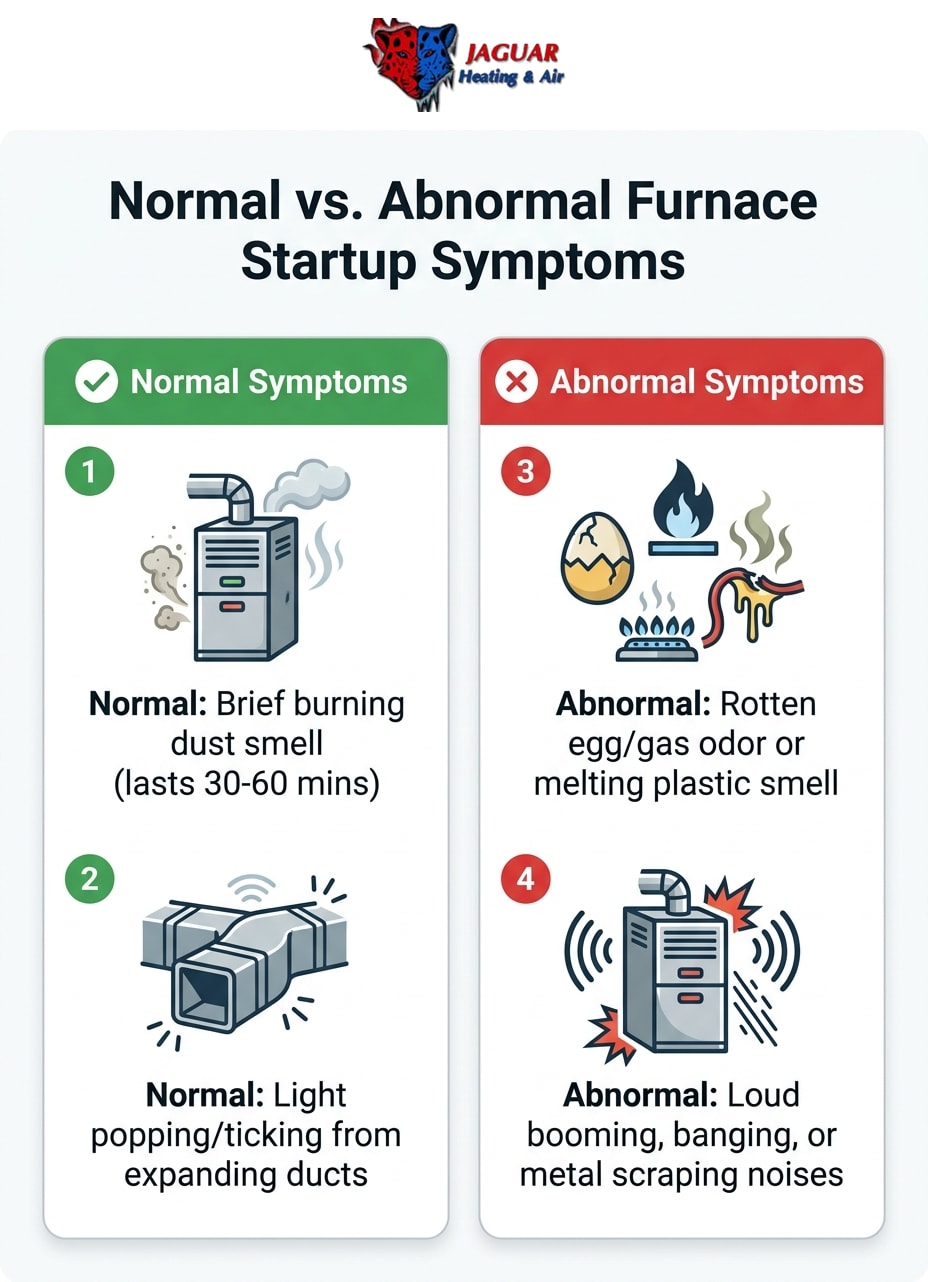
The most common cause for alarm during a November pre-winter startup is the sudden, distinct smell of something burning. Because the heat exchanger gets incredibly hot to warm the air passing over it, any dust that settled on it during the summer is instantly incinerated. This is the classic "burning dust" smell. It is completely normal, but it is not the only odor your system can produce. Knowing the difference between harmless dust burn-off and a dangerous chemical or gas leak is critical for home safety.
• Burning Dust / Hair — Likely Cause: Incineration of settled summer dust on the heat exchanger. — Is It Normal?: Yes, during the first few cycles of the season. — Required Action: Monitor for 30–60 minutes. Open a window if needed. It should dissipate on its own.
• Electrical / Melting Plastic — Likely Cause: Overheating blower motor, failing capacitor, or melting wire casing. — Is It Normal?: No. This indicates an electrical failure or severe friction. — Required Action: Shut the system off immediately at the thermostat. Call for professional diagnostics.
• Rotten Eggs / Sulfur — Likely Cause: A natural gas leak near the furnace or gas line. — Is It Normal?: No. This is a severe safety hazard and fire risk. — Required Action: Evacuate the home, leave doors open, and call your gas utility provider immediately.
• Musty / Damp Sock — Likely Cause: Bacterial growth or stagnant water in the condensate drain pan. — Is It Normal?: No, but usually not an immediate emergency. — Required Action: Schedule a professional cleaning to clear the drain line and sanitize the coil.
The quick fix: If you smell burning dust, give the system an hour to cycle. If the smell persists for days, or if you ever detect the sharp tang of melting wires or the distinct odor of gas, shut the equipment down instantly. Never ignore a persistent, abnormal smell hoping it will resolve itself.
Troubleshooting Lukewarm Air on Cold Mornings
Another frequent frustration we hear from homeowners in the Sacramento region is turning the thermostat up, hearing the system kick on, but feeling only lukewarm—or completely cold—air coming from the vents. When the house is already freezing, a heater blowing cold air feels like a massive failure. However, the cause is often a simple mechanical sequence or an airflow restriction rather than a broken furnace.
The Initial Ductwork Purge
The Problem: The furnace turns on, but the first blast of air from the vents is freezing cold.
The Cause: Before warm air can reach your living room, the system has to push out all the cold, stagnant air that has been resting inside the ductwork overnight.
The Solution: Patience. Give the system three to five minutes to purge the cold air and allow the heat exchanger to reach its operating temperature. If the air warms up shortly after, the system is operating perfectly.
The Dirty Flame Sensor Lockout
The Problem: The air never gets warm, and the furnace seems to turn itself off after just a few minutes.
The Cause: The flame sensor is a critical safety device that detects whether the gas burners have actually ignited. If the sensor is coated in carbon buildup or summer dust, it cannot "feel" the flame. To prevent raw gas from flooding your home, the sensor shuts the system down immediately.
The Solution: This requires professional heating maintenance. A Jaguar Heating & Air technician will carefully remove, clean, and recalibrate the sensor to restore the proper ignition sequence.
The Restrictive Air Filter
The Problem: The system blows warm air briefly, then blows cold air, then shuts off entirely in a rapid cycle.
The Cause: A severely clogged air filter blocks the return air from entering the furnace. Without enough fresh air moving over the heat exchanger, the internal temperature skyrockets. A safety limit switch detects this overheating and shuts the burners down to prevent a fire, while the blower continues to run, pushing unheated air into the home.
The Solution: Check your air filter. If it is caked in gray dust or pet hair, replace it immediately with a fresh, clean filter to restore proper airflow.
Decoding Furnace Noises: Pops, Bangs, and Squeals
HVAC systems are large, powerful machines, and they are never entirely silent. However, during a November pre-winter startup, you might hear sounds that make you question the integrity of the equipment. Categorizing these noises can help you identify when a sound is just a harmless physical reaction and when it indicates a failing component.
Why is my heater making a light popping or ticking sound?
This is usually completely normal. As the furnace pushes highly heated air into cold sheet-metal ductwork, the metal expands. When the cycle ends, the metal cools and contracts. This thermal expansion and contraction creates a rhythmic ticking or popping sound, especially near the vents. Unless the popping is extremely loud, it is just a quirk of the material.
What does a loud booming or banging at startup mean?
A loud boom or bang right when the furnace kicks on is highly abnormal and potentially dangerous. This is often caused by delayed ignition. If the burners are dirty or misaligned, natural gas builds up inside the combustion chamber before the igniter finally catches it. When it does ignite, the excess gas creates a miniature explosion. This rattles the entire cabinet and can eventually crack the heat exchanger. Turn the system off and call for professional service.
Why is there a high-pitched squealing noise?
A continuous high-pitched squeal usually points to a problem with the blower motor. In older systems, it might be a worn-out fan belt slipping on its pulley. In modern systems, it typically indicates that the bearings inside the blower motor are failing or lack lubrication. Ignoring a squeal almost always leads to a seized motor, which is an expensive repair.
What should I do if I hear metal-on-metal scraping?
Shut the system down instantly. Metal-on-metal scraping sounds like a spoon caught in a garbage disposal. This usually means the blower wheel has broken loose from its mount or a motor mount has snapped, causing the fan blades to scrape violently against the metal housing. Running the system in this state will shred the internal components.
Why Guesswork Fails: The Value of a Diagnostic Approach
When faced with an ambiguous symptom—like a heater that runs but struggles to maintain the set temperature—it is tempting to search for quick fixes or rely on visual inspections. However, modern combustion systems are highly complex, integrating electrical boards, pressurized gas valves, and sensitive safety limits. Relying on guesswork often leads to replacing parts that aren't actually broken, wasting time and money while the root problem remains untouched.
Just last November, a Sacramento homeowner reached out to our dispatch team when their heat refused to turn on during a sudden pre-winter cold snap right before the holidays. They needed heat urgently to keep the house comfortable for visiting family. A Jaguar Heating & Air technician arrived the very next day, but rather than just glancing at the unit and guessing the cause, they performed a thorough diagnostic test. By systematically checking the electrical draw, testing the safety switches, and measuring the gas pressure, they pinpointed the exact point of failure. The problem was fixed quickly and efficiently, restoring the heat without pushing unnecessary part replacements.
This is why our team relies on a comprehensive diagnostic approach. A true professional evaluation goes far beyond checking the filter. Our technicians use specialized tools to measure carbon monoxide levels, verify the microamp draw on the flame sensor, and ensure the gas pressure matches the manufacturer's exact specifications. Just as detailed testing is required for reliable AC maintenance, deep-dive heating diagnostics remove the mystery from your equipment's performance. It gives you the confidence of knowing exactly what condition your system is in, protecting both its longevity and your household's safety.
Long-Term Protection: Moving Beyond the Initial Startup
Surviving the first major startup of the season is a relief, but it does not guarantee reliable performance through the coldest months of the year. A furnace that powers on in November can still suffer a catastrophic breakdown in January if underlying wear and tear is ignored. Moving from a reactive mindset—only calling for help when the system completely fails—to a proactive strategy is the best way to protect your investment.
A fully cleaned, calibrated, and lubricated heating system operates with significantly higher energy efficiency. When burners are clear, filters are fresh, and the blower motor is operating without excess friction, the system uses less fuel and electricity to reach your desired temperature. Over the course of a long winter, this improved efficiency translates directly into lower monthly utility usage. Maximizing efficiency can also help you take advantage of generally applicable utility incentive programs or federal tax credits for qualifying system upgrades.
This is where routine care plans prove their worth. Enrolling in an HVAC maintenance membership ensures that both your heating and cooling equipment receive professional attention before their respective peak seasons begin. These plans keep your system in peak condition, catch small signs of wear before they turn into mid-season emergencies, and provide a documented history of professional care—which is often required to keep manufacturer warranties valid.
Frequently Asked Homeowner Questions About Fall HVAC Maintenance
When the weather shifts in the Sacramento region, getting common homeowner questions answered by trusted local experts is crucial. Here are the most frequent inquiries our Jaguar Heating & Air team receives regarding fall HVAC upkeep.
Why does my heater smell like burning dust?
Dust naturally settles on the heat exchanger while the furnace sits idle during the long summer months. When you turn the heat on for the first time, the extreme temperature of the heat exchanger incinerates this dust layer. This creates a temporary, noticeable burning odor throughout the house.
How long does the burning smell last when turning on the heater?
The normal dust burn-off smell typically dissipates within 30 to 60 minutes, or after the first two to three heating cycles. If the burning smell lasts longer than a day, or if it smells like melting plastic or electricity, turn the system off and schedule a professional inspection.
Why is my heater blowing lukewarm air?
Initially, your system must push the resting cold air out of the ductwork before the warm air arrives. If the air remains lukewarm, you likely have a dirty flame sensor preventing the burners from staying lit, or a severely restrictive air filter causing the system to short-cycle.
What noises indicate my furnace needs repair?
Loud booming sounds indicate delayed gas ignition, which is a serious safety hazard. High-pitched squealing points to a failing blower motor or worn belt, while metal-on-metal scraping means a component has broken loose. All of these require immediate professional repair to prevent further damage.
How often should I schedule professional heating checks?
We recommend scheduling a professional heating evaluation annually, ideally in the fall before heavy winter usage begins. This yearly check ensures safe fuel combustion, verifies that all safety limit switches are fully operational, and maximizes the system's energy efficiency.
Can a dirty filter cause my heater to shut down?
Yes, a dirty filter severely restricts the airflow entering the furnace, causing the internal temperature to rise rapidly. To prevent a fire or a cracked heat exchanger, the system's high-limit safety switch will automatically shut the furnace down until it cools off.
Enjoy a Warm, Worry-Free Winter
Navigating that November pre-winter startup doesn't have to be a stressful event. By understanding the difference between normal dust burn-off and the warning signs of a serious mechanical issue, you can operate your system with confidence. While changing your air filter and monitoring for odd smells are great first steps, professional guidance is always the safest route for complex combustion equipment. If you encounter strange noises, persistent odors, or lukewarm air that won't resolve, leaning on a thorough professional diagnostic from Jaguar Heating & Air will ensure your home stays warm, safe, and comfortable all season long.
Recent Posts
HVAC Maintenance Troubleshooting: Decoding the First Fall Heating Startup
Smelling burning dust during your fall startup? Why we rely on key home maintenance tips and troubleshooting to check your system. See what is safe.
Decoding the October Heating Startup Smell: A Safety Approach to HVAC Maintenance
Is that October heating smell normal dust or a hazard? Get clear answers using our local service expertise and area tips to keep your Sacramento home safe.
Navigating Heating Replacements in Sacramento: Heat Pumps vs. Gas Furnaces
Deciding between a heat pump and gas furnace? Review heating options comparisons for homeowners to make the right choice before winter. Compare your options.