Navigating Heating Replacements in Sacramento: Heat Pumps vs. Gas Furnaces
Deciding between a heat pump and gas furnace? Review heating options comparisons for homeowners to make the right choice before winter. Compare your options.
Deciding between a heat pump and gas furnace? Review heating options comparisons for homeowners to make the right choice before winter. Compare your options.

Facing a Failing Heater During Fall Start-Up
Is your heating system actually ready for winter, or are you just hoping it turns on when the first cold front hits? As we head into autumn, many homeowners discover that the system sitting dormant all summer is suddenly unresponsive, forcing them into navigating options comparisons for homeowners to figure out the best path forward. Before you panic, starting with professional HVAC maintenance services can clarify if you actually need a replacement, while joining an HVAC maintenance membership ensures your system is always protected year-round.
Turning on the heating system for the first time in autumn often reveals hidden mechanical failures that developed quietly over the summer. Dust settles heavily on burners, electrical connections loosen from thermal expansion, and blower motors can seize up from months of inactivity. When you switch the thermostat to "heat" and nothing happens, it is easy to assume the entire system is broken beyond repair. However, a failure discovered during an October fall maintenance and pre-winter inspection does not automatically mean you need to replace the entire unit.
A typical pattern we see involves homeowners assuming the worst about their equipment. For example, one local customer reached out during the summer needing a replacement estimate for their AC unit because it was severely underperforming. Instead of pushing for an unnecessary replacement, the technician thoroughly cleaned the impacted unit, which fully restored its function and saved the equipment. The exact same principle applies to heating systems in the fall. A professional assessment is strictly necessary to rule out simple issues like a dirty flame sensor, a tripped breaker, or a minor component failure before discussing a total replacement.
When an older system is genuinely beyond repair, however, you must decide whether to stick with what you know or upgrade to newer technology. Exploring all your choices early prevents panic-buying during the first major cold snap. Taking the time to understand your options now guarantees you will make a confident, informed decision for your home.
How Sacramento's Climate Changes the Heating Debate
Much of the online advice regarding heating systems assumes harsh, freezing winters, which dramatically skews recommendations away from certain technologies. If you read a generic home improvement guide written for a homeowner in Minnesota or New York, the advice will heavily favor systems built to combat sub-zero temperatures. But in California's Central Valley, the rules of the game are completely different.
Sacramento's unique climate features intense summer heat that demands robust cooling, paired with relatively mild winter conditions. Because Sacramento winter overnight lows generally hover around 40°F and rarely reach deep, sustained freezes, the criteria for an efficient heating system are vastly different than in the Midwest. A system must be evaluated on how well it handles year-round temperature fluctuations, not just how it performs in a blizzard.
Why local weather matters for your HVAC:
• Short-cycling risks: A traditional system built for extreme cold is often overkill for mild climates. It will turn on, blast intense heat, and shut off rapidly, which wears out parts prematurely.
• Cooling demands: The extreme summer heat requires any dual-purpose system to have exceptional cooling capacity.
• Humidity control: Mild, damp winters require systems that can gently circulate warm air to control indoor moisture without overheating the space.
Because you rely on your equipment heavily from May through September, routine AC maintenance is just as important as winter prep. You cannot look at heating in a vacuum; you have to consider how your choice impacts your home's comfort in July just as much as it does in December. Understanding this local weather context is the foundation of making the right upgrade choice.
Traditional Gas Furnaces: Familiarity and Reliability
Gas furnaces have been the standard in California homes for decades, offering rapid, high-heat output on chilly mornings. If you have lived in your home for a long time, chances are you have a gas furnace tucked away in your attic, closet, or garage. They operate by burning natural gas inside a metal heat exchanger. The system's blower motor then pushes air over that hot metal, warming the air before distributing it through your ductwork.
One of the main reasons homeowners stick with gas furnaces is pure familiarity. They provide a very hot, dry heat that warms up a room incredibly fast. Furthermore, modern furnaces are significantly more energy-efficient than older models. While a furnace from twenty years ago might have wasted a large portion of its fuel through the exhaust flue, today's models utilize advanced combustion technology to reduce wasted fuel and lower operational costs.
However, furnaces only do one job: heating. They require a separate, dedicated air conditioning unit to handle the intense Sacramento summers. If your furnace fails but your AC is still relatively new, replacing just the furnace makes logical sense. But if both are aging, you are looking at replacing two separate pieces of equipment. When the shared indoor blower starts failing, you might even notice that your AC blower motor sounds like a jet engine, signaling that the components shared by both the heating and cooling systems are reaching the end of their lifespan.
The Impact of California's Electrification Push
When evaluating a gas furnace, homeowners must consider California's long-term electrification initiatives and changing regulations around natural gas appliances. Statewide initiatives like Title 24 are actively encouraging the transition away from fossil fuels to reduce the state's overall carbon footprint.
While gas furnaces are still widely available and perfectly legal to install as replacements, future-proofing a home often involves looking toward electric alternatives. As the state continues to incentivize electric appliances, natural gas infrastructure may become less of a priority in residential planning. Choosing a gas furnace today means you are committing to utilizing natural gas for the 15-to-20-year lifespan of that equipment.
Modern Heat Pumps: The All-in-One Solution for Mild Winters
Unlike furnaces that generate heat by burning fuel, heat pumps transfer heat from the outside air into the home, making them incredibly energy-efficient. Even when it feels cold outside to you, there is still thermal energy present in the air. A heat pump acts exactly like an air conditioner in reverse; it extracts that ambient heat, concentrates it using refrigerant, and pumps it inside your living space.
In climates with mild winters, heat pumps operate at peak efficiency. Because Sacramento winter overnight lows hover around 40°F, heat pumps never struggle with the efficiency drop-offs seen in sub-zero climates. They can easily pull enough ambient heat from 40-degree air to keep your home perfectly comfortable without using excessive electricity. They do not have to work nearly as hard here as they would in a snowy climate.
A major advantage of a heat pump is its dual functionality. You are essentially getting two systems in one. During the blistering Sacramento summers, the heat pump reverses its operation. It pulls the heat out of your indoor air and dumps it outside, working exactly like a traditional central air conditioner to provide powerful cooling.
Furthermore, transitioning to this technology often comes with financial perks. Homeowners may be eligible for generic federal tax credits or local utility incentive programs when upgrading to qualifying heat pump technology. (Always verify current programs and eligibility with your utility provider or a qualified tax professional before making a purchase).
The comfort profile of a heat pump:
• Consistent airflow: Instead of blasting very hot air in short bursts, a heat pump provides a steady, consistent flow of warm air.
• Even temperatures: This continuous operation eliminates the hot and cold spots that often plague older homes.
• Quiet operation: Modern variable-speed heat pumps run at lower capacities most of the time, making them significantly quieter than traditional systems.
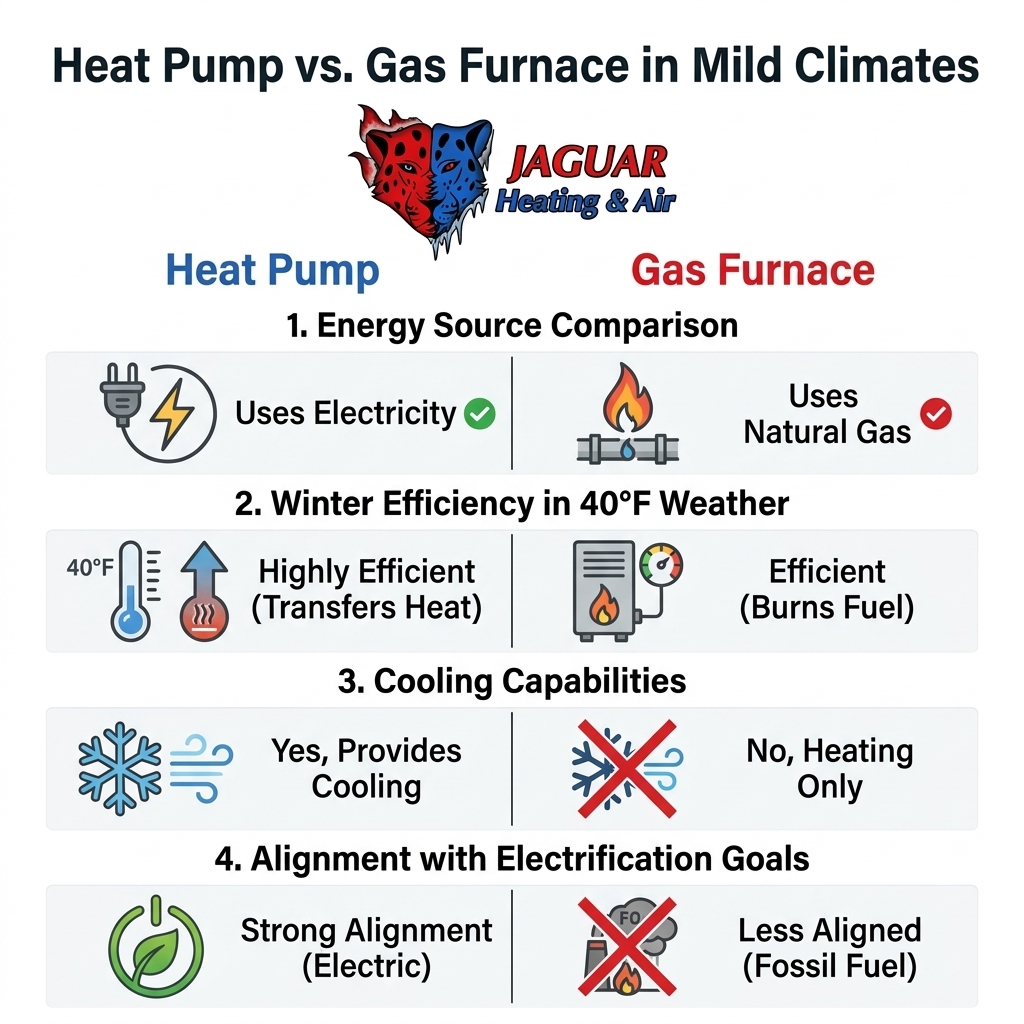
Side-by-Side Comparison: Heat Pump vs. Gas Furnace
To make the best choice for your home, it helps to look at the facts side-by-side. Both systems have their merits, but their application depends heavily on your specific goals, your home's existing infrastructure, and how you prioritize energy efficiency versus rapid heating.
• Energy Source — Modern Heat Pump: Electricity (transfers heat) — Traditional Gas Furnace: Natural Gas (generates heat)
• Climate Suitability — Modern Heat Pump: Excellent for mild Sacramento winters — Traditional Gas Furnace: Built for extreme, freezing cold
• Cooling Capability — Modern Heat Pump: Built-in AC (reverses in summer) — Traditional Gas Furnace: Requires a separate AC unit
• Environmental Impact — Modern Heat Pump: Supports state electrification goals — Traditional Gas Furnace: Relies on fossil fuels
• Heat Delivery Style — Modern Heat Pump: Steady, even, continuous warmth — Traditional Gas Furnace: Rapid, intense bursts of hot air
As the table illustrates, the decision often comes down to your long-term goals. If you want to align with state environmental targets and prefer a single system that handles both heating and cooling, the heat pump is the clear winner. If you are replacing a broken heater but your AC is brand new, a modern gas furnace might be the most practical immediate step.
Protecting Your Investment with Proactive Care
Whether you ultimately opt for a traditional furnace or a modern heat pump, the longevity of the system depends entirely on regular upkeep. You cannot install a state-of-the-art heating system, ignore it for five years, and expect it to run efficiently. Mechanical systems require ongoing attention to perform at their best.
Heat pumps run year-round, meaning they require bi-annual checks to ensure both heating and cooling modes function optimally. Because they never truly get an "off-season," the wear and tear on blower motors, capacitors, and refrigerant lines is continuous. Conversely, a standalone gas furnace typically requires a thorough inspection just once a year, right before the winter season begins.
This is exactly why scheduling heating system tune-ups during your October fall maintenance and pre-winter inspection is so critical. Professional tune-ups catch minor wear and tear before they escalate into costly mid-season breakdowns. During a visit, a technician will clean the coils, check the electrical connections, inspect the heat exchanger for safe operation, and ensure the system is drawing the correct amount of power.
Enrolling in a structured maintenance program ensures that warranties remain valid and efficiency stays high. Most manufacturers actually require proof of professional maintenance to honor parts warranties. Opting into a dedicated maintenance membership provides peace of mind and priority service, especially during extreme weather shifts. When the first major cold snap hits and everyone else is scrambling to book a repair, membership guarantees you are already taken care of.
Frequently Asked Questions About Sacramento Heating Options
Is a heat pump better than a gas furnace in Sacramento?
Due to mild winters, heat pumps are highly efficient and offer the bonus of summer cooling, making them an excellent choice locally. Because the temperature rarely drops below freezing, a heat pump does not have to work as hard as it would in a snowy climate. This dual functionality often makes it the preferred option for homeowners looking to upgrade their entire HVAC system at once.
Are heat pumps effective in mild California winters?
Yes, they operate at peak efficiency in temperatures well above freezing, easily handling 40-degree overnight lows. In fact, mild climates are exactly where heat pump technology shines brightest. They can extract plenty of ambient heat from cool air without needing auxiliary electric heating strips, keeping energy usage remarkably low.
Should I replace my gas furnace with a heat pump?
It depends on your home's infrastructure, but state electrification goals and potential tax incentives make it a compelling upgrade. If your existing ductwork and electrical panel can support the switch, a heat pump is a fantastic way to future-proof your home. However, if your air conditioner is brand new and only the furnace failed, replacing just the furnace might make more immediate sense.
How often does a heat pump need maintenance compared to a furnace?
Because a heat pump works year-round for both heating and cooling, it generally requires inspections twice a year, whereas a standalone furnace is typically checked once in the fall. You need a professional to check the cooling cycle in the spring and the heating cycle in the autumn. Skipping these checks can lead to decreased efficiency and premature component failure.
Can a heat pump handle Sacramento's extreme summer heat?
Absolutely. A heat pump functions exactly like a standard central air conditioner during the summer months. It uses the same refrigeration cycle to pull heat out of your home and release it outside, providing robust and reliable cooling even during the hottest July heat waves.
Next Steps for Your Home's Winter Comfort
Every home is unique, and the best heating solution depends on your specific layout, insulation levels, and personal comfort needs. There is no one-size-fits-all answer, which is why a personalized assessment is so valuable. Consulting with a local expert ensures you make an informed decision aligned with local climate demands, rather than relying on generic advice meant for different parts of the country.
Once you have made your choice, explore ongoing care options to protect whichever system you choose. Securing an HVAC maintenance membership guarantees that your new equipment will deliver consistent, efficient comfort for years to come. Take the time to evaluate your options now, so you can enjoy a warm, worry-free winter backed by a system designed specifically for your home's needs.
Recent Posts

Is a Burning Smell Normal During Fall Heating Startup? HVAC Maintenance FAQs Answered
Get clear answers on why your furnace smells like burning dust. We have common homeowner questions answered so you know when to wait and when to call a pro.
HVAC Maintenance and Replacement Options: Comparing Heat Pumps vs. Gas Furnaces
Decide with confidence this fall. We break down heating options comparisons for homeowners choosing between a heat pump and gas furnace. See which is best.

Fall HVAC Startup Checklist: Diagnosing Burning Smells and System Red Flags
Deciding if that burning dust smell is normal? See why this seasonal home maintenance checklist is critical for catching heating failures before winter hits.