.avif)
How Wildfire Ash Clogs Your AC Condenser Coils in Late Summer
Micro-ash from heavy smoke acts as an insulating blanket on your outdoor cooling fins. See why this unique debris causes severe mechanical strain and requires specialized removal.
Micro-ash from heavy smoke acts as an insulating blanket on your outdoor cooling fins. See why this unique debris causes severe mechanical strain and requires specialized removal.

The Hidden Impact of Late-Summer Wildfires on Your Outdoor AC Unit
At Jaguar Heating & Air, our team sees firsthand how the late summer to early fall wildfire season bears down on the valley, and you might be wondering exactly how wildfire ash clogs your AC condenser coils in late summer. As heavy smoke settles over the Sacramento region, most homeowners immediately check their indoor air filters and keep their windows locked tight. While protecting your indoor air quality is a smart move, your outdoor air conditioning unit is silently bearing the brunt of the environmental fallout. Micro-ash is fundamentally different from everyday dust, acting as a thick, insulating blanket that chokes the life out of your condenser. Before the critical fall transition arrives, it is essential to understand why this specific type of heat transfer failure happens and what you must do to stop it.
If you are already noticing a drop in cooling performance or strange noises from your outdoor unit, exploring professional air conditioning services is the best way to protect your system from long-term damage.
Why Micro-Ash Behaves Differently Than Normal Yard Dust
When you look at your outdoor air conditioning unit, you probably see the usual debris: a few dried leaves, some grass clippings, and a light coating of yard dust. These common environmental factors are relatively harmless. They sit loosely on the surface of the metal cabinet and are easily displaced by the powerful updraft of the condenser fan or a light breeze. Wildfire ash, however, plays by an entirely different set of physical rules.
In our years of servicing HVAC systems across the region, we've seen how the topography of Sacramento and surrounding valley areas creates a natural bowl that traps wildfire smoke and fine particulate matter for weeks at a time. This prolonged, concentrated exposure means your outdoor equipment is constantly pulling in contaminated air every time a cooling cycle initiates. While your indoor system is protected by dedicated air filtration, your outdoor condenser has no such defense. It relies entirely on the open air to function, making it highly vulnerable to microscopic invaders.
The Anatomy of PM2.5 Particles
To understand why wildfire smoke is so destructive to HVAC equipment, you have to look at the microscopic nature of the particulate matter itself. Wildfire ash is largely composed of PM2.5 particles. This designation means the particles are less than 2.5 micrometers in diameter—about 30 times smaller than a single strand of human hair.
Because these particles are practically microscopic, they do not just sit on the surface of your air conditioner. Instead, they are pulled forcefully into the unit and penetrate deeply into the incredibly narrow crevices of the aluminum cooling fins. Once inside, their jagged, irregular shapes allow them to lock together, packing densely into the tiny spaces where air is supposed to flow. This dense packing restricts airflow drastically compared to larger, smoother debris.
• Standard Yard Dust — Particle Size: Large (PM10+) — Behavior on AC Coils: Sits loosely on the surface; easily blown away by the fan. — Airflow Impact: Minimal, unless severely neglected over several years.
• Pollen & Spores — Particle Size: Medium — Behavior on AC Coils: Creates a sticky film but generally remains on the outer edges of the fins. — Airflow Impact: Moderate; can reduce efficiency over a full season.
• Wildfire Micro-Ash — Particle Size: Microscopic (PM2.5) — Behavior on AC Coils: Penetrates deep into fin crevices and locks together tightly. — Airflow Impact: Severe; rapidly chokes airflow and causes immediate heat retention.
The Chemical Threat: How Moisture Turns Ash Into a Cement Blanket
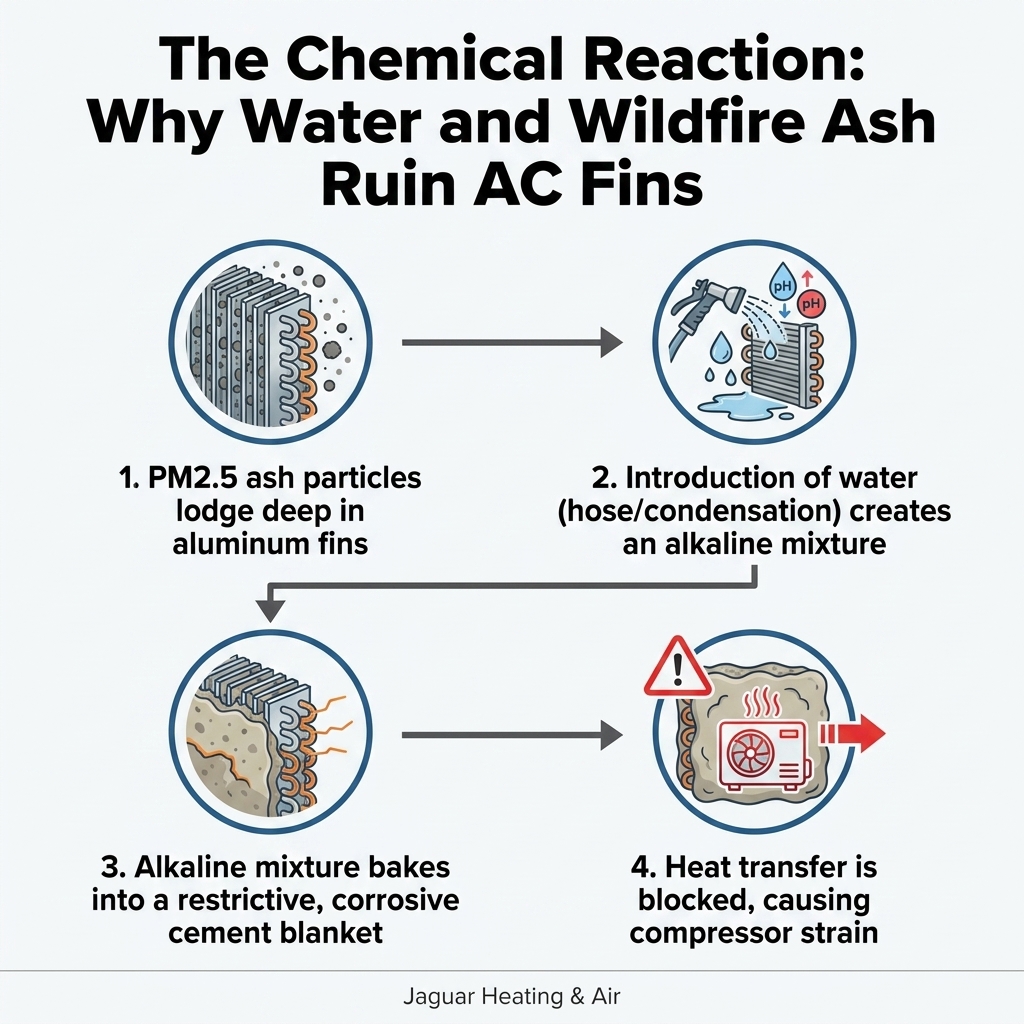
The physical blockage caused by PM2.5 particles is only the first half of the problem. The real danger during the late summer to early fall wildfire season occurs when this dry micro-ash undergoes a destructive chemical reaction. Wood ash is naturally highly alkaline. In its dry state, it is a nuisance, but when you introduce moisture, it transforms into a severe mechanical threat.
Our technicians frequently hear from Sacramento homeowners who assume their outdoor unit is perfectly dry just because it hasn't rained. Unfortunately, air conditioners naturally produce and encounter moisture every day. Morning dew settles on the metal cabinet. Condensation forms on the internal copper lines as cold refrigerant cycles through the hot outdoor air. Even high humidity levels in the early morning hours can provide enough moisture to trigger a reaction.
The chemical chain reaction:
• Moisture absorption: The microscopic ash particles absorb ambient condensation or morning dew like a sponge.
• Alkaline activation: The water mixes with the potassium and calcium in the wood ash, creating a highly alkaline, corrosive slurry.
• Baking process: As the sun rises and the outdoor unit heats up during extreme daytime temperatures, this wet slurry rapidly dries out.
• Cement formation: The dried mixture hardens into a dense, cement-like residue that bonds directly to the aluminum fins.
Once this chemical bonding occurs, the ash can no longer be blown away by the unit's fan or brushed off lightly. Worse, this alkaline mixture is highly corrosive. If left untreated, it will slowly pit and degrade the thin aluminum fins of the condenser, permanently reducing the lifespan of your equipment. What starts as a simple layer of smoke fallout quickly becomes a permanent, restrictive blanket that suffocates your system.
The Garden Hose Mistake: Why DIY Cleaning Ruins Condenser Fins
When our customers step outside and see their air conditioner covered in a layer of gray soot, their first instinct is usually to grab the nearest garden hose. It makes logical sense—if something is dirty, you wash it off. However, when dealing with wildfire fallout, taking a hose to your unit is one of the most damaging things you can do, and a pattern we see far too often.
As we just established, adding tap water to dry micro-ash instantly triggers a chemical reaction. By spraying down your unit, you are manually forcing that highly alkaline slurry deeper into the coil fins. Instead of washing the ash away, the water pushes the particulate matter into the tightest, most inaccessible areas of the condenser. Once the hot afternoon sun hits the unit, that wet ash bakes into the exact cement-like blanket you were trying to avoid.
Beyond the chemical danger, there is a significant physical risk to DIY cleaning. The aluminum fins on your condenser coil are incredibly fragile. They are designed to be as thin as possible to maximize heat transfer.
The risks of high water pressure:
• Flattened fins: The pressure from a standard garden hose nozzle is often enough to bend the delicate aluminum fins flat.
• Airflow blockage: When fins are bent over, they completely block air from pulling through the coil, acting like a closed set of window blinds.
• Irreversible damage: Once fins are severely flattened and crusted with baked-on ash, they are exceptionally difficult to comb back into place without snapping the metal.
Removing baked-on ash requires specialized, non-acidic chemical cleaners that neutralize the alkaline residue without eating away at the aluminum. It also requires calibrated, low-pressure washing techniques that professionals use to safely flush the coils from the inside out. This is exactly why experts strongly advise researching the proper methods for cleaning your AC coils rather than attempting a quick rinse that could cost you a compressor.
Heat Transfer Failure and Extreme Compressor Strain
To understand why this cement-like ash blanket is so dangerous, you need to understand the core function of your outdoor unit. The condenser coil's only job is to release the heat that your system absorbed from inside your home into the outdoor air. It acts as a massive radiator. For this process to work, vast amounts of ambient air must flow freely across the exposed aluminum fins.
When those fins are clogged with micro-ash, the coil loses its ability to breathe. The ash acts as a heavy insulator, trapping the heat inside the system. This creates a cascading mechanical failure. Because the heat cannot escape, the temperature and pressure of the refrigerant inside the copper lines begin to spike dangerously high. To keep pushing this high-pressure refrigerant through the system, the compressor has to work twice as hard, drawing significantly more electrical current.
This situation is amplified by the double-threat of late-summer extreme heat combined with heavy ash fall across Sacramento and surrounding valley areas. When ambient outdoor temperatures soar past 100 degrees, your air conditioner already has zero margin for error. If the condenser is insulated by ash, heat transfer becomes mathematically impossible. The compressor overheats, the internal lubricants break down, and the system eventually shuts down to protect itself.
Often, this severe strain mimics total system failure. In fact, our dispatch team at Jaguar Heating & Air recently received a morning service call from a local homeowner for a completely malfunctioning AC unit that had stopped cooling during a heavy smoke week. The outdoor cabinet was excessively hot to the touch, and the system was short-cycling. One of our technicians arrived, thoroughly explained that the issue was actually a severe micro-ash blockage rather than a dead compressor, and performed a specialized deep clean. We had the unit fixed and running perfectly before noon, saving the homeowner from an unnecessary replacement panic.
Recognizing the Warning Signs of Overheating
If your system is struggling with an ash-clogged condenser, it will usually give you warning signs before the compressor fully locks up. Watch for these symptoms during the late summer to early fall wildfire season:
• Longer run cycles: The system runs continuously but struggles to reach the temperature set on the thermostat, even on mild days.
• Hot outdoor casing: The metal cabinet of the outdoor unit feels excessively hot to the touch, radiating trapped heat.
• Short-cycling: The unit turns on for just a few minutes, shuts off abruptly, and then tries to start again a few minutes later.
• Tripped breakers: The compressor draws so much electrical current trying to overcome the high pressure that it trips your home's circuit breaker.
• Lukewarm air: The air coming from your indoor vents feels barely cool or entirely room-temperature because heat transfer has stopped.
If you notice any of these symptoms, shut the system off immediately to prevent further compressor damage and reach out for professional AC repair.
Transitioning to Fall: Clearing the Ash Before the Heating Season
As September progresses, your HVAC system faces a critical transition period. It must recover from enduring end-of-summer heat stress and begin preparing for fall heating. Carrying compromised, ash-clogged equipment into a new season is a recipe for premature failure.
This is especially true if you rely on a heat pump system. Unlike a traditional air conditioner that sits dormant all winter, a heat pump reverses its operation. In the fall and winter, it uses that exact same outdoor coil to extract ambient heat from the outside air and bring it inside. If that coil is still wearing a restrictive cement blanket of baked-on summer wildfire ash, your heat pump will struggle to heat your home, resulting in massive energy bills and excessive winter wear and tear. Federal tax credits and local utility incentives often apply to qualifying high-efficiency heat pump upgrades, but maximizing that efficiency requires keeping the coils pristine.
Navigating the region's unique wildfire season requires local expertise. At Jaguar Heating & Air, our professional deep-cleaning process goes far beyond a simple wipe-down. Our technicians use specialized coil brighteners designed to safely dissolve alkaline micro-ash without harming the fragile aluminum fins. We follow up with calibrated, low-pressure washing from the inside of the unit outward, ensuring that every trace of restrictive debris is safely neutralized and flushed away.
Before the weather turns cold and you demand a different type of performance from your equipment, you must ensure your system can breathe freely. Scheduling a comprehensive evaluation now guarantees that the hidden damage of summer smoke doesn't become a costly winter breakdown. Take action today and book your AC maintenance to secure your comfort for the seasons ahead.
Frequently Asked Questions
Does wildfire smoke damage outdoor AC units?
Yes, wildfire smoke can cause significant mechanical damage to outdoor units. The microscopic ash particles (PM2.5) get pulled deeply into the condenser fins, restricting airflow. Over time, this acts as an insulator, trapping heat inside the system and putting extreme strain on the compressor.
Why shouldn't I hose off wildfire ash from my AC?
Hosing off your unit can actually make the problem much worse. When you mix tap water with dry, highly alkaline wood ash, it creates a chemical slurry that bakes into a hard, cement-like crust. Additionally, the high water pressure from a garden hose can easily bend and flatten the fragile aluminum cooling fins, permanently blocking airflow.
Can micro-ash cause my compressor to overheat?
Absolutely. The compressor relies on the outdoor coil to release heat into the air. When micro-ash forms a blanket over the fins, heat transfer fails, causing refrigerant pressures to spike. The compressor has to work twice as hard to move this high-pressure refrigerant, leading to overheating and potential system failure.
How do professionals safely remove baked-on ash from condenser coils?
Professionals use a combination of specialized, non-acidic chemical cleaners and calibrated equipment. The chemical brighteners safely neutralize the alkaline ash without corroding the aluminum. Technicians then use controlled, low-pressure washing techniques to flush the debris from the inside of the unit outward, protecting the delicate fins.
Should I turn off my AC during a heavy wildfire smoke event?
If the smoke is incredibly dense, turning off the system can prevent massive amounts of ash from being pulled into the condenser. However, this isn't always practical during extreme summer heat. If you must run your AC during a fire event, it is critical to schedule a professional deep clean immediately after the smoke clears to remove the accumulated ash.
Protect Your System from the Ash
Wildfire ash is a unique, aggressive threat that requires a specialized response. Don't let a cement-like blanket of micro-ash suffocate your compressor and ruin your transition into the fall heating season. By recognizing the dangers of DIY hosing and trusting a clear, technical approach to coil restoration, you can save your equipment from irreversible damage. Schedule your comprehensive AC maintenance today to ensure your system breathes freely and runs efficiently all year long.
Recent Posts
Fall Home Maintenance Tips and Troubleshooting
Smelling burning dust during your first fall heating cycle? See what is normal versus a safety risk with our home maintenance tips and troubleshooting.

Navigating the October Heating Startup: A Guide to Fall HVAC Maintenance
Is your first fall heating startup causing strange odors? Rely on our local service expertise and area tips to know when to call a pro on this in Sacramento.

Why Your Furnace Smells Like Burning Dust: Essential HVAC Maintenance Questions Answered
Smelling burning dust this fall? Have common homeowner questions answered about your furnace. Decide with confidence on when to call a pro before winter.