.avif)
HVAC Maintenance Guide: Comparing Heating Replacement Options Before Winter
Before winter hits, make sure your furnace can handle the cold. Compare your options with these objective heating options comparisons for homeowners.
Before winter hits, make sure your furnace can handle the cold. Compare your options with these objective heating options comparisons for homeowners.

Navigating Heating System Failures Before the Cold Arrives
Your aging furnace is rattling louder than ever, leaving you shivering and wondering if it will actually survive another winter, which forces you into making rapid options comparisons for homeowners who just want reliable warmth. That strange noise from your heating system is not going away on its own, and ignoring it usually leads to a complete breakdown on the coldest night of the year. Discovering that your system is failing right as the temperatures begin to drop is an incredibly stressful experience. You are suddenly faced with a major household investment, and feeling rushed into a choice often results in buyer's remorse. Fortunately, catching these warning signs early gives you the breathing room to make an informed, objective choice about your home's future comfort.
Before making any major decisions, scheduling comprehensive Sacramento HVAC maintenance establishes a baseline for your system's health. Taking action during a mid-fall or October heating-startup period is the absolute best time to uncover underlying issues. Instead of facing an emergency replacement in the dead of winter when your family is freezing, you have the luxury of time. You can carefully weigh the benefits of sticking with a traditional gas furnace versus upgrading to a modern, highly efficient heat pump. Relying on a professional assessment during this critical autumn window ensures your decision is based on hard data and your home's specific heating requirements, rather than panic.
The Role of Proactive Evaluations in Heating Health
The problem: Many homeowners assume their heating system is fine simply because it turned on last year. However, internal components degrade over time, and a furnace that appears to work might actually be operating at a fraction of its original efficiency or harboring hidden safety hazards.
The cause: Years of thermal expansion, dust accumulation, and continuous vibration take a toll on mechanical parts. Systems that are over ten to fifteen years old frequently experience significant efficiency drops. Heat exchangers can develop microscopic cracks, blower motors lose their torque, and electrical connections loosen. Without a thorough professional evaluation, these hidden issues compound until the system fails completely.
The solution: A comprehensive inspection establishes the exact health of your equipment. During a targeted heating system maintenance visit, technicians perform rigorous safety checks, measure efficiency output, and analyze physical wear-and-tear. We frequently see the value of this proactive timing. For example, a local homeowner reached out late in the evening because their system was struggling. Because they called early in the season, a technician serviced it the very next day—performing detailed tests, replacing worn parts, and restoring the system so it ran perfectly before the extreme weather peaked. That same proactive approach applies to your furnace. Early detection of critical failures in the Sacramento Valley gives you the necessary time to research and objectively compare your replacement options with an honest professional who prioritizes your best interest over aggressive upselling.
Understanding Traditional Gas Furnaces
To make an informed decision during your mid-fall or October heating-startup, you first need to understand how traditional heating methods operate. Gas furnaces have been the standard for residential heating for decades, and they rely on a straightforward process of combustion. When your thermostat signals a need for heat, the furnace opens a gas valve and ignites burners inside a sealed combustion chamber. The resulting flames heat up a metal component called a heat exchanger. Your blower motor then pulls cold indoor air across this hot metal, warming the air before distributing it through your home's ductwork. The dangerous combustion gases are safely vented outside through a flue.
Lifespan and Reliability
According to ENERGY STAR recommendations, a well-maintained gas furnace typically lasts between fifteen and twenty years. They are renowned for producing very high-temperature air quickly, which provides a deep, cozy warmth that many homeowners appreciate. Because the technology is established and widespread, parts are generally readily available, and the core mechanics are highly reliable when serviced annually.
When Sticking with Gas Makes Sense
There are specific scenarios where replacing an old gas furnace with a new gas furnace is the most logical path. If your home already has extensive, properly sized gas piping and venting infrastructure in place, a direct replacement often requires less structural modification. Additionally, if your home suffers from poor insulation, the intense heat output of a gas furnace can help overcome those thermal leaks. However, it is important to note that gas furnaces rely entirely on fossil fuels. While modern condensing furnaces are much more efficient than older models, they still cannot match the sheer energy efficiency ceilings of newer, electrically driven technologies.
Why Heat Pumps Excel in Mild Winter Climates
If you are looking to maximize efficiency and modernize your home, air-source heat pumps offer a revolutionary alternative to combustion heating. Instead of burning fuel to generate heat, a heat pump uses electricity and advanced refrigerants to transfer heat from one place to another. Even when it feels cold outside, there is still ambient heat energy in the air. A heat pump absorbs this outdoor thermal energy, compresses it to raise its temperature, and releases it inside your home. In the summer, the process simply reverses, pulling heat out of your house to cool it down.
The Efficiency Multiplier
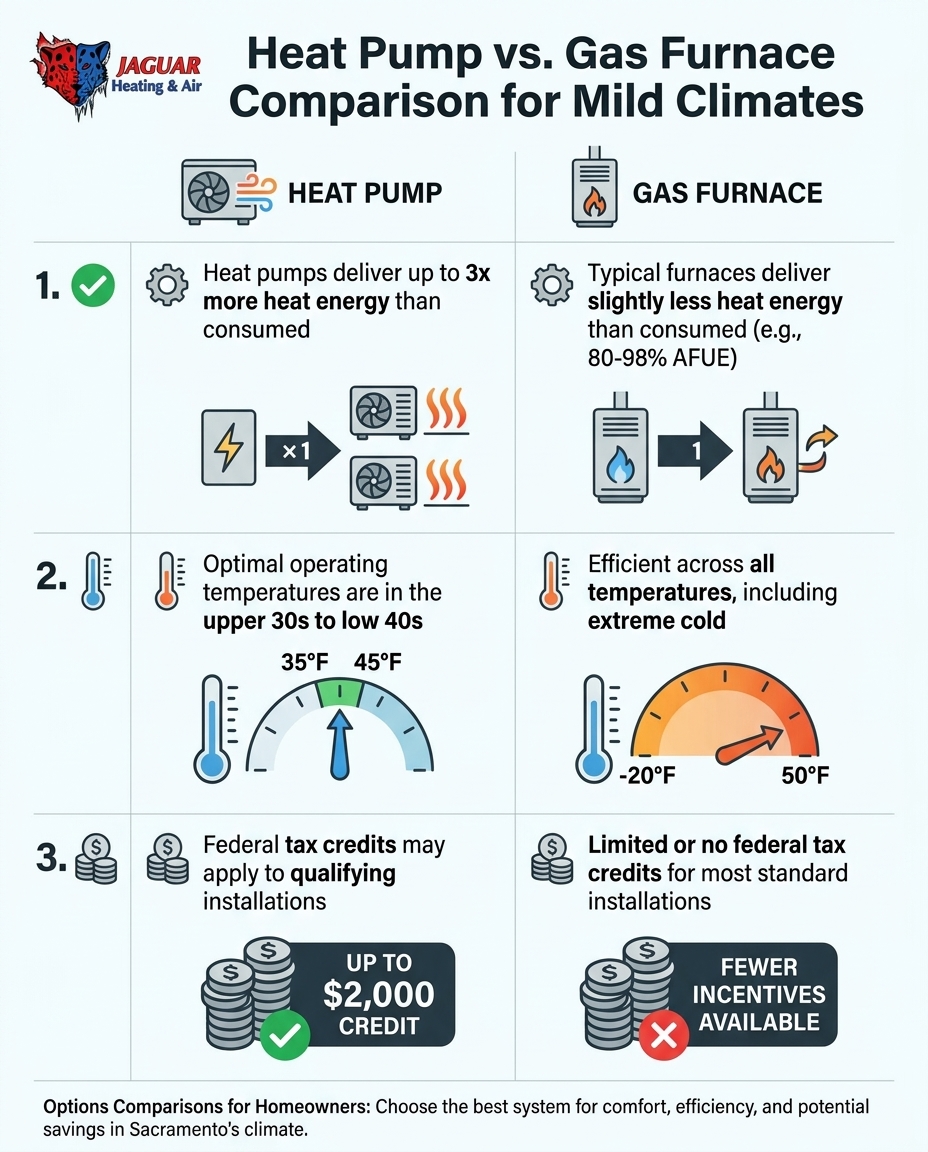
Because they move heat rather than creating it from scratch, heat pumps are incredibly efficient. Under optimal conditions, a modern air-source heat pump can deliver up to three times more heat energy to your home than the electrical energy it consumes to run the compressor and fans. This exceptional efficiency rating makes them a highly attractive option for homeowners looking to reduce their carbon footprint and lower their monthly utility consumption.
The Local Climate Advantage
The standard national debate between furnaces and heat pumps often focuses on freezing temperatures, but the Sacramento Valley climate completely changes the equation. Local winter lows typically range in the upper 30s to low 40s. This temperature bracket is the exact optimal operating range for modern air-source heat pumps. Because our region lacks the sustained, deep freezes seen in the Northeast or Midwest, a heat pump can operate at peak efficiency almost year-round without relying heavily on energy-intensive auxiliary heat strips. This local weather pattern heavily favors heat pump technology, making it the premier choice for regional homeowners.
Evaluating Energy Efficiency and Long-Term Savings
Understanding how efficiency is measured is crucial when comparing your replacement options during a mid-fall or October heating-startup. Gas furnaces and heat pumps use entirely different metrics to grade their performance, which can make direct comparisons confusing without a baseline understanding. Improved energy efficiency translates directly to long-term utility savings over the lifespan of the equipment, offsetting initial installation investments.
Comparing the Metrics
Gas furnaces are measured by Annual Fuel Utilization Efficiency (AFUE). This percentage tells you how much fuel is converted directly into usable heat. A modern high-efficiency furnace might have an AFUE of 95%, meaning 95% of the gas is turned into heat, while 5% escapes as exhaust. Heat pumps, on the other hand, are measured by Heating Seasonal Performance Factor (HSPF) for winter heating and Seasonal Energy Efficiency Ratio (SEER) for summer cooling. Higher numbers indicate better efficiency.
• Gas Furnace — Primary Efficiency Metric: AFUE (Percentage) — How It Works: Measures fuel converted to heat vs. lost exhaust. — Best Application: Homes with existing gas lines and poor insulation.
• Air-Source Heat Pump — Primary Efficiency Metric: HSPF / SEER (Rating) — How It Works: Measures total heating/cooling output over a season divided by electricity used. — Best Application: Mild climates where temperatures rarely stay below freezing.
The financial impact: Transitioning to a high-efficiency heat pump often qualifies homeowners for various financial incentives. Qualifying installations may be eligible for general federal tax credits and local utility incentive programs designed to encourage energy-efficient home upgrades. We strongly advise homeowners to consult with their utility providers or tax professionals to verify current, applicable rebate programs that can make the transition to a heat pump even more accessible.
Environmental Factors and System Resilience
Beyond the mechanics and efficiency ratings, it is important to consider how external environmental factors impact your system's performance. Transitioning to an electric heat pump offers significant environmental benefits by reducing your home's reliance on fossil fuel combustion. As the electrical grid continues to incorporate more renewable energy sources, an electric heat pump becomes progressively greener over its lifespan. However, this transition also changes how you must care for your equipment.
Year-Round Workhorses
Unlike a gas furnace that sits dormant all summer, a heat pump is a year-round workhorse. It handles both your summer cooling and your winter heating. Because it never truly gets an off-season, diligent, biannual maintenance becomes absolutely vital. The system accumulates wear and tear twice as fast as a standalone furnace or air conditioner, making routine inspections non-negotiable for long-term reliability in the Sacramento Valley.
Outdoor Debris and Airflow
Because heat pumps utilize an outdoor condenser unit to absorb ambient heat in the winter, they are highly susceptible to environmental debris. Late-summer and early-fall conditions often leave these outdoor units coated in dust, leaves, and particulate matter. Learning how wildfire ash clogs your AC condenser coils is critical, as that same ash will choke the system's ability to absorb heat once you switch it over to heating mode. Clearing the outdoor unit, washing the coils, and ensuring proper airflow are mandatory steps before the cold weather sets in.
Making an Objective Decision Before the Cold Arrives
Choosing between a traditional gas furnace and a modern heat pump comes down to understanding your specific home, your existing infrastructure, and your long-term goals. Gas furnaces offer traditional reliability and intense, rapid heat delivery, making them a solid choice if your home is already optimized for gas. Heat pumps, conversely, provide unmatched efficiency and environmental benefits, especially given how perfectly our local mild climate supports their operation.
The Value of a Second Opinion
Replacing a system is a major financial decision that should never be rushed during a mid-winter breakdown. This is why a mid-fall or October heating-startup inspection is so valuable. It gives you the time to have a professional thoroughly clean and evaluate your existing system to confirm if a full replacement is truly necessary, or if a targeted repair will suffice for a few more seasons.
Our commitment to honesty: Our thorough, expert inspection process catches minor wear-and-tear before it turns into a major breakdown, ensuring you only replace systems when absolutely necessary. During a recent summer visit, a customer was uncertain if a new air conditioner was actually needed. Instead of simply pushing a replacement estimate, our technician thoroughly cleaned and evaluated the existing unit. We determined no new system was needed, saving the customer significantly. That exact same honest, objective assessment applies to your heating system. We encourage you to schedule comprehensive evaluations, including routine AC maintenance and heating checks, to ensure year-round reliability for all your home comfort systems.
Frequently Asked Questions About Heating Replacements
Is a heat pump better than a gas furnace in mild climates?
Yes, heat pumps are generally considered superior in mild climates because they transfer heat rather than generating it from scratch. This heat transfer process uses significantly less energy than burning fossil fuels. They operate at absolute peak efficiency in regions like the Sacramento Valley that rarely experience sustained deep freezes, delivering exceptional comfort and lower utility consumption year-round.
At what temperature does a heat pump become inefficient?
Modern heat pumps remain highly efficient well down to freezing temperatures. The technology has advanced significantly, allowing them to extract ambient heat even when it feels very cold outside. Efficiency only begins to drop significantly when temperatures stay consistently below 20 to 30 degrees Fahrenheit for extended periods, which is a rarity in our regional climate.
What are my HVAC replacement options if my furnace fails inspection?
Homeowners typically have three main paths when a furnace fails a safety inspection. You can choose a direct gas furnace replacement, transition entirely to an electric air-source heat pump, or install a dual-fuel system that uses both technologies. The best choice depends heavily on your home's existing ductwork, your local climate, and your long-term energy efficiency goals.
How do I know if I need to replace my furnace before winter?
There are several distinct warning signs that indicate your furnace is nearing the end of its life. Signs include the system being over 15 years old, requiring frequent and costly repairs, causing steadily rising energy bills, and providing inconsistent heating from room to room. A professional fall inspection is the most reliable way to determine your system's true health and safety status.
Are there generic utility incentives available for high-efficiency heat pumps?
Yes, many utility companies and federal programs offer incentives for upgrading to modern, energy-efficient heat pumps. These programs are designed to encourage homeowners to reduce their carbon footprint and lower grid demand. Homeowners should always check directly with their local utility provider or a qualified tax professional to verify the current, applicable programs available in their specific area.
Secure Your Home's Comfort for the Coming Season
A clear, objective comparison of your replacement options helps you confidently choose the right technology for your home before the Sacramento Valley winter arrives. Don't wait for a total breakdown to force your hand. Protect your investment and secure your peace of mind by enrolling in an HVAC maintenance membership. Proactive, ongoing care is the best way to evaluate your current system's health and ensure any new equipment runs flawlessly for years to come.
Recent Posts
HVAC Maintenance: Troubleshooting the Fall Heating Startup
Why does your furnace smell like burning on that first chilly morning? Use our home maintenance tips and troubleshooting to know when to call a pro this fall.
HVAC Maintenance: Home Maintenance Tips and Troubleshooting for Fall Heating Startup
Why some systems smell burning during fall startup, and how these home maintenance tips and troubleshooting steps help you decide when to call a professional.
The Fall Seasonal Home Maintenance Checklist: Decoding Heating Startup Smells and Sounds
What that burning dust smell means for your furnace, and how to use this seasonal home maintenance checklist to decide when to call a pro this fall.