.avif)
HVAC Maintenance: Home Maintenance Tips and Troubleshooting for Fall Heating Startup
Why some systems smell burning during fall startup, and how these home maintenance tips and troubleshooting steps help you decide when to call a professional.
Why some systems smell burning during fall startup, and how these home maintenance tips and troubleshooting steps help you decide when to call a professional.

The First Chilly Evening: What to Expect When Starting Your Heater
At Jaguar Heating & Air, we know the scenario well: you flip the thermostat to 'heat' for the first time since last spring, and instead of immediate warmth, you are greeted with an alarming burning smell and strange noises—a stressful moment that makes mastering basic home maintenance tips and troubleshooting incredibly valuable. Our technicians often field calls during this mid-fall heating startup from homeowners wondering if their system is simply waking up from a long hibernation or if a serious mechanical failure is unfolding in the attic or utility closet.
The core decision you face during this initial startup is determining whether these strange symptoms are a harmless seasonal transition or a genuine hazard that requires immediate attention. Understanding this boundary is a foundational part of professional HVAC maintenance in Sacramento. As the heavy summer cooling season ends, the internal components of your climate control system must shift gears entirely. We always tell our customers that this transitional window is actually the ideal time to schedule AC maintenance to close out the cooling season properly while ensuring the heating side of your equipment is fully prepared for the dropping temperatures.
The reality of dual-season demands: Professional system care is not just a summer necessity. The shift into autumn requires the same level of diligence. When you understand what happens inside your furnace or heat pump during that first cycle, you can approach the change of seasons with confidence rather than anxiety.
The Hidden Impact of Summer Heat on Your Heating System
The problem: Many homeowners assume that because their furnace has been turned off since April, it is perfectly rested and ready to perform in October. However, central air and heating systems share several critical internal components. The most significant of these shared parts are the indoor air handler and the main blower motor.
The cause: In our years of providing climate control solutions throughout the Sacramento region, we've seen firsthand how extreme temperature swings take a toll. Going from triple-digit summer heat waves to chilly autumn nights forces these shared components to work overtime. During a long, intensely hot summer, your blower motor may run for hundreds of hours to circulate cold air through your home. This continuous operation degrades capacitors, wears down motor bearings, and stresses electrical relays. By the time you switch your thermostat to heating mode, the blower motor is already fatigued from months of heavy lifting.
The solution: System readiness requires evaluating the entire HVAC ecosystem, not just inspecting the furnace burners in isolation. Undetected summer wear and tear often manifests as a sudden breakdown on the very first chilly night of the year, simply because the weakened components cannot handle the sudden shift in operational demands. Recognizing that your heating system has already been working hard all summer is the first step toward proactive, preventative care.
Normal Startup Symptoms vs. When to Worry
Distinguishing between harmless operational quirks and dangerous mechanical faults is critical for a safe mid-fall heating startup. Knowing exactly what to listen for and what to smell can prevent a minor issue from escalating into a costly repair.
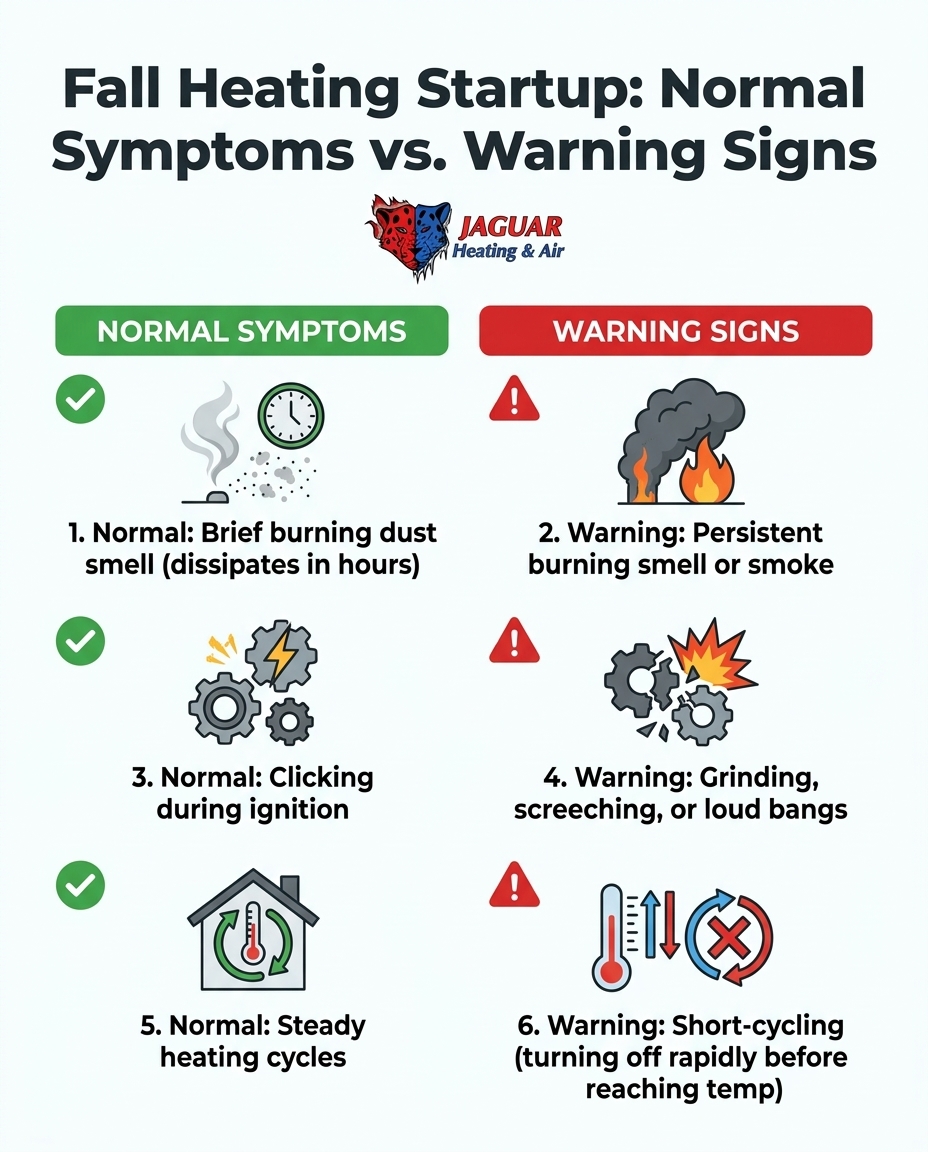
• Odors — Normal Startup Behavior: A faint 'burning dust' smell that dissipates within 1 to 3 hours as settled debris burns off the heat exchanger. — Warning Signs to Call a Pro: A strong electrical burning scent, persistent smoke, or a smell of raw gas that does not fade quickly.
• Sounds — Normal Startup Behavior: Initial clicking as the ignitor engages, followed by the smooth hum of the blower motor spinning up to speed. — Warning Signs to Call a Pro: Harsh grinding, loud screeching, or sudden bangs (delayed ignition) when the system attempts to start.
• Cycles — Normal Startup Behavior: Running for 10-15 minutes at a time to reach the set temperature smoothly and evenly. — Warning Signs to Call a Pro: Rapidly turning on and off every 2-3 minutes without ever warming up the living space.
• Airflow — Normal Startup Behavior: A brief period of cool air pushing out of the vents before the warm air begins to circulate. — Warning Signs to Call a Pro: Weak, barely noticeable airflow or air that remains completely cold after 10 minutes of operation.
Monitoring with technology: You can keep a close eye on these operational patterns by using your smart thermostat efficiently. Many modern thermostats track system run times and can alert you to irregular heating cycles that might indicate a struggling blower motor or a clogged filter.
The golden rule of safety: If a strange smell persists beyond the first day of operation, or if it is ever accompanied by visible smoke or a loud mechanical screech, shut the system down immediately at the thermostat. It is always better to pause operation and verify safety than to force a struggling system to keep running.
Safe Homeowner Troubleshooting Steps Before Calling a Pro: Home Maintenance Tips and Troubleshooting
Before you pick up the phone to request service from our team, there are several foundational checks we always recommend homeowners perform safely. These basic steps resolve a surprising number of startup issues without crossing into dangerous DIY territory. These checks also serve as the perfect complement to routine heating maintenance performed by a certified technician.
1. Inspect and replace the air filter: A dirty, clogged air filter is the leading cause of restricted airflow. When air cannot flow freely over the heat exchanger, the internal temperature of the furnace spikes. This heat buildup can trigger safety sensors, leading to rapid short-cycling and potential long-term damage to the system. Always start the season with a fresh, clean filter.
2. Verify thermostat settings: It sounds overly simple, but verify that the thermostat is actually switched to the 'Heat' setting. Ensure the target temperature is set at least three to five degrees higher than the current ambient room temperature to properly trigger the ignition sequence.
3. Clear the outdoor unit (for heat pumps): If your home utilizes a heat pump rather than a gas furnace, the outdoor condenser needs room to breathe. Clear away fallen autumn leaves, overgrown branches, and any debris that has accumulated around the base of the unit over the summer. The system requires at least two feet of unobstructed clearance on all sides to extract heat efficiently.
4. Check the circuit breakers: Ensure the dedicated breaker for your HVAC system is fully in the 'ON' position. Sometimes, a breaker can trip during a summer storm and go unnoticed until you try to turn the heater on months later.
The Boundary: When to Stop Troubleshooting and Call a Technician
While basic filter changes and thermostat adjustments are perfectly safe, there is a definitive threshold where homeowner troubleshooting must end and professional intervention must begin. Knowing this boundary protects both your safety and your equipment.
Understanding short-cycling: If your heater turns on, runs for a minute or two, and shuts off without reaching the set temperature, this is known as short-cycling. This is rarely a simple glitch. It is usually a symptom of a deeper mechanical issue, such as a failing flame sensor, an overheating blower motor, or a tripped safety limit.
The danger of electrical faults: If your system trips the circuit breaker, you can safely reset it exactly once. If it trips a second time, leave it off. Repeatedly resetting a tripped breaker is highly dangerous. A tripping breaker indicates an electrical dead short, an overworked blower motor pulling too much amperage, or a grounded wire. Forcing the system to restart under these conditions can cause severe electrical damage or fire risks.
Ignition failures: If you hear your furnace clicking repeatedly but it fails to light and produce warm air, the ignition sequence is failing. This could be due to a faulty ignitor, a closed gas valve, or a blocked exhaust flue. Resolving gas and combustion issues requires specialized diagnostic tools and a deep understanding of pressure metrics.
When a system crosses into these complex mechanical failures, it's time to let our licensed experts take over. For example, when a local homeowner requested a routine inspection on their AC unit last spring, our responding technician conducted a thorough and informative evaluation without pushing unnecessary sales. This transparent, diagnostic-first approach provided honest information and total peace of mind—a standard that applies equally to mid-fall heating diagnostics. A professional will evaluate the system safely, explaining the testing results and the root causes clearly.
The Danger of Bypassing Safety Switches
Modern furnaces are equipped with an array of built-in limit switches and safety sensors. These components are specifically designed to shut the entire system down if it begins to overheat, if the blower motor fails, or if exhaust gases fail to vent properly outdoors. Homeowners should never attempt to bypass, wire around, or disable these safety mechanisms. A furnace that shuts itself down is doing exactly what it was engineered to do: protecting your home from a catastrophic failure or carbon monoxide exposure.
Why a Thorough Diagnostic Beats a Basic Filter Change
True preventative care involves significantly more than just swapping out a standard air filter. A comprehensive, safety-focused diagnostic approach evaluates the entire mechanical ecosystem of your home.
A thorough diagnostic removes the guesswork from home comfort. During a recent summer heatwave, one of our customers needed their air conditioner checked for potential leaks. Utilizing our 24-hour service availability, our technician arrived on time and conducted a quick, efficient check that accurately identified the status of the equipment. This same level of rigorous, timely evaluation is exactly what our crew at Jaguar Heating & Air brings to every fall furnace inspection. Our detailed, safety-first inspections contrast sharply with quick, superficial checks that only look at the most obvious components.
What a true diagnostic includes:
• Heat exchanger evaluation: Technicians inspect the metal heat exchanger for microscopic cracks that could allow dangerous combustion gases to leak into the living space.
• Electrical draw testing: Using a multimeter, professionals measure the exact amperage drawn by the blower motor and inducer draft motor to catch failing components before they seize up completely.
• Gas pressure verification: Using a manometer, the technician ensures the gas valve is delivering the precise amount of fuel required for safe, efficient combustion.
• System-wide inspection: A comprehensive rooftop or attic inspection often reveals that a system is mechanically sound, but suffers from disconnected or leaking ductwork. In many cases, minor duct repairs restore full efficiency, saving the homeowner from an unnecessary total system replacement.
Catching minor wear-and-tear early prevents those issues from cascading into a catastrophic mid-winter breakdown. The long-term cost savings of this proactive approach are substantial. To ensure these deep-dive diagnostics happen automatically every season, many homeowners find immense value in enrolling in an HVAC maintenance membership, which guarantees priority service and routine safety evaluations.
Ensure a Safe Transition to Heating Season
Experiencing peace of mind during the first chilly night of the year comes directly from knowing the difference between normal startup behavior and actual mechanical faults. By understanding how your system transitions from cooling to heating, you can identify minor issues before they become major expenses.
Proactive diagnostics save money, extend the lifespan of your equipment, and keep your household safe. If you are ever unsure about your system's performance or safety limits, rely on our expert evaluations rather than guesswork. Applying these home maintenance tips and troubleshooting strategies ensures your heating system will deliver reliable, efficient warmth all winter long.
Frequently Asked Questions
Why does my heater smell like burning dust when I turn it on?
This is a very common occurrence caused by dust and debris settling on the heat exchanger over the long summer months. When the furnace ignites for the first time in autumn, this settled dust burns off rapidly, creating a distinct odor. The smell is generally harmless and should dissipate entirely within one to three hours of continuous operation. If the smell persists for days or smells like burning plastic or electrical wires, shut the system down and call a professional.
What should I check before turning on my furnace for winter?
Start by replacing your indoor air filter, as a clean filter ensures proper airflow and prevents the system from overheating. Next, check the area around your indoor unit to ensure no boxes, laundry, or flammable materials have been stored against it during the summer. Finally, verify that your thermostat is set to 'Heat' and the temperature is set high enough to trigger the system. For heat pumps, clear any fallen leaves or debris away from the outdoor condenser unit.
How do you troubleshoot a furnace that won't ignite?
First, verify that the thermostat has batteries and is properly communicating with the system. Next, check your electrical panel to ensure the dedicated HVAC circuit breaker hasn't tripped. You should also check the furnace power switch (which looks like a standard light switch near the unit) to ensure it wasn't accidentally turned off. If these basic power and thermostat checks do not resolve the issue, the problem likely lies with the ignitor, gas valve, or a safety limit switch, which requires a licensed technician to diagnose safely.
When should I call an HVAC professional for my heater?
You should call a professional anytime your system exhibits signs of a mechanical or electrical failure that goes beyond basic airflow issues. Immediate warning signs include loud grinding or banging noises, persistent burning smells, the system repeatedly tripping the circuit breaker, or the heater turning on and off rapidly without warming the house. Additionally, you should schedule a professional diagnostic annually before the heavy winter weather arrives to ensure the system is operating safely.
Why is my heater turning on and off constantly?
This behavior is known as short-cycling, and it most commonly occurs when the system is overheating due to restricted airflow. A severely clogged air filter is the most frequent culprit, as it traps heat inside the furnace and forces the high-limit safety switch to shut the burners down. If replacing the air filter does not stop the short-cycling, the issue could be a malfunctioning flame sensor, a failing blower motor, or an improperly sized unit, all of which require professional attention.
How do I know if my furnace is safe to use after sitting idle all summer?
The only definitive way to know your furnace is completely safe is through a comprehensive professional inspection. While a smooth startup with normal sounds and a brief dust smell indicates basic functionality, it does not confirm the integrity of the heat exchanger or the safety of the exhaust venting. A licensed technician uses specialized tools to test for carbon monoxide leaks, verify gas pressure, and ensure all internal safety limit switches are functioning correctly before the heavy heating season begins.
Recent Posts
The Fall Seasonal Home Maintenance Checklist: Decoding Heating Startup Smells and Sounds
What that burning dust smell means for your furnace, and how to use this seasonal home maintenance checklist to decide when to call a pro this fall.
Why Does My Heater Smell Like Burning Dust? Common Homeowner Questions Answered & A Fall Guide to AC Repair in Sacramento, CA
Why does your heater smell like burning dust? With common homeowner questions answered, see what we found causes this fall odor and when to call a pro.
Decoding Fall HVAC Startups: Your Guide to Maintenance and AC Repair in Sacramento, CA
Navigating the October Shift: When Sacramento Weather Demands Both Cooling and Heating October in the Central Valley brings a sudden, sharp transition in weathe