Why a Mini Split for a Detached Garage is the Ultimate Pre-Winter Upgrade
Why we recommend a mini split for detached garage heating. See how a ductless system transforms your chilly workspace before winter. Decide with confidence.
Why we recommend a mini split for detached garage heating. See how a ductless system transforms your chilly workspace before winter. Decide with confidence.

Transforming Your Chilly Workspace Before Winter Arrives
If you are tired of stepping into a freezing workshop in mid-November, installing a mini split for detached garage use is the most effective way to reclaim your comfort before winter truly sets in. You step out ready to tackle a weekend project, but the air is biting cold and your tools are practically freezing to the touch. The concrete floor radiates a deep chill, making it impossible to stay out there for more than a few minutes. This is a common frustration for homeowners trying to utilize their extra space during the colder months. When you are tired of abandoning your home gym, hobby room, or workspace just because the temperature drops, you need a permanent, safe solution.
Finding a reliable heating solution is a major decision point for anyone with an outbuilding. While it might be tempting to drag in a dusty space heater or try to tie the garage into your main home's ductwork, those shortcuts often lead to significant safety hazards and wasted energy. Instead, the right approach is to treat your detached space with the same level of care as your living room. A dedicated ductless system provides a foundational, permanent upgrade that transforms how you use the building. For comprehensive guidance on how these systems operate and why they are so effective, exploring professional mini-split services is the best first step. Let's look closely at why this technology is the ultimate pre-winter upgrade for Sacramento detached garages and workshops.
Why You Can't Just Extend Your Home's Central HVAC
When homeowners realize they need heat in a detached building, the first thought is often to look at the main house. If the central furnace is producing warm air right next door, why not simply run a duct extension underground or through a shared wall to heat the garage? The short answer is that doing so violates fundamental building science and creates severe safety risks for your family.
The Danger of Cross-Contamination
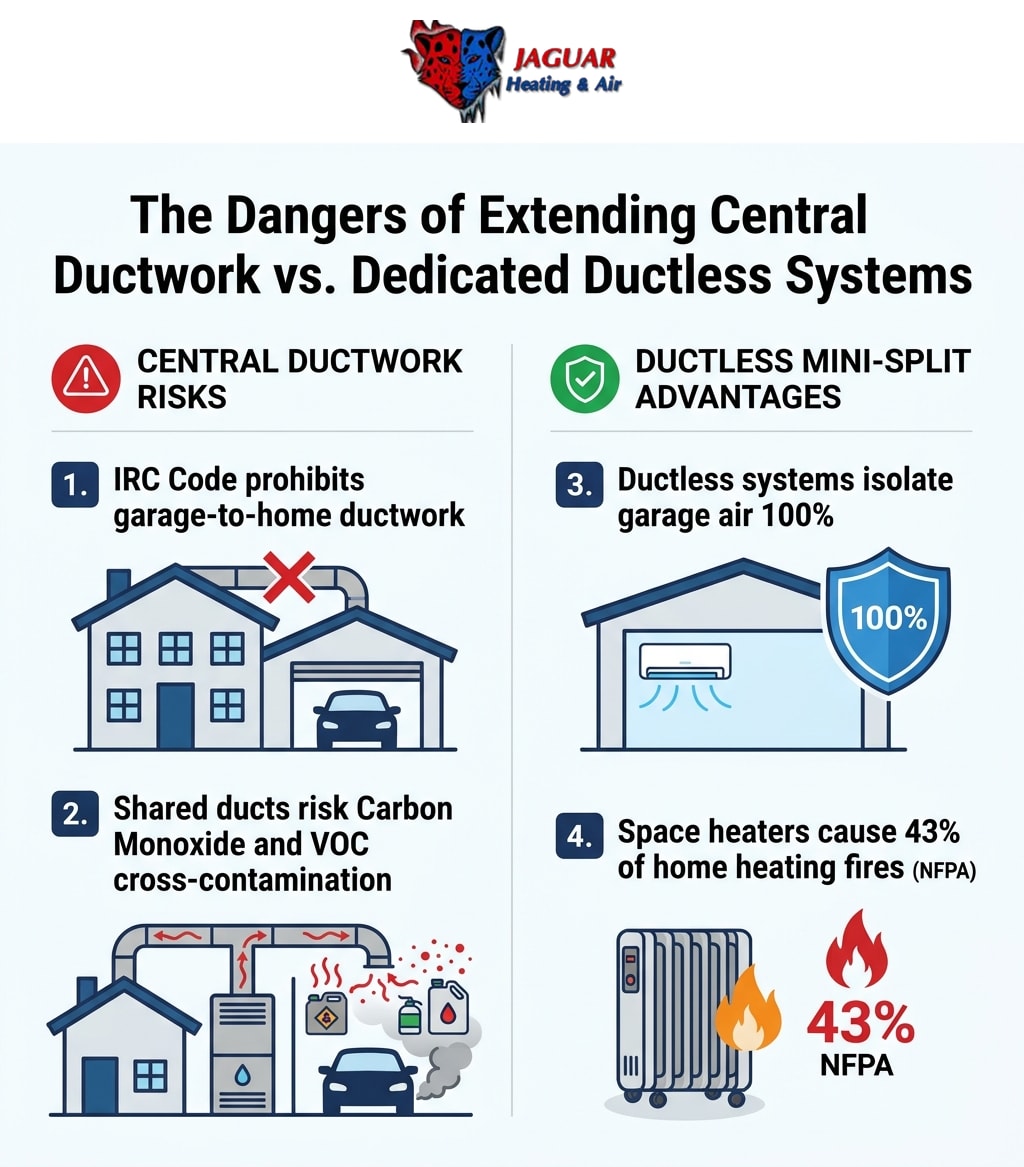
Garages and workshops are fundamentally different from living rooms. They are utilitarian spaces where we store lawnmowers, paint thinners, fertilizers, and vehicles. These items constantly off-gas volatile organic compounds (VOCs) and, in the case of engines, carbon monoxide.
Your central HVAC system relies on a delicate balance of supply and return air. If you extend a duct into a garage, that shared ductwork can easily act as a vacuum. When the system turns on, changes in air pressure can pull toxic fumes, exhaust, and chemical odors from the garage directly into your home's living spaces. Because of this severe life-safety risk, the International Residential Code (IRC) strictly prohibits connecting a garage to a main living space via ductwork. A detached structure requires an independent, isolated air system to keep your home's indoor air quality safe.
Ruining Your Home's Efficiency
Beyond the severe safety hazards, extending your central ductwork will wreak havoc on your HVAC system's performance. Central heating and cooling systems are meticulously sized for the specific square footage, layout, and insulation levels of the main home. They are a closed loop.
• Pressure Imbalances: Adding a long duct run to a garage starves the main house of necessary airflow, throwing off the static pressure of the entire system.
• Short-Cycling: The thermostat in your house controls the system. If the house warms up quickly but the garage is still freezing, the system shuts off, leaving the garage cold.
• Premature Failure: Forcing a blower motor to push air through illegal, extended ductwork causes the equipment to overwork, leading to higher utility bills and early system failure.
Because of these building science realities, it is clear that detached structures require their own dedicated heating source that operates entirely independent of the main house.
The Hidden Hazards of Portable Space Heaters
Once homeowners realize they cannot use their central HVAC system, they often pivot to the most common DIY heating method: the portable space heater. While plugging in a small heater seems like a quick fix to combat late fall and pre-winter damp chills, it is inherently dangerous and highly inefficient for a dedicated workshop or home gym.
According to the National Fire Protection Association (NFPA), portable space heaters are a leading cause of home heating fires. This risk is magnified exponentially in a garage environment. Workshops are frequently filled with combustible materials. Sawdust from woodworking, aerosols from spray paint, and flammable chemicals are often present in the air or on the floor. Introducing a space heater with glowing, red-hot electric elements into this environment is a recipe for disaster. A single stray spark or a heater accidentally knocked over by a power cord can ignite surrounding debris in seconds.
Furthermore, portable heaters are electrically inefficient. A standard plug-in heater draws around 1,500 watts of power. If you have a two-car garage, one small heater will barely take the edge off the cold. If you plug in two or three, you will likely overload the circuit breaker, especially if you try to run a table saw, treadmill, or air compressor at the same time. You end up paying exorbitant amounts in electricity for a space that remains unevenly heated and drafty.
Contrast this hazardous setup with the safety of a permanent, wall-mounted ductless unit. A mini-split keeps all heating elements safely enclosed and mounted high on the wall, far away from floor-level hazards, sawdust, and spills. If you want to understand more about how these modern systems outperform older technology, it is worth exploring when a Mitsubishi system is better than central air for specific, challenging spaces.
Why Proper System Sizing Matters for Uninsulated Spaces
Heating a detached structure is much more complex than heating a standard bedroom. Garages lack the standard residential insulation, vapor barriers, and drywall that keep a house warm. Because of this, proper system sizing is absolutely critical, and it requires professional expertise.
Many homeowners try to use generic online DIY sizing calculators to determine what size mini-split they need. These calculators almost always fail for detached structures because they assume the space has standard residential insulation. A garage with exposed studs, a thin metal door, and an uninsulated concrete slab has a drastically different thermal load than a finished living room.
Sacramento's winter lows routinely dip into the 30s and 40s, creating a pervasive damp chill that easily penetrates uninsulated concrete and exposed framing. If you rely on a generic calculator, you run two major risks:
• Under-sizing the system: If the unit is too small, it will run constantly at maximum capacity trying to overcome the heat loss through the concrete and uninsulated walls. It will never actually reach your target temperature, and the compressor will burn out prematurely.
• Over-sizing the system: If you buy the biggest unit possible "just to be safe," the system will short-cycle. It will blast the room with heat, shut off quickly, and fail to properly circulate the air or dehumidify the space, leaving the garage feeling clammy and uncomfortable.
This is where our first-hand experience becomes vital. At Jaguar Heating & Air, our team frequently sees the aftermath of DIY sizing attempts that fail to account for Sacramento's specific climate extremes. In our years of installing heating systems across the region, we've learned that performing accurate, professional load calculations specifically for uniquely challenging, uninsulated spaces is the only way to guarantee comfort. A professional will measure the exact heat loss of your specific building materials. Before investing in a system, having our experts evaluate your space through a home energy audit ensures you get a unit that is perfectly calibrated for your garage's unique thermal profile.
Year-Round Comfort: Heating and Cooling in One Unit
One of the most significant advantages of choosing a ductless mini-split for your garage is that it is not just a heater. A ductless system is essentially a highly efficient heat pump, meaning it provides comprehensive climate control for all twelve months of the year.
During the winter, the heat pump extracts ambient heat from the outside air, compresses it to raise the temperature, and delivers it inside to banish the late fall and pre-winter damp chills. But when the seasons change, the system uses a reversing valve to switch its operation entirely. In the summer, it absorbs the stifling heat trapped inside your garage and pumps it outside, providing robust, high-performance air conditioning. While your immediate goal might be surviving the winter cold, the system will also easily handle Sacramento's hot, dry summers, making your workshop comfortable even in July.
Another major benefit is the independent temperature control. Unlike a central system that conditions the whole house at once, a ductless unit comes with its own thermostat and remote. You only need to condition the garage when you are actively using it. You can keep the system set to a low maintenance temperature (like 50 degrees) during the week to protect your tools from freezing, and then bump it up to a comfortable 70 degrees right before you head out for a weekend project.
Because heat pump technology is incredibly energy-efficient, upgrading your detached space may also qualify you for general energy efficiency rebates or utility incentive programs. While specific programs fluctuate, installing a high-efficiency unit often comes with financial perks that help offset the initial investment. To learn more about how this dual-function technology operates, you can review the mechanics of heat pump installation.
Preparing Your Garage for a Ductless System
Before the installation day arrives, there are several structural and electrical requirements you should consider to ensure your garage is ready for a new ductless system. Taking a few proactive steps will maximize the efficiency and lifespan of your new equipment.
1. Evaluate Your Electrical Panel: Ductless systems require dedicated electrical circuits. Smaller units designed for single-car garages often run on standard 110V circuits. However, larger units required for two-car workshops or poorly insulated spaces typically require a 220V dedicated circuit. A professional will need to inspect your main electrical panel to ensure it has the capacity to support the new outdoor compressor.
2. Plan the Outdoor Placement: The system consists of an indoor air handler and an outdoor compressor. The outdoor unit needs to be placed on a solid, level surface (like a concrete pad or wall brackets) with plenty of clearance for airflow. It should be situated away from heavy debris or areas where water pools during winter rains.
3. Perform Basic Weatherization: Even the best HVAC system will struggle if the wind is blowing straight through your garage. Take time to install heavy-duty weatherstripping around the main garage door, add a bottom sweep to seal the gap against the concrete, and caulk around any windows or side entry doors. Keeping the cold drafts out will drastically reduce the workload on your new system.
4. Schedule Professional Installation: Installing a mini-split involves handling high-voltage electricity, drilling through exterior walls, and managing pressurized chemical refrigerants. This is not a weekend DIY project. Electrical and refrigerant work requires a licensed professional to protect your equipment warranties, ensure optimal performance, and keep your property safe.
By preparing your space and relying on experts, you guarantee a smooth transition. When you are ready to take the next step, scheduling a professional mini-split installation ensures the job is done right the first time.
Frequently Asked Questions About Garage Heating
Can you put a mini split in an uninsulated garage?
Yes, you can install a mini split in an uninsulated garage, but the system must be meticulously sized by a professional to handle the massive heat loss. Uninsulated spaces require significantly more heating capacity (BTUs) than finished rooms of the same size. Without proper load calculations, the unit will likely run constantly, failing to heat the space while driving up your energy bills.
Why is extending central ductwork to a garage unsafe?
Extending central ductwork to a garage is unsafe because it creates a direct pathway for toxic fumes to enter your home. Garages house vehicle exhaust, carbon monoxide, paint fumes, and chemical off-gassing. If a return duct pulls air from the garage, it will circulate those dangerous airborne toxins directly into your family's living room, which is why building codes strictly prohibit this practice.
Are space heaters safe for a garage workshop?
No, portable space heaters are highly unsafe for garage workshops due to the extreme fire risk. Workshops often contain combustible dust, sawdust, chemical aerosols, and flammable liquids that can easily ignite when exposed to a space heater's glowing electrical elements. A wall-mounted ductless system is much safer because it keeps the heating components elevated and isolated from floor-level hazards.
Does a garage need to be insulated for a mini split?
While a garage does not strictly need to be insulated for a mini split to operate, adding insulation is highly recommended. Insulating the walls, ceiling, and garage door will drastically improve the system's efficiency, reduce your monthly energy consumption, and prevent the unit from overworking. Even basic weatherstripping and door sweeps will make a noticeable difference in performance.
What size mini split do I need for a 2-car detached garage?
The size of the mini split needed for a 2-car detached garage depends entirely on the building's insulation, ceiling height, and local climate extremes. While a well-insulated garage might only need a 12,000 to 18,000 BTU unit, an uninsulated space with a concrete slab in a cold climate could require 24,000 BTUs or more. You must have a licensed HVAC technician perform a formal load calculation to determine the exact size required.
Do I need a 220V electrical panel for a garage mini split?
Whether you need a 220V electrical panel depends on the size and capacity of the mini split you choose. Smaller units (typically 9,000 to 12,000 BTUs) can often run on a standard 110V dedicated circuit. However, larger systems required for multi-car garages or uninsulated workshops almost always require a 220V dedicated circuit to operate safely and efficiently.
Take Control of Your Garage Climate Today
Trying to work in a freezing environment is frustrating, and relying on dangerous space heaters or illegal duct extensions simply isn't worth the risk. A dedicated ductless system provides the safe, efficient, and isolated comfort you need to fully utilize Sacramento detached garages and workshops all year long. November is the critical window to install permanent heating before the peak holiday season and the deepest winter chills arrive. Don't let another winter lock you out of your own space. Reach out to a local HVAC expert today to evaluate your garage, discuss your load calculation needs, and find the perfect system to keep your workspace comfortable and productive.
Recent Posts

Symptoms of a Cracked Heat Exchanger: Why Fall Heating Inspections Are About Safety
Yellow flames or soot can be symptoms of a cracked heat exchanger. See what fall safety inspections reveal and when to call a pro on this winter hazard.

Furnace Heat Exchanger Failure Signs: Why Rust Requires Mandatory Carbon Monoxide Testing
Why we treat rust as a major hazard. See the furnace heat exchanger failure signs that point to carbon monoxide leaks, and when to call a pro for testing.

Furnace Limit Switch Troubleshooting: Why Your System Shuts Off Early
Is your heat shutting off after just a few minutes? Begin your furnace limit switch troubleshooting to find out why it trips and when to call a pro on this.