Preparing Your Furnace for the First Freeze: Why We Always Check the Flame Sensor
Why we always check the flame sensor when preparing furnace for first freeze conditions. See what causes November lockouts and when to call a pro for help.
Why we always check the flame sensor when preparing furnace for first freeze conditions. See what causes November lockouts and when to call a pro for help.

The Hidden Risk Hiding in Your Furnace This November
November is officially here, and if you are preparing furnace for first freeze conditions, you might assume a quick air filter change is all it takes to get your system ready. While the afternoons might still feel mild, the overnight temperatures are about to drop sharply. Over our years of providing dedicated service, the team at Jaguar Heating & Air has seen firsthand how the transition from mild autumn weather to a sudden, biting cold catches many Sacramento homeowners completely off guard. Most people overlook the sensitive internal components that have been sitting idle in the dark all summer long.
To ensure your home is truly ready for the cold, professional heating services go far beyond the basics to address the hidden components that cause unexpected breakdowns.
When that first November freeze hits, heating systems across the region are forced to wake up and work at maximum capacity. This is exactly when a tiny, largely forgotten part—the flame sensor—decides to fail, leaving you shivering in the middle of the night. A proactive, professional inspection is the only reliable way to ensure your heat turns on and stays on when you need it most.
How Your Furnace's Flame Sensor Keeps Your Home Safe
To understand why your heating system might fail on a cold night in the Sacramento Valley, you first need to understand the mechanical safeguards built into the equipment. The flame sensor is a highly sensitive, thin metallic rod located inside the combustion chamber, positioned right directly in the path of the gas burners. Its entire job is to confirm that a fire is actually burning when the gas valve is open.
This is a critical, non-negotiable safety feature. If the gas valve opens and the burners fail to ignite, raw natural gas would quickly fill your furnace cabinet, your ductwork, and eventually your living spaces. To prevent this dangerous buildup, the flame sensor acts as a strict gatekeeper. If it does not detect a flame within a few seconds of the gas valve opening, it immediately shuts the entire system down.
The Ignition Sequence Explained
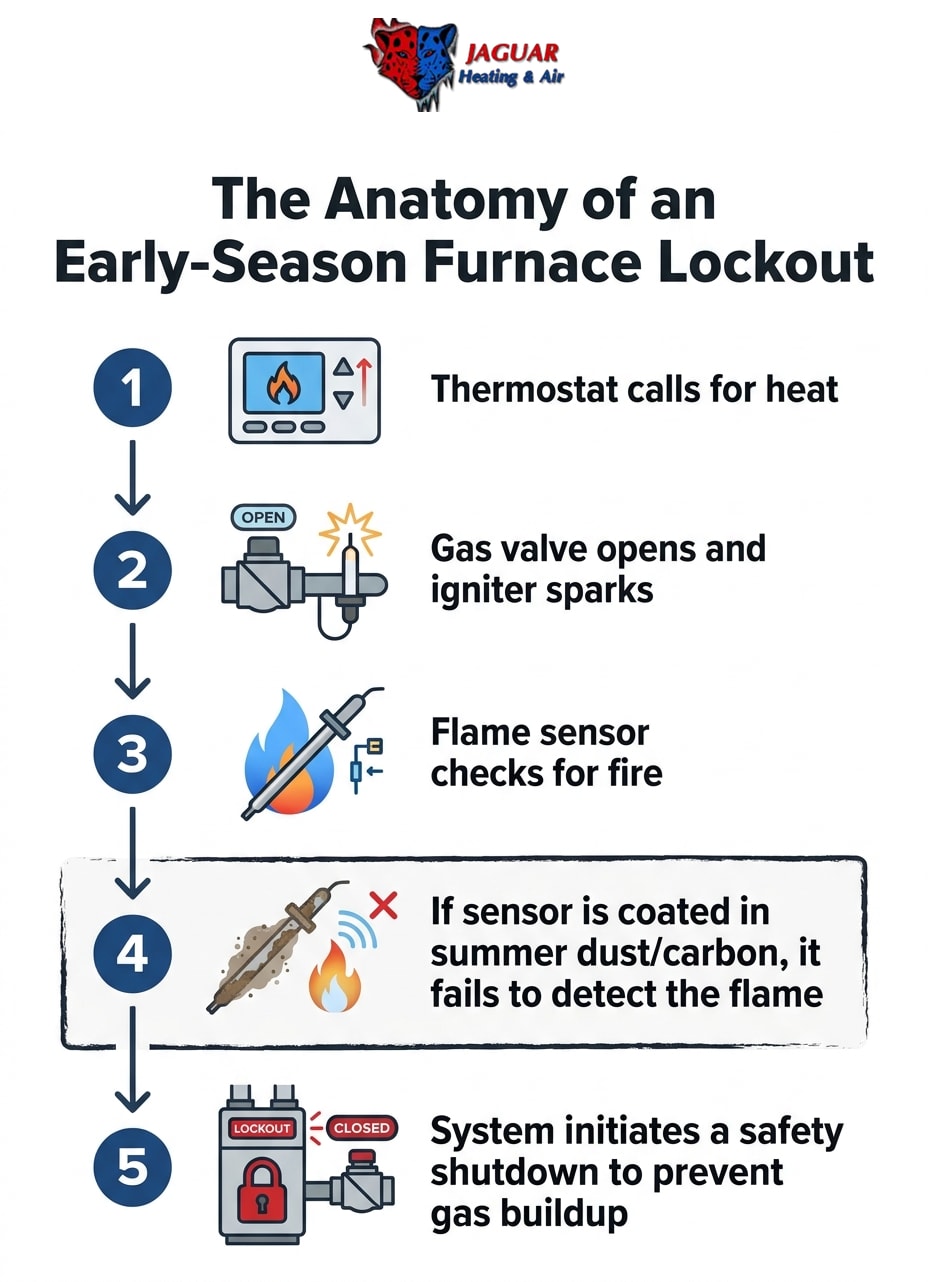
Modern heating systems follow a very specific, step-by-step order of operations to ensure safe combustion. Here is exactly what happens when your house gets cold:
1. The thermostat calls for heat: The temperature in your home drops below your set point, sending an electrical signal to the furnace control board.
2. The draft inducer motor starts: A fan turns on to clear out any lingering exhaust gases from the combustion chamber.
3. The igniter glows or sparks: The electronic ignition system activates, creating the heat source needed to light the fuel.
4. The gas valve opens: Fuel flows into the burners and mixes with the heat source to create a flame.
5. The flame sensor verifies ignition: Within roughly three to four seconds, the sensor must detect the flame and send a microamp electrical signal back to the control board to keep the gas flowing.
Why Summer Inactivity Leads to Early-Season Lockouts
The Problem: You turn your thermostat to "heat" during the first November freeze, the furnace makes a few promising noises, and then it goes completely silent. The house stays cold, and the system refuses to run.
The Cause: Months of inactivity allow environmental contaminants to settle on sensitive internal components. In our experience servicing HVAC systems across the Sacramento Valley, damp late autumns and dense Tule fog can significantly exacerbate moisture and dust accumulation inside garages, attics, and utility closets where furnaces are typically located. Over the summer, this moisture mixes with airborne dust to form a microscopic layer of grime on the flame sensor. When the furnace fires up for the first time, the heat bakes this grime into a hard carbon shell.
This oxidation and carbon coating acts as an electrical insulator. The flame sensor relies on a process called "flame rectification"—it actually uses the conductive properties of the fire itself to complete an electrical circuit. The current it measures is incredibly small, measured in microamps. Even a nearly invisible layer of carbon is enough to block this tiny electrical current. The furnace is technically working and the fire is burning, but the "blinded" sensor doesn't know it, forcing a safety shutdown.
The Solution: Routine heating maintenance before the cold weather permanently sets in. A professional technician will safely remove this insulating layer and verify that the microamp signal is reaching the control board.
Signs Your Heating System is Struggling to Ignite
Identifying a dirty flame sensor before it forces your system into a total shutdown can save you from a freezing night in the Sacramento Valley. Your furnace will usually give you a few warning signs that it is struggling to verify combustion.
Here is what our technicians recommend you look and listen for when you first turn your system on:
• Immediate short-cycling: The furnace turns on, you hear the "whoosh" of the burners lighting, but the flames shut off completely after just three to five seconds.
• Repetitive clicking sounds: You hear the system attempting to spark and ignite multiple times in a row, but you feel no warm air coming from the supply vents.
• Hard lockout mode: After three failed attempts to verify a flame, modern control boards will go into a safety lockout, shutting down completely for an hour or more before trying again.
• Blower fan running cold: Sometimes, the system will keep the blower fan running to clear unburned gas, blowing cold air through your house even though the burners are off.
It is important to differentiate between a combustion safety issue and a standard electrical problem. If you are wondering why your thermostat is blanking out, that usually points to a blown low-voltage fuse or a dead battery, not a flame sensor.
• Burners light for 3 seconds, then turn off — Likely Culprit: Flame Sensor — What the System is Doing: System is protecting the home from unverified gas flow.
• Thermostat screen is completely blank — Likely Culprit: Electrical / Fuse — What the System is Doing: System has lost low-voltage power entirely.
• Furnace runs but air is barely warm — Likely Culprit: Clogged Air Filter — What the System is Doing: System is suffocating from a lack of return airflow.
• System tries to start 3 times, then dies — Likely Culprit: Hard Lockout — What the System is Doing: Control board has disabled the unit for safety.
The Dangers of DIY Flame Sensor Maintenance
When homeowners learn that a dirty sensor is the cause of their heating woes, the temptation to grab a piece of sandpaper and fix it themselves is high. Unfortunately, our repair team frequently sees the costly aftermath of these DIY attempts. Attempting to service combustion components without proper training introduces severe safety risks and can easily destroy expensive equipment right before the first November freeze.
Flame sensors are highly sensitive instruments. Cleaning them with harsh abrasives like standard sandpaper leaves behind microscopic silica dust. When the burners ignite, this silica dust melts into glass, permanently coating the sensor and ruining it entirely. Furthermore, opening the combustion chamber and handling components near the gas manifold poses significant safety hazards. A slight misalignment or a damaged wire can lead to delayed ignition—a dangerous situation where gas pools in the chamber before violently igniting.
DIY attempts can also immediately void your manufacturer warranty. If your system is struggling to stay lit, relying on professional heating repair is the only way to ensure the job is done safely. A recurring dirty sensor can sometimes indicate deeper combustion issues, such as a cracked heat exchanger or improper fuel-to-air mixtures, which a simple cleaning will never fix.
What True Pre-Winter Heating Prep Looks Like
True winter preparation goes far beyond a simple visual check or a generic checklist. When you schedule a professional tune-up with Jaguar Heating & Air in the Sacramento Valley, you are paying for a comprehensive diagnostic evaluation of your home's most critical safety systems.
Our professional, safety-first diagnostic approach means we don't just look at the equipment; we actively test the critical safety switches. A technician will use a specialized multimeter to measure the exact microamp draw of the flame sensor while the furnace is running. If the reading is weak, they know precisely how to clean the rod using specialized, non-abrasive materials that won't leave a glass-forming residue. They will also inspect the heat exchanger for hairline cracks, test the high-limit temperature switches, and verify that the gas pressure is set to factory specifications.
The Value of Proactive System Care
Enrolling in an HVAC maintenance membership transforms how your home handles the changing seasons. The long-term benefits include:
• Fewer emergency breakdowns: Catching a weak flame sensor in October prevents a total loss of heat in late November.
• Peak energy efficiency: Clean burners and properly calibrated gas pressure mean your system uses less fuel to generate the same amount of heat.
• Extended equipment lifespan: Systems that don't have to constantly short-cycle or struggle against safety lockouts endure far less mechanical wear and tear over the years.
Frequently Asked Questions About Winter Furnace Prep
Why is my furnace not kicking on when it gets cold?
The most common reason a furnace fails to kick on during the first cold snap is a tripped safety sensor or a thermostat communication issue. If the system has been sitting idle all summer, dust and moisture can coat the flame sensor, blinding it to the burner's fire. When this happens, the furnace will automatically shut down as a safety precaution. A professional tune-up will identify and resolve these hidden blockages.
What happens if a furnace flame sensor is dirty?
If a furnace flame sensor is dirty, it cannot detect the microamp electrical current created by the burner flames. The control board will assume the fire failed to light and will immediately close the gas valve to prevent a dangerous fuel leak. You will typically hear the furnace ignite for three to five seconds before abruptly shutting off.
How do I prepare my furnace for winter?
Preparing your furnace for winter starts with replacing your air filter and ensuring all household vents are fully open and unobstructed. Once the basic airflow is clear, the most crucial step is scheduling a professional pre-season inspection. A licensed technician will clean the combustion chamber, test the safety switches, and verify that the system is operating efficiently before the first November freeze.
At what temperature should I turn on my furnace?
There is no universal rule, but most homeowners turn on their furnace when indoor temperatures drop below 64 to 68 degrees Fahrenheit. It is highly recommended to test your heating system on a mild autumn day rather than waiting for freezing overnight temperatures. This early test run allows you to catch any sensor or ignition issues before you desperately need the heat.
Why does my furnace shut off after only a few seconds?
A furnace that shuts off after only a few seconds is usually experiencing a phenomenon called short-cycling, most often caused by a dirty flame sensor. Because the sensor cannot verify the presence of a flame, it aborts the heating cycle to keep the home safe. Other potential causes include a severely clogged air filter causing the system to overheat and trip the high-limit switch.
How often should a furnace flame sensor be professionally inspected?
A furnace flame sensor should be professionally inspected and gently cleaned once a year, ideally during your annual autumn tune-up. Because the sensor sits directly in the path of the burner flames, it naturally accumulates carbon buildup over time. Annual professional care ensures it remains sensitive enough to read the flame accurately.
Ensure Your Home Stays Warm When the Cold Arrives
Your flame sensor plays a massive role in ensuring safe, reliable heat for your family. Waiting for the first freezing night in the Sacramento Valley is the absolute worst time to discover that summer dust has compromised your heating system's safety mechanisms. By taking action now, you can avoid the stress of an emergency breakdown.
Don't let a microscopic layer of carbon leave you shivering in the dark. Schedule your comprehensive heating maintenance today, and enjoy the peace of mind that comes with knowing your home is fully prepared for whatever the winter weather brings.
Recent Posts

Furnace Limit Switch Troubleshooting: Why Your System Shuts Off Early
Is your heat shutting off after just a few minutes? Begin your furnace limit switch troubleshooting to find out why it trips and when to call a pro on this.
Signs of Leaky Ductwork in Winter: Why November Heating Bills Spike
Is your November heating bill surprisingly high? Before blaming an aging furnace, look for signs of leaky ductwork in winter. See why we check attics first.
Understanding How Dense Fog Affects Heat Pumps When Valley Tule Fog Rolls In
What happens when heavy moisture triggers defrost mode. See how dense fog affects heat pumps and find out if your steaming unit needs pre-winter service.