Why Does My Furnace Smell Like Burning? An HVAC Maintenance Guide
Is that fall furnace odor dangerous? With common homeowner questions answered on burning smells, you can safely decide when it's dust and when to call a pro.
Is that fall furnace odor dangerous? With common homeowner questions answered on burning smells, you can safely decide when it's dust and when to call a pro.

Is That Burning Smell Normal During Your First Fall Furnace Startup?
Did you just turn on your heater for the first time this season, only to be met with a sudden, alarming burning smell coming from the vents? One of the most common homeowner questions answered by our technicians every autumn is whether this sudden odor means the house is in danger. It is a highly common scenario, especially during a November late-fall startup when temperatures finally drop enough to warrant switching the thermostat from cooling to heating.
The immediate panic homeowners feel when smelling smoke or a burning odor from their vents is completely understandable. Your home is your sanctuary, and fire hazards are a serious concern. However, before you reach for the fire extinguisher or evacuate the house, it helps to understand the mechanics of your heating system. You are facing a critical decision point: determining if the odor is harmless dust burning off the internal components, or if it is a dangerous electrical failure that requires immediate intervention.
In the vast majority of cases, the system simply needs to burn off accumulated debris that has settled inside the unit over the past several months. Providing immediate reassurance is our first step, but ensuring your system is mechanically sound is the ultimate goal. If you are preparing your home for the colder months, securing comprehensive Sacramento HVAC maintenance is the best way to prevent these startling odors before they happen.
The Science Behind the Scent: Valley Dust and Wildfire Ash
To understand why your furnace smells so strongly during its initial ignition, you have to look at what the equipment has been doing for the last half of the year: absolutely nothing. While your air conditioner was working overtime to keep your home cool, the heating side of your HVAC system sat completely dormant inside your walls, attic, or garage.
During this long dormancy, the internal components act like a magnet for airborne particulates. In our specific region, Sacramento Valley dust and late-summer wildfire ash accumulate heavily on dormant furnace components. The air filter catches a lot of this debris, but microscopic particles still make their way through the ductwork and settle directly onto the heat exchanger and the burner assembly. The heat exchanger is a crucial metal shield that separates the combustion process from the air you breathe. When it sits cold for months, it gathers a fine layer of environmental dust.
The problem: A dormant heating system covered in settled particulate matter.
The cause: The first time the thermostat calls for heat, the burners ignite, and the heat exchanger rapidly warms up to hundreds of degrees. This sudden, intense heat incinerates the settled particles instantly.
The solution: Allowing the system to complete its initial cycle while monitoring the odor, then scheduling professional cleaning to prevent heavy buildup in the future.
How Summer Dormancy Affects Your Heating System
The contrast between winter heating stress and summer cooling stress helps contextualize year-round system wear. During the summer, your system is dealing with condensation, high electrical loads, and constant airflow. You likely keep up with routine AC maintenance to manage this stress. However, the heating components suffer from stagnation.
• Particulate settling on internal components: Without the burners firing to keep the heat exchanger clean, dust, pet dander, and ash form an insulating blanket over the metal.
• The impact of poor indoor air quality: If your home experienced heavy wildfire smoke during the late summer, those microscopic ash particles are resting directly on the ignition sensors and burners, making the first startup particularly pungent.
• Lubricant settling: The oils and lubricants in the blower motor can settle during periods of inactivity, meaning the motor has to work slightly harder during its very first run of the season.
The 15 to 30-Minute Rule: When to Wait and When to Worry
Because a burning smell can indicate either a completely normal process or a severe hazard, you need a reliable way to tell the difference. We advise homeowners to follow the 15 to 30-minute rule. This provides clear, time-bound sensory thresholds to guide your decision safely without unnecessary panic.
1. Note the exact time of ignition: As soon as you turn the thermostat to "heat" and hear the furnace kick on, look at the clock. The standard timeline for normal dust burn-off begins immediately.
2. Monitor the smell closely: Do not leave the house or go to sleep. Stay near a central air vent and pay attention to the intensity of the odor. A normal dust burn-off will peak in intensity within the first few minutes and then steadily decline.
3. Ventilate the space: Open a few windows or doors temporarily. This allows fresh air to circulate and helps clear the harmless odors from your living space faster. Turn on ceiling fans to keep the air moving.
4. Enforce the 15 to 30 minutes dissipation time: By the 15-minute mark, the smell should be noticeably fading. By the 30-minute mark, it should be completely gone.
5. Shut the system down if it persists: This is a strict instruction. If the smell is still strong, growing worse, or changing in character after 30 minutes, go straight to your thermostat and switch the system entirely off. A smell that outlasts the 30-minute window is no longer burning dust; it is a mechanical or electrical issue.
Electrical Odors vs. Dust Burn-Off: Identifying the Danger Signs
Not all burning smells are created equal. Your nose is an excellent diagnostic tool if you know what you are sniffing for. Educating yourself on the difference between harmless environmental odors and critical mechanical failures is vital for home safety.
The smell of burning dust is generally described as earthy, dry, or slightly like a faint campfire. It might remind you of the smell of a space heater that has just been plugged in. It is unpleasant, but it does not sting the eyes or smell chemical in nature. On the other hand, dangerous electrical failures produce highly distinct, unnatural odors. These smells indicate potential short circuits, failing blower motors, or compromised wiring.
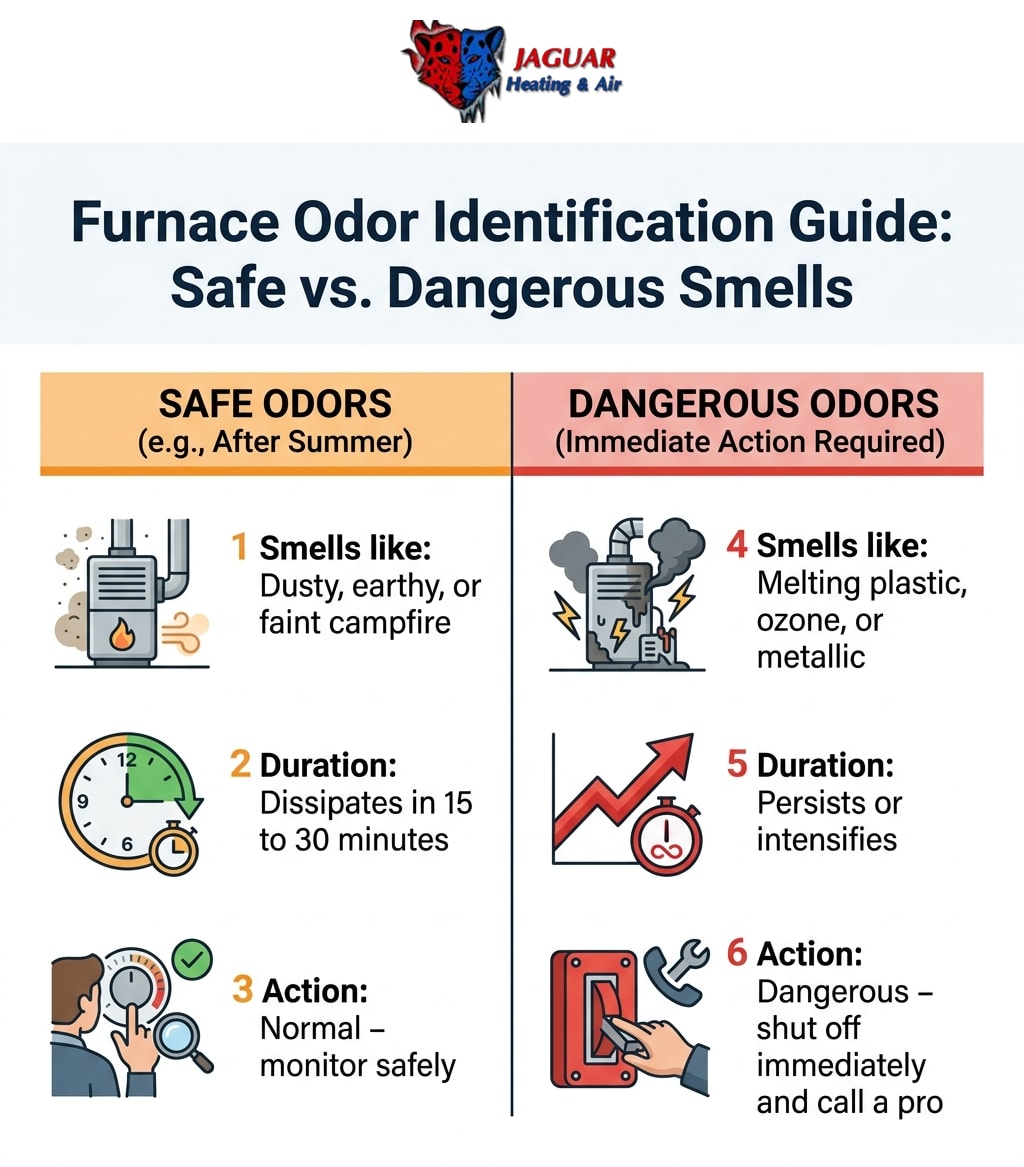
• Dry, earthy, dusty, faint campfire — Likely Source: Accumulated valley dust and ash on the heat exchanger — Severity Level: Low (Normal startup) — Required Action: Monitor for 15 to 30 minutes dissipation time.
• Sharp, fishy, melting plastic — Likely Source: Overheating wire insulation or failing electrical relays — Severity Level: High (Fire hazard) — Required Action: Shut down immediately and call a professional.
• Metallic, hot metal, grinding smell — Likely Source: Failing blower motor bearings or seized fan — Severity Level: High (Mechanical failure) — Required Action: Shut down immediately to prevent motor burnout.
• Ozone (like a lightning storm) — Likely Source: Electrical arcing inside the control board — Severity Level: Critical (Immediate danger) — Required Action: Shut down at the breaker box and call for emergency service.
We often draw parallels to other HVAC components that suffer from electrical fatigue to emphasize the seriousness of these smells. Just as understanding why your AC compressor overheats helps you catch summer breakdowns early, recognizing the smell of a stressed furnace motor helps you prevent winter heating failures.
Signs You Should Shut Off the Furnace Immediately
• Acrid, chemical, or melting plastic odors: These smells never indicate dust. They mean synthetic materials inside the unit are melting.
• Visible smoke coming from the vents: Dust burn-off creates an odor, but it should never create visible smoke in your living room. If you see smoke, shut the unit off at once.
• Smell persisting longer than the normal burn-off window: If you are past the 30-minute mark and the odor is still strong, the system is actively burning something it shouldn't be.
Why Proper Diagnostics Go Beyond a Simple Filter Swap
When a burning smell persists and you make the right call to shut the system down, the next step is bringing in an expert. A persistent burning smell requires much more than just changing a dirty air filter or wiping down the outside of the cabinet. It requires deep, technical troubleshooting to locate the exact source of the heat friction or electrical resistance.
At Jaguar Heating & Air, our safety-first, deeply analytical diagnostic approach means we do not just look at the system; we test its operating parameters. One of the most critical checks is measuring static pressure. Static pressure is essentially the blood pressure of your HVAC system. If the airflow is restricted—perhaps by collapsed ductwork or a failing blower—the heat exchanger cannot release its heat into the home. It overheats, leading to dangerous high-limit trips and persistent burning odors.
Furthermore, our technicians measure amp draws on the blower motor and the inducer motor. An amp draw tells us exactly how much electrical current the motor is pulling to do its job. If a motor is failing, it will pull excessive amperage, causing the internal wiring to overheat and emit that telltale melting plastic smell. Comprehensive electrical integrity checks ensure that no wire harnesses are fraying, no contacts are pitted, and no relays are sticking. This level of technical scrutiny is what prevents future fire hazards during a November late-fall startup.
How Proactive Care Prevents Start-Up Surprises
The best way to handle a burning smell is to prevent it from happening in the first place. This bridges the specific problem of start-up odors to the broader necessity of routine, proactive system care. When you schedule professional maintenance before the cold weather arrives, you eliminate the surprises that cause panic on the first chilly night of the year.
Professional cleaning physically removes the accumulated dust, pet dander, and wildfire ash before the first ignition ever takes place. Beyond just eliminating the smell, a clean heat exchanger and calibrated burners provide massive efficiency benefits. A clean system transfers heat more effectively, meaning your furnace runs for shorter cycles and consumes less energy to warm your home.
Here is what proactive heating system maintenance accomplishes to keep your home safe and odor-free:
• Deep cleaning of the heat exchanger: Technicians remove the insulating layer of dust that causes the initial 15 to 30 minutes dissipation time of burning odors.
• Burner calibration: Ensuring the gas pressure and flame sequence are operating perfectly prevents soot buildup and unburned gas odors.
• Electrical connection tightening: Proactive inspections catch fraying wires, loose terminals, and failing capacitors before they create electrical arcing and ozone smells.
• Motor lubrication and inspection: Checking bearings and moving parts prevents the metallic grinding smells associated with mechanical friction.
• Airflow verification: Confirming that the blower is moving the correct volume of air prevents the system from overheating and shutting down on safety limits.
Frequently Asked Questions About Furnace Odors and Safety
How long does the burning smell last when you turn on the heater?
The standard burn-off period lasts between 15 and 30 minutes. During this time, the accumulated dust on the heat exchanger is safely incinerated. The smell should peak within the first few minutes and steadily fade. If the odor persists beyond 30 minutes, you should shut the system down.
When should I worry about a burning smell from my furnace?
You should worry if the smell changes from a dusty, earthy odor to a sharp, chemical, or metallic smell. Additionally, if the smell lasts longer than 30 minutes, or if you see any visible smoke coming from your vents, it is a sign of a deeper mechanical or electrical issue. In these cases, turn off the unit immediately and contact a professional.
What does an electrical fire in a furnace smell like?
An electrical fire or overheating wire typically smells like melting plastic, burning rubber, or sharp ozone (similar to the smell in the air after a lightning strike). It may also have a distinct "fishy" odor, which is caused by the heat-resistant chemicals in wire insulation breaking down under extreme temperatures.
Is it normal for a furnace to smell like burning plastic?
No, it is never normal for a furnace to smell like burning plastic. While burning dust is a normal part of the first seasonal startup, a plastic smell indicates that synthetic components, wire casings, or electrical relays are actively melting. This is a severe fire hazard that requires immediate shutdown.
Can a dusty furnace catch on fire?
While the thin layer of typical household dust burning off the heat exchanger is not a fire hazard, extreme neglect can be dangerous. If a furnace is heavily clogged with debris, lint, or foreign objects, or if the airflow is severely restricted, the system can overheat. Modern furnaces have safety switches to prevent fires, but relying on safety switches instead of maintenance is risky.
How can I prevent my furnace from smelling when I turn it on?
The most effective prevention method is scheduling a professional tune-up in the early fall. A technician will clean the heat exchanger, vacuum out the burner assembly, and replace the air filter before you ever turn the system on. This removes the fuel source for the odor, ensuring a clean, smell-free startup.
Ensure a Safe Heating Season with Professional Care
Dealing with strange odors from your vents can be unsettling, especially during that crucial November late-fall startup when you just want your home to be warm and comfortable. While brief startup odors from burning dust are completely normal and will fade within a short window, persistent or chemical smells demand expert attention. Your home's safety should never be left to guesswork.
There is immense peace of mind that comes from knowing your heating system is mechanically sound, electrically safe, and operating at peak efficiency. As winter approaches, prioritize the safety and comfort of your household by securing ongoing professional oversight. Explore the benefits of an HVAC maintenance membership to ensure your system is thoroughly inspected, cleaned, and calibrated year after year, giving you the confidence that every time you turn on the heat, your home remains safe and comfortable.
Recent Posts
Navigating Early Winter HVAC Maintenance: A Safety-First Diagnostic Guide
Why your furnace smells like burning dust. Decide when to wait it out versus calling a pro with our home maintenance tips and troubleshooting.
HVAC Maintenance: Troubleshooting the First Late-Fall Heating Cycle
Notice a burning smell during your first fall heating cycle? See our home maintenance tips and troubleshooting to decide when to call a pro.

HVAC Maintenance: Home Maintenance Tips and Troubleshooting Sluggish Heating in Damp Weather
Why your heater struggles on damp fall mornings. Use these home maintenance tips and troubleshooting steps to decide with confidence when to call a pro.