.avif)
Why Your AC Compressor Overheats on September Afternoons
A sudden AC shutdown during late-summer heat is usually a sign of cumulative fatigue, not a death sentence. See how 95°+ days trigger thermal overload and what to do next.
A sudden AC shutdown during late-summer heat is usually a sign of cumulative fatigue, not a death sentence. See how 95°+ days trigger thermal overload and what to do next.

The Breaking Point: When Late-Summer Heat Shuts Down Your System
Late summer in the Valley is finally giving way to early fall, but the lingering heat is exactly why your AC compressor overheats on September afternoons. At Jaguar Heating & Air, we see this exact scenario play out year after year. You rely on your cooling system to keep your home comfortable for months on end, only to have it suddenly shut down just as the season transitions. It is an incredibly frustrating experience. The system has worked relentlessly since May, battling extreme weather, only to fail when the finish line is in sight. If you are dealing with a sudden shutdown, you are likely wondering if this is a minor hiccup or a catastrophic failure requiring a completely new unit.
When 95°+ afternoon temperatures trigger a thermal overload, it forces your system to shut down to protect itself. This built-in safety mechanism is designed to prevent permanent damage to the compressor motor. While a sudden lack of cold air is alarming, our technicians always remind homeowners that this specific type of failure is often a sign of cumulative fatigue rather than a death sentence for the equipment. Understanding what is happening inside the outdoor cabinet is the first step toward resolving the issue.
For homeowners facing this exact scenario, professional AC repair is usually the most effective path forward. Before assuming the worst about your Air Conditioning system, it helps to understand the mechanical reality of why late-season heat pushes equipment past its breaking point, and how targeted maintenance can bring it back online.
Understanding the Thermal Overload Switch
To decode why your system shuts down when you need it most, you have to look at the internal safety mechanisms designed to protect it. The thermal overload switch is a critical component housed inside the compressor. Its sole purpose is to cut power to the motor before it literally melts or sustains permanent, irreversible damage from excessive heat.
Here is how the thermal overload safety mechanism functions during a high-stress event:
1. Continuous Monitoring: The switch constantly monitors both the electrical current being drawn by the motor and the physical temperature of the compressor shell.
2. Threshold Detection: When the system struggles to cool the home, the compressor works harder, drawing more amperage and generating excess internal heat.
3. Safety Activation: If 95°+ afternoon temperatures triggering thermal overload push the internal heat past a safe threshold, the switch automatically breaks the electrical circuit, instantly shutting the compressor off.
4. Cool-Down Period: The switch will not allow the system to turn back on until the internal temperature drops back to a safe baseline, which can take several hours.
It is crucial to understand that a tripped thermal overload switch is a symptom of an underlying stressor, not the root problem itself. The switch is doing exactly what it was engineered to do. Because this mechanism deals with high-voltage electricity and internal motor temperatures, resetting this switch or diagnosing the internal electrical components requires a licensed professional. There is no safe DIY reset button for a thermal overload switch. Attempting to bypass it or force the system to run will almost certainly result in a destroyed compressor.
Four Months of Strain: The Reality of Cumulative Thermal Fatigue
A cooling system does not usually fail out of nowhere. By the time early fall arrives, your equipment has been subjected to months of continuous operation. We call this "cumulative thermal fatigue"—the gradual wear and tear on HVAC components from running non-stop through the brutal summer months.
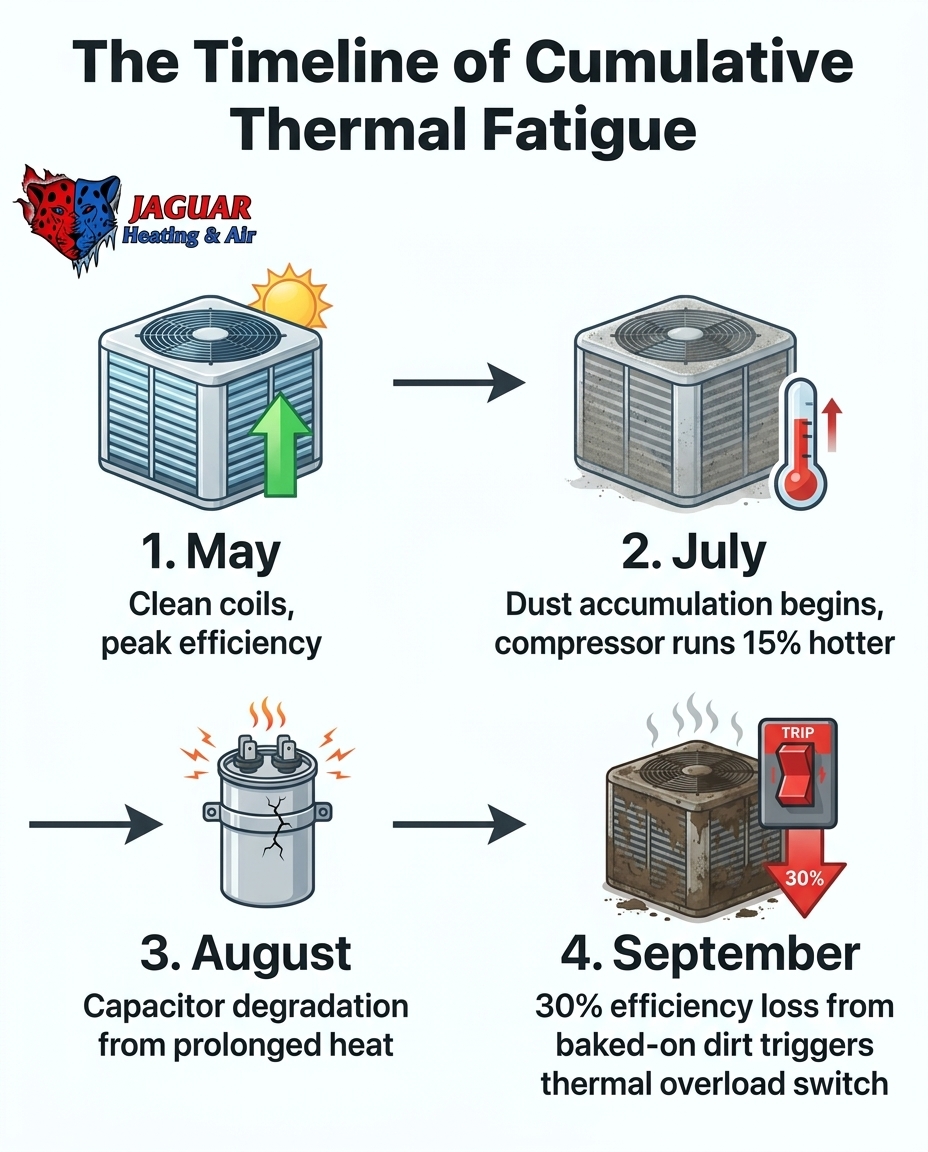
Think about the condition of your system back in May. The coils were likely clean, the electrical components were fresh, and the system could easily reject heat. But in our years of servicing Sacramento homes, we know that our prolonged triple-digit heat waves mean the AC rarely gets a rest day between May and August. This relentless demand accelerates cumulative fatigue. As the system loses efficiency incrementally over the summer, the compressor is forced to run longer cycles. Longer run times mean the compressor generates more of its own internal heat, compounding the stress of the outdoor weather.
The Cycle of Overworking
When the system runs continuously, it enters a vicious cycle of overworking. Longer run times lead to higher internal motor temperatures. Furthermore, when the region experiences warm nights, the lack of nighttime cooling prevents the system from fully resetting its thermal baseline. The compressor starts the next day already warm, making it much easier to overheat by mid-afternoon.
This cumulative fatigue is also responsible for other late-season issues. For example, months of continuous condensation can lead to severe drainage blockages, which is Why Your AC Drain Line Clogs and Floods During High Humidity Spikes. By the time late summer / September in Sacramento rolls around, the entire system is exhausted, heavily soiled, and operating far below its original efficiency rating.
The Primary Culprit: Baked-On Dust and Dirty Condenser Coils
While the ambient temperature plays a significant role in overheating, the most common environmental culprit our team encounters is a heavily soiled condenser coil. The outdoor unit's primary job is to release the heat absorbed from inside your home into the outside air. It does this by blowing air across a series of metal fins and coils filled with hot refrigerant.
The Problem: Sacramento's dry summer climate and regional agricultural dust create a unique, heavy buildup on these coils. Over four months, pollen, dry dirt, and debris are constantly pulled into the outdoor unit by the fan.
The Cause: By late summer / September in Sacramento, this dust bakes onto the coils, acting like a thick insulating blanket. According to the U.S. Department of Energy, dirty condenser coils can reduce a system's cooling efficiency by up to 30%. Because the heat cannot escape through the blanket of dirt, the refrigerant returns to the compressor much hotter than it should be.
The Solution: This 30% reduction directly forces the compressor to work harder, running hotter and hotter until the thermal overload switch trips. Fortunately, this is entirely preventable and fixable. Just recently, the Jaguar Heating & Air team responded to a local homeowner who called for a replacement estimate, convinced their system was dead after a late-summer shutdown. Instead of pushing a massive overhaul, our technician found the coils were simply choked with dirt. We cleaned the AC unit instead of recommending replacement, and no new AC unit was needed. Routine AC maintenance removes this baked-on grime, allowing the system to breathe and reject heat properly once again.
Failing Capacitors: The Hidden Electrical Stressor
Not all overheating issues are caused by dirt and restricted airflow. Often, the root cause of late-season compressor fatigue is a failing electrical component known as a capacitor.
What is a capacitor? Think of the dual run capacitor as a large, heavy-duty battery. When your thermostat calls for cooling, the compressor requires a massive jolt of starting torque to get the heavy internal motor spinning. The capacitor stores electricity and delivers this precise jolt.
The impact of prolonged heat: Capacitors are highly sensitive to prolonged high ambient temperatures. After a brutal summer of continuous use, the internal chemical composition of the capacitor degrades. It slowly loses its ability to hold a full charge.
The "hard start" phenomenon: When a weak capacitor struggles to start the compressor, the motor experiences a "hard start." It pulls excessive electrical current from your home's breaker panel to compensate for the weak capacitor. This massive draw of electrical current generates intense heat inside the motor. If 95°+ afternoon temperatures triggering thermal overload are already stressing the system, a hard start will easily push the internal temperature past the safety limit, shutting the system down.
Replacing a degraded capacitor is a standard, straightforward professional repair for our licensed team. Catching a weak capacitor before it completely fails can save the compressor from permanent electrical damage and restore reliable performance.
Repair vs. Replace: Decoding Your Late-Season Breakdown
When the AC stops blowing cold in September, a homeowner's worst fear is that the entire system needs to be replaced right before the heating season begins. A dead compressor feels like a final death sentence for the unit. However, we consistently remind our clients that a tripped thermal overload switch, dirty condenser coils, or a bad capacitor are fixable maintenance issues, not absolute indicators of a ruined system.
When a Jaguar Heating & Air technician arrives for a late-season diagnostic, they are looking for specific data points to determine the true health of the equipment. They will test the electrical draw of the motors, check the refrigerant levels for leaks, and inspect the coil airflow.
• System shuts off mid-afternoon, turns on at night — Likely Cause: Tripped thermal overload / Dirty coils — Typical Resolution: Professional coil cleaning & airflow check
• Loud humming or clicking at the outdoor unit — Likely Cause: Failing or dead dual run capacitor — Typical Resolution: Professional capacitor replacement
• Compressor draws high amps but won't start — Likely Cause: Internal mechanical failure / Locked rotor — Typical Resolution: Compressor or full system replacement
• Ice forming on the indoor or outdoor coils — Likely Cause: Low refrigerant leak / Clogged air filter — Typical Resolution: Leak search, repair, and filter replacement
During a stretch of triple-digit heat, one Sacramento customer reached out to us when their AC stopped cooling the house entirely. Our responding technician explained the specific underlying problem and repair options clearly. After a targeted fix, the house is now cool again, proving that a hot-weather breakdown doesn't always mandate a replacement. Jaguar Heating & Air brings deep local expertise in accurately diagnosing whether a system has simply succumbed to Sacramento heat fatigue or if it has genuinely reached the end of its lifespan. The worst thing you can do is ignore the problem or try to force the system to run, which easily turns a minor repair into a catastrophic failure.
Breaking the Cycle: Preventing Next Year's September Shutdown
The most effective way to manage late summer / September in Sacramento is to stop cumulative thermal fatigue before it starts. The best defense against a late-season breakdown is starting the season with a clean, fully optimized system.
Routine, professional upkeep is designed to catch degrading capacitors and dirty coils long before they cause an overload. Addressing these issues now, during the early fall transition, not only resolves current cooling problems but also serves as the perfect pre-heating-season tune-up. It prepares your entire HVAC system for the upcoming winter heating demands while ensuring it is ready for next spring. Additionally, if an upgrade is ultimately needed, generic federal tax credits and local utility incentive programs may apply to qualifying high-efficiency heat pump installations, making fall an ideal time to evaluate your options.
Here are the proactive steps we recommend to break the cycle of overheating:
• Schedule an off-season deep clean: Have a professional remove the baked-on agricultural dust from the outdoor condenser coils to restore maximum heat transfer.
• Test electrical components early: Have a technician measure the microfarad readings on your capacitors. Replacing a weak capacitor early prevents a hard start in September.
• Change indoor filters frequently: A clogged indoor filter restricts airflow, forcing the outdoor compressor to work harder and run hotter, while also degrading your indoor air quality. Change filters every 30 to 90 days.
• Ensure proper clearance: Keep shrubs, tall grass, and debris at least two feet away from the outdoor cabinet to guarantee the system has enough airflow to cool itself down.
Joining a structured HVAC maintenance membership is the easiest way to keep your system resilient against extreme weather, ensuring you never have to worry about a sudden shutdown when you need comfort the most.
Frequently Asked Questions About Overheating AC Compressors
Why does my AC compressor shut off on hot afternoons?
Your AC compressor shuts off on hot afternoons because its internal thermal overload switch trips to prevent permanent motor damage. When 95°+ afternoon temperatures triggering thermal overload combine with cumulative wear, the system generates more heat than it can dissipate. This safety feature cuts the power until the internal components cool down to a safe baseline.
What causes an AC compressor thermal overload switch to trip?
A thermal overload switch trips when the compressor motor draws excessive electrical current or reaches a dangerously high physical temperature. This is typically caused by restricted airflow from dirty coils, a failing capacitor that causes a "hard start," or low refrigerant levels. The switch is a symptom of these underlying stressors, not the root problem itself.
Can a dirty coil cause a compressor to overheat?
Yes, a dirty condenser coil is one of the leading causes of compressor overheating. When coils are coated in baked-on dust and dirt, they act like an insulating blanket, preventing the system from releasing heat into the outside air. This forces the compressor to run longer and hotter, eventually triggering a shutdown.
Can a bad capacitor cause an AC to overheat?
Absolutely. A bad capacitor struggles to provide the massive jolt of electricity needed to start the compressor motor. When the capacitor is weak, the motor pulls excessive electrical current from your home's breaker panel to compensate, which generates intense internal heat and rapidly leads to an overheating event.
How long does it take for an overheated AC compressor to cool down?
An overheated AC compressor typically takes anywhere from two to four hours to cool down enough for the thermal overload switch to reset. However, if the root cause—such as a dirty coil or a weak capacitor—is not resolved by a professional, the system will simply overheat and shut down again shortly after turning back on.
Is it normal for my AC to struggle in late September?
While it is common for AC units to show signs of strain in late September due to cumulative thermal fatigue, it is not something you should ignore. Four months of continuous operation take a toll on moving parts and electrical components. If your system is struggling, it is a clear sign that it needs professional maintenance to restore its efficiency and prepare it for the upcoming heating season.
Recent Posts

Fall HVAC Startup Checklist: Diagnosing Burning Smells and System Red Flags
Deciding if that burning dust smell is normal? See why this seasonal home maintenance checklist is critical for catching heating failures before winter hits.

Fall HVAC Maintenance Troubleshooting: Decoding Furnace Startup Smells and Sounds
Is that burning dust smell normal? See what happens inside your system during fall startup and find home maintenance tips and troubleshooting to stay safe.

A Proactive Seasonal Home Maintenance Checklist for HVAC Systems
Why we prioritize October heating inspections. Use this seasonal home maintenance checklist to prevent sudden furnace failures. Schedule your checkup today.