.avif)
Why Your AC Drain Line Clogs and Floods During High Humidity Spikes
Late-August humidity in the Sacramento Valley can overwhelm your cooling system overnight. Spot the early warning signs of a sluggish condensate line before an indoor flood strikes.
Late-August humidity in the Sacramento Valley can overwhelm your cooling system overnight. Spot the early warning signs of a sluggish condensate line before an indoor flood strikes.

The Sudden Threat of Overwhelmed AC Drain Pans in Late Summer
Late August in the Sacramento Valley brings a sudden, heavy shift in the weather, leaving many homeowners wondering exactly why your AC drain line clogs and floods during high humidity spikes. At Jaguar Heating & Air, our team sees this pattern every year as families transition into the back-to-school season. For months, your cooling system has likely handled the dry, scorching heat without a single complaint. The air conditioner runs constantly, but the lack of moisture in the air means the system is primarily focused on lowering the temperature. However, as the season transitions and weather patterns pull in heavy Delta Breeze humidity or monsoonal moisture, the indoor cooling load changes drastically overnight.
If you are already dealing with a sudden ceiling leak or an overflowing indoor unit, professional help for your Air Conditioning system is the safest way to prevent further water damage to your home.
This dramatic shift from bone-dry heat to unexpected mugginess is the exact catalyst for sudden condensate drain failures. Systems that ran perfectly all summer can suddenly overflow, sending water cascading through ceilings or pooling across utility room floors. The concrete problem lies in how your air conditioner handles this sudden influx of airborne moisture. When the humidity spikes, a partially restricted drain line that was functioning "just fine" under a light load is suddenly overwhelmed by gallons of rapid condensation. Recognizing early sluggishness in your system's drainage before a catastrophic ceiling leak occurs is the critical decision point for any homeowner navigating the late-summer heat.
How High Humidity Forces Your AC into Overdrive
To understand why your system suddenly struggles during late-summer August humidity spikes, you first have to look at the secondary function of your air conditioner. While most homeowners think of an AC solely as a machine that pumps cold air into the house, it is actually functioning as a massive, whole-home dehumidifier. In fact, the process of cooling the air inherently removes moisture from it. Warm air holds significantly more water vapor than cold air. When your system pulls warm, muggy air from your hallways and pushes it over the freezing-cold indoor evaporator coil, that moisture condenses into liquid water—just like water droplets forming on the outside of a cold glass of iced tea on a hot afternoon.
During extreme high humidity conditions, a standard residential central air conditioner can extract anywhere from 5 to 20 gallons of water per day from your indoor air. That is an enormous volume of liquid that must be safely managed and routed out of your home. If you have ever wondered whether you need a dehumidifier, observing how much water your AC produces during a muggy week is a great indicator of your indoor moisture levels.
Under normal, healthy operating conditions, this heavy condensation drips off the evaporator coil fins and falls directly into the primary drain pan located beneath the unit. From there, gravity (or a dedicated condensate pump) pulls the water through a PVC condensate drain line, routing it safely to the outside of your home. As long as the pathway remains completely clear, the system can handle almost any amount of water. But when the volume of water spikes exponentially, even the smallest restriction in that pathway becomes a serious threat to your property.
The Silent Threat: How Dry Heat Masks Partial Drain Line Clogs
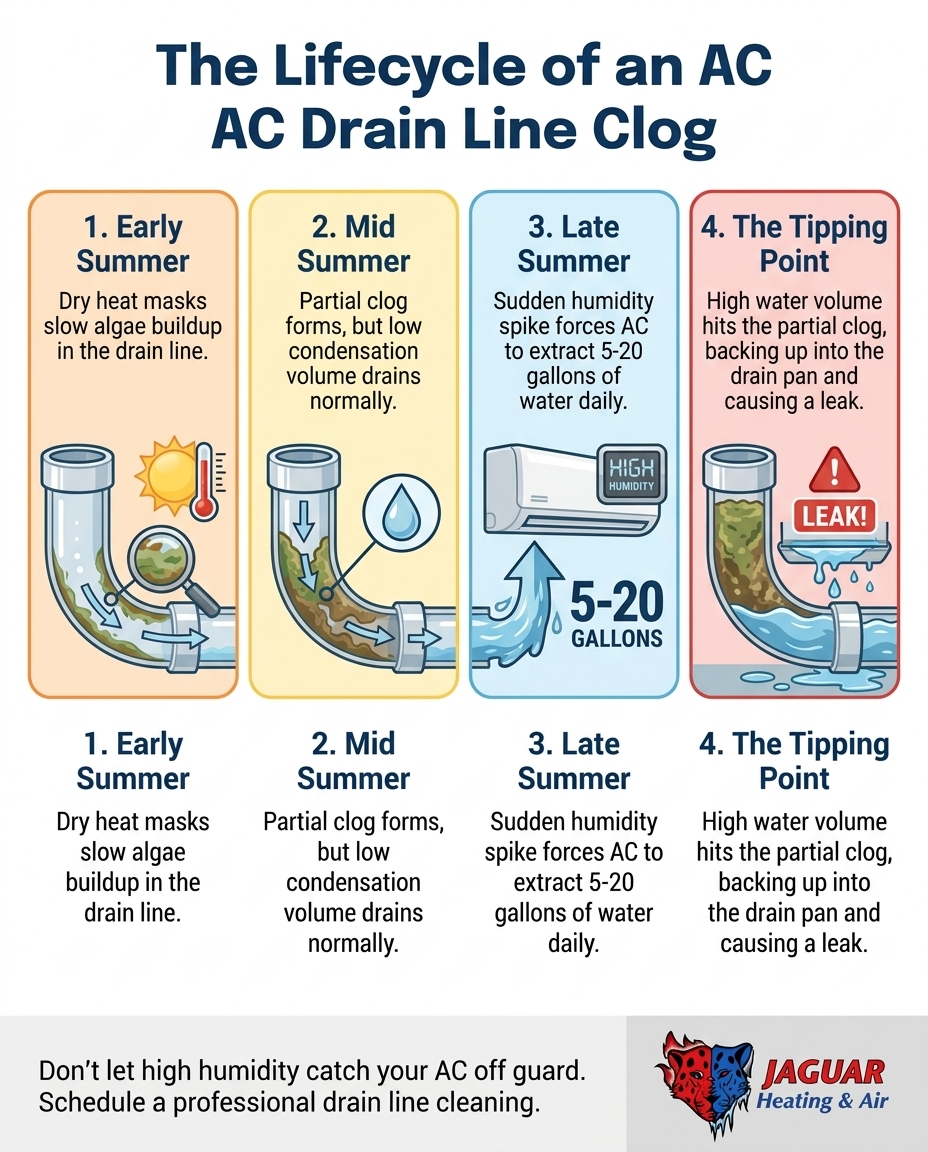
In our years of maintaining air conditioners across the Sacramento Valley, we've found that the most frustrating aspect of late-summer drain line failures is the psychological false sense of security that builds up over the early summer months. June and July are typically characterized by intense, dry heat. Because there is very little moisture in the air during these months, your air conditioner produces a relatively low volume of condensation. The water trickles slowly into the drain pan and makes its way outside without much force.
However, the inside of your AC's condensate drain line is a warm, dark, and damp environment—the absolute perfect breeding ground for algae, mold, mildew, and biological slime. Over the course of the spring and early summer, airborne dust mixes with this biological growth to form a thick, sticky sludge inside the PVC piping. This partial clog forms slowly, coating the inside of the pipe and narrowing the pathway for water to escape.
Because the typical dry heat of early summer produces less condensation, a partially blocked line can still keep up with the low water volume. The slow trickle of water simply sneaks past the sludge. You continue to enjoy a cool home, entirely unaware that your drain line is operating at a fraction of its intended capacity.
• Early Summer — Typical Weather Pattern: Intense, dry heat with very low humidity — Condensation Volume: Low (trickle of water) — Drain Line Status: Algae builds slowly; low water flow bypasses the sludge easily.
• Mid Summer — Typical Weather Pattern: Consistent dry heat, peak temperatures — Condensation Volume: Moderate — Drain Line Status: Partial clog thickens, but drainage remains adequate for the load.
• Late Summer — Typical Weather Pattern: Sudden Delta Breeze or monsoonal moisture — Condensation Volume: Extreme (5 to 20 gallons daily) — Drain Line Status: High water volume hits the restriction; rapid backup and overflow occurs.
This dynamic creates a hidden danger. The dry heat effectively masks the developing problem. By the time the weather shifts and the true test arrives, the drain line is already compromised and completely unprepared for the heavy lifting required during a humidity spike.
The Tipping Point: When Late-Summer Moisture Overwhelms the System
The Problem: The failure of a condensate drain system is rarely a gradual event; it is almost always a sudden, catastrophic spike. When late-summer August humidity spikes suddenly hit the region, the environmental shift forces your air conditioner to pull massive, unprecedented amounts of moisture from the indoor air in a very short period.
The Cause: This exponential increase in condensate volume means the system suddenly has to process gallons of water in a matter of hours. The water rushes off the evaporator coil and into the drain pan, flowing rapidly into the PVC drain line. But when this heavy rush of water hits the thick biological sludge that has been quietly growing all summer, the narrowed pipe simply cannot handle the flow rate. The water hits the partial clog like a brick wall. Because the AC continues to run and extract more moisture, the water has nowhere to go but backward.
The Solution: The water backs up through the pipe, filling the primary drain pan to the brim. Once the pan overflows, the water spills directly into the unit's housing, leaking out into your attic, ceiling, or utility closet. Preventing this tipping point requires proactive professional maintenance before the humidity arrives, ensuring the entire length of the PVC line is completely clear of biological buildup and capable of handling maximum flow rates.
Early Warning Signs Your Condensate System is Struggling
Catching a sluggish drain line before it turns into a major indoor flood requires vigilance, especially when the weather begins to shift in the Sacramento Valley. Your air conditioning system will usually provide a few subtle hints that it is struggling to process moisture. Knowing what to look—and smell—for can save you from severe property damage.
Musty Odors and Diminished Air Quality
• Standing water breeds growth: When water sits stagnant in a poorly draining pan, biological growth accelerates rapidly. This creates a distinct, dirty-sock or musty odor.
• Odors spread quickly: Because the drain pan sits directly in the path of your system's blower motor, these unpleasant smells are quickly distributed through the ductwork and into every room of your house.
• Impact on comfort: If you notice that your home feels clammy or smells damp despite the AC running constantly, it is a strong indicator that moisture is trapped inside the unit. Exploring indoor air quality solutions can help manage these ongoing humidity and odor issues once the primary drain problem is resolved.
Visible Water Near the Indoor Unit
• Checking the base of the air handler: Safely inspect the floor around your indoor unit (whether it is in a closet, garage, or basement) for unexplained pooling water or dark moisture stains on the concrete.
• Noticing unusual dampness: Look for bubbling paint, warped baseboards, or damp drywall directly adjacent to the HVAC closet.
• Listening for dripping sounds: When the unit shuts off, listen closely. A healthy system should not sound like a running faucet or a heavy, continuous drip inside the metal cabinet.
Acting quickly when these signs appear during a heatwave is essential. One local homeowner recently reached out to our Jaguar Heating & Air dispatch for 24-hour service to have their air conditioner checked for leaks after noticing unusual dampness around their unit. Because they acted fast, our technician arrived on time, quickly identified the sluggish drain, and efficiently resolved the issue before any standing water could damage their flooring.
The High Cost of Overflowing Attic Drain Pans
When late-summer August humidity spikes overwhelm a compromised drain line, the location of your indoor unit dictates the severity of the resulting property damage. Systems mounted in the attic are uniquely vulnerable and pose the highest risk to your home's structural integrity. Unlike a basement unit that might simply create a puddle on a concrete floor, an attic unit sits directly above your living space, separated only by a layer of insulation and fragile drywall.
Attic installations are typically equipped with a secondary drain pan (an emergency pan) placed underneath the entire unit. This secondary pan is designed to catch the overflow if the primary drain line inside the cabinet fails. However, if the secondary drain line is also clogged with dust and debris from sitting idle in the attic all year, this emergency pan will quickly fill to the brim.
Once the secondary pan overflows, the progression of damage is rapid and severe. The water spills over the metal lip and immediately begins soaking into the fiberglass or blown-in insulation surrounding the unit. The insulation acts like a giant sponge, holding gallons of water against the top of your ceiling drywall. Eventually, the drywall becomes completely saturated. You may first notice a sudden, spreading brown water stain on your ceiling, or bubbling ceiling paint. In the worst-case scenarios, the sheer weight of the waterlogged insulation and drywall causes a catastrophic structural collapse, sending debris and water crashing down into your hallway or living room.
Why Professional Intervention Beats Risky DIY Fixes
When faced with a sudden AC leak or a backed-up drain pan in the Sacramento Valley, the instinct for many homeowners is to search for a quick, do-it-yourself fix. However, attempting to clear a heavily clogged condensate line without the proper tools and training often makes the situation significantly worse. Professional intervention is the only safe, reliable way to restore your system's drainage and protect your home from further water damage.
The Dangers of Chemical DIY Solutions
A common, yet highly risky, misconception is that pouring harsh chemicals down the condensate line will instantly clear a severe blockage. This approach is fraught with hidden dangers:
• Bleach degrades PVC glue: Pouring undiluted bleach into your drain line can eat away at the chemical cement holding the PVC joints together, leading to permanent leaks inside your walls.
• Vinegar is ineffective on heavy clogs: While vinegar is sometimes used for light maintenance, it is completely ineffective against the thick, dense biological blockages that cause sudden overflows.
• Chemicals do not remove physical debris: Liquid solutions simply flow over or around solid obstructions like dirt, rust flakes, or heavy algae mats, leaving the core blockage entirely intact.
The Value of Proactive System Maintenance
Licensed HVAC professionals do not rely on pouring liquids down a pipe and hoping for the best. Instead, they use specialized, high-powered equipment to physically remove the blockage. Technicians utilize high-suction commercial vacuums at the exterior termination point to pull the clog out, or carefully regulated pressurized air to push the line clear without rupturing the pipes.
Beyond simply clearing the line, a professional will perform a comprehensive inspection of the entire condensate system. They will ensure the primary drain pan isn't cracked or rusted through, verify that the condensate pump (if applicable) is functioning correctly, and treat the pan to prevent future biological growth. In fact, one Sacramento customer recently called our team fearing their overflowing unit meant they needed a total replacement estimate. Instead of pushing a new system, our technician thoroughly cleaned the clogged AC components, restoring full function and proving that great customer service means fixing the root cause.
Investing in routine AC maintenance before the seasonal shift is the best defense. Jaguar Heating & Air provides prompt emergency repair responses to clear these blockages safely, ensuring your home remains protected from costly water damage when the humidity spikes.
Frequently Asked Questions About AC Condensation and Clogs
Can high humidity cause an AC to leak water?
Yes, high humidity drastically increases the amount of condensation your air conditioner produces. When the indoor air is thick with moisture, the system pulls gallons of water out of the air each day. If the drain line has even a partial restriction, this sudden surge in water volume can quickly overwhelm the system, causing the drain pan to back up and leak water into your home.
Why is my AC drain pan suddenly overflowing?
A sudden overflow usually means a biological clog inside the drain line has reached a critical tipping point just as your system was forced to process a high volume of condensation. Over the summer, algae and dust build up slowly inside the pipe. When late-summer August humidity spikes hit, the massive influx of water cannot squeeze past the blockage, forcing it to back up into the drain pan and spill over the edges.
How do I know if my AC drain line is clogged?
The most common signs of a clogged drain line include a musty, damp odor coming from your air vents, visible water pooling around the base of your indoor unit, or unexplained water stains on your ceiling if the unit is in the attic. You might also notice that your air conditioner shuts off unexpectedly, as many modern systems have safety float switches designed to cut power when the drain pan fills with water.
What happens when the AC drain line gets clogged?
When the drain line is completely blocked, the water extracted from your indoor air has no way to exit the home. It will continue to fill the primary drain pan until it overflows. This overflow can severely damage the sensitive electrical components inside the HVAC cabinet, soak surrounding insulation and drywall, and lead to expensive structural repairs and mold remediation if not addressed immediately by a professional.
Does dry heat mask a clogged condensate line?
Yes, dry heat creates a false sense of security because the air conditioner produces very little condensation when humidity is low. A partially clogged line can easily handle a slow trickle of water during dry spells. Homeowners often remain completely unaware of the growing blockage until a sudden shift in weather introduces heavy moisture, turning a hidden partial clog into an immediate overflow emergency.
How quickly can algae build up in an AC drain pan?
Algae and biological slime can begin forming in a matter of weeks, especially during the hottest parts of the summer. The drain pan and condensate line provide a consistently warm, dark, and damp environment, which is ideal for rapid biological growth. Without regular professional maintenance and preventative treatments, this buildup can quickly narrow the drain pipe and set the stage for a late-season backup.
Protect Your Home Before the Next Humidity Wave Hits
Waiting for a brown water stain to spread across your ceiling means the worst of the damage is already done. The key to protecting your home in the Sacramento Valley is recognizing the early warning signs of a sluggish drain line and taking action before the weather shifts. Understanding why your AC drain line clogs and floods during high humidity spikes allows you to stay one step ahead of the changing seasons.
If you notice musty odors, sluggish drainage, or unusual moisture around your indoor unit, do not wait for an emergency to unfold. Call our licensed professionals at Jaguar Heating & Air at the very first sign of trouble. Scheduling a thorough inspection or AC repair in Sacramento will ensure your condensate lines are completely clear, securing your peace of mind and keeping your home dry through the very end of the cooling season.
Recent Posts
Why We Test Your AC's Amp Draw During Late Summer Maintenance
Even if your vents are blowing cold air, months of intense heat can push your compressor to the brink. We measure invisible electrical fatigue to catch stressed parts before a total breakdown.
The Impact of Rodent Damage on Your Attic Ductwork Efficiency
If your cooling system runs constantly but your home stays warm, roof rats may have chewed through your flex ducts. See why a tape patch isn't enough to safely restore your system's airflow.
How Proper Refrigerant Charge Impacts Your Monthly SMUD Bill
Blaming lingering Sacramento heat for high September electricity usage? A minor 10% refrigerant undercharge forces your AC to run drastically longer, quietly multiplying your energy costs.