Understanding How Dense Fog Affects Heat Pumps When Valley Tule Fog Rolls In
What happens when heavy moisture triggers defrost mode. See how dense fog affects heat pumps and find out if your steaming unit needs pre-winter service.
What happens when heavy moisture triggers defrost mode. See how dense fog affects heat pumps and find out if your steaming unit needs pre-winter service.

Is Your Heat Pump Struggling Through the Morning Fog?
You wake up on a cold morning, look out the window into a thick white haze, and notice something alarming: your outdoor HVAC unit is emitting a massive plume of steam and making a loud, unexpected swooshing sound. If you are wondering how dense fog affects heat pumps, you are not alone. This sudden change in equipment behavior is a very common source of anxiety for homeowners living in the Sacramento Valley. The short answer is that your system extracts heat from the outdoor air, making it highly sensitive to specific combinations of moisture and temperature.
Determining whether these frequent, noisy cycles are a normal reaction to the weather or a sign of a failing system is the crucial first step in protecting your home this season. A system that is simply adapting to the environment requires no intervention, but a unit that is genuinely struggling needs professional attention before the temperatures drop further.
For comprehensive heat pump services or localized heat pump maintenance in Sacramento, our team is here to help.
The Unique Environmental Mechanics of Valley Tule Fog
To understand why your heating system behaves differently here than it might in other parts of the country, you have to look at the sky. The Sacramento Valley is geographically shaped like a massive bowl, bordered by the Coast Ranges to the west and the Sierra Nevada to the east. During the late autumn and winter months, this topography creates the perfect storm for a specific weather phenomenon known as Tule fog.
Tule fog typically forms on cold, clear nights immediately following a heavy rainfall. Because cold air is dense, it sinks to the valley floor, trapping the moisture left behind by the rain. This creates a strong temperature inversion layer that locks cold, damp air close to the ground for extended periods—sometimes lasting for days or even weeks without lifting.
Why this matters for your HVAC system:
• Extreme moisture density: Unlike a light coastal marine layer, Tule fog contains a massive volume of suspended liquid water droplets.
• Ground-level concentration: The fog sits exactly at the elevation where your outdoor compressor is installed, forcing the unit to pull thick, wet air through its fins constantly.
• Temperature hovering near freezing: The fog usually forms when ambient temperatures are in the upper 30s to low 40s, which is the exact temperature range that puts the most mechanical stress on outdoor heating equipment.
This specific environmental baseline means your equipment is working in conditions that are vastly different from a dry, freezing night. The sheer volume of water in the air changes how the system breathes, processes air, and manages its own temperature.
How High Atmospheric Moisture Impacts Outdoor Coils
Your heat pump does not burn fuel to create heat; instead, it moves heat from one place to another. Even when it feels freezing outside, there is still thermal energy in the air. To absorb that energy and bring it inside your home, the outdoor coil must become significantly colder than the surrounding outdoor air.
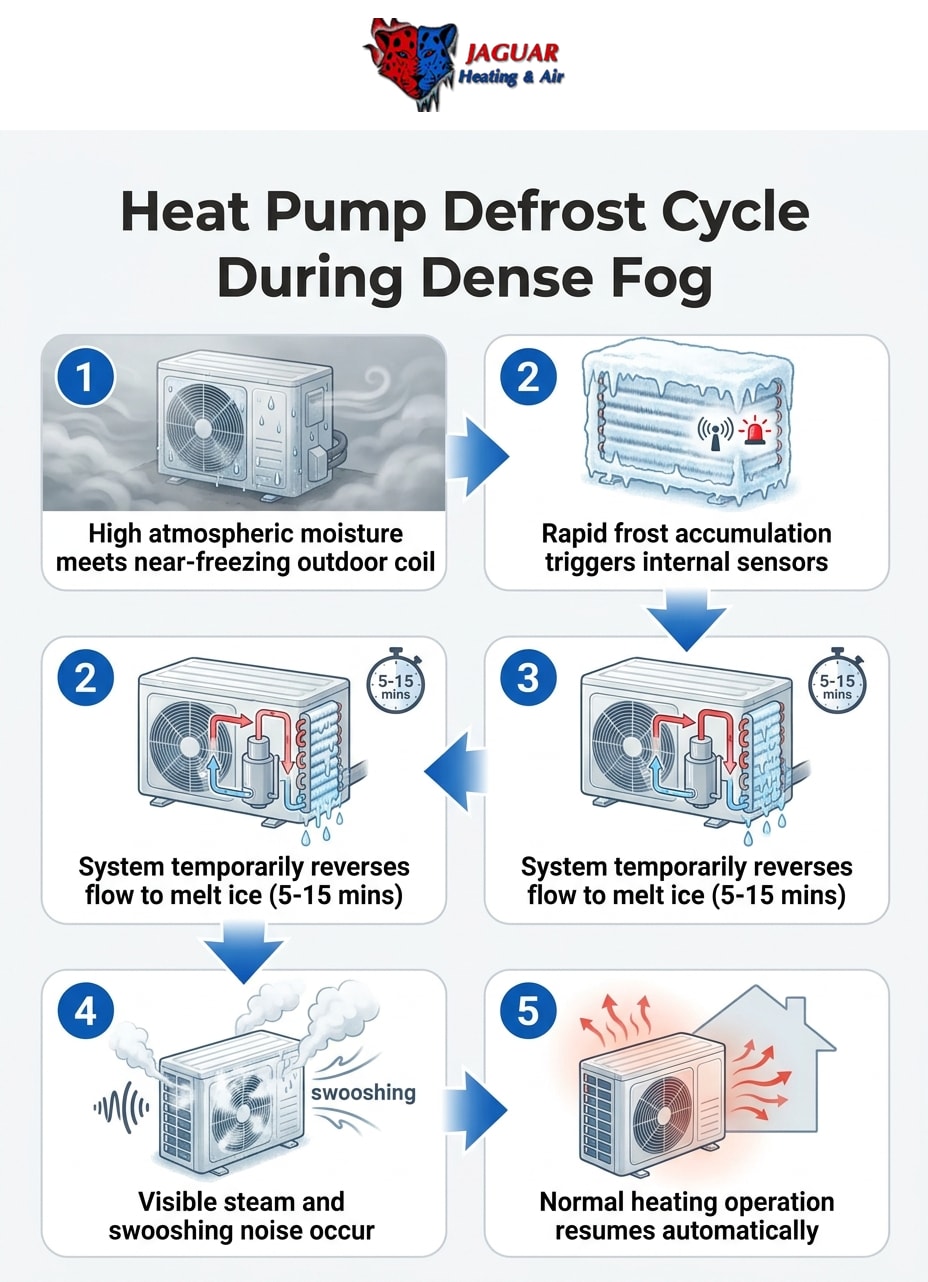
When high atmospheric moisture near freezing temperatures interacts with this ultra-cold equipment, physics takes over. Here is the step-by-step process of what happens inside your unit on a foggy morning:
1. Ambient Heat Absorption: The system pumps sub-freezing liquid refrigerant into the outdoor copper and aluminum coils. The fan pulls the foggy, 38-degree air across these freezing coils to absorb ambient heat.
2. Instant Condensation: Because the fog is already entirely saturated with water, the moisture hits its dew point the exact second it touches the cold metal fins.
3. Rapid Frost Accumulation: Since the coil itself is operating below 32 degrees Fahrenheit, that condensation does not just drip off as water. It instantly freezes into a layer of white frost.
4. Insulation Effect: As the frost builds up, it acts like an insulating blanket over the metal fins. This blocks the air flow and prevents the refrigerant from absorbing any more heat from the outside air.
5. Automated Sensor Activation: Once the system realizes it can no longer pull heat through the ice, internal sensors trigger an automated response to protect the compressor and restore airflow.
This rapid frost accumulation is entirely unavoidable when the air is thick with moisture. The unit is doing exactly what it was designed to do, but the heavy fog forces it to manage ice buildup much faster than it would on a dry winter night.
Decoding the Defrost Cycle: Steam and Strange Noises
When your system gets covered in frost, it initiates a built-in self-preservation sequence called the defrost cycle. This cycle is the source of the strange behaviors that often send homeowners running outside in a panic.
The Swooshing Noise
When the defrost cycle begins, you will often hear a loud "swoosh" or "whoosh" sound. This is the reversing valve shifting inside the unit. The system temporarily reverses its flow, taking the hot, pressurized refrigerant that was heading into your house and sending it back outside into the frozen coil. The noise is simply the sound of high-pressure gas instantly changing direction. While it sounds dramatic, it is a completely normal mechanical function.
The Plume of Steam
As the hot refrigerant floods the outdoor coil, the outdoor fan intentionally shuts off. This prevents cold outside air from cooling the coil down, allowing the metal to heat up rapidly. The frost melts in a matter of minutes. Because the metal is now hot and covered in melting ice water, it releases a large cloud of white vapor into the cold morning air. Homeowners frequently mistake this for electrical smoke, but it is entirely harmless steam.
Indoor Pauses in Heating
Because the system is temporarily sending its heat outside to melt the ice, it cannot heat your home at the same time. You may notice the indoor vents blowing lukewarm or slightly cool air for a few minutes. Most modern thermostats will activate secondary backup heat strips to keep you comfortable during this brief window. If your home struggles to stay warm during these damp weather events, troubleshooting sluggish heating in damp weather often starts with checking how efficiently the system manages these cycles.
Normal Fog Operation vs. A True Heating Emergency
While steam and strange noises are part of the standard defrost process, the high moisture of valley fog can quickly expose underlying mechanical failures. It is important to know the difference between a system that is working hard and a system that is breaking down.
One customer reached out during the spring for what they thought was just an air conditioning issue running low; during the scheduled evening service, our technicians performed multiple tests, replaced necessary parts, and recharged the refrigerant gas, fully restoring the system with a one-year warranty. This exact same level of rigorous diagnostic testing applies directly to your heating system in the winter. If your unit is low on refrigerant, it will freeze up constantly and fail to defrost properly, leading to an emergency.
• Frost Buildup — Normal Fog Operation: A light, even coating of white frost on the outdoor fins. — True Heating Emergency: A solid, thick block of heavy ice encasing the entire unit and fan.
• Cycle Duration — Normal Fog Operation: The defrost mode lasts between 5 and 15 minutes before returning to heat. — True Heating Emergency: The system runs in defrost mode continuously for over 30-40 minutes.
• Steam/Vapor — Normal Fog Operation: White, odorless steam that dissipates quickly into the air. — True Heating Emergency: Dark smoke, or a distinct burning electrical smell coming from the unit.
• Indoor Air — Normal Fog Operation: Brief periods of lukewarm air, followed by a return to warm heating. — True Heating Emergency: The indoor air handler blows cold air continuously for hours.
If you notice any of the red flags in the emergency column, do not wait for the system to correct itself. Forcing a frozen unit to run can crush the aluminum coils or burn out the compressor motor. Timely heating maintenance ensures that your sensors and reversing valves are functioning correctly before a catastrophic breakdown occurs.
Managing Indoor Comfort When Outdoor Humidity Peaks
Extended periods of damp outdoor fog do not just affect your outdoor equipment; they can inadvertently impact your indoor air quality as well. When the valley is blanketed in heavy fog for days at a time, the high outdoor humidity constantly presses against your home's envelope. If your house is poorly sealed, that moisture will find its way inside through drafty windows, unsealed doors, and tiny cracks in the foundation.
Under normal circumstances, a properly functioning HVAC system helps regulate indoor moisture as a natural byproduct of conditioning the air. However, during the late fall and winter Tule fog season (November), your system is spending a significant amount of its time locked in defrost cycles just to keep itself running. When it is constantly fighting outdoor ice, its ability to effectively condition and dehumidify your indoor air is greatly reduced.
This is why addressing indoor air quality is just as important as temperature control during damp seasons. If your windows are constantly fogging up on the inside, or if the air in your home feels clammy and heavy despite the heater running, you are experiencing the secondary effects of the outdoor weather. We highly recommend exploring professional indoor air quality solutions to maintain a healthy, balanced home environment when the outdoors is completely saturated.
Preparing Your System for the Late Fall and Winter Fog Season
Because the Central Valley experiences such a specific type of winter weather, generic national HVAC advice often falls short. Ensuring your system is ready for peak seasonal stress requires deep local expertise. November is the critical window for pre-winter readiness, just as the heavy fog season begins to settle in.
Here is what professionals check during a localized winter tune-up to ensure your system can handle the fog:
• Defrost Control Boards: Technicians verify that the time-temperature control board is accurately reading the outdoor conditions and triggering the defrost cycle at the correct intervals.
• Outdoor Thermostat Sensors: The thermistors that measure coil temperature must be precisely calibrated. If they read too warm, the system will never defrost and will turn into a block of ice.
• Reversing Valve Solenoids: The valve that shifts the refrigerant flow must actuate smoothly. If it sticks, the system gets trapped in the wrong mode.
• Refrigerant Charge: Proper refrigerant levels are vital. A system that is slightly low on charge will run much colder than designed, causing it to freeze up instantly in damp weather.
A strict warning against DIY repairs: Never attempt to check your own refrigerant levels, as handling pressurized gases requires specialized licensing and calibrated gauges. Furthermore, if you see ice on your outdoor unit, never attempt to chip it off with a screwdriver, knife, or ice pick. The aluminum fins and copper tubing are incredibly fragile, and one slip can puncture the coil, destroying the entire unit. Always let the system melt the ice naturally, or call a professional if it fails to do so. Ensuring peak efficiency now can also help you take advantage of generic energy savings and utility programs throughout the winter months.
Frequently Asked Questions About Heat Pumps in Dense Fog
Why is my heat pump steaming in the cold?
It is not smoke; it is harmless steam. This is caused by the system's automatic defrost cycle melting frost off the outdoor coil. When the hot refrigerant hits the icy metal, the rapid temperature change creates water vapor. This is completely normal operation during cold, damp weather and indicates your system is protecting itself.
How does dense fog affect heat pumps?
Dense fog introduces extremely high levels of suspended moisture to the outdoor unit. When this moisture is pulled across the sub-freezing outdoor coils, it freezes rapidly into frost. This forces the system to enter its defrost cycle much more frequently than it would on a dry day, temporarily pausing your indoor heating.
What triggers a heat pump defrost cycle?
Internal sensors detect a drop in coil temperature or a restriction in airflow caused by ice buildup. Time-temperature control boards then initiate the cycle automatically to melt the blockage. The cycle ends when the coil temperature rises enough to indicate that all the ice has successfully melted away.
Is it normal for a heat pump to freeze up in high humidity?
A light, even coating of white frost is completely normal in high humidity. However, a solid block of thick ice encasing the entire unit is not normal. Severe freezing indicates a failing defrost control board, low refrigerant levels, or a bad sensor that requires professional repair.
Can dense Tule fog cause permanent damage to my outdoor unit?
The fog itself will not cause permanent damage if the system is functioning correctly and defrosting as designed. However, if the defrost cycle is broken, the resulting heavy ice buildup can crush the delicate aluminum coils or damage the fan blades. Regular maintenance prevents these secondary damages from occurring.
How long should a heat pump defrost cycle last during foggy weather?
A standard defrost cycle typically lasts between 5 to 15 minutes. The system should automatically return to standard heating mode afterward. If it runs longer than 20 minutes, or cycles constantly without actually heating the home, you should turn the unit off and call a professional.
Secure Your Winter Comfort With Expert Local Diagnostics
Understanding how dense fog affects heat pumps is the key to peace of mind during the winter months. While frequent defrosting, plumes of steam, and loud swooshing noises are normal reactions to heavy valley moisture, a well-maintained system handles this environmental stress much more efficiently. Local experts understand exactly how regional weather impacts your equipment, and we know exactly what to look for before a minor sensor issue turns into a major breakdown.
Do not wait until your unit is encased in solid ice on the coldest morning of the year. Schedule a professional inspection today to ensure your defrost sensors, reversing valves, and refrigerant levels are fully operational, securing reliable, uninterrupted comfort for your home all winter long.
Recent Posts

Why Your Furnace Won't Ignite: The Hidden Causes of Dropped Flames
Waking up cold? If you are wondering why furnace won't ignite, see what triggers sudden safety lockouts and when to call a Sacramento pro for diagnostics.
Why Does My Furnace Smell Like Burning? An HVAC Maintenance Guide
Is that fall furnace odor dangerous? With common homeowner questions answered on burning smells, you can safely decide when it's dust and when to call a pro.
Navigating Early Winter HVAC Maintenance: A Safety-First Diagnostic Guide
Why your furnace smells like burning dust. Decide when to wait it out versus calling a pro with our home maintenance tips and troubleshooting.