.avif)
Decoding Fall HVAC Startups: Your Guide to Maintenance and AC Repair in Sacramento, CA
Navigating the October Shift: When Sacramento Weather Demands Both Cooling and Heating October in the Central Valley brings a sudden, sharp transition in weathe
Navigating the October Shift: When Sacramento Weather Demands Both Cooling and Heating October in the Central Valley brings a sudden, sharp transition in weathe

Navigating the October Shift: When Sacramento Weather Demands Both Cooling and Heating
October in the Central Valley brings a sudden, sharp transition in weather, making a comprehensive seasonal home maintenance checklist critical before evening temperatures plummet. You might be running your cooling system during a warm afternoon, only to realize the house feels freezing by 9:00 p.m. This mid-fall (October) heating startup is a notorious stress test for residential climate control systems. Homeowners frequently experience a wave of anxiety when they switch their thermostats to "heat" for the first time in months, only to be met with strange odors, unsettling noises, or uneven airflow.
The reality of this seasonal shift is that your heating and cooling systems are not entirely separate entities. They share vital internal components, meaning the exhaustion your system suffered during the summer directly impacts its ability to keep you warm in the winter. Before the first frost hits, it is essential to distinguish between harmless seasonal startup symptoms and serious mechanical red flags. By addressing these shared components early, you can secure reliable performance and avoid unexpected breakdowns when you need warmth the most. If you suspect your system is already struggling with this transition, exploring professional air conditioning services is the smartest first step toward total home comfort.
The Shared Component Connection: Most homeowners do not realize that the blower motor pushing chilled air into your living room in July is the exact same motor responsible for distributing heated air in November. When that motor, or the associated air handler, sustains wear and tear from heavy cooling demands, those underlying issues do not simply vanish when you change the thermostat setting. They hibernate—only to surface the moment you demand heating performance.
Understanding this transition requires a proactive approach. Waiting until a freezing night to discover your furnace cannot properly circulate air often leads to uncomfortable delays. By navigating this October shift with a clear understanding of your system's interconnected nature, you can catch lingering summer fatigue before it evolves into a mid-winter heating failure.
The Compounding Toll of Sacramento Summers on Shared HVAC Components
The Sacramento Central Valley is famous for its relentless, dry summer heat, but the toll this climate takes on your home's infrastructure goes far beyond standard wear and tear. Months of heavy, continuous cooling usage place immense strain on shared HVAC components, particularly the blower motor, indoor evaporator coil, and the system's electrical relays. By the time fall arrives, these parts have often been operating at maximum capacity for hundreds of hours.
Environmental stressors unique to our region compound this mechanical fatigue. Sacramento's extreme dry heat kicks up significant amounts of valley dust, while late-summer wildfire ash introduces ultrafine particulate matter into the air. This combination is highly abrasive and severely reduces the lifespan of standard air filters. When filters clog prematurely with ash and dust, the blower motor must work twice as hard to pull air through the system. This restricted airflow causes the motor to run hotter and longer, degrading its internal bearings and straining the electrical capacitors that help it start.
The Hidden Impact of Wildfire Ash:
• Microscopic infiltration: Wildfire ash is much finer than typical household dust, allowing it to bypass cheaper filters and coat the indoor coil.
• Insulating effect: When ash coats internal components, it acts as an unintended insulator, preventing proper heat transfer and forcing the system to run longer cycles.
• Airflow restriction: A clogged filter creates negative pressure, which can actually pull unfiltered air from the attic or crawlspace through tiny gaps in your ductwork.
Fortunately, thorough cleaning and professional attention can often resolve these performance issues without requiring full system replacements. Scheduling routine AC maintenance at the end of the cooling season is a highly effective way to clear out this accumulated debris before it impacts your winter heating. One Sacramento customer recently needed their air conditioning unit and coil replaced after a grueling summer. Instead of just swapping the parts, our team recommended and installed an upgraded unit, driving out of the way to secure the equipment quickly. The system is now working properly for the winter transition, and a follow-up call ensured everything was running smoothly.
Pre-heating season inspections are designed to catch this exact type of lingering summer wear and tear. By addressing the physical accumulation of dust and ash now, you restore the system's baseline efficiency and protect the shared mechanical parts from premature failure during the colder months.
Decoding the First Heating Cycle: Normal Dust Burn-Off vs. Warning Signs
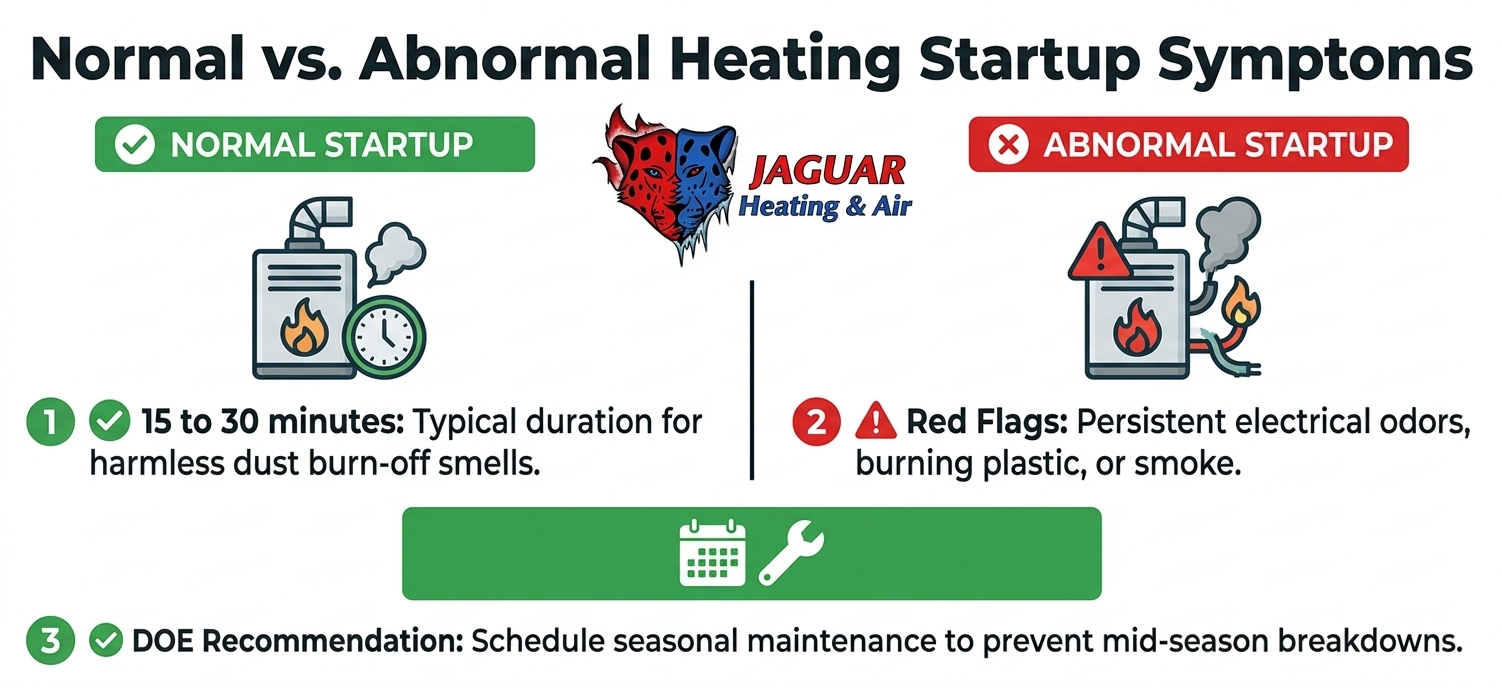
The Problem: You turn on your heating system for the first mid-fall (October) heating startup, and within minutes, a distinct burning smell fills the house. For many homeowners, this triggers immediate alarm and the fear of an electrical fire or a failing furnace.
The Cause: During the long summer months when the furnace sits idle, dust, pet dander, and microscopic debris naturally settle on the heat exchanger and heating elements. When the system fires up for the first time, these components rapidly reach high temperatures, literally incinerating the settled debris. This process is known as "dust burn-off."
The Solution: The science behind this phenomenon dictates a very specific timeline. Normal dust burn-off typically dissipates within 15 to 30 minutes of the first heating cycle. If your home has good ventilation, the odor should fade quickly and not return on subsequent cycles. However, distinguishing between this harmless event and a dangerous mechanical failure requires knowing exactly what to smell for.
• Musty, slightly burnt dust — Likely Cause: Normal accumulation on the heat exchanger burning off. — Required Action: Wait 15-30 minutes. Ensure vents are open.
• Acrid, burning plastic — Likely Cause: Melting wire casings, failing capacitors, or foreign objects in vents. — Required Action: Shut system down immediately. Call a professional.
• Sharp electrical/ozone smell — Likely Cause: Overheating blower motor, failing circuit board, or short circuit. — Required Action: Turn off power at the breaker. Call a professional.
• Rotten eggs (sulfur) — Likely Cause: Natural gas leak near the furnace. — Required Action: Evacuate the home, call the gas company and HVAC tech.
If you experience persistent electrical odors, burning plastic smells, or visible smoke, these are absolute red flags indicating dangerous component failures. In these scenarios, the immediate step is to shut down the system at the thermostat and the breaker panel. Our team prides itself on local expertise in accurately diagnosing heat-fatigued systems. We prioritize precise diagnostics over quick fixes, ensuring that when strange odors occur, we identify the root electrical or mechanical fault rather than just resetting a switch.
The Fall Home Maintenance Checklist: HVAC Edition
A properly executed maintenance routine is the best defense against winter breakdowns in the Sacramento Central Valley. However, it is vital to understand where homeowner responsibilities end and professional requirements begin. The Department of Energy (DOE) heavily recommends seasonal HVAC maintenance to improve efficiency and lower utility costs, but safety must always come first.
Safe DIY Maintenance Steps
There are several highly effective tasks you can perform yourself to prepare your home for the temperature drop. These tasks focus on airflow and exterior clearance:
• Inspect and replace air filters: After a long summer, your filters are likely heavily soiled by valley dust and wildfire ash. Start the heating season with a brand-new, high-quality pleated filter to ensure maximum airflow to the blower motor.
• Clean the perimeter of the outdoor unit: Summer storms and falling autumn leaves often leave debris clustered around the outdoor condenser. Clear a two-foot perimeter around the unit to ensure unrestricted airflow, which is especially important if you utilize a heat pump for winter heating.
• Ensure vents are unblocked: Walk through every room and confirm that supply and return registers are open and unobstructed by furniture, rugs, or drapes. Closing vents in unused rooms actually increases pressure inside the ductwork and strains the system.
• Check thermostat settings: Verify that your programmable thermostat is properly scheduled for fall temperatures, ensuring it isn't fighting itself by switching back to cooling during a mild afternoon.
When to Call a Licensed Professional
While DIY tasks handle the external airflow, the internal mechanics of your system require specialized training. Any work involving electrical panels, refrigerant lines, or internal gas furnace components legally and safely requires a licensed technician. If you encounter issues in these areas, relying on emergency HVAC service is far safer than attempting a dangerous workaround.
• Internal component cleaning: Accessing the heat exchanger or the evaporator coil requires dismantling the cabinet. A professional has the tools to clean these delicate fins without bending or damaging them.
• Safety switch testing: Modern furnaces are equipped with high-limit switches and flame sensors that prevent fires and gas leaks. These must be tested with professional multimeters to ensure they trigger correctly.
• Electrical and gas diagnostics: Checking the amperage draw of a blower motor or measuring the manifold gas pressure of a furnace involves high voltage and combustible materials. Never attempt to adjust these settings yourself.
Routine fall maintenance performed by a professional effectively resets your system, preventing unexpected mid-season breakdowns during the coldest months of the year.
Investigating Strange Sounds: From Blower Motors to Short-Cycling
Beyond unusual smells, strange sounds during a fall startup are the most common indicator of lingering summer wear. When a system sits dormant or transitions between modes, the first few cycles often reveal mechanical weaknesses that developed during the heavy cooling season.
Common Abnormal Noises and Their Meanings:
• Grinding or metal-on-metal scraping: This typically indicates worn bearings in the blower motor. After pushing heavy, cold air all summer, the lubrication in the bearings can dry out, causing severe friction.
• High-pitched squealing: Often points to a slipping or degrading blower belt (in older models) or a failing inducer motor in the furnace.
• Loud booming on startup: A delayed ignition in a gas furnace causes gas to build up before igniting all at once. This is a serious safety hazard that requires immediate professional calibration.
One of the most alarming sounds is when the AC blower motor sounds like a jet engine, which points to severe airflow restriction or a motor that is over-amping and dangerously close to failure. Alternatively, a blower fan that fails to turn on entirely is often a symptom of electrical strain or a worn capacitor that finally gave out after a long summer. A typical pattern we see is blower motor failure at the worst possible time. For example, one local homeowner experienced an AC blower fan failure late on a Friday night during a warm spell. A technician arrived the following morning and had the issue completely resolved within 20 minutes, restoring airflow before the house grew uncomfortable.
Another major symptom is short-cycling—when the system turns on, runs for only a minute or two, and shuts off rapidly. In the fall, this is frequently connected to severe airflow restrictions (like a clogged filter) causing the heat exchanger to overheat and trip the safety limit switch. It can also stem from a malfunctioning thermostat misreading the ambient temperature. Timely repairs are crucial here; allowing a system to short-cycle forces the motors to endure constant stop-and-start electrical surges, which will quickly turn a minor repair into a major component failure.
Why Ignoring Late-Season Cooling Issues Compromises Winter Heating
As October brings cooler evenings to the Sacramento Central Valley, it is incredibly tempting to simply turn off a malfunctioning air conditioner, switch the thermostat to heat, and pretend the cooling problem doesn't exist. Sweeping summer HVAC issues under the rug is a dangerous gamble because of the interconnected nature of the system.
Because the air handler and the blower motor are shared components, a failure in cooling mode will almost certainly persist in heating mode. If your blower motor was struggling to push air in August, it will struggle to push warm air in December. Furthermore, unaddressed issues can cause cascading damage while the system sits idle.
The Danger of Unresolved Summer Damage:
• Refrigerant Leaks: If your AC was freezing up late in the summer due to low refrigerant, the underlying leak is still there. As the system sits, moisture can enter the lines, causing acidic sludge to form that will destroy the compressor when you turn the AC back on in the spring.
• Moisture and Mold: A frozen evaporator coil that thaws improperly can overwhelm the condensate drain pan. If left unaddressed in the fall, this standing water becomes a breeding ground for mold inside your ductwork, which the furnace will then blow throughout your home all winter.
• Electrical Strain: A weak capacitor that was barely starting the blower motor in September will likely fail completely during a cold snap in January, leaving you without any heat.
Resolving all cooling performance issues before officially winterizing the system is the only way to guarantee a seamless transition. If you ignored a struggling condenser or a weak blower fan at the end of summer, scheduling AC repair in Sacramento now will ensure those shared components are fully restored and ready to handle the heavy lifting of winter heating.
Sacramento Homeowner FAQs: Fall HVAC Transitions
What should be on a fall home maintenance checklist?
A complete fall home maintenance checklist should prioritize preparing your home for colder temperatures and increased indoor time. Key items include replacing heavily soiled HVAC air filters, clearing debris from around outdoor heat pumps or AC condensers, and ensuring all indoor vents are unblocked. Additionally, you should test smoke and carbon monoxide detectors, seal drafty windows, and schedule a professional pre-winter furnace inspection.
Why does my heater smell like burning dust when I turn it on?
Your heater smells like burning dust because microscopic debris settles on the internal heating elements during the long summer dormant period. When the furnace ignites for the first time in the fall, these components rapidly heat up, incinerating the accumulated dust and pet dander. This is a normal process known as dust burn-off and is rarely a cause for concern.
How long does the burning smell last when you turn on the heater?
A normal dust burn-off smell should last between 15 to 30 minutes during the first heating cycle of the season. Once the initial layer of settled debris is incinerated, the odor will dissipate and should not return on subsequent cycles. If the smell persists for hours, or if it smells like burning plastic or electricity, shut the system down and call a professional.
When should I schedule fall HVAC maintenance?
You should schedule fall HVAC maintenance in late September or October, just before the first major temperature drop in the Central Valley. Booking this service before you heavily rely on your heating system ensures that any lingering summer wear and tear is addressed early. It also allows you to secure an appointment before technicians are booked solid with mid-winter emergency calls.
How do I prepare my HVAC system for winter?
To prepare your HVAC system for winter, start by replacing the air filter to ensure maximum airflow to the blower motor. Clear any leaves, twigs, or debris away from the outdoor unit to maintain proper ventilation. Finally, have a licensed professional inspect the heat exchanger, test the safety limit switches, and calibrate the thermostat to ensure safe, efficient operation.
How does Sacramento wildfire ash affect my furnace filter?
Sacramento wildfire ash severely reduces the lifespan of standard furnace filters because the particulate matter is much finer and denser than household dust. This ash quickly clogs the filter media, creating a restrictive barrier that forces the blower motor to overwork. Replacing your filter immediately after wildfire season is critical to prevent airflow restriction and overheating during the winter.
Secure Your Comfort Before the Central Valley Winter
Transitioning your home from heavy cooling to reliable heating requires more than just flipping a switch on the thermostat. By addressing startup symptoms early and completing a thorough seasonal home maintenance checklist, you can prevent minor summer wear from turning into a freezing winter emergency. A clear understanding of normal startup quirks versus genuine mechanical red flags brings immense peace of mind. Don't wait until the coldest night of the year to find out if your system is ready—schedule a professional pre-winter inspection today to ensure your home remains safe, efficient, and perfectly comfortable all season long.
Recent Posts
Decoding the October Heating Startup: AC Repair and Fall Maintenance in Sacramento, CA
Burning dust smells on the first chilly night? Use this seasonal home maintenance checklist to see what is normal and when to call a pro on this startup.
Why Your Thermostat Blanking Out Might Just Be a Blown Low-Voltage Fuse
A completely dead thermostat screen right as fall begins often triggers panic. See why a blown 3-amp low-voltage fuse is actually protecting your furnace control board.
How to Tell If Your AC Contactor is Pitted and Failing
After thousands of high-load cycles this summer, your AC's electrical components are exhausted. Catching a failing contactor early prevents a catastrophic compressor breakdown this fall.