.avif)
Why Your Furnace Smells Like Burning Dust: Essential HVAC Maintenance Questions Answered
Smelling burning dust this fall? Have common homeowner questions answered about your furnace. Decide with confidence on when to call a pro before winter.
Smelling burning dust this fall? Have common homeowner questions answered about your furnace. Decide with confidence on when to call a pro before winter.

The Sudden Burning Scent During Your First Fall Startup
Have you recently turned on your heater for the very first time this season, only to be met with a strong, alarming odor spreading through your vents? If you are searching to have common homeowner questions answered about that distinctive burning smell, you are certainly not alone. It is a chilly evening, you switch the thermostat to heat, and suddenly the entire house smells like something is on fire. At Jaguar Heating & Air, our team fields dozens of calls every October from homeowners who freeze at this exact decision point: do you keep running the system and hope the smell fades, or do you shut it down immediately to prevent a potential disaster?
Booking professional HVAC maintenance in Sacramento is the best way to ensure your system is safe and ready for the cooler months ahead.
The anxiety during an October first-heating startup is completely understandable. However, knowing what causes this scent is the first step toward safe, efficient home heating. Proper seasonal care eliminates this guesswork entirely, preparing the internal components so that your first cozy night indoors stays comfortable and stress-free. Let's break down exactly what our technicians see happening inside your unit and how to determine if the situation requires urgent professional attention.
How the Sacramento Valley Climate Impacts Your Heating System
To understand why your furnace smells so strongly right now, we have to look at the unique environment it operates in. Having serviced Sacramento Valley homes for years, our technicians know firsthand how the long, intensely dry summers impact local HVAC systems. From May through late September, the extreme heat and lack of moisture allow airborne dust, pollen, and dry particulate matter to circulate heavily through the air. While your heating system sits entirely dormant during these hot months, that dry dust is steadily settling directly onto the internal heat exchanger and the burners.
In more humid climates, moisture in the air can sometimes weigh dust down or cause it to clump differently. But here in our dry regional conditions, a pattern we see often is that the dust remains light, loose, and highly combustible. When you finally call for heat as the chilly winter nights arrive, the initial fall burn-off is significantly more noticeable. This environmental reality makes proactive care essential rather than optional. The dust does not just disappear on its own; it waits patiently for that first spark of the season.
The Anatomy of Dust Accumulation
You might be wondering how so much debris gets inside the unit if you change your air filters regularly. The truth is, standard filters are fantastic at catching larger particles while the system is actively running, but they cannot stop microscopic dust from settling during a long off-season.
• Bypassing the standard filter: When the system is off, ambient air still moves through the ductwork naturally, carrying tiny particles that settle on stationary components deep inside the cabinet.
• Vulnerable internal components: The heat exchanger, burner ribbons, and the ignition assembly are prime real estate for this dust to collect undisturbed over several months.
• The initial ignition process: The moment your thermostat triggers the heating cycle, the burners ignite. The settled debris is instantly incinerated by the sudden burst of high heat, sending that unmistakable burnt-dust odor straight through your supply vents.
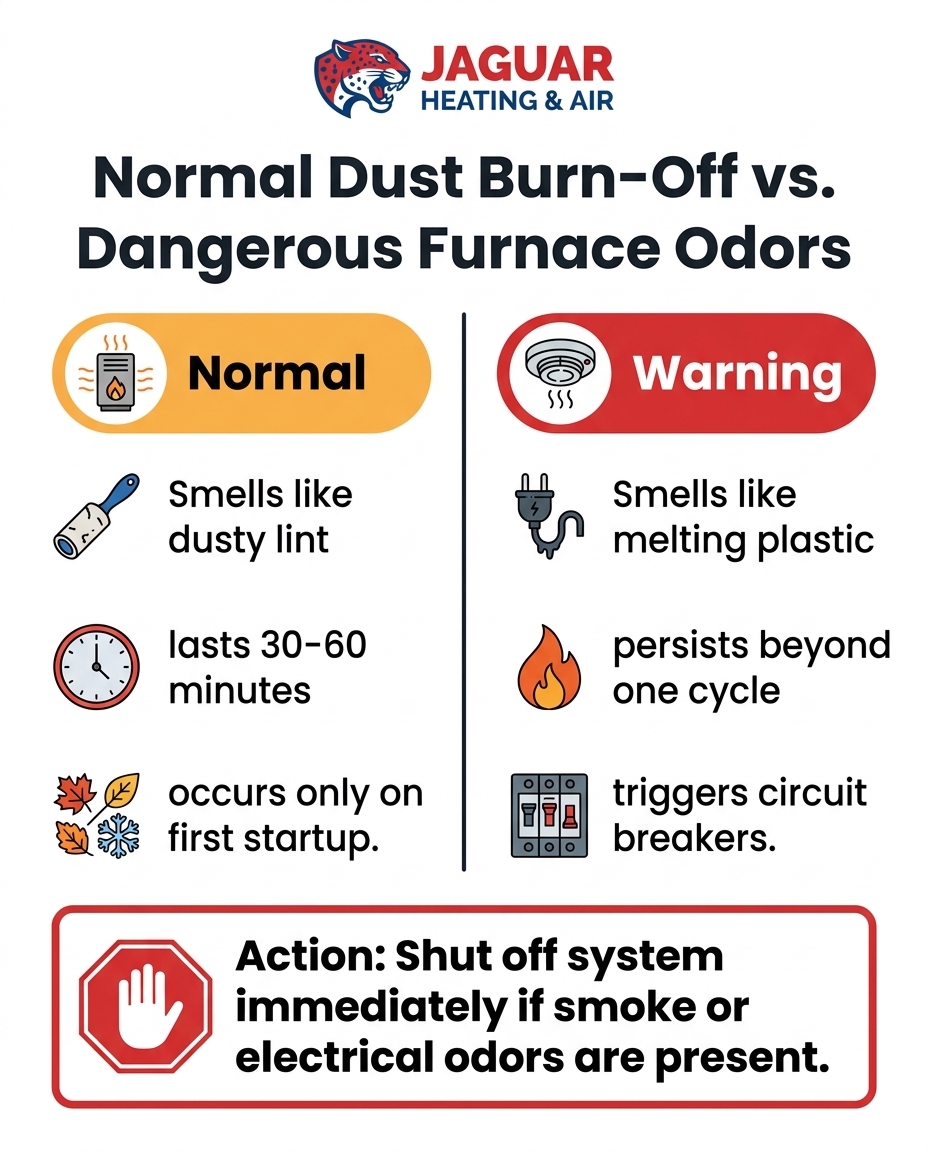
Normal Dust Burn-Off vs. Warning Signs of Electrical Failure
In our experience, not all burning smells are created equal. Knowing how to differentiate between a harmless, temporary odor and a dangerous mechanical or electrical issue can save your equipment and protect your home. During an October first-heating startup, a brief dusty scent is expected if the unit has not been professionally cleaned. However, other specific odors indicate a critical failure that requires immediate intervention.
• Odor Profile — Normal Dust Burn-Off: Smells like scorched lint, dry dust, or an overheated hair dryer. — Electrical / Mechanical Warning: Smells like melting plastic, burning rubber, fish, or harsh ozone.
• Duration — Normal Dust Burn-Off: Dissipates completely within 30 to 60 minutes of the first cycle. — Electrical / Mechanical Warning: Persists for hours, gets continually stronger, or returns every time the unit runs.
• Visual Cues — Normal Dust Burn-Off: No visible smoke or haze anywhere in the home. — Electrical / Mechanical Warning: Visible smoke or a thin haze coming from vents or the unit itself.
• System Behavior — Normal Dust Burn-Off: System runs smoothly, sounds normal, and reaches the set temperature. — Electrical / Mechanical Warning: System short-cycles, trips the circuit breaker, or shuts down prematurely.
When to Turn Off the Unit Immediately
If you notice anything in the warning column of the chart above, you must take immediate action. Do not wait to see if the smell goes away on its own.
• Identifying dangerous smells: An ozone or electrical fire smell means wires are actively melting or a motor is burning out. This is a severe fire hazard that requires the system to be powered down.
• Noticing smoke from vents: If you see smoke coming from the supply registers, shut the system down at the thermostat immediately and call an emergency technician.
• Circuit breaker issues: Hearing persistent tripping of the circuit breaker alongside an acrid odor means the system is drawing too much power due to a dangerous short circuit.
A comprehensive pre-season inspection clears this settled dust manually. When a technician cleans the heat exchanger before you ever turn the heat on, you prevent the stressful burning smell entirely.
Listening for Trouble: When Strange Noises Accompany the Odor
Our technicians frequently find that a burning smell is not the only symptom your system exhibits during its first run of the season. If you hear unusual sounds alongside the odor, it usually indicates a deeper mechanical strain. Most homeowners do not realize that the blower motor inside your HVAC system is shared between both the cooling and heating functions. That means all the heavy summer wear-and-tear your system endured cooling your home carries right over into the fall.
If your AC blower motor sounds like a jet engine, a grinding metal box, or a squealing belt during the summer, those exact same noises will persist when you switch the thermostat to heating.
Common warning sounds include heavy vibrations, loud banging during startup, or a high-pitched squeal. These noises often point to worn out bearings that have dried up, a loose blower wheel, or severe airflow restriction. When a system is clogged with heavy dust and debris, restricted airflow forces the motor to overwork just to push air through the house. An overworked motor runs extremely hot, which can actually produce a burning electrical smell that mimics the harmless dust burn-off. Addressing these sounds early prevents sudden, catastrophic breakdowns on the absolute coldest nights of the year. Ignoring a squealing motor in October almost guarantees a completely failed motor by December.
Why Professional Diagnostics Beat Basic Filter Swaps
Our service professionals at Jaguar Heating & Air often speak with homeowners who believe that changing the air filter is all the preparation their system needs for the winter months. While swapping out a dirty filter is a crucial homeowner task that greatly improves airflow, it does absolutely nothing to clean the internal heat exchanger or test the vital electrical components.
This is where scheduling comprehensive heating maintenance makes a massive difference in your home's comfort and safety. Professional diagnostics go far beyond basic DIY tasks.
1. Testing vital safety switches: A technician verifies that the high-limit switch and flame rollout switches are fully operational. These are the built-in safeguards that automatically shut your furnace down if it overheats or if flames escape the burner area.
2. Inspecting for gas leaks: For gas furnaces, checking the gas valve, burner alignment, and pilot or electronic ignition system ensures there are no combustible gas leaks or dangerous carbon monoxide risks.
3. Calibrating the thermostat: Ensuring the thermostat accurately reads the room temperature prevents the system from running longer than necessary, reducing unnecessary mechanical strain.
4. Cleaning internal components: Manually wiping down the heat exchanger, burners, and blower assembly removes the heavy dust that causes the burning smell in the first place.
The Efficiency Connection
Jaguar Heating & Air focuses on thorough, professional diagnostic checks that catch early wear-and-tear. We recommend this comprehensive approach because it keeps your SMUD energy bills low and prevents premature system replacements. Additionally, maximizing your system's efficiency through regular maintenance can sometimes help you qualify for generally applicable energy rebates or federal tax credits—we always advise homeowners to verify current programs with their utility provider or a tax professional.
How does a clean system save energy? Soot and dust act as a thick layer of insulation over the heat exchanger. When the heat exchanger is insulated by dirt, it cannot transfer heat efficiently into the air blowing through your home. Consequently, the system is forced to run much longer to reach your desired temperature. There is a direct, undeniable correlation between clean components and energy conservation. By keeping the internal parts pristine, you protect the lifespan of the equipment through reduced mechanical stress and enjoy lower utility costs all winter long.
Preventative Measures That Protect Your Equipment Year-Round
Heating and cooling systems are deeply interconnected. As we mentioned earlier, they share ductwork, blower motors, and complex control boards. Because of this shared infrastructure, they require a holistic approach to care. You cannot neglect the system in the summer and expect it to perform flawlessly when the winter frost arrives.
Consistent AC maintenance during the warmer months sets the stage for a smooth transition into the heating season. Routine checkups establish a baseline for your system's performance. When our technicians know exactly how your unit normally operates, it becomes incredibly easy to spot minor deviations—like a slight drop in airflow or a tiny fluctuation in electrical draw—before they turn into major, expensive failures.
Proactive diagnostics prevent emergencies by solving problems before they cause severe discomfort or property damage. For example, our team recently helped a local homeowner who reached out during the summer when their cooling system desperately needed servicing. A technician arrived, diagnosed the underlying issue, and fixed the unit quickly before noon. Because the homeowner recognized the immense value of ongoing care, they immediately enrolled in a structured maintenance servicing plan. Now, their future tune-ups are scheduled automatically, ensuring their system is prepped, cleaned, and optimized before the weather ever shifts.
That is the true value of structured maintenance agreements. They provide complete peace of mind, ensuring that a professional is keeping a close eye on your equipment year-round, so you never have to wonder if a strange smell or loud noise is dangerous.
Frequently Asked Questions About Fall System Startups
We understand that the transition into cooler weather brings up a lot of valid concerns. Here are the most common homeowner queries our team receives regarding initial heating season startups and strange odors.
Why does my heater smell like burning dust?
Your heater smells like burning dust because settled debris on the internal components is incinerating. During the long off-season, dust, pet dander, and airborne particles settle heavily onto the dormant heat exchanger and burners. When the system ignites for the first time, the sudden high heat burns off this accumulated layer, sending a scorched dust odor straight through your ductwork and into your living spaces.
How long does the burning smell last when you turn on the heater?
The normal dust burn-off smell typically lasts between 30 to 60 minutes during the first heating cycle of the season. Once the initial layer of settled dust has been incinerated, the odor should dissipate completely. If you notice lingering odors that persist for hours, or if the smell returns every time the unit kicks on, it requires immediate professional attention to rule out a mechanical issue.
Is it safe to run a furnace that smells like burning?
We tell our customers that it is generally safe to run the furnace if the odor is strictly a brief, dusty smell occurring on the very first startup of the year. However, it is entirely unsafe to operate the system if it smells like melting electrical plastic, burning rubber, or ozone. If you cannot confidently identify the smell as simple dust, the safest course of action is to turn the system off at the thermostat and call an expert.
When should I worry about my furnace smelling?
You should worry and take immediate action if the smell persists beyond the first cycle, changes to a harsh chemical or electrical odor, or is accompanied by any visible smoke. Additionally, if you hear loud grinding noises or if your circuit breaker trips while the smell is present, these are severe warning signs. Shut the unit down immediately to prevent potential fire hazards or further equipment damage.
Does changing the filter stop the burning smell?
No, changing the air filter will not stop the initial burning smell. The odor originates from dust that has already settled deep inside the combustion chamber and directly on the heat exchanger during the off-season. While installing a clean filter is essential for improving overall airflow and protecting the blower motor, it cannot reach or clean the internal components where the dust burn-off is actually happening.
Rest Easy With a Professionally Inspected Heating System
Experiencing a sudden burning scent during an October first-heating startup is enough to make anyone anxious, but uncertainty about your system's safety is completely unnecessary. While a brief dust smell is a normal environmental reality of our dry climate, you never want to gamble on whether an odor is harmless or hazardous to your home.
A clear, expert explanation and a thorough physical inspection provide the ultimate peace of mind. We encourage all homeowners to explore structured maintenance plans that keep the system running cleanly and efficiently year-round. By having a professional clean the heat exchanger, test the safety switches, and optimize your equipment before the cold weather truly sets in, you can enjoy a warm, safe home all winter without the worry.
Recent Posts

Why Your Furnace Smells Like Burning Dust: A Guide to Fall HVAC Maintenance
Does your furnace smell like burning dust? Review our home maintenance tips and troubleshooting to see what we found inside a typical fall heating startup.
HVAC Maintenance: Decoding the Burning Smell During Your First Fall Startup
Smelling burning dust on the first chilly morning? Apply our home maintenance tips and troubleshooting to decide if it's normal burn-off or a safety hazard.
HVAC Maintenance Guide: Comparing Heating Replacement Options Before Winter
Before winter hits, make sure your furnace can handle the cold. Compare your options with these objective heating options comparisons for homeowners.