.avif)
Navigating the October Heating Startup: A Guide to Fall HVAC Maintenance
Is your first fall heating startup causing strange odors? Rely on our local service expertise and area tips to know when to call a pro on this in Sacramento.
Is your first fall heating startup causing strange odors? Rely on our local service expertise and area tips to know when to call a pro on this in Sacramento.

The Shift to Fall: What Happens During Your October Heating Startup
As October brings a noticeable shift in the air to the Sacramento area, relying on our local service expertise and area tips can help homeowners realize it is time for fall HVAC maintenance as evening temperatures drop. The brisk weather signals the moment to finally switch the thermostat from cooling to heating for the first time in months. However, before you enjoy that first wave of warmth, it is essential to understand the mechanical realities of this seasonal transition. Navigating the October heating startup is about much more than simply adjusting a dial; it involves waking up dormant components and safely shifting your system's operation.
For comprehensive care, explore our HVAC maintenance plans to ensure your system is fully prepared for the seasonal shift.
When you initiate the October heating startup, the system undergoes a rapid sequence of events. The blower motor, which has been circulating conditioned air all summer, continues to operate, but now the gas valve opens, the igniter glows, and the burners fire up. This sudden introduction of high heat to a heat exchanger that has been sitting idle creates specific, noticeable symptoms. In our experience at Jaguar Heating & Air, sluggish initial performance, strange noises as metal expands, or unusual odors are incredibly common. The primary challenge for any homeowner is determining whether these initial startup symptoms are part of a normal, safe transition or if they point to a hidden hazard that requires a professional inspection.
How Summer Particulates Impact Your System's Transition
To understand why your furnace behaves the way it does in the fall, you have to look at what it was doing all summer. Continuous air circulation is the primary function of your air conditioner, drawing warm air from your home, passing it over cold coils, and returning it. Throughout this process, the system pulls in airborne particulates. Heat exchanger accumulation occurs because the furnace's heat exchanger sits directly in this air stream, even when the heating function is turned off.
Our team typically sees that Sacramento's environmental factors make this buildup particularly heavy. The combination of high valley dust and late-summer wildfire ash significantly increases the particulate load on your HVAC filters and internal components. If you want to understand how wildfire ash clogs AC condenser coils outside, you can picture that same fine particulate matter being drawn into your indoor blower and settling thickly across the heat exchanger over the course of several months.
When the October heating startup finally occurs, these accumulated summer particulates are suddenly subjected to hundreds of degrees of heat. The dust, pet dander, and fine ash resting on the metal surfaces begin to singe. This direct mechanical connection between summer particulate buildup and the intense heat of the furnace's first ignition is exactly what causes the temporary burning odors that alarm so many homeowners during the fall transition.
Decoding Furnace Odors: Normal Burn-Off vs. Safety Hazards
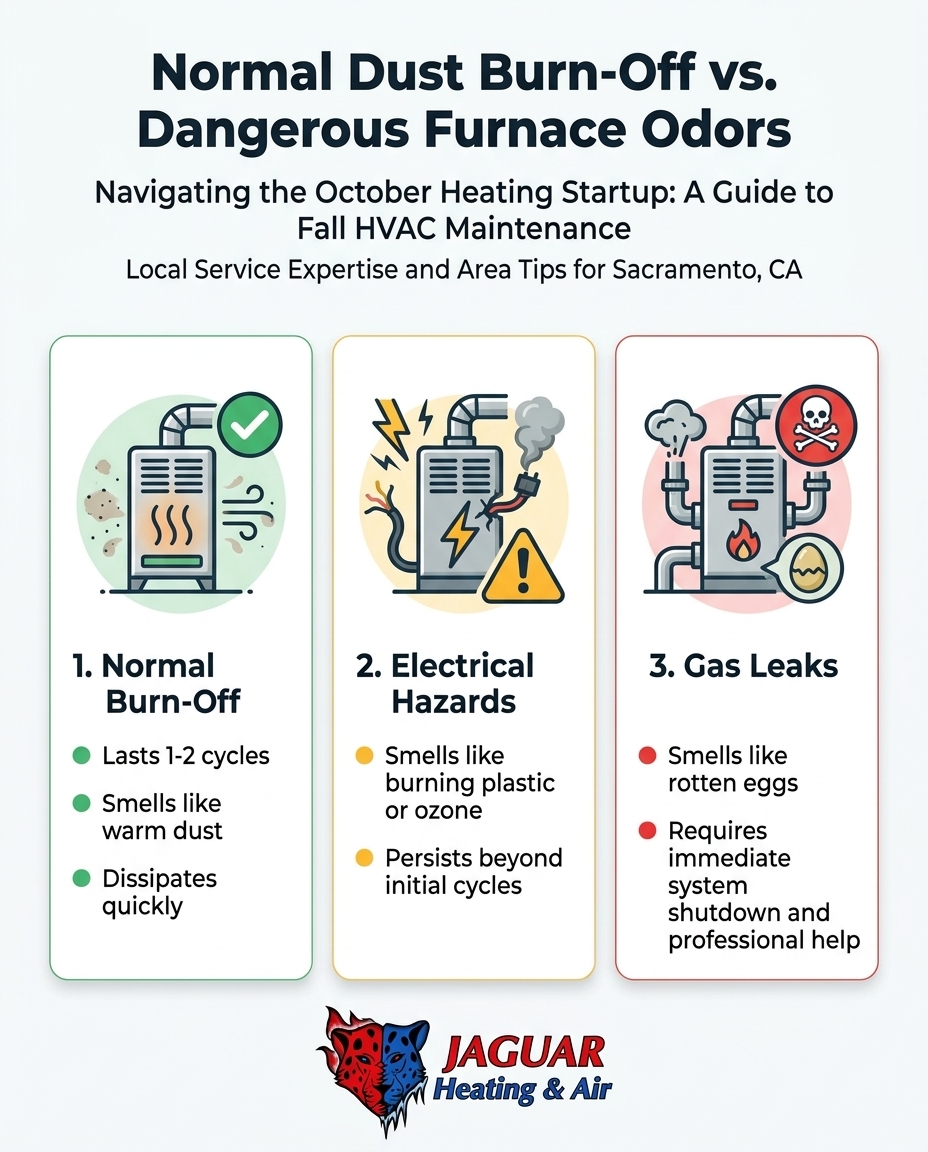
Distinguishing between normal dust burn-off odors vs. persistent electrical/gas smells is a critical safety skill for any homeowner. Because the heat exchanger is covered in months of settled dust, a certain amount of odor is unavoidable. However, knowing when a smell crosses the line from a normal seasonal occurrence to a dangerous hazard dictates whether you should let the system run or shut it down immediately.
• Dust Burn-Off — Description: Smells like warm, singed dust or a slightly musty burning scent. — Typical Duration: 1 to 2 heating cycles (usually dissipates within 24 hours). — Recommended Action: Monitor the system; normal operation can continue.
• Electrical Burning — Description: Acrid, sharp smell similar to melting plastic, hot metal, or ozone. — Typical Duration: Persists as long as the system is running; does not fade. — Recommended Action: Shut down the system immediately at the thermostat and breaker.
• Gas or Rotten Eggs — Description: Strong sulfur or rotten egg scent near the unit or vents. — Typical Duration: Immediate and persistent upon startup or even when idle. — Recommended Action: Evacuate, leave the system off, and call the gas company/HVAC professional.
When to Wait It Out
If you notice brief, dissipating dusty smells during the first 24 hours of operation, this is typically standard behavior. As long as the odor smells strictly like warm dust and is not accompanied by strange grinding noises, flashing error codes, or unexpected system shutdowns, the heat exchanger is simply clearing off the summer accumulation. Allow the furnace to complete its first few cycles to see if the scent clears.
When to Shut Down and Call a Professional
Safety hazards present themselves with distinct, aggressive odors. Acrid, electrical, or metallic burning smells that persist beyond the first few cycles often indicate a failing blower motor, melted wire casings, or an overheating circuit board. Furthermore, any scent of rotten eggs or gas indicates a severe safety risk, such as a cracked heat exchanger or a leaking gas valve. In these scenarios, distinguishing normal dust burn-off odors vs. persistent electrical/gas smells could save your home from a catastrophic failure.
Airflow Restrictions: The Hidden Cause of Furnace Short-Cycling
Another prevalent issue our technicians encounter during the October heating startup is short-cycling—a condition where the furnace fires up, runs for a brief period, and then abruptly shuts down before the house reaches the target temperature. This is rarely a random glitch; it is almost always a mechanical response to restricted airflow.
The Problem: Your furnace repeatedly turns on and off, leaving your home chilly and causing your energy bills to spike due to the constant restarting of the ignition sequence.
The Cause: Every modern furnace is equipped with a high-limit switch, a critical safety mechanism designed to prevent the unit from overheating and causing a fire. When filters become clogged with summer dust, or internal components are heavily soiled, the blower motor cannot push enough air over the heat exchanger to cool it down. The heat becomes trapped inside the cabinet. Within minutes, the internal temperature spikes, tripping the high-limit switch and forcing the system into an emergency shutdown.
The Solution: Restoring proper airflow is the only way to stop the short-cycling loop. While replacing a heavily soiled filter is the first step, the restriction often lies deeper within the system. Heavy summer accumulation on the blower wheel or within the ductwork can choke the system's output. In these cases, scheduling professional duct cleaning or a comprehensive internal blower cleaning is necessary to clear the blockages, prevent damage to the heat exchanger, and restore efficient operation.
Why Valley Dust and Ash Require Specialized Diagnostic Care
From our years working on Sacramento homes, we know that generic maintenance checklists found online often fall short because they fail to account for the specific environmental realities of different regions. In the Central Valley, the transition from summer to fall involves unique particulate loads that require a more tailored approach to system diagnostics.
During the late summer, the delta breezes that provide evening cooling also carry fine agricultural dust and seasonal ash directly into homes and HVAC systems. This fine particulate matter bypasses standard fiberglass filters much more easily than typical household dust. Once inside, it coats the flame sensor, clogs the pressure switch ports, and insulates the heat exchanger, changing the way the furnace operates.
Because of this, having a professional assess the specific wear-and-tear patterns caused by these local factors is crucial. A generic national guideline might simply suggest wiping down the cabinet, but a technician with deep local expertise in Sacramento's unique environmental challenges knows exactly which sensor ports are most likely to be fouled by valley ash. This specialized diagnostic care ensures that normal dust burn-off odors vs. persistent electrical/gas smells are accurately identified, preventing unexpected breakdowns when the true winter cold arrives.
What to Expect from a Comprehensive Fall System Tune-Up
When you schedule a professional safety inspection prior to the October heating startup, the goal is to verify that every component has survived the summer and is ready for the intense demands of the heating season. A thorough tune-up involves specific, methodical steps to reassure you of the system's safety and efficiency.
• Thorough inspection of the heat exchanger: Technicians use specialized cameras to inspect the metal for micro-fractures or rust. Even a hairline crack can allow dangerous combustion gases to mix with your breathing air.
• Cleaning the burner assembly: Removing carbon buildup and summer dust from the burners ensures a clean, blue flame and prevents delayed ignition, which can cause a small, startling explosion inside the cabinet.
• Calibration of safety controls: Testing the high-limit switch, the flame sensor, and the pressure switches guarantees that the furnace will automatically shut down if a dangerous condition arises.
• Evaluation of indoor air quality components: Assessing the condition of the filter, the blower motor, and the ductwork after a heavy cooling season ensures that airflow remains unobstructed.
Just recently, our Jaguar Heating & Air team visited a local homeowner who reached out for a routine checkup before the seasonal shift. Our technician performed a thorough and informative inspection of the system, verifying the condition of the burners and safety switches, and confirming the unit's status honestly without pushing unnecessary sales. This level of transparent, detailed evaluation is exactly what we believe homeowners need to ensure a safe transition into the heating season.
The Value of Proactive System Care and Servicing Plans
Transitioning from a reactive mindset—waiting for the furnace to break down before calling for help—to a proactive approach is the single best way to protect your HVAC investment. Routine care fundamentally changes how your system handles the shift from summer to fall.
By scheduling regular maintenance, you actively prevent the deep buildup of dangerous particulates over the summer. A clean system does not have to work as hard to push air, which reduces mechanical strain on the blower motor and prevents the high-limit switch from tripping. More importantly, proactive care provides the peace of mind that comes from knowing the system has been professionally cleared for safe winter operation, significantly reducing the anxiety of distinguishing normal dust burn-off odors vs. persistent electrical/gas smells on your own.
Enrolling in an HVAC maintenance membership offers unparalleled convenience and reliability. These scheduled servicing plans ensure that your equipment is inspected and cleaned before the peak season begins, securing priority service and extending the overall lifespan of your heating and cooling equipment.
Frequently Asked Questions About Fall System Transitions
Why does my heater smell like burning dust?
Your heater smells like burning dust because particulates accumulate on the heat exchanger during the months it sits idle. When you turn on the furnace for the first time in the fall, the sudden high temperatures singe this layer of dust, pet dander, and airborne debris. This process creates a distinct, warm, musty odor that is generally harmless and temporary.
How long should a furnace smell like burning when first turned on?
A furnace should only smell like burning dust for one to two heating cycles, typically dissipating completely within the first 24 hours of operation. If you are experiencing normal dust burn-off odors vs. persistent electrical/gas smells, the scent will fade quickly. If the smell remains strong after a day, or smells like melting plastic, shut the system down.
When should I schedule fall HVAC maintenance?
You should schedule fall HVAC maintenance in late September or early October, just before the nighttime temperatures drop significantly. Having the system inspected before you actually need to rely on it ensures that any summer wear-and-tear is addressed, preventing unexpected breakdowns during your first major heating cycle.
What does HVAC maintenance include?
Professional HVAC maintenance includes a comprehensive safety and performance check of the entire system. Technicians will inspect the heat exchanger for cracks, clean the burner assembly, test all safety mechanisms like the high-limit switch, calibrate the thermostat, and evaluate the blower motor and filter for proper airflow.
Is HVAC maintenance really necessary?
Yes, HVAC maintenance is absolutely necessary to ensure safe operation, especially for gas furnaces. Routine inspections catch minor issues like fouled flame sensors or restricted airflow before they cause the system to short-cycle or, worse, before a cracked heat exchanger leaks dangerous combustion gases into your home.
How does summer wildfire ash affect my heating system's performance?
Summer wildfire ash is composed of extremely fine particulates that easily bypass standard filters and coat the internal components of your HVAC system. This ash insulates the heat exchanger, fouls sensitive electronic sensors, and restricts the blower motor, leading to severe burning odors and potential short-cycling when the furnace is first ignited.
Ensure a Safe Heating Season with Expert Diagnostics
The October heating startup is a critical moment for your home's comfort and safety. Addressing unusual odors or short-cycling immediately is essential to preventing minor mechanical issues from escalating into complete system failures. While a brief dusty smell is normal, persistent acrid odors or a furnace that refuses to stay running are clear indicators that the system is struggling to breathe or operate safely.
Professional diagnostics are the only definitive way to guarantee system safety. A licensed technician can accurately assess the condition of your heat exchanger, verify the functionality of your safety switches, and clear away the heavy particulate loads left behind by the summer months. Prompt action is the key to a stress-free winter. Schedule your professional HVAC maintenance in Sacramento before the colder winter months set in, ensuring you receive a clear, technical, and accessible evaluation of your system's health.
Recent Posts

Why Your Furnace Smells Like Burning Dust: Essential HVAC Maintenance Questions Answered
Smelling burning dust this fall? Have common homeowner questions answered about your furnace. Decide with confidence on when to call a pro before winter.

Why Your Furnace Smells Like Burning Dust: A Guide to Fall HVAC Maintenance
Does your furnace smell like burning dust? Review our home maintenance tips and troubleshooting to see what we found inside a typical fall heating startup.
HVAC Maintenance: Decoding the Burning Smell During Your First Fall Startup
Smelling burning dust on the first chilly morning? Apply our home maintenance tips and troubleshooting to decide if it's normal burn-off or a safety hazard.