.avif)
All About What Happens If You Don't Change Your Air Filter
Discover what happens if you dont change your air filter in your home HVAC or car engine and learn how to prevent costly damage.
Discover what happens if you dont change your air filter in your home HVAC or car engine and learn how to prevent costly damage.

What Happens If You Don't Change Your Air Filter — And Why It Matters
What happens if you don't change your air filter can range from higher energy bills to complete HVAC system failure. Here's a quick summary of the risks:
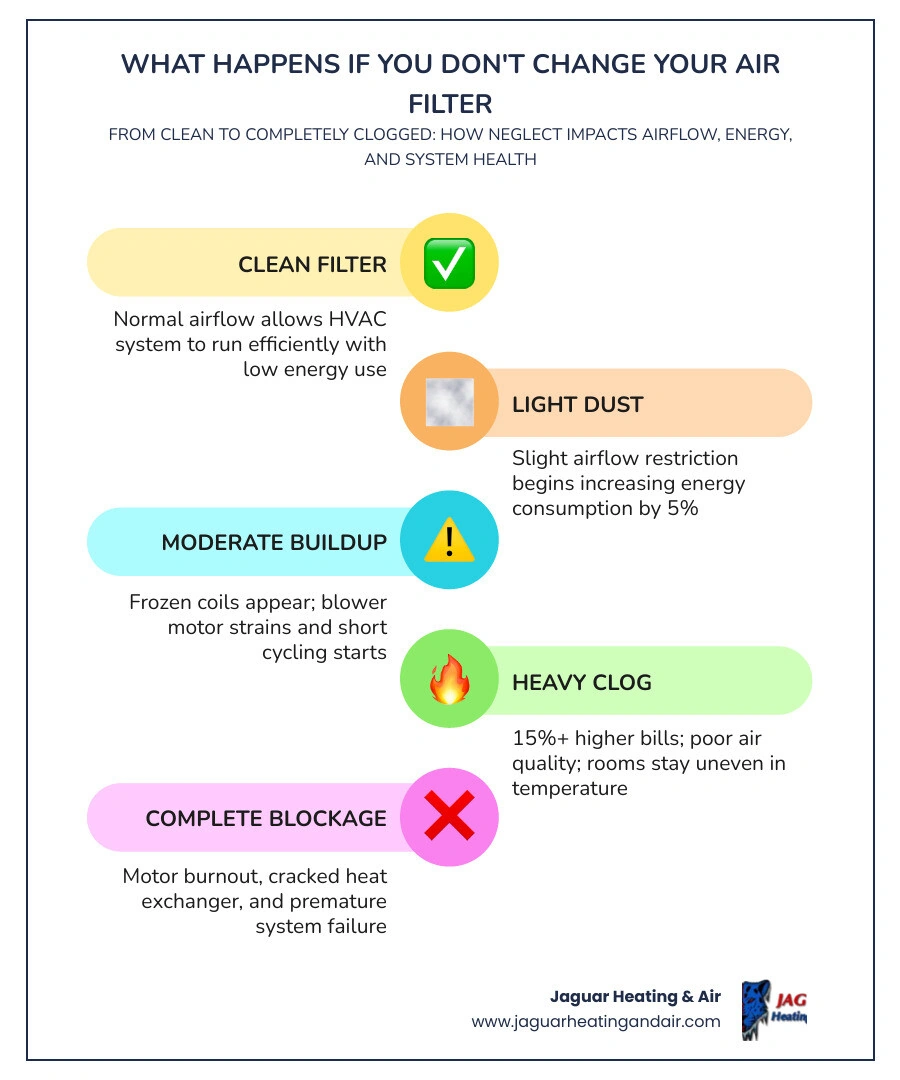
- Higher energy bills - A clogged filter forces your system to work harder, increasing energy use by 5% to 15% or more
- Poor indoor air quality - Dust, pollen, pet dander, and other pollutants recirculate through your home
- Frozen evaporator coils - Restricted airflow causes coils to ice over, stopping your AC from cooling
- Blower motor damage - Strain from restricted airflow wears out motors faster than normal
- Short cycling - Your system turns on and off rapidly, accelerating wear on components
- Premature system failure - HVAC systems engineered to last 15 years can fail years earlier
- Uneven temperatures - Rooms farthest from the unit may never reach the set temperature
Most Sacramento-area homeowners don't think about their air filter until something goes wrong. By then, what started as a simple $20 fix can turn into a much bigger problem. Indoor air is already two to five times more polluted than outdoor air on average — and a clogged filter makes that worse while quietly driving up your utility bill every month.
What happens if you dont change your air filter further reading:
- how hot dry valley affects filter replacement frequency
- how often should you change your hvac air filter
- how pets affect how often you change your filter
The Dual Role: HVAC Filters vs. Car Engine Filters

To truly understand what happens if you dont change your air filter, it helps to look at how air filters function across different parts of our daily lives. Whether we are discussing the central heating and air conditioning unit keeping our living room comfortable or the vehicle sitting in our driveway, filters act as the primary defense system against dirt, dust, and microscopic debris.
In both residential homes and automobiles, these filters act as the "lungs" of the system. They draw in air, trap unwanted particulates, and allow clean air to pass through to keep internal components running smoothly. However, the exact mechanics and priorities of these two systems differ significantly. To learn more about how these filters function, check out our guide on Everything You Need to Know About HVAC Filters.
The Primary Function of a Home HVAC Filter
There is a common misconception that residential HVAC filters are designed solely to purify the air we breathe. While high-quality filters certainly help improve indoor air quality, their number one job is actually to protect the heating and cooling equipment itself.
Inside your home's HVAC system, a powerful blower motor pulls air from your living spaces through return vents, pushes it across the evaporator coils (for cooling) or the heat exchanger (for heating), and distributes it back into your rooms. If dust, hair, and lint are allowed to coat these delicate internal parts, the system's ability to transfer heat drops dramatically. A clean filter acts as a physical barrier, keeping these components clean and preventing costly mechanical failures. Keeping up with this simple task is one of the most important Reasons to Maintain Your Home's HVAC System.
The Primary Function of a Car Engine Air Filter
Under the hood of your car, the engine air filter serves a similar protective purpose but in a high-combustion environment. Internal combustion engines require a precise mixture of fuel and air to create the miniature explosions that propel your vehicle forward.
The engine air filter sits at the opening of the air intake system, trapping dirt, sand, road debris, and insects before they can enter the combustion chamber. If these abrasive particles bypass the filter, they can physically score the cylinder walls, damage the pistons, and contaminate the engine oil. Additionally, modern vehicles rely on a Mass Airflow (MAF) sensor to measure the volume of air entering the engine. If a dirty filter lets fine dust through, it can foul the MAF sensor, causing the vehicle's computer to calculate the incorrect fuel-air mixture, which leads to immediate drops in horsepower and fuel efficiency.
What Happens If You Dont Change Your Air Filter
When you neglect to change your air filter, a slow but damaging chain reaction begins. Whether in your home or your car, the immediate result of a dirty filter is a significant restriction in airflow. Because the system has to work twice as hard to pull air through a dense wall of trapped dirt, energy consumption spikes, and components begin to experience extreme physical strain.
Over time, this restricted airflow leads to a phenomenon known as short cycling in HVAC units. This is when the system overheats or freezes and shuts down prematurely, only to turn back on a few minutes later. This rapid starting and stopping places immense wear on the electrical and mechanical parts of your system. If you notice your system behaving this way, it is one of the classic Signs Your AC Needs Repair.
What Happens If You Dont Change Your Air Filter in Your Home HVAC System?
In a residential HVAC system, a clogged filter leads to several severe mechanical issues:
- Frozen Evaporator Coils: During the cooling season, your air conditioner's evaporator coils rely on a steady stream of warm indoor air to keep them from getting too cold. When a dirty filter blocks that airflow, the refrigerant inside the coils drops below freezing. The moisture in the air condenses on the coils and quickly turns to ice, completely blocking any remaining airflow and potentially sending liquid refrigerant back to the compressor, which can destroy it.
- Blower Motor Burnout: The blower motor is the workhorse of your HVAC system. When it has to fight against the high static pressure of a clogged filter, it draws more electrical current and runs much hotter. This extra heat dries out internal lubricants and cracks wire insulation, eventually burning the motor out entirely.
- Cracked Heat Exchanger: During the winter, your furnace relies on airflow to carry heat away from the heat exchanger and into your home. If a dirty filter restricts that airflow, the heat exchanger will overheat. The constant, extreme expansion and contraction from overheating can cause the metal to crack, which introduces a high risk of dangerous carbon monoxide leaking into your indoor air.
- Auxiliary Heat Activation: In heat pump systems, restricted airflow can prevent the outdoor unit from heating the home efficiently, forcing the system to rely on expensive auxiliary electric heat strips to keep up, sending utility bills sky-high.
Maintaining a clean filter ensures your system operates at peak efficiency, which has a direct impact on your home's overall efficiency. Discover more about The Connection Between Energy Efficient HVAC and Your Home Value.
What Happens If You Dont Change Your Air Filter in Your Car?
If you ignore your car's engine air filter, the consequences are equally costly:
- Reduced Horsepower and Acceleration: Just like a runner trying to breathe through a straw, a choked engine cannot pull in enough oxygen. You will notice a sluggish throttle response and a distinct lack of power when trying to merge onto the highway.
- Engine Damage from Particle Ingestion: Over time, a heavily saturated filter can deform or tear under the strong vacuum pressure of the engine. This allows unfiltered, abrasive road dust to enter the engine cylinders, causing rapid wear on internal components.
- Check Engine Light and Sensor Fouling: A dirty filter can cause your car's computer to trigger a check engine light due to MAF sensor errors or engine misfires caused by an overly "rich" fuel mixture (too much fuel, not enough air).
The Progressive Timeline of Filter Neglect
To help you visualize the risks, here is a breakdown of what happens to your home and HVAC system over a timeline of extended filter neglect:
| Timeline | HVAC Performance & System Impact | Indoor Air Quality & Comfort | Financial & Operational Consequences |
|---|---|---|---|
| 1 Month | Normal operation; very minor dust accumulation on the outer pleats. | Air remains relatively clean; standard dust levels on furniture. | Utility bills are stable; system runs within its designed parameters. |
| 3 Months | Blower motor begins working slightly harder; minor reduction in airflow. | Dust starts settling faster on surfaces; slight musty odor when system starts. | Energy bills may increase by 5% to 15% as runtimes lengthen slightly. |
| 6 Months | Severe airflow restriction; evaporator coils may begin to frost; system short cycles. | Air feels stagnant; allergy and asthma symptoms flare up; noticeable odors. | Utility bills spike by 20% to 30%; high risk of sudden system breakdown. |
| 2 Years | Complete mechanical breakdown; burned-out blower motor or cracked heat exchanger. | Severe indoor air pollution; potential mold growth inside ductwork and coils. | Massive repair bills; complete system replacement may be required. |
As of June 2026, keeping a strict eye on this timeline is more critical than ever to protect your home's budget and comfort. For a deeper dive into timing, read Don't Let It Clog: Your Ultimate Guide to HVAC Filter Timing.
Factors That Accelerate Filter Clogging
While the table above provides a general guideline, several environmental and household factors can cause your air filter to clog much faster than average.
Here in the Sacramento Valley, our weather and environment play a huge role. Dry, windy summers stir up fine agricultural dust, and high pollen counts in the spring quickly coat filters. Furthermore, regional wildfire smoke contains microscopic ash particles that can saturate a standard filter in a matter of days.
Inside the home, pets are the leading cause of rapid filter clogging. Pet hair and dander are heavy and quickly carpet the surface of your filter, blocking air passages. To understand how these factors apply to your specific situation, read about How Pets Affect How Often You Change Your Filter and learn How Hot, Dry Valley Affects Filter Replacement Frequency.
Frequently Asked Questions About Air Filter Maintenance
Can running an HVAC system without a filter cause immediate damage?
Yes, running your HVAC system without a filter is highly discouraged, even for a single day. Without a filter, the return vents will pull dust, pet hair, and airborne debris directly into the indoor cabinet. This debris will immediately coat the wet evaporator coils and stick to the blower motor fan blades.
Within hours, this dust accumulation can insulate the coils, reducing heat transfer and causing the system to freeze up. Long-term, this neglect will lead to motor failure and can easily void your manufacturer's warranty. To protect your investment, make sure you know How to Keep Your HVAC Warranty in Place.
What are the early warning signs that my air filter needs to be changed?
You don't have to wait for your system to break down to know it's time for a fresh filter. Keep an eye out for these common warning signs:
- Weak Airflow: The air coming out of your supply registers feels noticeably weaker or less cool than usual.
- Dusty Vents: You notice a buildup of gray dust on the grilles of your return and supply vents.
- Musty Odors: A stale, dusty, or musty smell fills the room whenever the heating or air conditioning turns on.
- The Visual Light Test: Take the filter out and hold it up to a bright light source. If you cannot see light passing through the pleats, the filter is saturated and needs to be replaced.
How often should residential air filters be replaced?
As a general rule, standard 1-inch pleated filters should be replaced every 30 to 90 days. However, the ideal frequency depends on your specific household conditions:
- Single occupant, no pets: Every 90 days.
- Typical suburban home with one pet: Every 60 days.
- Multiple pets or family members with allergies/asthma: Every 20 to 45 days.
- Vacation homes or low-use properties: Every 6 to 12 months.
Additionally, pay attention to the MERV (Minimum Efficiency Reporting Value) rating of your filter. While higher MERV filters trap smaller particles, they also restrict airflow more quickly and require more frequent inspections to ensure they aren't choking your system.
Conclusion
Understanding what happens if you dont change your air filter is the first step toward protecting your home's comfort, your family's health, and your wallet. A simple, regular filter change prevents the cascading mechanical failures, high energy bills, and poor air quality that come with system neglect.
At Jaguar Heating & Air, we are dedicated to keeping your home running efficiently year-round. As a family-owned business and a Trane Comfort Specialist, our NATE-certified technicians are proud to serve communities across the Sacramento area, including Elk Grove, Folsom, Roseville, El Dorado Hills, Lincoln, Rocklin, Woodland, Carmichael, Citrus Heights, Fair Oaks, Granite Bay, Mather, Orangevale, and Rancho Cordova.
Don't wait for a clogged filter to cause an unexpected breakdown. Schedule professional HVAC maintenance with Jaguar Heating & Air today to ensure dependable comfort and peak efficiency for your home.
Recent Posts
What a Rattling Outdoor Fan Blade Means for Your AC's Lifespan
A vibrating condenser fan creates micro-vibrations that act as a ticking time bomb for delicate copper lines. Find out why you shouldn't ignore this fall noise.
Why We Test Your AC's Amp Draw During Late Summer Maintenance
Even if your vents are blowing cold air, months of intense heat can push your compressor to the brink. We measure invisible electrical fatigue to catch stressed parts before a total breakdown.
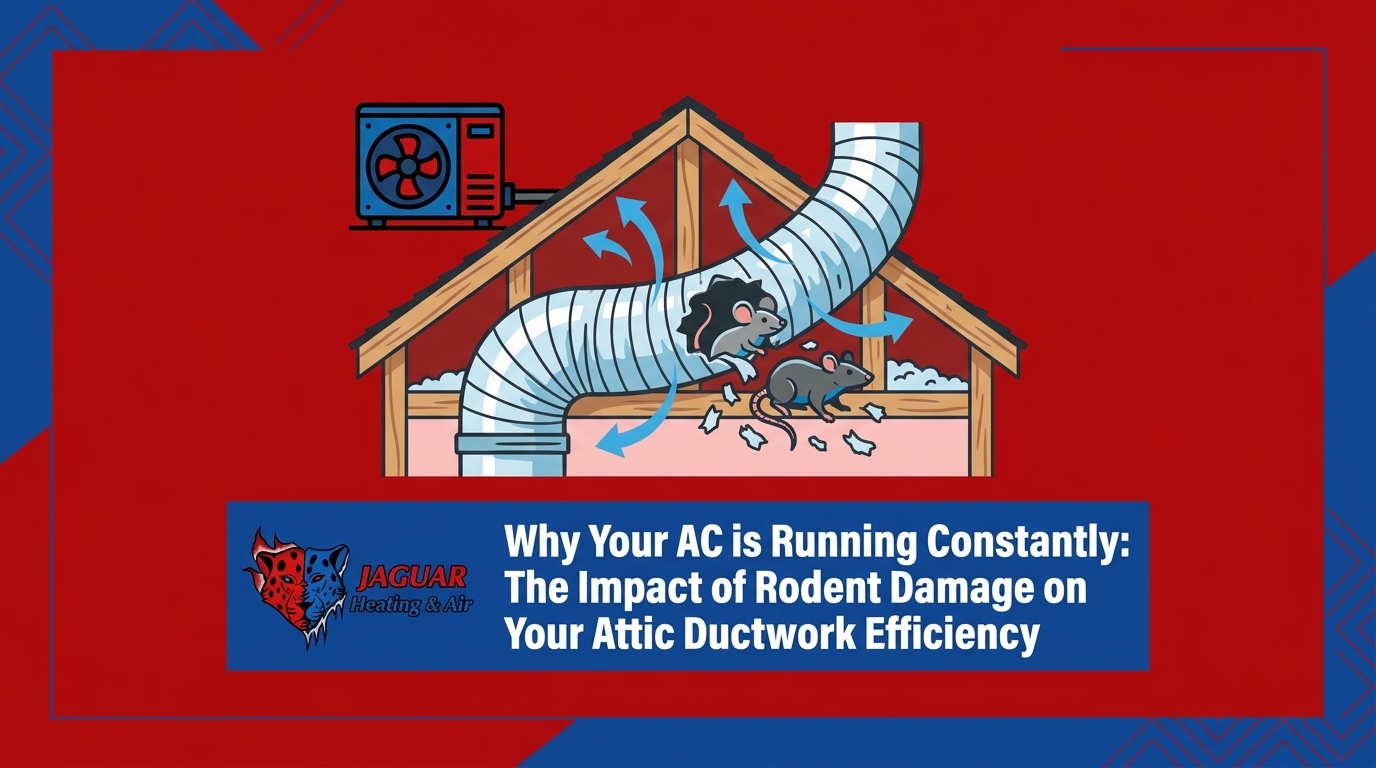
The Impact of Rodent Damage on Your Attic Ductwork Efficiency
If your cooling system runs constantly but your home stays warm, roof rats may have chewed through your flex ducts. See why a tape patch isn't enough to safely restore your system's airflow.