.avif)
Why Your Sacramento Home Needs a Hard Start Kit on the AC Compressor
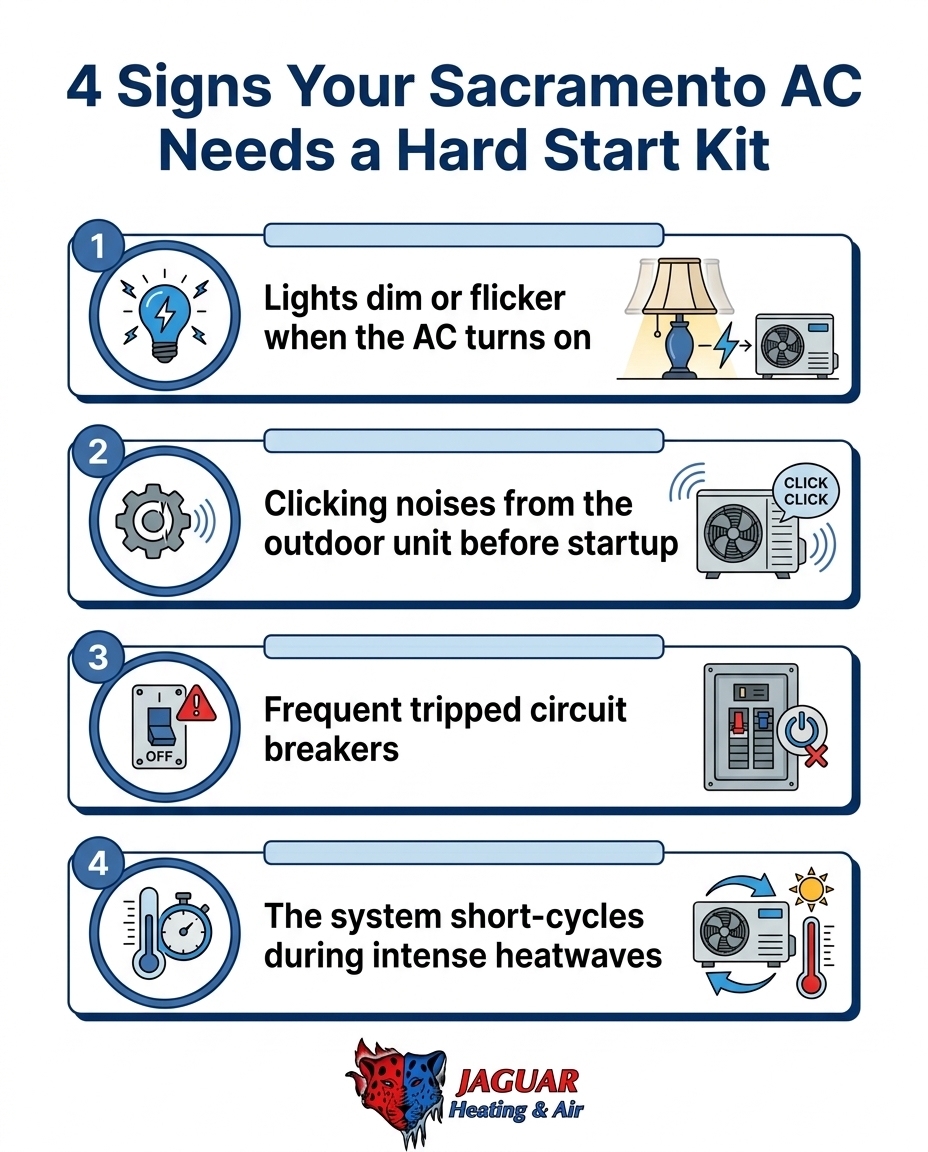
Dimming lights when the AC turns on are a major warning sign of electrical strain. See how a hard start kit reduces this power draw and protects your aging compressor during late-summer heatwaves.
Dimming lights when the AC turns on are a major warning sign of electrical strain. See how a hard start kit reduces this power draw and protects your aging compressor during late-summer heatwaves.

Myth: Dimming Lights When the AC Kicks On Are Just a Normal Part of Summer
Many homeowners believe that when the living room lights dim for a second as the air conditioner kicks on, it is just a normal quirk of a heavy appliance running in the background. The truth is quite different. If you are wondering why your Sacramento home needs a hard start kit on the AC compressor, those flickering lights are your first major clue. They are not harmless; they are a visible symptom of immense electrical strain on an aging system.
When you rely on our team at Jaguar Heating & Air for professional air conditioning services to diagnose these electrical drops, we can often save an aging unit before it fails completely.
As cooling systems age, the internal mechanical parts begin to wear down and experience higher physical resistance. Every time the thermostat calls for cooling, the compressor motor has to work significantly harder to overcome that internal friction. This struggle requires a massive gulp of electricity from your home's electrical panel. When the draw is too high, it steals power from the rest of the house, causing your lights to dim or flicker momentarily.
This creates a critical decision point for homeowners, especially as the brutal August late-summer heat begins to set in and kids head back to school. Do you address this hidden electrical strain early with a targeted component upgrade, or do you ignore it and risk a complete, catastrophic system breakdown during the hottest part of the year? Ignoring the symptom forces the compressor to endure maximum stress during every single startup cycle. Eventually, the motor will overheat, the internal windings will burn out, and you will be left facing a massive replacement bill instead of a simple, proactive enhancement.
The Hidden Electrical Surge: Understanding Locked Rotor Amps (LRA)
To understand why your air conditioner struggles as it gets older, we have to look at the mechanical reality of how a compressor turns on. The moment your system receives the signal to start, it requires a massive, split-second surge of power. In the HVAC industry, this surge is measured in high starting amps (Locked Rotor Amps), often abbreviated as LRA on your equipment's data plate.
Locked Rotor Amps represent the absolute maximum current the motor draws when the rotor is completely stationary and trying to break free from a resting state. For a typical residential air conditioning unit, this startup inrush current can be four to eight times higher than the normal running current used to keep the system operating once it is already spinning.
This massive power draw places a heavy burden on your home's electrical panel. If the compressor takes too long to start, that surge lasts longer than your electrical breakers are designed to handle. Our technicians often find that this prolonged electrical demand is exactly why your Sacramento AC keeps tripping the breaker during peak heat. The breaker senses the extended high-voltage draw and shuts the circuit down to prevent an electrical fire.
The Science of the Startup Surge
Think of your compressor like a heavy freight train. Getting a stopped train moving requires an incredible amount of energy and forward momentum. Once the train is rolling down the tracks, it takes a fraction of that energy to maintain its speed. Your compressor acts the exact same way.
In that split second of startup, the motor must instantly pressurize the refrigerant gas sitting in the lines. As internal components age, they lose their factory lubrication, and bearings begin to wear down. This increases the physical resistance against the motor. The harder it is to push the refrigerant, the more electrical energy the motor demands from your panel to force the system into motion. Without intervention, this daily struggle degrades the electrical windings inside the compressor until they short out entirely.
Standard Run Capacitor vs. Hard Start Kit: What's the Difference?
Every standard air conditioning unit comes from the factory with a run capacitor. While this component is essential, our team at Jaguar Heating & Air knows it is often not enough to support a system as it enters the later stages of its lifespan. Understanding the difference between factory parts and aftermarket upgrades is crucial when considering AC repair in Sacramento.
A standard run capacitor is designed to provide a continuous, steady supply of electrical phase-shifting to keep the motor running efficiently once it has already started. Some units also feature a basic factory start capacitor, but these are generally sized for brand-new, perfectly lubricated compressors operating under ideal conditions. They do not account for the mechanical wear and tear that accumulates over a decade of use.
A hard start kit, on the other hand, is a specialized, two-part upgrade consisting of a high-capacity start capacitor and a potential relay. The relay monitors the electrical voltage and connects the powerful start capacitor to the circuit for the exact fraction of a second the motor needs to break free from its resting state. Once the compressor achieves its running speed, the relay instantly drops the hard start kit out of the circuit.
Side-by-Side Component Comparison
To see exactly how these components differ in their approach to protecting your system, review this breakdown:
• Primary Function — Factory Run Capacitor: Maintains running efficiency during operation. — Hard Start Kit Upgrade: Delivers massive torque solely for startup.
• Surge Duration — Factory Run Capacitor: Prolonged surge on older, worn motors. — Hard Start Kit Upgrade: Reduces startup surge duration by up to 50%.
• Electrical Impact — Factory Run Capacitor: Draws high starting amps (Locked Rotor Amps) longer. — Hard Start Kit Upgrade: Gets the motor spinning instantly, dropping amps fast.
• Heat Generation — Factory Run Capacitor: Allows motor windings to heat up during slow starts. — Hard Start Kit Upgrade: Prevents overheating by minimizing startup time.
By effectively cutting the duration of the startup surge in half, a hard start kit drastically reduces the amount of heat generated inside the compressor motor. Since heat is the number one killer of electrical windings, this simple upgrade serves as a powerful shield against premature mechanical failure.
How Sacramento's Triple-Digit Heat Multiplies Compressor Strain
The mechanical principles of air conditioning apply everywhere, but local climate factors change how quickly a system degrades. In the Central Valley, August brings some of Sacramento's highest sustained temperatures. This relentless, late-summer baking heat maximizes the frequency of your system's cooling cycles, forcing the compressor to start and stop dozens of times a day just to maintain a livable indoor temperature.
Every single time that compressor kicks on, it endures physical wear. When temperatures exceed 100 degrees for days on end, your system is denied the recovery time it needs. This constant demand is incredibly taxing on an aging unit. Keeping ahead of this wear requires routine AC maintenance to ensure the electrical components are operating within safe parameters before the worst heat waves arrive.
Furthermore, late-summer afternoons place immense strain on local utility grids. When thousands of homes are pulling maximum power simultaneously, voltage fluctuations can occur. If your aging compressor is already struggling to pull high starting amps (Locked Rotor Amps) from a taxed grid, the risk of a startup failure skyrockets.
The Danger of Late-Summer Short Cycling
Extreme ambient temperatures also contribute to a phenomenon known as short-cycling. When the outdoor heat load is overwhelming, a struggling system may turn on, run for a brief period, shut off prematurely, and then try to restart almost immediately.
This rapid restarting is incredibly dangerous for the compressor. When an AC shuts off, the refrigerant pressure inside the lines takes several minutes to equalize. If the system tries to restart before that pressure balances out, the motor has to push against a massive wall of residual pressure. This scenario demands the highest possible electrical surge. A hard start kit provides the extreme torque necessary to punch through that pressure wall, preventing the motor from stalling, overheating, and burning out under the brutal August late-summer heat.
Repair vs. Replace: Is a Hard Start Kit the Right Move for Your Aging AC?
When an air conditioner begins to show signs of severe struggle, homeowners often face a stressful choice. Should you invest in a component upgrade, or is it time to replace the entire system? A hard start kit is a phenomenal tool, but it is not a magic wand that can resurrect a dead compressor. Knowing when to use it requires an honest evaluation of the equipment.
Recently, a local homeowner reached out to us during a stretch of hot weather when their AC started blowing ambient air. With a tight budget and rising temperatures, they were worried about a massive bill. One of our service technicians professionally explained the specific system failure and provided clear repair options, allowing them to fix the system without an immediate, full-scale upgrade. At Jaguar Heating & Air, we are committed to this kind of honest assessment, providing cost-effective bridge solutions like hard start kits rather than aggressively pushing for full replacements whenever a minor repair will do the job.
If your system is showing signs of terminal failure, however, a hard start kit will only waste your time. We want you to know the difference between a system that needs a boost and a system that requires a full AC replacement.
When to Install a Compressor Saver
A hard start kit is the perfect life-extending solution under specific conditions. If your system fits this profile, an upgrade is highly recommended:
• The system is 8 to 12 years old: The unit has significant mileage but has been well-maintained overall.
• Lights dim only during initial startup: The system runs perfectly fine and blows cold air once it finally gets going.
• Occasional breaker trips: The breaker trips during the hottest parts of the day, but the system functions normally otherwise.
• You want to bridge the gap: You plan to replace the system in a year or two and need the current unit to survive the August late-summer heat.
When It's Time for an Upgrade
Conversely, some warning signs indicate that the compressor is simply too far gone. If you notice these symptoms, a hard start kit will not save the unit:
• Mechanical grinding or screeching: Loud metal-on-metal noises indicate internal bearings have shattered.
• Frequent refrigerant leaks: If the coils are leaking Freon alongside electrical failures, the system is compromised on multiple fronts.
• The compressor is grounded: A technician tests the motor and finds that the internal electrical windings have already melted and shorted to the casing.
The Dangers of High-Voltage DIY: Why This is a Pro-Only Job
With countless online tutorials available, it can be tempting to try and install a hard start kit yourself to save time. However, opening up the electrical panel on your condensing unit is incredibly dangerous and should only ever be handled by a trained professional.
Air conditioning capacitors do not act like standard batteries. They are designed to store lethal amounts of high-voltage energy, and they retain that electrical charge long after the power has been shut off at the breaker. If you touch the wrong terminals without properly discharging the capacitor first, the resulting shock can cause severe injury or worse.
Beyond the physical danger, our team has seen firsthand the technical risks of improper installation:
1. Wiring the relay backward: Hard start kits use specific potential relays. If wired incorrectly, the start capacitor will fail to drop out of the circuit. This will continuously pump maximum voltage into the motor, destroying the compressor in minutes.
2. Voiding manufacturer warranties: Adding aftermarket electrical components without a licensed professional's documentation instantly voids any remaining warranty on your equipment.
3. Misdiagnosing the root cause: Without specialized multimeters, you cannot accurately measure the high starting amps (Locked Rotor Amps). You might install a kit when the real issue is a failing fan motor or a burnt contactor.
A professional technician has the training to discharge existing capacitors safely, measure the exact electrical draw, and ensure the new kit is wired in parallel precisely as required by the manufacturer.
Frequently Asked Questions About AC Hard Start Kits
Do I really need a hard start kit on my AC?
The short answer is that if your system is older and struggling to turn on, we highly recommend a hard start kit. It reduces the mechanical and electrical strain on an aging motor by delivering a massive jolt of starting torque. If your lights dim when the system kicks on, or if the unit hesitates before blowing cold air, this kit can prevent premature compressor failure.
How do I know if my AC compressor is struggling to start?
The most obvious signs are visual and auditory. You will likely notice your interior lights flickering or dimming momentarily when the thermostat calls for cooling. Additionally, you may hear a loud clicking, buzzing, or humming noise from the outdoor unit as it tries to pull high starting amps (Locked Rotor Amps) before the fan finally engages.
Can a hard start kit damage a compressor?
When installed correctly by a licensed professional, a hard start kit will not damage a healthy or aging compressor; it actually protects it from heat damage. However, if the kit is wired incorrectly and the start capacitor fails to disengage after startup, the continuous high voltage will overheat and destroy the compressor motor very quickly.
Why do my lights dim when the air conditioner turns on?
Your lights dim because the AC compressor requires an enormous surge of electricity to overcome resting mechanical resistance. This sudden, massive draw temporarily pulls voltage away from the rest of your home's electrical panel. As compressors age and internal friction increases, this electrical demand grows, making the dimming effect much more noticeable.
Is a hard start kit worth it for an older air conditioner?
Yes, it is often one of the most cost-effective ways to extend the life of an aging unit. By reducing the startup surge duration by up to 50%, the kit minimizes the heat generated inside the motor windings. This can help an older system survive a few more seasons, giving you time to plan for a full replacement rather than dealing with an emergency breakdown.
Protect Your Compressor Before the Next Heatwave Hits
Understanding the immense electrical strain your system faces during the August late-summer heat is the first step in protecting your home's comfort. You do not have to settle for dimming lights, tripped breakers, and the constant worry that your aging compressor is on its last legs. A hard start kit offers the peace of mind that comes from knowing your AC has the electrical support it needs to handle the grueling startup process.
If you suspect your system is struggling to pull the high starting amps (Locked Rotor Amps) required to keep your home cool, do not wait for a complete failure. Reach out to our team at Jaguar Heating & Air for a professional, honest assessment of your aging unit. By addressing the strain today, you can extend the life of your equipment, improve its reliability, and keep your home perfectly comfortable no matter how hot the Sacramento Valley gets.
Recent Posts
What a Rattling Outdoor Fan Blade Means for Your AC's Lifespan
A vibrating condenser fan creates micro-vibrations that act as a ticking time bomb for delicate copper lines. Find out why you shouldn't ignore this fall noise.
Why We Test Your AC's Amp Draw During Late Summer Maintenance
Even if your vents are blowing cold air, months of intense heat can push your compressor to the brink. We measure invisible electrical fatigue to catch stressed parts before a total breakdown.
The Impact of Rodent Damage on Your Attic Ductwork Efficiency
If your cooling system runs constantly but your home stays warm, roof rats may have chewed through your flex ducts. See why a tape patch isn't enough to safely restore your system's airflow.