.avif)
Valley Heat vs Your Air Filter
Learn how hot dry valley affects filter replacement frequency in Sacramento. Check filters monthly, spot warning signs & choose MERV 8-11 for valley dust.
Learn how hot dry valley affects filter replacement frequency in Sacramento. Check filters monthly, spot warning signs & choose MERV 8-11 for valley dust.

Why Hot Dry Valley Climates Force You to Replace Your Air Filter Far More Often
How hot dry valley affects filter replacement frequency is simple: the dry, dusty conditions of the Sacramento Valley cause air filters to clog weeks faster than manufacturer schedules assume, meaning most homeowners should inspect filters monthly and replace them every 30 days during peak seasons rather than the standard 90-day interval.
Quick answer by season:
| Season | Primary Threat | Recommended Check Frequency |
|---|---|---|
| Spring (Mar-May) | Dry winds, valley dust | Every 30 days |
| Summer (Jun-Sep) | Heat, agricultural dust, wildfire smoke | Every 30 days or after major smoke/wind events |
| Fall (Oct-Nov) | Harvest silt, post-wildfire ash | Every 30-45 days |
| Winter (Dec-Feb) | Dry air, light dust | Every 45-60 days |
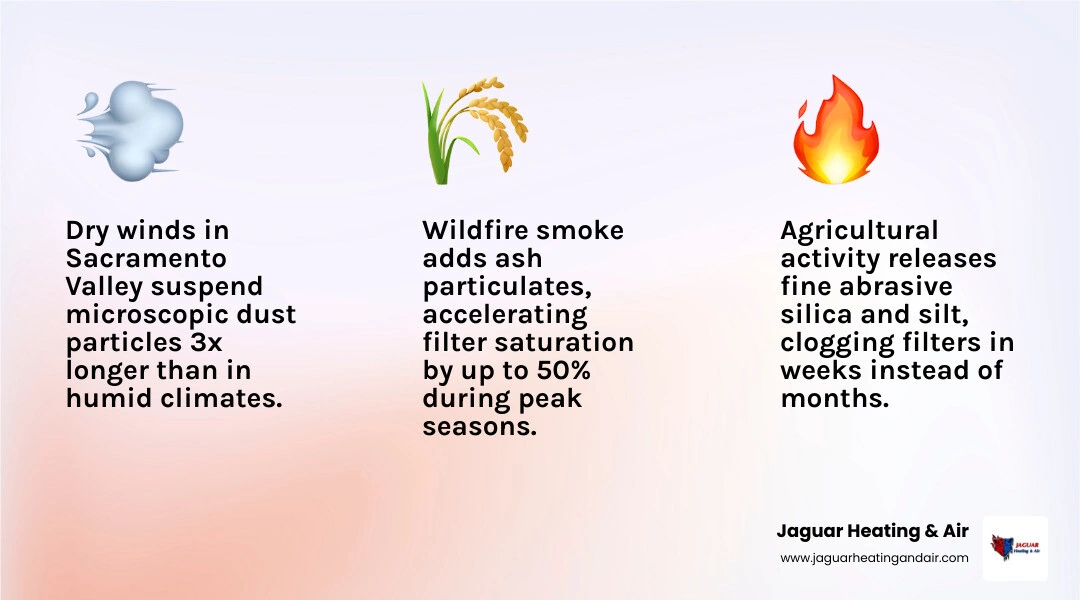
Most air filter guidelines are written for average conditions — moderate temperatures, mild humidity, and limited airborne particulates. The Sacramento Valley is none of those things. From spring through fall, valley residents deal with dry winds that keep microscopic dust particles suspended in the air for far longer than in humid climates, where moisture helps pull those particles to the ground. Add in agricultural activity, wildfire smoke, and the fine abrasive silica baked into local soil, and you have a combination that can saturate a standard filter in a matter of weeks.
That buildup doesn't just look bad. It quietly restricts airflow, strains your blower motor, and forces your HVAC system to work harder during the months when Sacramento temperatures already push it to its limits.
How hot dry valley affects filter replacement frequency in Northern California
Living in areas like Roseville, Rocklin, or Elk Grove means enjoying beautiful sunshine, but it also means living in a "high-particulate" environment. When we talk about how hot dry valley affects filter replacement frequency, we have to look at the mineralogy of our local dirt.
Unlike the soft, organic "dust bunnies" you might find in a humid coastal city, valley dust is often composed of abrasive crystalline silica, aluminum, and magnesium oxides. These are essentially microscopic rocks. In a hot, dry valley, the low humidity acts as a preservative for these particles. In a humid climate, water droplets latch onto dust, making it heavy so it falls to the ground. In our dry Sacramento summers, those particles stay airborne, floating right into your return vents.
This creates what we call a "static charge" effect. Dry air allows mineral particles to maintain a charge that makes them physically bond to surfaces. When they hit your filter, they don't just sit there; they weave into the fibers, creating a solid wall that air can’t pass through. To learn the basics of what these components do, check out Everything You Need to Know About HVAC Filters.
The science of suspended particulates in dry air
Most of the dust that clogs your filter in Folsom or Citrus Heights is under 10 microns in size. To put that in perspective, a human hair is about 70 microns wide. These tiny particles are the most dangerous for your HVAC system because they are small enough to bypass low-quality filters but large enough to coat your expensive internal components.
When the atmospheric stability of the valley traps air near the ground—common during our hot May 2026 afternoons—your HVAC system acts like a giant vacuum cleaner. It processes thousands of cubic feet of air every hour. If that air is filled with suspended silt, your filter becomes the frontline soldier. Protecting your indoor air isn't just about comfort; it's about wellness. You can read more about the Ways HVAC System Impacts Health to see why keeping that filter clean is so vital for your family.
Adjusting your schedule: how hot dry valley affects filter replacement frequency
If you look at the fine print on a box of filters, it might say "lasts up to 90 days." In the Sacramento Valley, we consider that a "best-case scenario" for a home that is rarely occupied and has no pets. For the rest of us in places like El Dorado Hills or Woodland, we are living in what manufacturers categorize as "severe conditions."
In severe conditions, the rule of thumb is to halve the replacement interval. If your filter is rated for 90 days, you should be checking it at 30 days and likely replacing it by day 45. During peak heat waves in July or August, when the AC is running 12 to 15 hours a day, a 30-day replacement cycle is often necessary to prevent airflow restriction. This is the HVAC equivalent of changing your car's oil more frequently if you spend all day idling in traffic or driving on dirt roads.
Warning signs your filter is struggling with valley dust

You don't always need a calendar to tell you it's time for a change. Your home and your HVAC system will start dropping hints. One of the most reliable ways to check is the "light test." Take your filter out and hold it up to a bright light or the sun. If you can’t see light passing through the fibers, the filter is "blinded" by dust and needs to go.
A struggling filter often takes on a gray, fuzzy, or even black appearance. This isn't just surface dirt; it’s a sign that the microscopic gaps in the filter media are completely plugged. If you ignore this, the dust won't just stay on the filter—it will start to migrate into your ductwork. This is one of the primary Reasons Get Ductwork Cleaned Every Year, as once that silt gets past the filter, it settles in your vents and recirculates forever.
Identifying how hot dry valley affects filter replacement frequency through system performance
Have you noticed that your home in Lincoln or Rancho Cordova feels unevenly cooled? Maybe the living room is chilly, but the back bedrooms feel stuffy. This is a classic sign of reduced airflow pressure caused by a clogged filter.
When the filter is caked with valley silt, the blower motor has to work twice as hard to pull air through the blockage. This creates "static pressure" issues. Think of it like trying to breathe through a thick wool blanket while running a marathon. Eventually, your system will slow down its air delivery to protect itself. This leads to a massive loss in efficiency. In fact, just 1/16th of an inch of dust accumulation on your internal evaporator coil can reduce system efficiency by over 20%. You can see the details on How Dirty Ductwork Decreases HVAC Efficiency Rocklin CA.
Physical indicators of silica and silt infiltration
Because our valley dust is rich in minerals like silica, it has a "gritty" texture. If you run your finger along a supply register and it feels like fine sandpaper rather than soft lint, you have a filtration problem.
Other signs include:
- Whistling or Humming: A high-pitched sound coming from your return vent usually means the system is "starved" for air and is trying to suck air through any tiny gap it can find.
- The "Singe" Odor: When dust bypasses a filter and settles on electric heat strips or furnace burners, it creates a distinct burning smell the next time the system activates.
- Rattling Noises: Abrasive dust can actually get into the bearings of your blower motor, causing it to lose its aerodynamic balance and start vibrating.
Seasonal triggers for accelerated filter clogging in the Valley
In Northern California, our maintenance needs shift with the weather. We don't have a "set it and forget it" climate.
| Event | Impact on Filter | Strategy |
|---|---|---|
| Spring Winds | Stirs up winter sediment and pollen. | Check monthly; replace if "fuzzy." |
| Summer Heat | High run-times mean more air (and dust) processed. | Strict 30-day replacement. |
| Harvest Season | Massive influx of fine agricultural silt. | Inspect every 2 weeks during peak harvest. |
| Wildfire Smoke | Microscopic ash and carbon particles. | Immediate replacement after smoke clears. |
Staying on top of these triggers is part of the HVAC Maintenance Tasks Homeowner Perform to keep their systems running for the full 15-20 year lifespan.
The impact of agricultural activity and harvest dust
If you live in Woodland, Carmichael, or near the outskirts of Elk Grove, you know that harvest season is "dust season." The almond harvest, in particular, kicks up an incredible amount of fine silt. This isn't just dirt; it’s a chemically reactive dust that can actually be corrosive to the copper coils in your AC unit if left to sit.
During these peak particulate periods, your HVAC system acts like a giant air purifier for your whole house. While that's great for your lungs, it’s tough on the filter. We recommend homeowners in agricultural zones check their filters every two weeks during the height of the harvest.
Wildfire season and emergency filter maintenance
Unfortunately, wildfire smoke has become a regular part of our Northern California summers. Smoke particles are significantly smaller than dust—often 2.5 microns or less. These particles are sticky and oily. When they hit your air filter, they create a "glaze" that can completely seal off airflow in a matter of days during heavy smoke events.
If you can smell smoke inside your home, your filter is already working overtime. Once an air quality alert has passed, you should replace your filter immediately, regardless of how new it is. The ash and carbon trapped in the filter fibers will continue to off-gas odors into your home even after the skies outside turn blue again.
Choosing the right filter for abrasive Northern California conditions
Not all filters are created equal when it comes to fighting valley dust. Many people buy the cheapest fiberglass filters available, but in a hot, dry valley, these are often insufficient. Fiberglass filters are designed to catch "boulders"—large lint and hair—but they let the abrasive silica and fine silt pass right through.
For our climate, we generally recommend a pleated filter. The folds in a pleated filter provide more surface area, which means they can hold more dust before they start to restrict airflow. Think of it like a winding mountain road versus a straight path; the winding road (the pleats) gives the dust more places to get "stuck."
Balancing filtration and airflow in a hot dry valley
The "strength" of a filter is measured by its MERV rating (Minimum Efficiency Reporting Value). While it’s tempting to buy the highest MERV rating possible (like a MERV 16 or a HEPA filter), this can actually hurt your system.
- MERV 1-4: Mostly fiberglass. Not recommended for valley dust.
- MERV 8-11: The "Sweet Spot." These catch the majority of valley silt, pollen, and mold spores without putting too much strain on your blower motor.
- MERV 13+: Great for allergies, but they are very dense. In a dusty valley, these can clog so fast that they cause your system to overheat or your evaporator coils to freeze up.
We always recommend checking your system’s manual or asking one of our NATE-certified technicians which MERV rating your specific blower motor can handle. Using a filter that is too thick can lead to "limit issues," where the system shuts down because it can't breathe.
Frequently Asked Questions
How often should I check my filter during Sacramento's harvest season?
During harvest season, especially in agricultural areas like Woodland or Elk Grove, you should perform a visual inspection every 30 days at a minimum. If you live directly adjacent to tilled fields or almond orchards, checking every two weeks is a smart move. If the filter looks gray or you can no longer see the white material through the dust, replace it immediately.
Can I use a HEPA filter to stop valley dust in a standard HVAC system?
Usually, no. True HEPA filters are very thick and designed for specialized hospital-grade systems. A standard residential blower motor in a home in Folsom or Roseville isn't powerful enough to push air through a HEPA filter. Using one can cause your motor to burn out or your AC coils to freeze. A MERV 11 pleated filter is usually the best high-efficiency alternative for residential use.
Does wildfire smoke require an immediate filter change?
Yes. Wildfire particulates are oily and microscopic. They clog filters much faster than standard household dust and can trap odors that will linger in your home. We recommend replacing your filter as soon as the outdoor air quality index (AQI) returns to a healthy level.
Conclusion
Understanding how hot dry valley affects filter replacement frequency is the first step in protecting your home's most expensive appliance. In the Sacramento Valley, we don't have the luxury of following the "standard" advice found on the back of a filter box. Our abrasive silica, agricultural silt, and dry winds require a more proactive approach.
At Jaguar Heating & Air, we’ve spent years helping families in Sacramento, Elk Grove, Folsom, and beyond navigate the unique challenges of our Northern California climate. As a family-owned business and Trane Comfort Specialist, we know exactly what our local dust does to HVAC systems. Whether you need a professional maintenance check to clean your silt-covered coils or you're looking for the best filtration strategy for your home, our NATE-certified technicians are here to help with same-day service and a 100% satisfaction guarantee.
Don't let the valley dust win the war against your comfort. Schedule your professional HVAC service with us today and breathe easier knowing your system is protected.
Recent Posts
HVAC Maintenance Guide: Comparing Heating Replacement Options Before Winter
Before winter hits, make sure your furnace can handle the cold. Compare your options with these objective heating options comparisons for homeowners.
HVAC Maintenance: Troubleshooting the Fall Heating Startup
Why does your furnace smell like burning on that first chilly morning? Use our home maintenance tips and troubleshooting to know when to call a pro this fall.
HVAC Maintenance: Home Maintenance Tips and Troubleshooting for Fall Heating Startup
Why some systems smell burning during fall startup, and how these home maintenance tips and troubleshooting steps help you decide when to call a professional.