.avif)
All About How Tule Fog Season Affects Your Heating
Discover how tule fog season affects your heating comfort and efficiency with expert Sacramento HVAC tips for Central Valley homes.
Discover how tule fog season affects your heating comfort and efficiency with expert Sacramento HVAC tips for Central Valley homes.

Why Tule Fog Season Affects Your Heating More Than You Might Expect
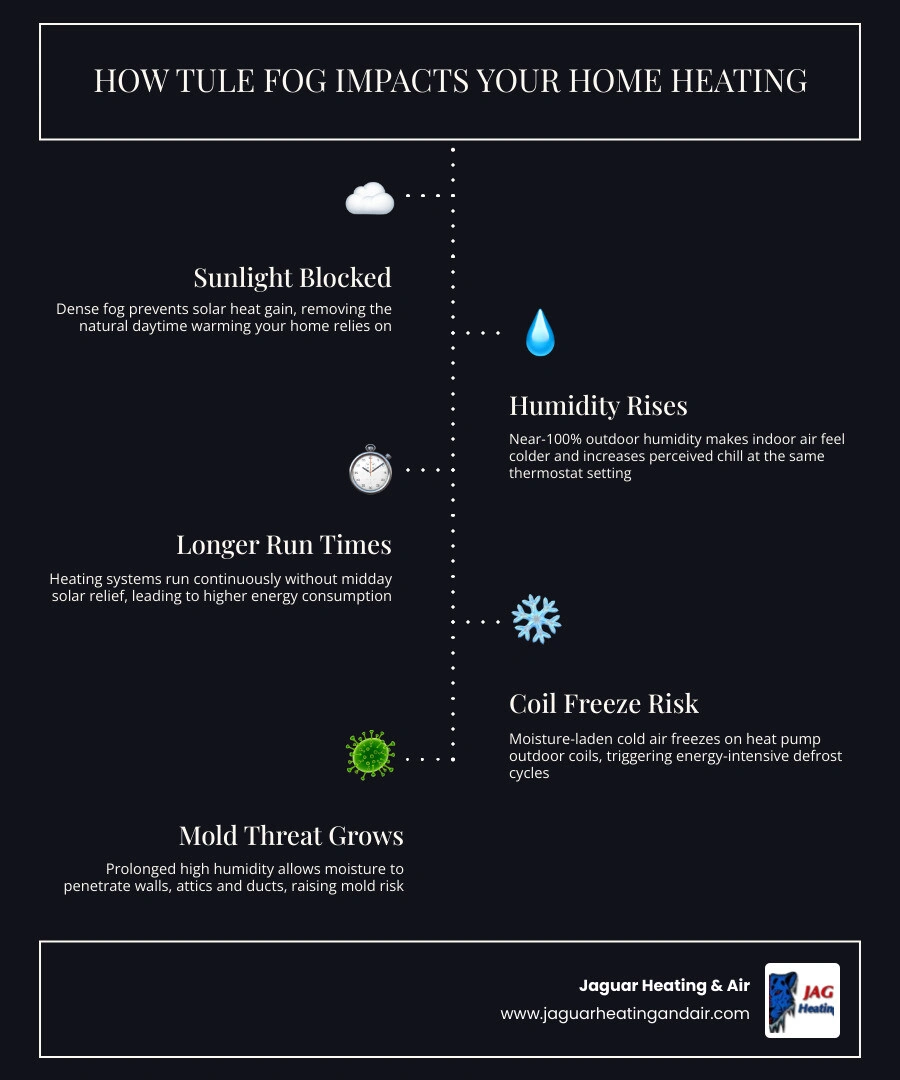
Understanding how tule fog season affects your heating is something most Sacramento-area homeowners don't think about until their furnace is running nonstop and their energy bill climbs higher than expected. Tule fog is a dense, ground-hugging winter fog unique to California's Central Valley — and it does more than just gray out your neighborhood for days on end. It blocks the sunlight your home normally relies on for passive warmth, raises indoor humidity, and forces your heating system to work harder with no daytime break.
Here is a quick look at the main ways tule fog affects home heating:
- Longer furnace run times — Fog blocks solar heat gain, so your system never gets that midday assist from the sun.
- Damp air that feels colder — Higher humidity makes a 68°F home feel more like the mid-60s, even with the thermostat set correctly.
- Heat pump stress — Cold, moisture-laden air can freeze outdoor coils, triggering defrost cycles that temporarily cut heating output.
- Higher energy use — Without solar warming during the day, heating systems run almost continuously during multi-week fog events.
- Increased mold risk — When outdoor humidity stays near 100% for weeks, moisture can work its way into walls, attics, and ductwork.
Sacramento has seen stretches of up to 22 consecutive foggy days — the longest since the 1970s — and a single November that brought nine dense fog advisories. For homeowners in Elk Grove, Folsom, Roseville, and across the greater Sacramento region, that kind of fog season puts real stress on heating systems that may not be ready for it.
How tule fog season affects your heating vocab explained:
- how extreme heat and wildfire smoke stress your system
- how sacramento climate affects your hvac system
What Is Tule Fog and Why Does It Blanket the Central Valley?
Tule fog is not your average coastal mist. Named after the tule reeds (Schoenoplectus acutus) that once filled the vast, marshy wetlands of the Central Valley, this weather phenomenon is a thick, incredibly dense radiation fog. Because the Central Valley is shaped like a giant bowl—hemmed in by the Sierra Nevada mountains to the east and the Coast Ranges to the west—it acts as a physical trap for cold, heavy air and moisture.
When late autumn and winter rains saturate the valley floor, they leave behind abundant ground-level moisture. Under the right atmospheric conditions, this moisture becomes the perfect recipe for weeks of gray, bone-chilling cold.
The Science of Radiation Fog and Temperature Inversions
Unlike marine fog, which forms over the ocean and rolls inland, tule fog is a radiation fog that forms directly over land. It requires a very specific combination of ingredients:
- High ground-level moisture (usually from recent winter rain)
- Clear skies overnight to allow heat to escape back into space
- Light, calm winds that prevent the air layers from mixing
- A stable high-pressure system sitting over the region like a lid
On calm, clear winter nights, the ground loses heat rapidly through a process called radiative cooling. As the ground temperature drops, it cools the air directly above it down to its dew point, forcing the moisture in the air to condense into a thick fog layer.
Under normal conditions, air temperature decreases as you go higher up. However, tule fog creates a dramatic temperature inversion. A layer of warm, dry air rides over the top of the cold, damp air trapped on the valley floor. Because cold air is denser and heavier than warm air, it cannot rise. The high-pressure system aloft acts as a lid, keeping this cold, saturated air trapped at ground level for days, or even weeks, at a time.
Historical Trends: Is California's Fog Fading Away?
While long-time residents of Sacramento, Elk Grove, and Woodland remember winter weeks where the sun completely disappeared, scientific data shows that our fog patterns are changing. Research indicates that tule fog days in California's Central Valley have declined by approximately 46% to 50% over the past 30 to 40 winters.
This long-term decline is primarily driven by warming winter nighttime temperatures associated with climate change, alongside a drop in the number of winter chill hours (temperatures between 32°F and 45°F) since the 1950s.
However, "less frequent" does not mean "completely gone." As we look at recent climate trends leading up to June 2026, we still experience highly concentrated, severe fog events. For instance, the region recently saw a December with 22 straight days of relentless fog—the longest continuous run since the 1970s. Earlier historical records remind us of Fresno experiencing 16 consecutive days of dense fog in 1985, while Sacramento endured 17.
When a strong high-pressure ridge sets up, the resulting inversion can still blanket the valley in a 400-mile-long, 50-mile-wide fog bank that completely alters daily energy and heating demands.
How Tule Fog Season Affects Your Heating
When the valley is blanketed in gray, your home's heating system must work under entirely different operating conditions than it does on a clear, sunny winter day.
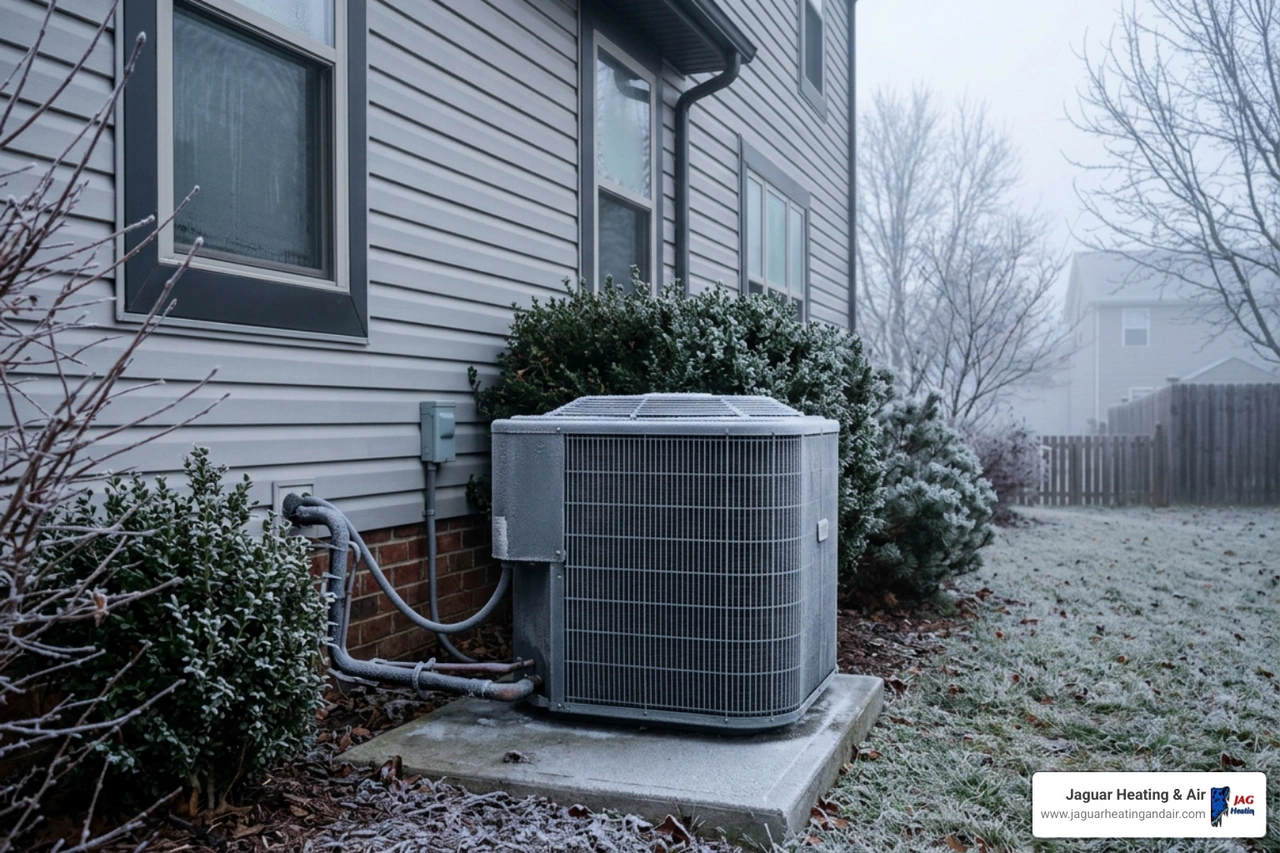
During a typical clear winter day in Sacramento or Roseville, the sun provides substantial "passive solar heat gain" through your windows, naturally warming your walls and roof. This daytime solar assist allows your furnace or heat pump to take a much-needed break.
During tule fog season, however, the sun is completely blocked. The temperature remains locked in a damp, all-day chill. This lack of natural warming, combined with high outdoor humidity, means your heating system has to run much longer to maintain a comfortable indoor climate.
Here is a quick look at how heating performance compares between clear and foggy winter conditions:
| Heating Variable | Clear Winter Day | Tule Fog Winter Day |
|---|---|---|
| Solar Heat Gain | Moderate to High (helps warm the home) | Extremely Low to None (blocked by fog) |
| Outdoor Relative Humidity | Moderate (40% - 60%) | Extremely High (90% - 100%) |
| Daytime Temperature Recovery | Significant warming by afternoon | Minimal change; persistent ground-level chill |
| Heating System Run Time | Intermittent (cycles off during peak sun) | Continuous or prolonged cycles |
| Energy Consumption | Standard / Baseline | Elevated due to longer cycles and defrost needs |
Thermostat Adjustments: How Tule Fog Season Affects Your Heating Comfort
Have you ever noticed that 68°F indoors feels perfectly cozy on a sunny spring day, but feels downright drafty and freezing when the tule fog rolls in? That isn't just in your head. High outdoor humidity easily migrates indoors, raising the relative humidity inside your home.
Damp air has a higher heat capacity than dry air, which means it conducts heat away from your body more quickly. Additionally, the lack of sunlight keeps your home's exterior walls, windows, and doors cold to the touch. These cold surfaces radiate chill directly into your living spaces.
When homeowners feel this damp, bone-chilling cold, their natural reaction is to walk over to the thermostat and bump it up a few degrees. While this makes you feel warmer, raising the thermostat forces your furnace to run even longer, compounding your energy bills.
If your furnace is struggling to keep up during these damp stretches, or if you notice your Why Furnace Not Blowing Warm Air, it could be a sign that the relentless runtime is exposing a mechanical issue that requires professional attention.
Heat Pump Defrost Cycles: How Tule Fog Season Affects Your Heating Efficiency
For homeowners in Sacramento, Citrus Heights, and Rancho Cordova who rely on electric heat pumps, tule fog presents a unique mechanical challenge. A heat pump works by extracting heat from the outdoor air and transferring it indoors.
During a dense tule fog event, the outdoor air is saturated with moisture (often near 100% relative humidity) and temperatures hover in the 30s or low 40s. As the heat pump extracts heat, the temperature of the outdoor coil drops below freezing. The heavy moisture in the fog instantly condenses and freezes onto these cold coils, forming a thick layer of frost or ice.
To prevent itself from turning into a solid block of ice, the heat pump must periodically enter a defrost cycle. During this cycle:
- The system temporarily reverses its operation, running in cooling mode to send warm refrigerant back to the outdoor coils to melt the ice.
- Because running in cooling mode would otherwise blow cold air into your home, the system activates its auxiliary electric resistance heat strips (often called "heat strips" or "emergency heat") to keep the indoor air warm.
- These auxiliary heat strips require significantly more electricity than standard heat pump operation, leading to a temporary spike in energy consumption.
If your heat pump is constantly cycling into defrost mode, or if you suspect your heating elements are failing, it is critical to address it before winter peaks. If you are experiencing ignition issues with a dual-fuel or gas system, you can read about the Reasons Furnace Won't Ignite Elk Grove CA to understand what might be stalling your system.
Microclimates, Insulation, and Indoor Air Quality Challenges
The geography of the greater Sacramento area means that winter weather is not uniform. Microclimates play a huge role in how much heating your home actually needs.
Valley Gloom vs. Foothill Sunshine: Microclimates and Sizing
Our region experiences "two different winters" simultaneously. While valley locations like Sacramento, Elk Grove, and Woodland are trapped under a thick, chilly blanket of gray, foothill communities like El Dorado Hills and parts of Folsom often sit safely above the inversion layer, enjoying clear blue skies and warm sunshine.
This stark temperature contrast means a home in the valley floor will require much more consistent heating and longer run times than an identically sized home in the foothills. When designing and installing heating systems, professional HVAC technicians must carefully calculate these local microclimates. A system sized for a sunny foothill home might struggle to keep up on the damp, sunless valley floor.
To ensure your system is operating at peak efficiency regardless of where you live, scheduling routine Heating Maintenance Sacramento CA is the best way to keep your system calibrated for local conditions.
Drafts, Insulation, and Moisture Control
When the tule fog settles in, your home's structural weak points are quickly exposed. Because the damp cold is relentless, heat loss occurs continuously through under-insulated attics, poorly sealed ductwork, and older windows.
Single-pane windows are especially problematic during fog season. The extreme temperature difference between the cold, damp outdoor air and the warm, heated indoor air causes the glass to drop below the dew point. This results in "window sweating"—heavy condensation dripping down the glass onto the wooden sills, which can quickly lead to wood rot and localized mold growth.
To protect your home and keep your heating system running efficiently, it's highly recommended to take proactive steps before the fog rolls in. Learn How to Get Heating System Ready for Winter by sealing drafts, checking insulation levels, and inspecting your windows.
Indoor Air Quality: Mold Risks and Trapped Pollutants
Because tule fog keeps homes closed up tight for weeks at a time, indoor air quality (IAQ) can degrade rapidly. The high outdoor humidity makes it incredibly easy for indoor humidity levels to cross the critical 60% relative humidity threshold.
Once relative humidity exceeds 60%, it creates an ideal breeding ground for mold and mildew. Mold spores can germinate and begin growing on damp drywall, window frames, and inside dark closets on exterior walls within 24 to 48 hours of sustained high humidity.
Furthermore, the very same temperature inversions that trap cold air at ground level also trap localized air pollutants. Particulate matter (PM2.5) from fireplaces, vehicle exhaust, agricultural dust, and lingering wildfire smoke residue gets pinned down in the valley floor. When you run your heating system, these trapped pollutants can be pulled into your home.
To combat these indoor air quality challenges:
- Run exhaust fans in the bathroom and kitchen for at least 20 minutes after bathing or cooking to vent excess moisture outdoors.
- Upgrade to MERV 13 air filters if your HVAC system's manufacturer specifications allow it. These high-efficiency filters are dense enough to trap microscopic mold spores, pollen, and PM2.5 particles.
- Consider a whole-home dehumidifier to actively pull moisture out of the air, keeping your indoor relative humidity in the healthy 30% to 50% range.
Frequently Asked Questions About Tule Fog and Home Heating
Does tule fog actually make my house colder, or does it just feel that way?
It is a combination of both. High relative humidity makes the air feel significantly colder than dry air at the exact same temperature because damp air conducts heat away from your skin much faster.
Additionally, because the fog completely blocks the sun, your home's exterior structure remains cold all day. Without solar warming, your walls and windows constantly draw heat out of your living spaces, forcing you to rely entirely on your heating system.
If your home is struggling to maintain a stable, comfortable temperature during these damp stretches, it may be time to consult a professional for Heating Repair Sacramento CA to ensure your system is operating at full capacity.
Is it normal for my heater to run more during a long, foggy stretch?
Yes, this is completely normal. Because there is no daytime solar heat gain to warm your home naturally, your heating system must run longer and cycle more frequently to offset the continuous heat loss.
However, if your system is running constantly without ever reaching your thermostat setpoint, or if you hear unusual noises, it could indicate that the extended run times are putting excessive wear and tear on your blower motor, heat exchanger, or compressor.
Is it safe to run my heating system during heavy tule fog?
Yes, it is highly recommended to run your heating system during heavy fog. Running your system keeps the air circulating, which prevents cold, stagnant pockets of damp air from settling in your closets and corners where mold likes to grow.
Just make sure your air filters are clean so you are effectively filtering out the trapped winter pollutants, and ensure your outdoor heat pump unit is free of debris so it can drain melted frost properly during its defrost cycles.
Conclusion
Tule fog is a hallmark of winter in the Central Valley, bringing a distinct set of challenges to our homes, our comfort, and our heating systems. From the damp, bone-chilling cold that keeps our furnaces running overtime to the moisture-heavy air that stresses our heat pumps and threatens our indoor air quality, managing your home comfort during fog season requires local expertise.
At Jaguar Heating & Air, we are a family-owned HVAC company proudly serving Sacramento, Elk Grove, Folsom, Roseville, El Dorado Hills, Lincoln, Rocklin, Woodland, Carmichael, Citrus Heights, Fair Oaks, Granite Bay, Mather, Orangevale, and Rancho Cordova, CA.
As a Trane Comfort Specialist with a team of NATE-certified technicians, we are dedicated to keeping your home warm, dry, and healthy all winter long. We offer flat-rate pricing, same-day service, and a 100% customer satisfaction guarantee.
Whether you need a seasonal tune-up to prepare for the heavy valley fog, an emergency repair on a freezing morning, or an upgrade to a high-efficiency heating system, we are here to help. Contact us today to explore our comprehensive Jaguar Heating & Air services and keep your home cozy all season long.
Recent Posts

Decoding Fall HVAC Startups: Your Guide to Maintenance and AC Repair in Sacramento, CA
Navigating the October Shift: When Sacramento Weather Demands Both Cooling and Heating October in the Central Valley brings a sudden, sharp transition in weathe
Decoding the October Heating Startup: AC Repair and Fall Maintenance in Sacramento, CA
Burning dust smells on the first chilly night? Use this seasonal home maintenance checklist to see what is normal and when to call a pro on this startup.
Why Your Thermostat Blanking Out Might Just Be a Blown Low-Voltage Fuse
A completely dead thermostat screen right as fall begins often triggers panic. See why a blown 3-amp low-voltage fuse is actually protecting your furnace control board.