.avif)
Why We Check the Evaporator Coil First When Your Home Won't Cool Below 78
When your AC runs non-stop but the thermostat is stuck at 78 degrees, it usually isn't a refrigerant leak. A hidden airflow restriction at the indoor coil is often the true culprit.
When your AC runs non-stop but the thermostat is stuck at 78 degrees, it usually isn't a refrigerant leak. A hidden airflow restriction at the indoor coil is often the true culprit.

The Frustration of an AC System That Won't Budge Past 78
It is a common misconception that when your air conditioner is running constantly but your house is stuck at 78 degrees indoors, the system simply needs a "Freon" top-off. Here is the truth: understanding exactly why we check the evaporator coil first when your home won't cool below 78 is the key to solving the real problem, rather than just treating a symptom. That stubborn temperature plateau usually points to a hidden airflow restriction deep inside the indoor unit. To fix the issue properly, a professional has to look at the components most homeowners never see.
For comprehensive Air Conditioning solutions, a proper diagnostic is where everything begins.
The Illusion of the Refrigerant Leak
When your system runs for hours on end without dropping the temperature, it is natural to assume something is empty and needs to be refilled. You hear the vents blowing, you feel slightly cool air coming out, but the thermostat refuses to budge. This specific discomfort—the feeling of paying for electricity while still sweating inside your own home—drives many people to request a quick refrigerant charge. However, jumping straight to that conclusion ignores how air conditioning actually works.
The real issue: A cooling plateau rarely means your system is out of refrigerant. Instead, it usually means your system has lost its physical ability to absorb heat from your indoor air. The machinery is working as hard as it can, but a microscopic barrier is standing in the way of thermal transfer. To understand why your house is stuck at 78 degrees indoors, we have to look at the science of how your system removes heat.
The Thermodynamics of a Cooling Plateau
Air conditioners do not actually "create" cold air. Instead, they operate on the principle of thermal transfer. Your system acts like a sponge for heat, absorbing the warmth from your indoor air and pumping it outside. When your system is stuck at 78 degrees indoors, it means that the "sponge" is full or blocked, and it can no longer absorb heat fast enough to overcome the heat entering your home.
The Battle Between Indoor Capacity and Outdoor Heat
During the peak of summer, Sacramento's triple-digit ambient temperatures create a massive outdoor thermal load. The sun beats down on your roof, heat radiates through your windows, and warm air tries to infiltrate every crack in your home's envelope. Your air conditioner has to extract heat faster than the outdoor weather pushes it inside.
One local homeowner called us during triple-digit heat because their house simply was not getting cool, despite the system running non-stop. When our technician arrived, they explained the problem wasn't a broken unit, but a thermodynamics issue where the indoor unit could no longer absorb enough heat to fight the outdoor weather. After walking the homeowner through all available options and resolving the restriction, the house was finally cool again.
When any slight inefficiency occurs indoors, you get a noticeable temperature plateau. The system has enough capacity to stop the house from reaching 90 degrees, but it lacks the capacity to pull the temperature down to a comfortable 72 degrees. If you need AC repair, understanding this balance is the first step. A system running continuously but plateauing is sending a clear signal: its heat absorption capacity is restricted.
Why the Evaporator Coil is the Hidden Culprit in Late Summer
Inside your indoor unit sits the evaporator coil. This A-shaped or N-shaped web of copper tubing and aluminum fins is the exact location where the refrigerant absorbs the heat from your home's air. Because this coil gets very cold during operation, it naturally pulls humidity out of the air, making the metal fins wet with condensation.
The Microscopic Blanket of Dirt
Over the course of a long cooling season, your system circulates thousands of cubic feet of air every hour. Even with a good air filter, microscopic particles slip through. By the time an August late-summer heatwave hits, your AC has likely run for hundreds of hours. The dry, dusty conditions typical of late-summer in Sacramento accelerate the buildup of debris on that wet indoor coil. Pet dander, skin cells, cooking oils, and fine dust stick to the wet metal, baking into a restrictive paste.
• The insulation effect: Dirt acts as a highly effective insulator. It physically blocks the warm indoor air from touching the cold metal of the coil.
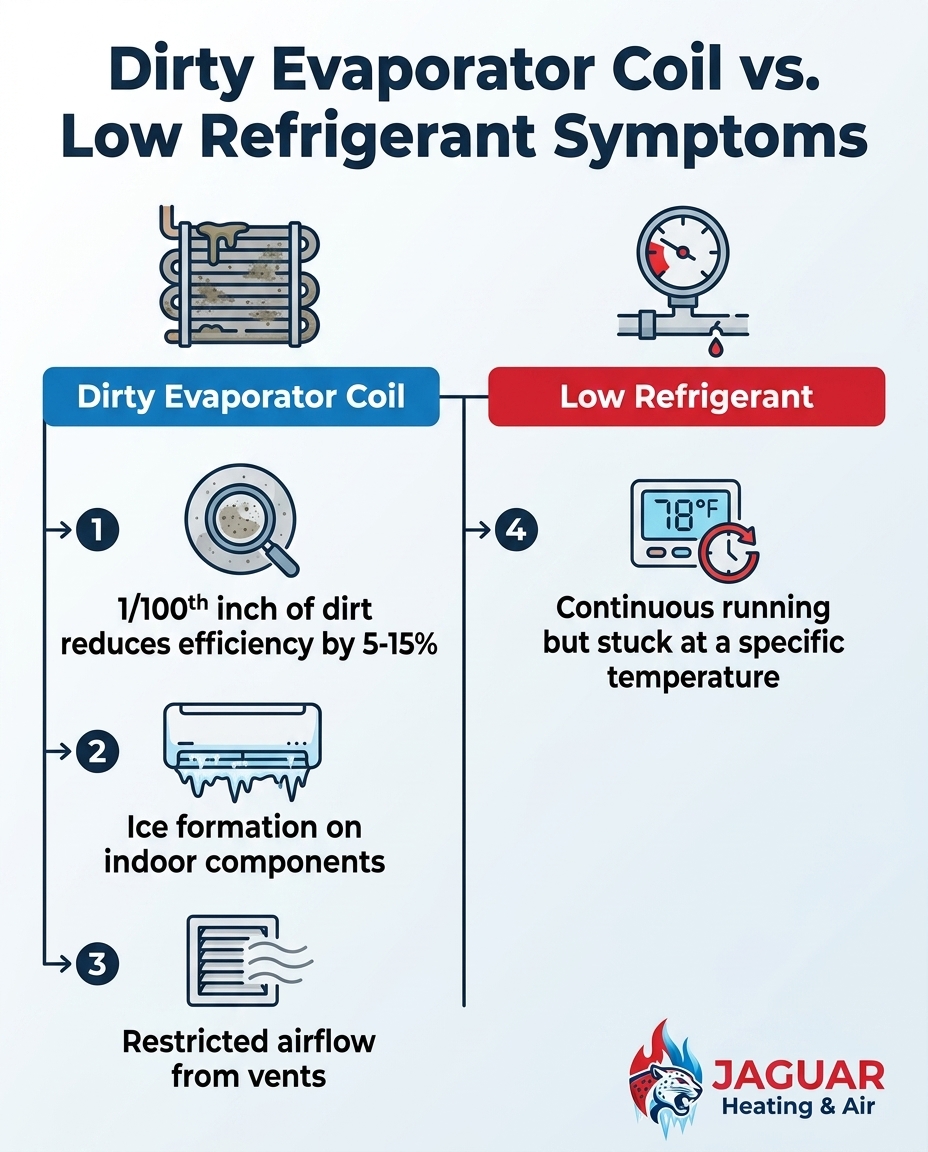
• The efficiency drop: A buildup of just 1/100th of an inch of dirt on an evaporator coil can reduce your entire system's efficiency by 5% to 15%.
• The airflow choke: As the dirt thickens, it clogs the tiny spaces between the aluminum fins, severely restricting how much air can physically pass through the system.
This is why a cooling plateau happens. The microscopic barrier prevents the refrigerant from absorbing indoor heat. If your system is struggling with airflow, professional duct cleaning and coil maintenance are often the most effective ways to restore performance before the next heatwave hits.
The Myth of the Quick Freon Charge
Assuming your system just needs a refrigerant top-off is a costly mistake. Air conditioning systems are closed loops. The refrigerant travels in a continuous circle between the indoor and outdoor units; it does not "burn up" or get consumed like gas in a car over the summer. If your system is genuinely low on refrigerant, it means there is a physical hole in the copper tubing that must be found and repaired.
Overlapping Symptoms, Different Causes
The danger of misdiagnosis is severe. If a technician simply adds refrigerant to a system that actually has a dirty evaporator coil, the excess pressure can cause catastrophic damage to the compressor outside. Because the symptoms overlap so closely, it is critical to know the difference.
• Thermostat Behavior — Dirty Evaporator Coil: Stuck at 78 degrees indoors despite constant running — Low Refrigerant (Leak): Stuck at 78 degrees indoors despite constant running
• Airflow from Vents — Dirty Evaporator Coil: Noticeably weak or restricted airflow — Low Refrigerant (Leak): Normal airflow volume, but the air feels lukewarm
• Ice Formation — Dirty Evaporator Coil: Ice builds up on the indoor coil due to trapped cold — Low Refrigerant (Leak): Ice builds up on the outdoor refrigerant lines
• Root Cause — Dirty Evaporator Coil: Months of dust buildup acting as insulation — Low Refrigerant (Leak): A physical hole or leak in the closed copper loop
When you understand that adding refrigerant to a dirty system is dangerous, you can see why professional diagnostics focus on airflow and cleanliness first.
Inside Our Diagnostic Process: Why We Check the Coil First
When we arrive at a home that is stuck at 78 degrees indoors, we do not guess. Our transparent diagnostic process builds trust by showing homeowners exactly why we inspect specific components. We want you to understand the "why" behind the repair. Another customer called in the morning because their unit was not functioning correctly and couldn't break that 78-degree mark. Our technician fixed the unit before noon and took the time to explain exactly what was wrong by showing them the physical airflow restriction.
The Step-by-Step Evaluation
1. Thermostat and Airflow Check: We start by verifying the thermostat settings and feeling the volume of air coming out of your vents. Weak airflow immediately points us toward the indoor unit.
2. Measuring Temperature Drop (Delta T): We use specialized digital thermometers to measure the air temperature entering the return vent and the air temperature leaving the supply vents. A healthy system should have a specific temperature drop (usually 16 to 20 degrees). If the drop is incorrect, it confirms a thermal transfer issue.
3. Static Pressure Testing: We check the air pressure inside the ductwork to see how hard the blower motor is working to push air through the system. High pressure indicates a blockage, often at the coil.
4. Visual Coil Inspection: We safely open the indoor air handler to inspect the evaporator coil directly. We look for the insulating layer of dust, pet hair, and potential ice formation. Ice forms because the restricted airflow traps the cold inside the coil, causing the condensation to freeze solid.
A strict warning: Accessing and evaluating the evaporator coil safely requires professional training and specialized tools. The coil fins are razor-sharp and easily crushed, and the surrounding electrical components carry high voltage. This is not a DIY project; it requires a licensed professional to diagnose and correct safely.
The Ripple Effect: How a Dirty Coil Strains Your Entire System
Ignoring a temperature plateau does more than just keep you uncomfortable during an August late-summer heatwave. When the evaporator coil is choked with dirt, it sets off a chain reaction of mechanical stress throughout your entire HVAC system. A temperature plateau is an early warning sign of impending component failure.
Mechanical Stress and High Utility Bills
First, your blower motor is forced to work overtime. Because the dirt restricts the physical space for air to pass through, the motor has to push much harder against the resistance. This continuous, high-strain operation draws excessive electricity, driving up your utility bills. If your AC blower motor sounds like a jet engine, it is likely fighting against a severe airflow restriction.
Second, and more dangerously, a dirty coil threatens your outdoor compressor. The refrigerant enters the indoor coil as a cold liquid and is supposed to absorb enough heat to boil into a warm gas before returning outside. If the dirt prevents the refrigerant from absorbing heat, it returns to the outdoor compressor as a liquid. Compressors are designed to pump gas, not liquid. This condition, known as "liquid slugging," can destroy a compressor entirely, turning a routine cleaning into a major system replacement.
Restoring Thermal Transfer and Cooling Capacity
The solution to an August late-summer heatwave cooling plateau is a professional coil cleaning. Once the insulating layer of dirt is safely removed, the system can finally breathe again.
The Professional Cleaning Process
Our technicians use specialized, non-acidic foaming cleaners designed specifically for indoor coils. This foam expands deep into the aluminum fins, lifting the baked-on dirt, pet dander, and biological growth to the surface. We then carefully rinse the coil, allowing the debris to flow safely down the condensate drain line. If any of the delicate aluminum fins were crushed or bent, we use specialized fin combs to straighten them, further improving airflow.
Once proper airflow is restored, the system can finally overcome the outdoor thermal load. The home will begin to cool down steadily, finally breaking past that stubborn 78-degree mark. To prevent this issue from ruining future summers, regular AC maintenance is essential. Having the coil inspected and cleaned before the heavy cooling season begins ensures that your system maintains maximum heat absorption capacity all summer long.
Frequently Asked Questions
Why won't my AC cool below 78 degrees?
Your system likely has an airflow restriction preventing it from absorbing enough heat. When an AC plateaus at a specific temperature, it means the unit is working, but it lacks the thermal transfer capacity to overcome the outdoor heat.
What happens when an AC evaporator coil gets dirty?
Dirt acts as an insulator on the metal coil. This microscopic blanket prevents the cold refrigerant inside the coil from absorbing the heat from your indoor air, severely dropping the system's cooling efficiency.
Why do HVAC techs check the indoor coil first?
Technicians check the indoor coil first because it is the primary site of heat absorption. Most cooling plateaus are caused by dirty coils restricting airflow, rather than a mechanical failure or a refrigerant leak.
Can a dirty evaporator coil cause the AC to run constantly?
Yes, a dirty coil forces the system to run constantly. Because the system cannot absorb heat efficiently, the thermostat never reaches its target temperature, forcing the unit to run non-stop in a futile attempt to cool the house.
How do I know if the problem is low refrigerant or a dirty coil?
You need a professional diagnostic to measure the system's temperature drop and pressure levels. While both issues cause the system to run constantly without cooling the house, adding refrigerant to a dirty coil can cause severe damage to the compressor.
Get Your Cooling Capacity Back on Track
You do not have to settle for a house that refuses to cool down. Understanding why we check the evaporator coil first when your home won't cool below 78 is the first step toward real comfort. If you are tired of your AC running constantly without results, reach out for a professional diagnostic today.
Recent Posts
Decoding Fall HVAC Startups: Your Guide to Maintenance and AC Repair in Sacramento, CA
Navigating the October Shift: When Sacramento Weather Demands Both Cooling and Heating October in the Central Valley brings a sudden, sharp transition in weathe
Decoding the October Heating Startup: AC Repair and Fall Maintenance in Sacramento, CA
Burning dust smells on the first chilly night? Use this seasonal home maintenance checklist to see what is normal and when to call a pro on this startup.
Why Your Thermostat Blanking Out Might Just Be a Blown Low-Voltage Fuse
A completely dead thermostat screen right as fall begins often triggers panic. See why a blown 3-amp low-voltage fuse is actually protecting your furnace control board.