.avif)
The Danger of Oversized AC Units in Smaller East Sacramento Homes
A fast-cooling air conditioner might sound great, but it often leaves historic homes feeling damp and clammy. Learn why bigger isn't always better for your indoor comfort.
A fast-cooling air conditioner might sound great, but it often leaves historic homes feeling damp and clammy. Learn why bigger isn't always better for your indoor comfort.

Escaping the Clammy Chill: When Your AC Works Too Fast
Your thermostat says the room is a cool 70 degrees, but the air feels heavy, damp, and uncomfortably cold—a classic symptom of the danger of oversized AC units in smaller East Sacramento homes. You might find yourself reaching for a sweater indoors, even while the intense dry heat of a Sacramento afternoon rages outside. This jarring, unnatural contrast happens when a cooling system is simply too large for the space it serves. Instead of providing steady, comfortable relief, an oversized system blasts the house with frigid air and shuts off within minutes. While rapid cooling might sound like a benefit during August late-summer cooling, our team at Jaguar Heating & Air often sees how it actually creates a frustrating and miserable indoor environment.
When an air conditioner works too fast, it fails to perform its secondary, equally critical job: removing humidity. The result is a home that cools down in a fraction of the normal time but leaves you feeling clammy and chilled to the bone. Recognizing these distinct symptoms is the first step toward reclaiming your indoor comfort. Rather than simply living with the dampness as we transition into the back-to-school season, it is time to stop accepting the discomfort and have our professionals evaluate your system's actual load requirements. For comprehensive solutions, explore our Air Conditioning services and learn more about AC Installation in Sacramento.
How East Sacramento Historic Neighborhoods Challenge Standard AC Sizing
In our years of experience servicing East Sacramento historic neighborhoods, we consistently find that their architectural charm comes with unique structural characteristics that make standard HVAC sizing formulas dangerously inaccurate. Homes built between the 1920s and 1940s were constructed with entirely different materials and thermal properties than modern suburban builds. Lath and plaster walls, original hardwood floors over crawlspaces, and older insulation standards create a thermal envelope that behaves differently under the stress of summer heat. When contractors use a generic "rule of thumb"—such as assigning one ton of cooling capacity for every 400 to 500 square feet—they completely ignore the specific heat-gain profile of these older, smaller homes.
Modern suburban homes are often built tightly, with thick insulation and large, centralized duct systems designed to handle high volumes of air. In contrast, older homes often feature smaller, original footprints that simply do not require massive amounts of raw cooling power. Defaulting to the largest available unit without considering the home's specific thermal envelope is a recipe for chronic discomfort and mechanical failure.
The Impact of Outdated Ductwork on Modern Systems
Our technicians frequently find that the most significant bottleneck in historic homes is the existing ductwork. Older ducts were often designed for heating only, or for early, low-capacity air conditioning systems. They simply cannot handle the high cubic feet per minute (CFM) output of today's oversized units.
Forcing too much air through small ducts creates a host of secondary problems. High static pressure builds up inside the duct system, forcing the blower motor to work against intense resistance. This not only causes excessive noise at the vents—often sounding like a wind tunnel—but it also leads to uneven cooling, blown duct seals, and conditioned air leaking into attics or crawlspaces before it ever reaches your living room.
The Physics of Cooling: Why Bigger Isn't Better for Humidity Control
To understand why an oversized unit leaves your home feeling damp, you have to look at the physics of how air conditioning actually works. An air conditioner has two fundamental jobs: lowering the ambient temperature and removing moisture from the air (dehumidification). These two processes happen simultaneously, but they do not happen at the same speed.
Dehumidification requires the system to run for a sustained period. Warm, moist indoor air is pulled across the freezing-cold evaporator coil. As the air passes over the coil, the moisture in the air condenses into water droplets—much like condensation forming on the outside of a cold glass of water on a summer day. Those droplets then fall into a drain pan and are channeled out of your home. However, it takes time for the coil to get cold enough, and for enough air to pass over it, to effectively extract that moisture.
When an oversized unit blasts massive amounts of cold air into a smaller space, the thermostat reaches its set temperature far too quickly. The system shuts off before the moisture can be extracted. The cold air remains, but the humidity is left behind, creating that cold, clammy feeling that drives homeowners to constantly adjust their thermostats. Just this late summer, our team at Jaguar Heating & Air had a Sacramento homeowner reach out during triple digit heat because their AC system was not cooling the house effectively—it felt incredibly damp despite running constantly. Once our technicians explained the underlying airflow and sizing problems and clearly presented all available options, adjustments were made, and the house is now cooling down significantly with proper dehumidification. If you are struggling with heavy, damp indoor air, exploring Indoor Air Quality Solutions can help mitigate the problem while addressing the root cause.
• Cooling Cycle Length — Properly Sized AC Unit: 15 to 20 minutes per cycle — Oversized AC Unit: Under 10 minutes (Short-cycling)
• Humidity Control — Properly Sized AC Unit: Excellent moisture extraction — Oversized AC Unit: Poor; leaves air feeling clammy
• Temperature Evenness — Properly Sized AC Unit: Consistent across most rooms — Oversized AC Unit: Severe hot and cold spots
• Energy Consumption — Properly Sized AC Unit: Steady, predictable usage — Oversized AC Unit: High spikes from frequent motor starts
Spotting the Warning Signs of an Oversized Air Conditioner
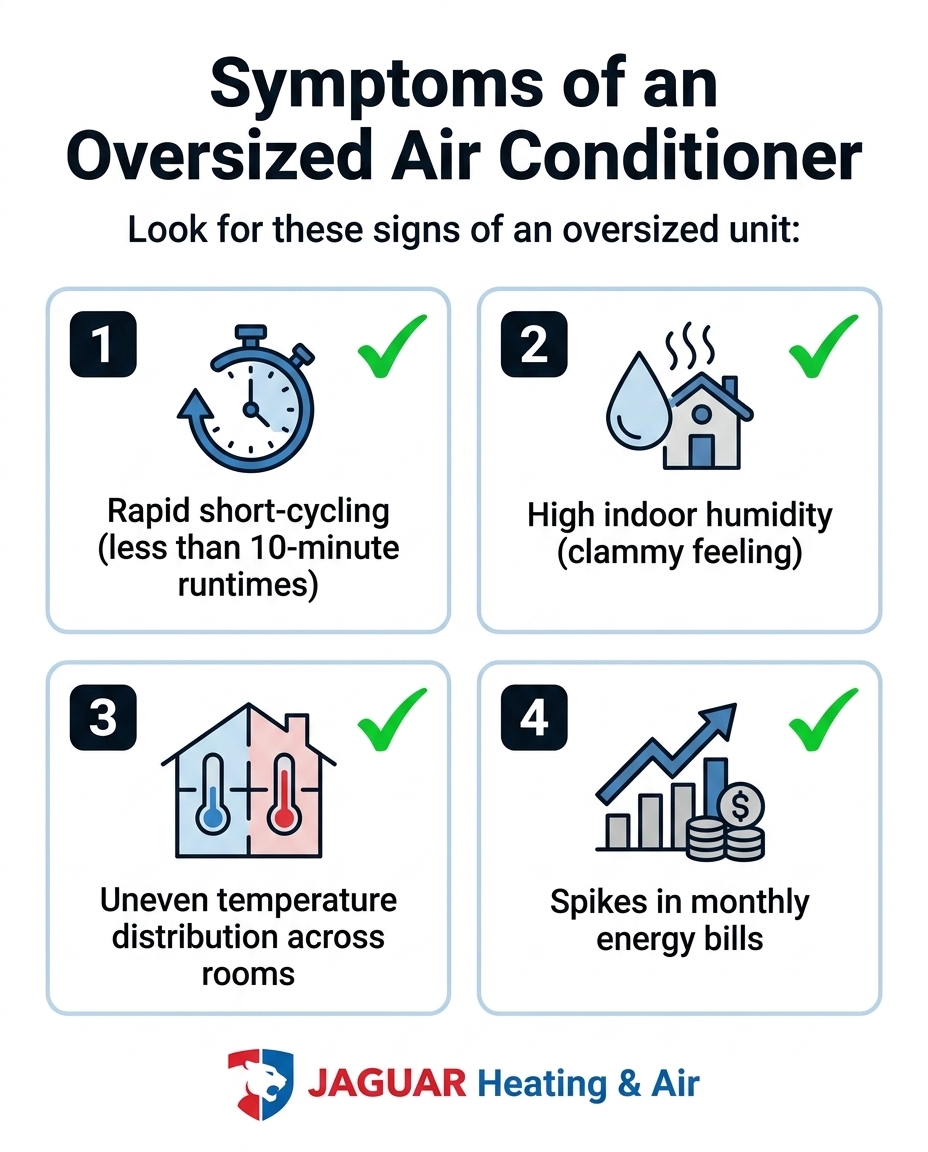
If you suspect your system is too large for your home's actual cooling load, the equipment will usually give you clear operational clues. You do not need to be an HVAC technician to spot the symptoms; you just need to know what to listen and feel for. When we inspect homes in the area, we advise homeowners to pay attention to these primary warning signs:
• Rapid short-cycling intervals: The unit turns on, blasts cold air for less than 10 minutes, and abruptly shuts off, only to turn back on a few minutes later.
• Unusually high energy bills: Your monthly utility costs spike because the compressor requires a massive surge of electricity every time it starts up.
• Noticeable temperature swings: The room with the thermostat cools down instantly and shuts the system off, leaving other rooms in the house hot and stuffy.
• Excessive operational noise: When the system turns on, the rush of air sounds like a jet engine at the return vent rather than a smooth, quiet hum.
• A persistent feeling of dampness: The air feels heavy and clammy, forcing you to lower the thermostat even further just to feel comfortable.
If these symptoms sound familiar, your system is likely struggling with rapid short-cycling intervals. For a deeper dive into the mechanical side of this issue, read our guide on Diagnosing a Short-Cycling AC Unit.
The Hidden Toll of Rapid Short-Cycling Intervals on Your System
Beyond the immediate discomfort of a clammy home, an oversized air conditioner is actively destroying itself from the inside out. The most stressful and energy-intensive part of an air conditioner's operation is the startup phase. When the system kicks on, the compressor draws five to seven times its normal running current to overcome inertia and start pumping refrigerant.
In a properly sized system, this massive energy draw happens two or three times an hour on a hot day. In an oversized system experiencing rapid short-cycling intervals, the compressor might start six, eight, or even ten times an hour. This constant stop-and-go operation is the mechanical equivalent of driving a car exclusively in heavy, bumper-to-bumper city traffic. It accelerates wear and tear on the compressor, pits the electrical contactors, and drains the capacitors long before their expected lifespan.
This relentless cycle also exacts a heavy financial toll. Because starting the motor repeatedly draws massive amounts of electricity, your energy bills will be significantly higher than if a smaller unit were running continuously. Furthermore, as HVAC professionals, we often see this constant on/off cycling exacerbate late-season system wear, leading to sudden, catastrophic breakdowns right when August late-summer cooling demands are at their peak. Protecting your investment means addressing these mechanical stresses early through professional AC Repair in Sacramento.
Replacing Guesswork with Precision Load Calculations
The only way to definitively solve the problem of an oversized AC unit is to abandon guesswork in favor of hard science. The Air Conditioning Contractors of America (ACCA) established the Manual J load calculation as the strict industry standard for determining the exact cooling capacity a specific home requires. At Jaguar Heating & Air, we provide expert, precision load calculations to ensure the right-sized unit for historic and smaller homes, prioritizing your comfort and efficiency over upselling the biggest system available.
A proper Manual J calculation is a comprehensive assessment that takes multiple distinct variables into account. Our professional technicians will measure:
1. Exact square footage and ceiling height: Determining the total cubic volume of air that needs to be conditioned.
2. Window placement and quality: Evaluating the solar heat gain through single-pane versus double-pane glass, and which direction the windows face.
3. Insulation quality: Inspecting the R-value of the insulation in the attic, walls, and crawlspaces to see how much heat penetrates the thermal envelope.
4. Ductwork condition: Testing the existing ducts to ensure they can handle the proposed airflow without creating excessive static pressure.
This scientific approach stands in stark contrast to contractors who use outdated estimates or simply replace a failing unit with a larger one "just to be safe." Sometimes, a holistic assessment reveals that the equipment size isn't the only issue. For example, one of our local customers recently called us for a replacement estimate for an AC unit they assumed was failing. Instead of just giving an estimate for a costly new system, our technician thoroughly inspected and cleaned the existing AC unit. The outcome was clear: no new AC unit was needed after the cleaning restored proper airflow and efficiency. Proper diagnosis prevents unnecessary expenses and guarantees that your home receives exactly the cooling power it needs.
Frequently Asked Questions About AC Sizing and Comfort
Why does my house feel damp with the AC on?
Your house feels damp because the air conditioner is cooling the air too quickly without running long enough to remove the humidity. Air conditioners need sustained runtimes (usually 15 to 20 minutes) to pull moisture out of the indoor air. When an oversized unit short-cycles, it leaves the moisture behind, resulting in a cold but clammy environment.
What happens if my AC unit is too big?
If your AC unit is too big, it will cool your home rapidly and shut off prematurely, a process known as short-cycling. This prevents the system from dehumidifying the air properly, leading to indoor discomfort. Additionally, the constant starting and stopping causes severe mechanical wear on the compressor and drives up your monthly energy bills.
How do I know if my AC is oversized?
You can identify an oversized AC by watching for short, rapid cooling cycles that last less than 10 minutes. Other strong indicators include a persistently clammy feeling indoors, significant temperature differences between rooms, and unusually high electricity bills during the summer months. If you notice these signs, a professional load calculation by our team can confirm the sizing issue.
Does a larger AC cool a house better?
No, a larger AC does not cool a house better; it actually performs worse when it comes to overall comfort. While a larger unit drops the temperature faster, it fails to remove humidity, leaving the air feeling heavy and damp. Proper cooling requires a delicate balance of temperature reduction and moisture removal, which only a correctly sized unit can achieve.
Can short-cycling be fixed without replacing the whole unit?
Our technicians find that sometimes short-cycling can be resolved without a full replacement if the root cause is an airflow restriction rather than an oversized unit. Clogged filters, dirty evaporator coils, or blocked return vents can mimic the symptoms of an oversized system by causing the unit to overheat and shut down prematurely. A professional diagnostic is required to determine whether the issue is mechanical, airflow-related, or a fundamental sizing mismatch.
How long should a properly sized AC run during a Sacramento summer?
During the peak heat of a Sacramento summer, a properly sized air conditioner should run for about 15 to 20 minutes per cycle to efficiently cool and dehumidify the home. On days with extreme triple-digit temperatures, it is completely normal for a correctly sized system to run almost continuously to maintain your set temperature. This steady operation is far more efficient and better for the equipment than turning on and off every five minutes.
Restore Genuine Comfort to Your Historic Home
The persistent myth that "bigger is better" has left far too many homeowners in East Sacramento historic neighborhoods shivering in damp, clammy living rooms. Validating your frustration is the first step: a cold house that feels uncomfortable is a clear sign that your system is working against your home's natural architecture. You do not have to settle for rapid short-cycling intervals and high energy bills. By securing a professional, precision load calculation from Jaguar Heating & Air, you can ensure your cooling system matches your home's exact needs. Reach out to our local experts today to schedule a thorough assessment and restore genuine, lasting comfort to your living space.
Recent Posts
Decoding Fall HVAC Startups: Your Guide to Maintenance and AC Repair in Sacramento, CA
Navigating the October Shift: When Sacramento Weather Demands Both Cooling and Heating October in the Central Valley brings a sudden, sharp transition in weathe
Decoding the October Heating Startup: AC Repair and Fall Maintenance in Sacramento, CA
Burning dust smells on the first chilly night? Use this seasonal home maintenance checklist to see what is normal and when to call a pro on this startup.
Why Your Thermostat Blanking Out Might Just Be a Blown Low-Voltage Fuse
A completely dead thermostat screen right as fall begins often triggers panic. See why a blown 3-amp low-voltage fuse is actually protecting your furnace control board.