.avif)
Deciding Between a Single-Stage and Variable-Speed AC for Sacramento Summers
Facing an end-of-season AC failure during the August heat means making a fast upgrade choice. See how efficiency and daily comfort differ between system types.
Facing an end-of-season AC failure during the August heat means making a fast upgrade choice. See how efficiency and daily comfort differ between system types.

Surviving Late Summer: Making the Right AC Upgrade Call
August in the Valley is unforgiving, and deciding between a single-stage and variable-speed AC for Sacramento summers becomes an urgent reality when your old unit finally quits. By the time late summer rolls around and the back-to-school transition begins, your cooling system has likely been running non-stop for months. The constant strain of triple-digit days wears down aging compressors, making August a notorious month for end-of-season breakdowns. When you are left sweating in your own living room, the fatigue sets in quickly, and the pressure to make a fast replacement choice feels overwhelming.
However, rushing into a replacement without understanding your options can leave you with a system that struggles to keep up with the local climate. Your primary dilemma is straightforward: do you replace your broken equipment with a standard single-stage model, or do you upgrade to a highly efficient variable-speed system? Making the right choice requires balancing your daily comfort needs, the long-term energy efficiency of your home, and the specific footprint of your ductwork.
Need immediate assistance? Learn more about our comprehensive Air Conditioning services or schedule an AC replacement in Sacramento to restore your home's comfort today.
How Sacramento's Triple-Digit Heat Impacts Your AC Choice
When evaluating air conditioning systems, it is critical to look beyond national averages and focus on the specific climate of Sacramento, CA. The intense, dry heat of the Central Valley places a unique burden on residential cooling equipment. While homes in milder coastal climates might only need their AC for a few hours in the afternoon, inland homes demand consistent, high-capacity cooling just to maintain a livable indoor temperature.
In our years of restoring comfort to local homes at Jaguar Heating & Air, our team typically sees that prolonged heatwaves are the ultimate stress test for any HVAC system. When temperatures soar past 100 degrees for several consecutive days, the structural materials of your house—the roof, the framing, and the insulation—absorb and retain massive amounts of thermal energy. This thermal mass continues to radiate heat into your living spaces long after the sun goes down.
The Strain of Prolonged Heatwaves
During a standard summer, your home might passively cool off at night, giving your air conditioner a chance to rest. But during a classic Sacramento heatwave, nighttime temperatures often remain uncomfortably high. Without that overnight relief, your AC is forced to work overtime.
Aging systems rapidly lose their ability to keep up with this relentless demand. Compressors overheat, capacitors fail, and blower motors burn out, leading to those inevitable late-summer breakdowns. Because the local climate demands such rigorous performance, choosing a replacement system is not just about picking a box that blows cold air. It requires selecting a technology designed to manage heavy, continuous heat loads without wearing itself out prematurely.
Single-Stage Air Conditioners: The Traditional 100% Approach
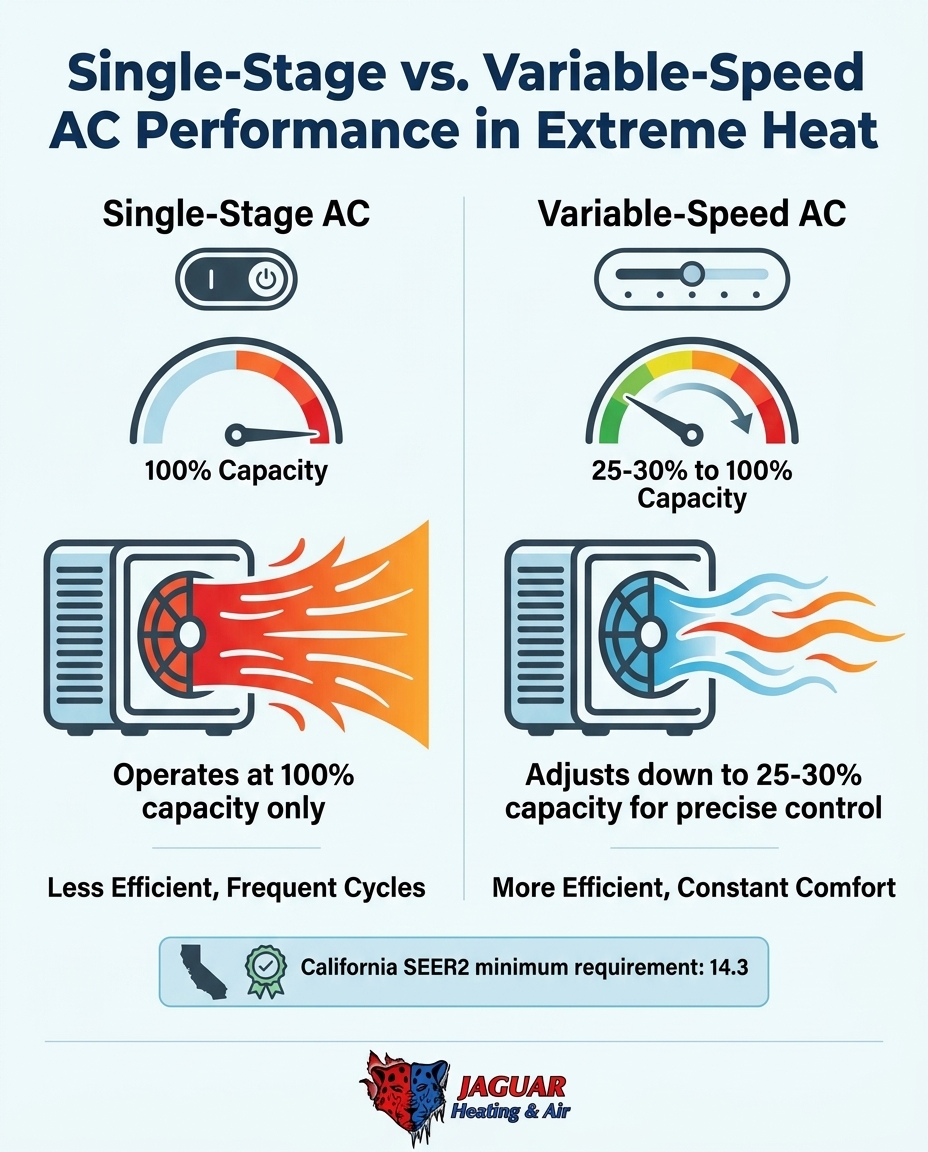
To understand your options, you first need to understand the baseline. Single-stage air conditioners represent the traditional approach to home cooling. They operate on a very simple, binary mechanical principle: they are either running at maximum capacity, or they are completely turned off.
Here is how a single-stage system functions in a typical home:
1. The thermostat triggers: When indoor temperatures rise above your set point, the thermostat sends a signal to the AC.
2. The 100% blast: The compressor kicks on at full speed, blasting maximum cold air through your ductwork.
3. The rapid cool-down: The system quickly drops the temperature in the rooms closest to the vents.
4. The abrupt shutoff: Once the thermostat registers the target temperature, the entire system shuts down completely.
While this technology is reliable and time-tested, it has distinct drawbacks in extreme heat. The jarring on/off cycles can create noticeable temperature swings in your home. Because the system blasts air so forcefully and then shuts off, it often creates hot spots in larger homes or in rooms situated far from the thermostat. This rapid cycling—known as short cycling—also puts heavy wear and tear on the electrical components.
Despite these limitations, single-stage units remain a viable, budget-conscious option for many families. They easily meet California's strict 14.3 SEER2 minimum efficiency requirements, and for smaller homes with straightforward ductwork, they provide excellent cooling power. We see this pattern frequently. For example, one local homeowner recently needed their AC replaced during the late-summer rush. Our team at Jaguar Heating & Air evaluated their home's needs and provided a traditional single-stage system approach with transparent communication and no hidden charges, getting their home perfectly cooled just in time for the new school year.
Of course, if your current single-stage unit is just struggling rather than completely dying, a professional AC repair might buy you another season to weigh your replacement options.
Variable-Speed Air Conditioners: Precision Cooling and Superior Dehumidification
If a single-stage AC is like a car that can only drive at 100 miles per hour or sit parked, a variable-speed air conditioner is like a car with a precise gas pedal. Variable-speed technology (often referred to as inverter technology) allows the compressor to adjust its cooling output in tiny increments based on the exact temperature needs of your home at any given moment.
Instead of blasting air at full capacity, variable-speed compressors can ramp down to operate at capacities as low as 25% to 30%. When the intense heat of a Sacramento afternoon hits, the system might run at 80% or 90% capacity. As the sun sets and the cooling demand drops, the system seamlessly ramps down to 30%, running continuously at a low, quiet speed to maintain a perfectly even temperature.
This continuous, low-speed operation provides several massive benefits for your home comfort:
• Elimination of hot spots: Because the air is constantly circulating, temperatures remain perfectly even in every room of the house.
• Superior dehumidification: Even in dry climates, indoor moisture from cooking, showering, and breathing builds up. Continuous air circulation pulls significantly more humidity out of the air than a system that constantly shuts off.
• Enhanced indoor air quality: Your AC filter only cleans the air when the blower fan is running. A variable-speed system runs almost constantly at low speeds, meaning your air is being filtered 24/7.
Another major advantage is the noise level. Older single-stage units are notorious for the loud, abrupt mechanical clunk when they start up. With inverter technology, the system ramps up so smoothly that you barely hear it running. You won't have to worry about waking up in the middle of the night because your AC blower motor sounds like a jet engine when the compressor kicks on.
Side-by-Side: Single-Stage vs. Variable-Speed in Extreme Heat
When making a significant upgrade to your home, seeing the differences laid out clearly can help clarify the decision. Both systems will keep your home cool, but they achieve that goal in very different ways. Below is a direct comparison of how single-stage and variable-speed systems handle the extreme demands of a Sacramento summer.
• Operation Style — Single-Stage AC: On/Off (100% capacity or 0%) — Variable-Speed AC: Continuous, adjusting from 25% to 100%
• Temperature Swings — Single-Stage AC: Noticeable fluctuations (1-3 degrees) — Variable-Speed AC: Precise consistency (within 0.5 degrees)
• Dehumidification — Single-Stage AC: Basic (stops when the target temp is hit) — Variable-Speed AC: Superior (constant air circulation removes more moisture)
• Noise Levels — Single-Stage AC: Louder, abrupt startup sounds — Variable-Speed AC: Ultra-quiet, smooth ramping up and down
• Wear and Tear — Single-Stage AC: Higher strain from constant starting and stopping — Variable-Speed AC: Lower strain due to continuous, gentle operation
• Best Suited For — Single-Stage AC: Smaller footprints, budget-conscious replacements — Variable-Speed AC: Larger homes, resolving hot spots, maximizing IAQ
The bottom line on performance: If your primary goal is to cool the house down quickly and you don't mind minor temperature fluctuations, a single-stage system gets the job done reliably. However, if you are tired of freezing in the hallway while sweating in the master bedroom, the continuous circulation of a variable-speed system provides an unmatched level of comfort.
Balancing Upfront Investment with Long-Term Efficiency ROI
Upgrading your home's cooling infrastructure is a major decision, and the financial aspect plays a massive role in which system you ultimately choose. It is no secret that variable-speed systems require a higher initial investment compared to standard single-stage units. The advanced inverter technology, specialized blower motors, and complex control boards simply cost more to manufacture and install.
However, when planning for a new AC installation, it is critical to look beyond the sticker price and consider the long-term Return on Investment (ROI). Because variable-speed systems run at lower capacities for much of the day, they draw significantly less electricity than a single-stage unit that constantly pulls massive surges of power to start up. Over the 15-to-20-year lifespan of the equipment, those daily energy savings add up substantially, often offsetting the higher initial installation costs.
Additionally, high-efficiency variable-speed systems frequently qualify for generic utility rebates—such as those offered by local utility providers—as well as federal tax credits under current energy initiatives. While these programs change frequently, they are designed to incentivize homeowners to choose energy-saving technology, making the upgrade much more accessible. We always advise readers to consult with a professional and check current utility guidelines to calculate the true cost-benefit ratio for their specific home.
We see this play out regularly. Recently, during a brutal end-of-season heatwave, a customer in Vacaville needed their entire air conditioning unit and coil replaced. Our team drove out from Sacramento to evaluate the failing system. After reviewing the options and the long-term efficiency benefits, we were able to recommend and install an upgraded variable-speed AC unit for a sensible upfront investment, ensuring their home was ready for the remaining summer heat and years to come.
No-Pressure Consultations: Sizing the Right System for Your Needs
One of the biggest mistakes homeowners make during an AC replacement is assuming that the most expensive, highest-tier unit is automatically the best choice for their house. The truth is, the highest-tier variable-speed unit isn't always the mandatory choice for every single home in Sacramento.
Before you commit to a specific technology, your home requires a proper load calculation (often called a Manual J calculation) and a thorough ductwork inspection. If your ductwork is undersized, leaking, or poorly designed, even the most advanced variable-speed compressor will struggle to deliver its promised efficiency and comfort. A high-end system hooked up to failing ducts is a recipe for frustration.
This is where working with a reputable local team makes all the difference. At Jaguar Heating & Air, we provide transparent, no-pressure cost-benefit analyses based on our extensive experience with Central Valley homes. Our goal is to empower you to make the right choice for your comfort and your home's unique footprint, rather than aggressively upselling you on a top-tier unit you might not actually need. We prioritize objective education, ensuring you understand exactly how a system will perform in your specific house before any work begins.
Ready to Upgrade Your Comfort? Book Your Consultation Today
As the August heat continues to push aging systems to their breaking point, waiting for a total failure is the most stressful way to handle an AC replacement. If your current unit is struggling to keep up with the triple-digit temperatures, now is the time to evaluate your options calmly and objectively.
Whether a reliable single-stage system fits your needs perfectly, or you are ready to experience the continuous comfort of a variable-speed upgrade, you deserve a system that can handle Sacramento's toughest weather. Don't let another heatwave dictate your comfort. Reach out today to schedule a free, no-pressure estimate and let our local experts help you compare the best solutions for your home. Secure your AC replacement in Sacramento and enjoy reliable cooling for years to come.
Frequently Asked Questions
Is a variable speed AC worth the investment in Sacramento?
Yes, for many homeowners in the Central Valley, the investment pays off significantly. The intense, prolonged heatwaves in Sacramento force standard ACs to work incredibly hard, whereas variable-speed units handle the load smoothly by running continuously at lower speeds. This reduces wear and tear, lowers long-term energy usage, and eliminates frustrating hot spots throughout the house.
What is the main difference between single stage and variable speed?
The main difference lies in the compressor's operating capacity. A single-stage AC only has one speed: 100% fully on or completely off. A variable-speed AC uses an inverter to adjust its output anywhere from roughly 25% to 100%, allowing it to match the exact cooling demand of your home minute by minute.
Does variable speed cool better in extreme heat?
Variable-speed systems excel in extreme heat because they provide continuous, even cooling rather than blasting cold air and shutting off. By running constantly at adjusted speeds, they prevent the indoor temperature from fluctuating and keep humidity levels exceptionally low, making the air feel cooler and more comfortable even when it is well over 100 degrees outside.
What are the disadvantages of a variable speed AC?
The primary disadvantage is the higher upfront installation cost compared to standard units. Additionally, the advanced technology inside variable-speed systems—such as specialized inverter boards and proprietary thermostats—can make out-of-warranty repairs more complex and expensive if components eventually fail.
Do I need new ductwork if I upgrade to a variable-speed AC?
Not necessarily, but your existing ductwork must be thoroughly inspected before installation. Variable-speed systems rely on specific static pressure and continuous airflow to function correctly; if your current ducts are severely undersized, crushed, or leaking, they will need to be repaired or replaced so the new system can operate efficiently.
How do variable-speed systems improve indoor air quality during wildfire season?
Variable-speed systems run their blower fans almost continuously at very low speeds, which means air is constantly circulating through your HVAC filter. During smoky conditions, this 24/7 filtration traps significantly more airborne particulates, ash, and allergens than a single-stage system that only filters the air during its brief cooling cycles.
Recent Posts
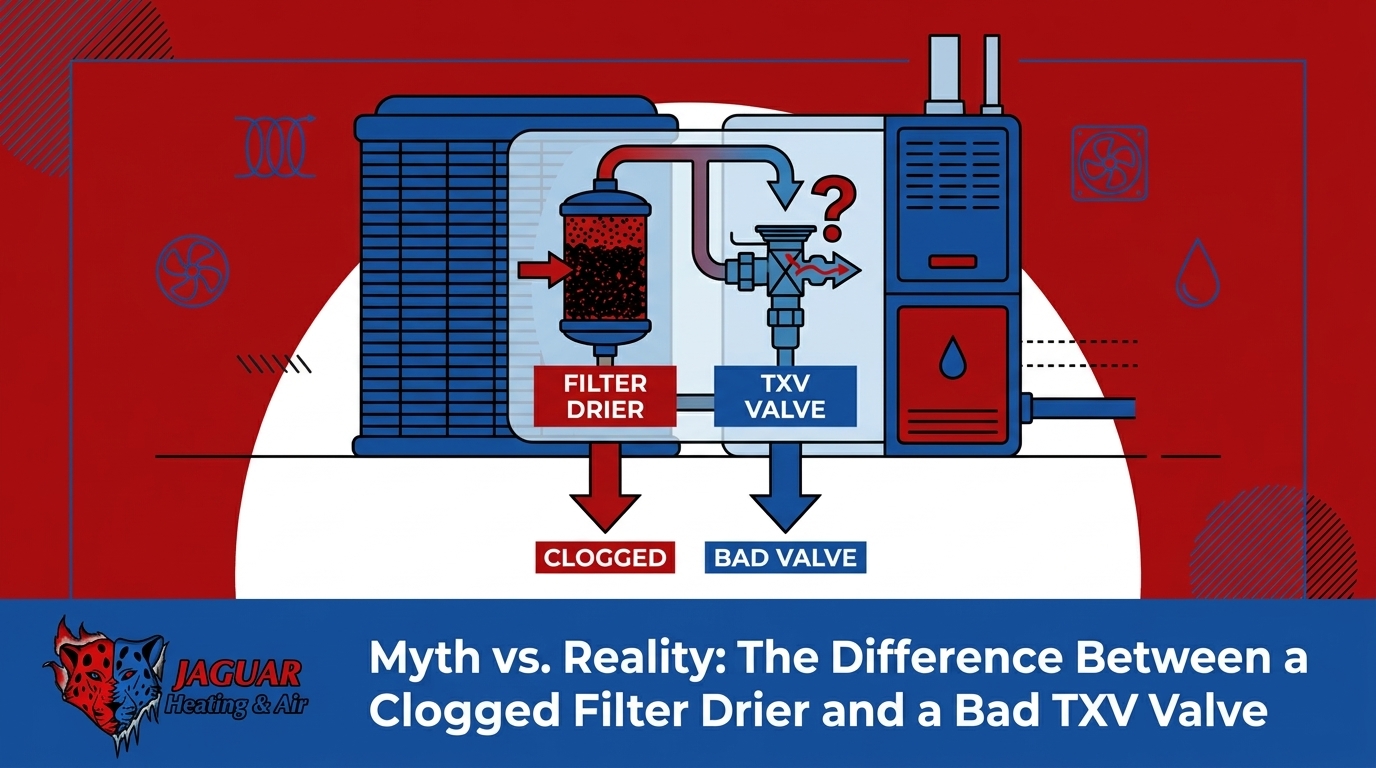
The Difference Between a Clogged Filter Drier and a Bad TXV Valve
An AC that blows warm air isn't always leaking refrigerant—it might be suffering from a flow restriction. Find out how technicians trace the bottleneck to restore your cooling.
How Sacramento's Hard Water Affects Your Evaporative Cooler Pads
By September, Sacramento's heavy mineral content often turns swamp cooler pads into rock-hard blocks. See why airflow drops drastically and weigh your end-of-season options.
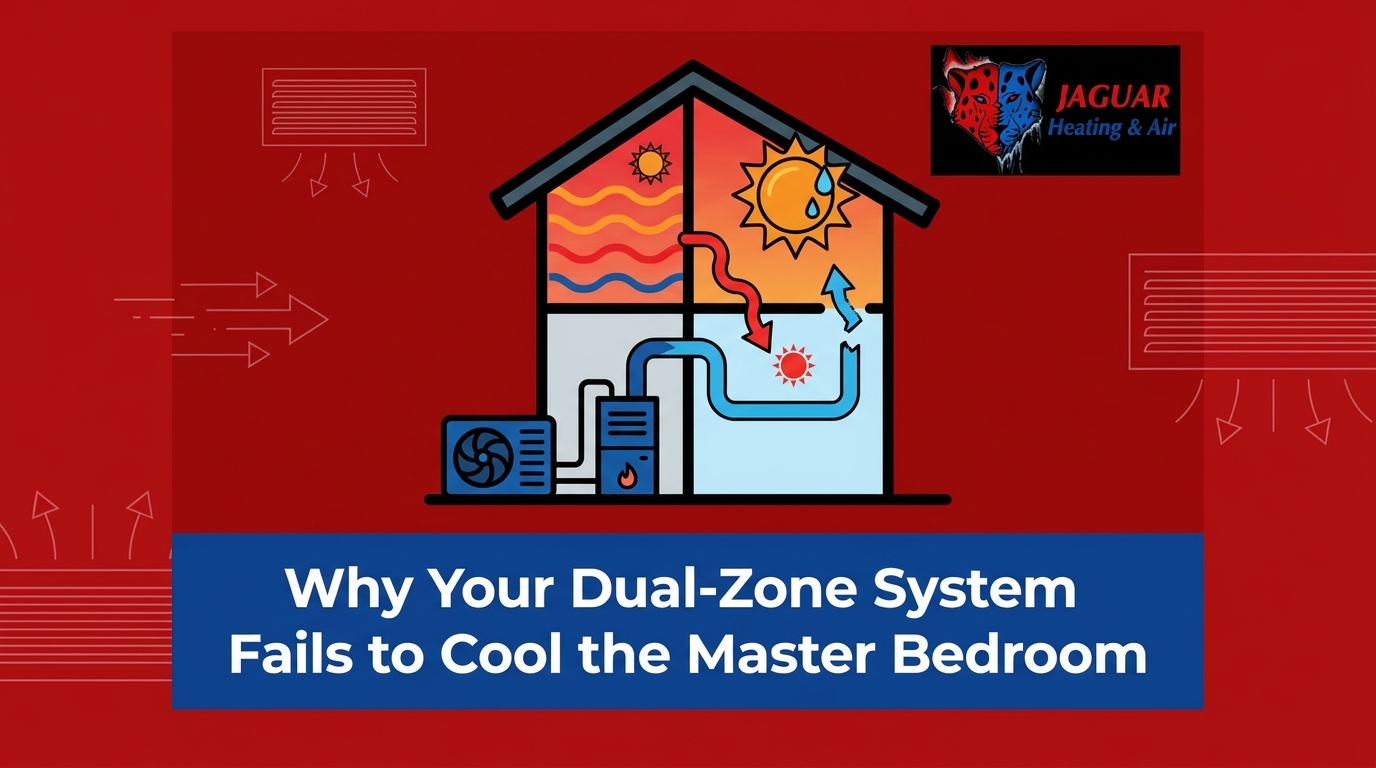
Why Your Dual-Zone System Fails to Cool the Master Bedroom
Persistent temperature imbalances in your master suite are rarely a main AC capacity issue. Discover how stuck motorized zone dampers disrupt airflow and why a pre-season diagnostic is crucial.