.avif)
How Much Clearance Your Outdoor AC Unit Actually Needs to Breathe
Hiding your AC condenser behind bushes or fences traps heat and forces the system to overwork. Learn the exact clearance measurements required to restore proper airflow and cooling.
Hiding your AC condenser behind bushes or fences traps heat and forces the system to overwork. Learn the exact clearance measurements required to restore proper airflow and cooling.

Why Hiding Your Condenser Costs You Comfort
As kids head back to school and late-summer temperatures continue to bake Sacramento, your AC might be running nonstop, but the house still feels warm, leaving you to wonder exactly how much clearance your outdoor AC unit actually needs to breathe. Homeowners often invest heavily in backyard landscaping, only to realize that the large metal box sitting next to the patio disrupts their carefully planned aesthetic. The immediate reaction is usually to hide the outdoor air conditioning unit behind dense bushes, tall ornamental grasses, or custom-built privacy fences. While this might improve the look of your outdoor living space, this aesthetic choice traps heat, forcing the system to rebreathe its own exhaust. Before you look into comprehensive Air Conditioning upgrades or schedule routine AC maintenance, the first step is checking the physical space around your equipment.
When an air conditioner is suffocated by physical barriers, routine tune-ups cannot overcome the mechanical restriction. The system is designed to pull in ambient air and push out extreme heat. If that heat hits a solid wooden fence or a thick wall of shrubbery, it has nowhere to go but right back into the system. Deciding to cut back landscaping or remove restrictive fencing is the crucial first step to restoring proper airflow. If you fail to provide adequate space, the cumulative stress on the system will inevitably lead to a breakdown, often peaking right in the middle of intense August late-summer heat when you rely on your cooling system the most.
• Dense Shrubs & Bushes — Impact on Airflow: Blocks side intake, drops debris into coil fins — Long-Term Result: Overheating, dirty coils, reduced lifespan
• Solid Custom Fencing — Impact on Airflow: Traps exhaust heat, creates a localized hot zone — Long-Term Result: Severe short-cycling, compressor failure
• Open Perimeter (Clear) — Impact on Airflow: Allows unrestricted ambient air intake and exhaust — Long-Term Result: Peak efficiency, lower energy bills, reliable cooling
The Mechanics of Heat Transfer: Why Your AC Needs to Breathe
To understand why physical clearance is absolutely non-negotiable, it helps to understand the basic thermodynamics of how your cooling system operates. An air conditioner does not actually "create" cold air in the way a furnace creates heat. Instead, it acts as a heat transfer machine. The indoor evaporator coil absorbs heat and humidity from the air inside your home, transferring that thermal energy into the chemical refrigerant. That heated refrigerant is then pumped outside to the condenser unit.
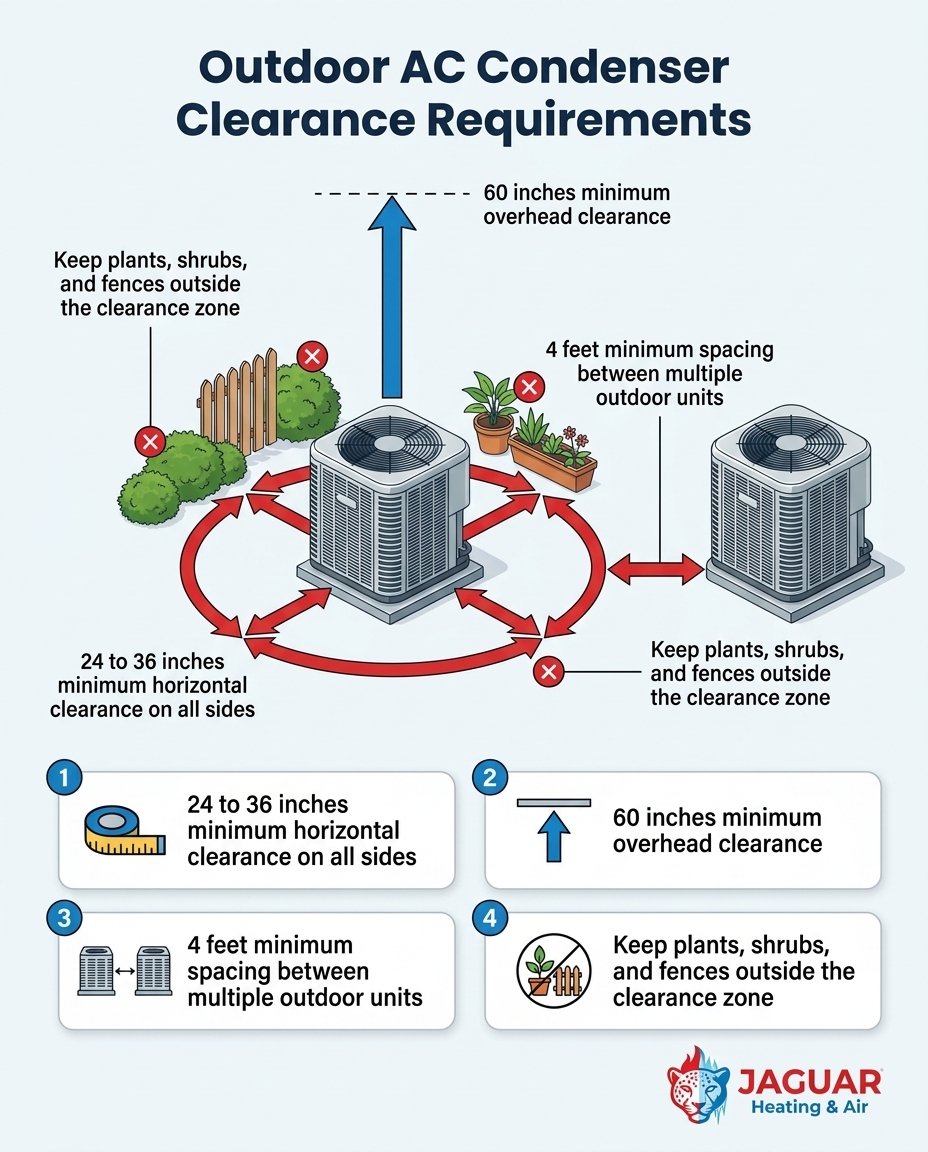
The outdoor condenser unit is entirely responsible for dissipating this absorbed heat into the surrounding ambient air. The large fan at the top of the unit pulls cooler outside air through the metal fins on the sides, stripping the heat from the refrigerant coils, and then blasts that superheated exhaust straight up into the sky. For this process to work efficiently, the system requires a minimum of 24 to 36 inches of horizontal clearance on every single side.
• The Intake Phase: The unit requires a massive volume of fresh, ambient air to pull through the side panels.
• The Exhaust Phase: The fan must push the hot air far enough away that it dissipates into the atmosphere.
• The Rebreathing Trap: When clearance is restricted, the expelled hot air bounces off the obstruction and is immediately pulled back into the side intake panels.
This "rebreathing" process drastically reduces the system's ability to cool the refrigerant. If the air being pulled into the unit is already heated from its own exhaust, the heat transfer process stalls. The system has to run twice as long to achieve a fraction of the cooling, plummeting overall efficiency and driving up your monthly utility costs.
Exact Clearance Measurements for Optimal Airflow
Manufacturer specifications dictate strict physical boundaries to ensure safe and efficient operation. These are not merely suggestions; they are engineering requirements designed to keep the internal compressor from destroying itself under thermal load. Ignoring these measurements voids warranties and guarantees premature mechanical failure.
Horizontal Clearance Requirements
Horizontal clearance is the most commonly violated rule by homeowners planting shrubs or building privacy screens. You must maintain a strict minimum of 24 to 36 inches of horizontal clearance on all sides of the unit. This specific radius allows adequate ambient air to flow through the coil fins without restriction.
1. Measure from the outer casing: Take a tape measure and extend it outward from the metal grill of the AC unit.
2. Check all four sides: Even if three sides are clear, one blocked side (like a unit pushed too closely against the house foundation) can disrupt the intake vacuum.
3. Account for plant growth: If you plant a small shrub at the 24-inch mark in the spring, it will likely encroach into the danger zone by mid-summer. Always plant outside the 36-inch maximum radius.
Overhead Clearance Limits
While side clearance handles the intake, overhead clearance is critical for the upward-exhausting fan motors. Ensure a minimum of 60 inches (5 feet) of unobstructed vertical space above the unit. The hot air needs a clear path to escape into the atmosphere. You must avoid building decks, patios, or low-hanging roof extensions directly over the condenser. If a deck is built too low over the unit, the heat creates a thermal blanket, forcing the hot air back down toward the ground where it is sucked right back into the system.
Spacing Between Multiple Units
If your property has multiple AC units to cool different zones of a large home, they must be placed at least 4 feet apart from one another. Units placed too close together will pull in each other's superheated exhaust air. When one unit is running, it creates a localized pocket of extreme heat. If the neighboring unit kicks on, it is starved of the cool ambient air it needs, pulling in the 120-degree exhaust of the first unit instead.
The Danger of Aesthetic Landscaping and Custom Fences
Balancing backyard aesthetics with mechanical necessity means choosing low-lying plants well outside the required radius. In our experience serving the Sacramento area, our team at Jaguar Heating & Air frequently finds that beautifully designed custom slatted fences are the root cause of compressor failure. Our technicians routinely arrive at homes where the homeowner has spent significant time and effort building a visually appealing wooden enclosure around their condenser, only to find the compressor motor completely burnt out.
Even fences with gaps or lattice work severely disrupt the volume of air required for the unit to function. Homeowners often assume that because a fence has slats, air can move freely. However, an air conditioning fan requires a massive, uninterrupted cubic volume of air. Slats and lattice create turbulence and drag, reducing the intake volume by half. Maintaining 24 to 36 inches of horizontal clearance is the only way to ensure the fan doesn't have to fight against physical resistance to pull air inside.
Furthermore, overgrown shrubs and dense bushes not only block airflow but also drop leaves, pollen, and debris directly into the condenser coil. Pine needles, in particular, can slide right through the protective metal grill and pack tightly against the delicate aluminum fins. Over time, this organic matter rots and forms a dense, felt-like mat that completely seals off the airflow, suffocating the system from the inside out.
How Restricted Airflow Strains the Compressor in High Heat
In extreme triple-digit ambient heat, the AC system already operates near its maximum capacity. Sacramento's extreme summer temperatures leave absolutely zero margin for error when it comes to condenser heat dissipation. When it is 105 degrees outside, the unit is working incredibly hard just to find air cool enough to absorb the heat from the refrigerant.
When airflow is choked by fences or weeds, the compressor must run significantly longer cycles to achieve the same cooling result. Instead of running for 15 minutes and shutting off, a suffocating unit might run for 45 minutes straight. This prolonged strain causes internal electrical and mechanical components to overheat, leading to thermal overload shutdowns. The system's internal safety sensors will detect the extreme heat and shut the unit down to prevent a fire or total mechanical destruction.
Just this past August, our technicians responded to a local homeowner whose house simply wasn't cooling effectively during a brutal stretch of back-to-school triple-digit heat. The system was running, but only blowing lukewarm air indoors. Our technician explained the problem—the unit was entirely choked by dense landscaping—and outlined the available options clearly. Once the physical obstructions were cleared and the system was serviced, the house was cooling effectively again. The cumulative effect of this stress peaks during late-summer heat, often resulting in complete system failure when cooling is needed most.
Recognizing the Warning Signs of a Suffocating Outdoor Unit
If you suspect your landscaping or fencing is causing an issue, your system will usually give you warning signs before a catastrophic breakdown occurs. Catching these symptoms early can save your compressor from permanent damage.
• Short-cycling behavior: The system turns on, runs for a very brief period, and shuts off rapidly without adequately cooling the home. This happens because the internal components overheat and trigger a safety shutdown.
• Unexplained utility spikes: Energy bills spike unexpectedly as the unit draws more and more electrical power to compensate for the severely reduced efficiency.
• Extreme exterior heat: The outdoor unit feels exceptionally hot to the touch. While condensers are naturally warm, a suffocating unit will radiate intense, abnormal heat from the metal casing.
• Loud mechanical noises: You may hear unusual humming noises, grinding sounds, or a harsh buzzing as the compressor struggles against the high pressure of trapped heat.
If you have checked the perimeter and the unit still exhibits these symptoms, professional AC repair is necessary to diagnose internal coil blockages or motor strain. The damage from August late-summer heat can be cumulative, meaning the wear and tear from previous weeks of suffocation might finally be showing up as mechanical failure.
Reclaiming Your AC's Breathing Room: Actionable Guidelines
Correcting clearance issues is largely a matter of straightforward yard maintenance. By taking proactive steps, you can immediately relieve the thermal strain on your cooling system and protect your investment.
1. Trim back all encroaching vegetation: Cut back bushes, low-hanging branches, and tall grass to restore the mandatory 24 to 36 inches of horizontal clearance. Use hedge trimmers to create a definitive buffer zone around the concrete pad.
2. Remove solid or semi-solid fencing: If a privacy screen was installed directly around the condenser pad, take it down or move it back. If you must hide the unit, build a screen at least three to four feet away from the unit, ensuring the top remains completely open to the sky.
3. Clear away accumulated organic debris: Turn off the power to the unit at the breaker box. Then, carefully clear away fallen leaves, pine needles, dirt, and grass clippings from the base of the unit. Use a soft brush or a gentle garden hose (never a pressure washer) to rinse the exterior casing.
4. Establish a routine maintenance schedule: Make it a habit to check the perimeter monthly throughout the spring and summer growing seasons. Plants grow rapidly, and a clear perimeter in May can easily become a choked jungle by July.
When to Call a Professional for Airflow Damage Assessment
If the unit has been suffocating for an extended period, simply clearing the brush may not reverse the internal wear. The compressor might have already sustained internal damage from operating at excessive pressures and temperatures. A professional technician can measure refrigerant pressures and assess the compressor's electrical amp draw to ensure no permanent damage occurred.
When an AC system has been heavily restricted, the wear on the coil and compressor can be severe. For example, our team at Jaguar Heating & Air recently assisted a customer in Vacaville who needed a full air conditioning unit and coil replacement after extensive wear compromised their older system. We drove out from Sacramento, recommended and sourced a highly efficient upgraded AC unit, and made a follow-up call to confirm the new system was functioning perfectly with proper airflow. Professional maintenance includes deep-cleaning the condenser coils, which often become packed with micro-debris from nearby overgrown plants that a garden hose simply cannot wash away.
Unusual mechanical noises after clearing the perimeter indicate that the fan motor or compressor requires immediate expert attention. If your AC Blower Motor Sounds Like a Jet Engine or the outdoor compressor rattles violently when starting up, the system has likely suffered from the cumulative strain of August late-summer heat and requires professional diagnostics before it fails completely.
Restoring Efficiency with Proper Clearance Guidelines
Understanding exactly how much space the condenser needs empowers homeowners to make smart landscaping decisions that don't compromise their home comfort. Maintaining the proper perimeter—specifically that crucial 24 to 36 inches of horizontal clearance—ensures the system operates efficiently, draws less electricity, and avoids unnecessary wear and tear on expensive internal components.
Your air conditioner works tirelessly to keep your home comfortable, but it needs your help to breathe. By keeping bushes trimmed, removing restrictive fences, and keeping the overhead exhaust path clear, you give your equipment the best chance at a long, reliable lifespan. If you suspect your unit has suffered from restricted airflow or is showing signs of thermal strain, exploring professional maintenance options can help restore peak performance and protect your home's comfort for seasons to come.
Frequently Asked Questions
How much space does an AC unit need around it?
An outdoor air conditioning unit requires a minimum of 24 to 36 inches of horizontal clearance on all sides. This space allows the unit to pull in an adequate volume of ambient air to cool the internal coils. Without this buffer zone, the system will struggle to transfer heat efficiently.
Can I put a fence around my AC unit?
While you can put a fence around your AC unit for aesthetic reasons, it must be placed at least three to four feet away from the unit itself. The fence should ideally have wide gaps to allow air movement, and the top must remain completely open. Building a tight, solid box around the condenser will cause it to overheat and fail.
What happens if my outdoor AC unit is blocked?
If the outdoor unit is blocked by debris, bushes, or fencing, it will begin rebreathing its own hot exhaust. This causes the system to work much harder, leading to rapid short-cycling, spiked energy bills, and eventual thermal overload. Over time, this restriction can permanently damage the compressor motor.
How much overhead clearance does an AC condenser need?
An AC condenser requires a minimum of 60 inches (5 feet) of unobstructed vertical space above it. The fan is designed to blast hot exhaust air straight up and away from the home. If a deck, low roof, or heavy tree branch blocks this path, the hot air will bounce back down into the unit.
Does tall grass affect an air conditioner's performance?
Yes, tall grass significantly affects an air conditioner's performance by blocking the lower intake vents. Furthermore, when tall grass is cut nearby, the loose clippings can easily be sucked into the delicate aluminum fins of the condenser coil. This creates a dense mat of organic debris that restricts airflow and traps moisture.
How often should I trim the landscaping around my AC unit?
You should inspect and trim the landscaping around your AC unit at least once a month during the active growing season. Fast-growing shrubs and weeds can quickly encroach on the required 24 to 36-inch clearance zone. Keeping up with regular trimming ensures your system always has the breathing room it needs to operate efficiently.
Recent Posts
Decoding the October Heating Startup: AC Repair and Fall Maintenance in Sacramento, CA
Burning dust smells on the first chilly night? Use this seasonal home maintenance checklist to see what is normal and when to call a pro on this startup.
Why Your Thermostat Blanking Out Might Just Be a Blown Low-Voltage Fuse
A completely dead thermostat screen right as fall begins often triggers panic. See why a blown 3-amp low-voltage fuse is actually protecting your furnace control board.
How to Tell If Your AC Contactor is Pitted and Failing
After thousands of high-load cycles this summer, your AC's electrical components are exhausted. Catching a failing contactor early prevents a catastrophic compressor breakdown this fall.