.avif)
Why Your AC Smells Like Dirty Socks When It First Kicks On
That foul odor blasting from your vents during a late-summer heatwave isn't your imagination. Understand the biological cause of Dirty Sock Syndrome and the safest ways to eliminate it.
That foul odor blasting from your vents during a late-summer heatwave isn't your imagination. Understand the biological cause of Dirty Sock Syndrome and the safest ways to eliminate it.

The Unpleasant Surprise: Dealing With Sudden AC Odors
You walk through the front door during a sweltering heatwave, expecting a wave of crisp, refreshing air, but instead, you are left wondering why your AC smells like dirty socks when it first kicks on. That initial blast of foul, musty air is jarring, especially when you keep a clean house. The odor hits you instantly, lingering just long enough to make you uncomfortable before slowly fading as the system continues to run. If you are experiencing this highly specific stench during August late-summer cooling cycles, you are not alone, and your nose is not playing tricks on you. At Jaguar Heating & Air, one of the most common patterns we see during the back-to-school transition is a sudden spike in calls from Sacramento homeowners dealing with this exact odor.
In the HVAC industry, this phenomenon has a very specific, albeit unglamorous, name: Dirty Sock Syndrome. While the smell might make you suspect a dead animal in the vents or a catastrophic mechanical failure, the reality is entirely different. This odor is a common biological issue, not a mechanical breakdown of your air conditioning systems. It stems from the natural way your cooling equipment handles moisture and temperature changes inside the dark, enclosed cabinet of your indoor unit.
Because the root cause is biological growth hidden deep within the delicate components of your HVAC system, surface-level dusting and standard filter swaps will not resolve the stench. Eliminating the odor permanently requires professional AC maintenance to safely neutralize the bacteria at the source.
What Exactly Is 'Dirty Sock Syndrome'?
Dirty Sock Syndrome is the exact term professionals use to describe the accumulation of moisture, microscopic dust, and microbial growth on your indoor evaporator coil. The indoor coil is the part of your system responsible for actually removing heat from your home's air. Over time, this component becomes a haven for microbes. When you search for why your system smells like dirty socks when it first kicks on, you are experiencing the off-gassing of these harmless but incredibly foul-smelling bacteria.
To better understand what you are dealing with, it helps to distinguish this specific biological odor from other warning signs your system might be sending.
• Dirty Socks / Gym Clothes — Likely Cause: Bacterial growth on the indoor evaporator coil. — Urgency Level: Moderate (Air quality concern)
• Burning Plastic / Electrical — Likely Cause: Overheating blower motor or failing electrical components. — Urgency Level: High (Turn system off immediately)
• Rotten Eggs / Sulfur — Likely Cause: Potential natural gas leak near the furnace or water heater. — Urgency Level: Critical (Evacuate and call gas company)
• Exhaust Fumes — Likely Cause: Cracked heat exchanger leaking combustion gases. — Urgency Level: High (Turn system off immediately)
The Biological Reality Behind the Odor
The smell is a direct byproduct of a functioning HVAC ecosystem. Even the highest-rated air filters allow a tiny fraction of microscopic dust particles to pass through. These particles settle on the cold, wet metal fins of the evaporator coil. Microbes naturally present in the air then attach to this wet dust, using it as a food source. As these bacteria feed and multiply, they release volatile organic compounds (VOCs). These gases are what your nose registers as the unmistakable stench of unwashed gym clothes. The bacteria themselves are generally harmless to healthy individuals, but the smell they produce is pungent and deeply unpleasant.
Why It's Not a Reflection of Your Housekeeping
One of the most common reactions to Dirty Sock Syndrome is embarrassment. Homeowners often assume the smell means their house is dirty. Here is the thing: the inside of an HVAC cabinet is completely isolated from your regular home cleaning routines. You can mop your floors daily, vacuum meticulously, and sanitize every surface, but you cannot scrub the internal evaporator coil hidden behind screwed-on sheet metal panels. This biological reaction happens in impeccably clean homes just as often as anywhere else. It is a natural consequence of air physics, moisture, and temperature, not a reflection of your housekeeping standards.
The Science of Condensation and Microbial Growth
To understand why these microbes thrive inside your equipment, you have to look at how air conditioning actually works. Your AC does not just cool the air; it acts as a giant whole-home dehumidifier. Warm air holds significantly more moisture than cold air. When your system pulls warm indoor air across the freezing-cold evaporator coil, the air rapidly drops in temperature, forcing it to release its moisture. This process produces gallons of water every single day.
The intense climate in the Sacramento region plays a massive role in this process. With summer temperatures regularly exceeding 100°F, local air conditioning systems are forced to run for hours on end. This heavy usage leads to massive condensation buildup inside the cabinet. While the system is designed to drain this water away, the coil itself remains perpetually wet during operation. By the time we reach August late-summer cooling cycles, your system has been cycling through intense heat and heavy moisture for months, creating the perfect storm for bacterial colonization.
How Your Evaporator Coil Handles Moisture
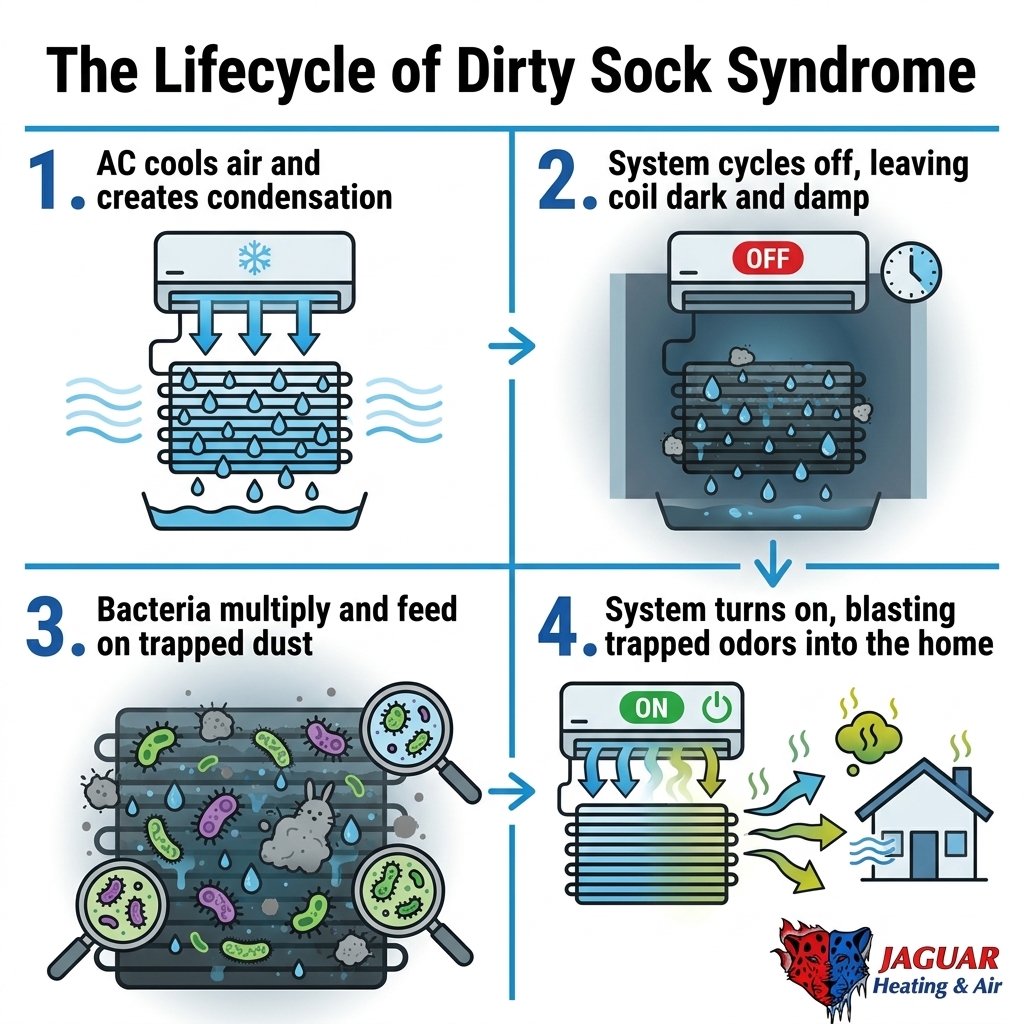
The lifecycle of moisture inside your system dictates how quickly bacteria can grow. Here is exactly what happens during a standard cooling cycle:
1. Temperature Drop: Refrigerant pumps through the copper tubes of the evaporator coil, dropping the surface temperature to near freezing.
2. Condensation Formation: Warm return air blows over the cold metal. Airborne water vapor instantly condenses into liquid droplets on the aluminum fins.
3. Drainage Collection: Gravity pulls these droplets down into a specialized drain pan located beneath the coil.
4. Evacuation: The water flows out of the pan and through a PVC condensate drain line to the outside of your home.
If the drain pan is slightly unlevel, or if the drain line develops a minor clog from algae, stagnant pools of water form inside the dark cabinet. Even if the system drains perfectly, the microscopic spaces between the thousands of aluminum fins stay damp long after the system shuts off, providing the exact environment microbes need to multiply.
Why You Only Notice the Smell When the System First Turns On
The most confusing aspect of Dirty Sock Syndrome is its timing. Homeowners consistently report that their AC smells like dirty socks when it first kicks on, but the odor seems to vanish after five or ten minutes. This specific pattern is entirely due to the temperature cycling of the evaporator coil.
The Incubation Period: When your home reaches the target temperature on the thermostat, the outdoor compressor shuts down. The indoor evaporator coil stops receiving cold refrigerant and slowly warms back up to room temperature. The inside of the cabinet remains pitch black, highly humid, and now, pleasantly warm. This creates an ideal "incubation" chamber. During this off-cycle, the bacteria go into overdrive, multiplying rapidly and releasing a high concentration of odorous gases that become trapped inside the enclosed ductwork and cabinet housing.
The Blast Effect: When the thermostat calls for cooling again, the indoor blower motor immediately spins up, pushing a massive volume of air through the cabinet. This initial gust forcefully ejects all the concentrated, trapped bacterial gases out through your supply vents at once. You get hit with the "blast effect"—a concentrated wave of stinky-feet odor.
The Dissipation: After a few minutes of running, the evaporator coil drops back down to a freezing temperature. This extreme cold effectively shocks the bacteria, suppressing their ability to off-gas. At the same time, the continuous airflow flushes the remaining odor out of the room. The smell hasn't been cured; it has simply been masked by the freezing temperatures until the next time the system shuts off and warms up again.
The Dangers of DIY Coil Cleaning
Once homeowners identify the source of the odor, the immediate impulse is often to grab a bottle of bleach and a scrub brush. Attempting to clean an indoor evaporator coil yourself is highly dangerous to both the equipment and your wallet. The coil is an incredibly sensitive, expensive component, and improper handling can lead to catastrophic system failure.
The Problem with Household Cleaners: Standard household cleaning chemicals, especially bleach and heavy-duty degreasers, are highly corrosive. Evaporator coil fins are made of ultra-thin aluminum—often only 0.004 inches thick. Applying bleach to these fins triggers a chemical reaction that literally eats away the metal, causing microscopic pitting. Over time, this corrosion leads to severe refrigerant leaks. Furthermore, surface-level wiping only touches the outer edges of the coil. It does not penetrate the deep, V-shaped interior where the majority of the bacteria live and thrive during August late-summer cooling cycles.
The Risk of Physical Damage: Because the fins are so thin, they bend under the slightest pressure. Scrubbing them with a brush will flatten the fins against each other, completely blocking airflow and causing the system to freeze over into a block of solid ice. Accessing the coil also requires disassembling sealed sheet metal panels, navigating high-voltage electrical wires, and bypassing safety switches.
The Professional Solution: Professional deep cleaning restores system efficiency without risking irreversible damage. In our years of servicing cooling systems throughout the Sacramento region, our team at Jaguar Heating & Air has seen firsthand the costly aftermath of DIY coil cleaning. We frequently respond to late-summer service calls where well-meaning homeowners have bent their coil fins or caused refrigerant leaks by using harsh chemicals. This risk of irreversible damage is exactly why we strongly recommend relying on certified experts rather than attempting internal cabinet maintenance yourself. Our technicians use specialized, non-corrosive foaming agents that expand deep into the coil bed, lifting biological growth out safely. If you want to ensure your entire system is free of contaminants, you might also consider professional duct cleaning services to remove dust buildup that feeds these microbes.
Why Bleach and Household Cleaners Fail
• Corrosive chemical reactions: Standard cleaners strip the protective coating off aluminum coils, leading to rapid oxidation and refrigerant leaks.
• Failure to penetrate: Spraying the surface does not neutralize biological growth deep within the dense fin pack.
• Incomplete neutralization: Bleach may bleach the color of mold and bacteria, but it often fails to kill the root structure on porous surfaces, meaning the smell will return within weeks.
Advanced Solutions for Lasting Indoor Air Quality
While a professional deep-cleaning is the mandatory first step to physically remove the existing bacteria, it is only half the battle. If the conditions inside the cabinet remain the same, the microbes will eventually return. To stop Dirty Sock Syndrome permanently, you need preventative upgrades that continuously protect the evaporator coil.
Working with our team at Jaguar Heating & Air means you benefit from our firsthand expertise in comprehensive indoor air quality solutions that go beyond simple filter changes to actively deep-clean evaporator coils and eliminate biological growth. We consistently recommend the installation of a UV germicidal light inside the HVAC cabinet as one of the most effective upgrades. These specialized ultraviolet lamps are mounted directly over the evaporator coil, shining continuously on the damp metal.
The UVC wavelength fundamentally alters the DNA of mold spores, bacteria, and viruses, stripping them of their ability to reproduce. When microbes cannot reproduce, the colony collapses, and the off-gassing stops entirely. Paired with high-efficiency air filters—which capture the microscopic dust particles that the bacteria use for food—these systems create a hostile environment for biological growth. By addressing both the food source (dust) and the microbes themselves (via UV light), you ensure the air blowing into your Sacramento region home remains clean, safe, and completely odor-free.
How Airflow and Blower Motors Distribute Odors
The bacteria on the coil produce the smell, but the blower motor is the delivery mechanism that forces that odor into your living space. The blower motor is essentially the lungs of your HVAC system, pulling air from the return vents and pushing it out through the supply registers.
A pattern our technicians see often is that a struggling blower motor can actually exacerbate moisture problems. A weak motor moves less air across the coil, meaning the coil stays colder and wetter than it should, increasing condensation and giving bacteria more time to multiply. Sometimes, homeowners notice strange noises accompanying airflow issues. If you hear grinding, screeching, or if your AC blower motor sounds like a jet engine, it indicates mechanical stress that is likely reducing airflow efficiency.
Furthermore, the blower wheel itself—often called a squirrel cage—can become caked in the same damp dust that coats the coil. When the blades of the blower wheel are dirty, they cannot scoop and push air effectively. Keeping the blower assembly and the surrounding ductwork meticulously clean ensures that odors aren't trapped in the distribution system. When you notice that your system smells like dirty socks when it first kicks on, our technicians will inspect the blower motor alongside the coil to ensure the entire air path is clear of biological contaminants.
Frequently Asked Questions About Dirty Sock Syndrome
What causes dirty sock syndrome in air conditioners?
It is caused by a buildup of mold, mildew, and bacteria on the indoor evaporator coil. These microbes thrive in the dark, damp environment created by the AC's condensation process. As the bacteria feed on microscopic dust particles trapped in the moisture, they release volatile organic compounds that smell exactly like dirty, unwashed gym socks.
Is dirty sock syndrome dangerous or toxic?
For most healthy individuals, the bacteria causing the odor are harmless, though highly unpleasant. However, it can irritate those with asthma, allergies, or compromised immune systems. While it is not a highly toxic emergency like a gas leak, breathing in bacterial off-gassing daily during August late-summer cooling cycles is detrimental to your overall indoor air quality and should be resolved.
Why does my AC smell like stinky feet?
The "stinky feet" smell is the specific off-gassing produced by the bacteria feeding on dust and moisture inside your HVAC cabinet. Different strains of bacteria produce different odors, but the specific microbes that colonize aluminum evaporator coils produce gases that human noses interpret as sweaty feet or musty gym clothes.
How do professionals fix dirty sock syndrome?
Professionals use specialized, non-corrosive foaming cleaners to deep-clean the evaporator coil safely. This expanding foam pushes deep into the coil fins to lift out dirt and neutralize the bacteria without damaging the fragile aluminum. They may also install UV germicidal lights directly above the coil to prevent the bacteria from returning in the future.
Is it safe to run my AC if it smells like dirty socks?
Yes, it is generally safe to run the system temporarily to stay cool, but the root cause should be addressed promptly to improve air quality. Running the system will not cause a mechanical breakdown, but ignoring the biological growth allows the bacterial colony to expand, making the eventual cleaning process more difficult.
Can changing my air filter fix Dirty Sock Syndrome?
No, changing the filter will not remove bacteria that has already colonized the evaporator coil. A clean, high-efficiency filter is vital for preventing future dust buildup, which starves the bacteria of their food source, but professional coil cleaning is absolutely required to eliminate the existing odor.
Why does the smell go away after the AC runs for a few minutes?
Once the AC is running, the evaporator coil gets extremely cold, which suppresses the bacterial off-gassing. The initial blast of air simply clears out the concentrated gases that built up inside the warm, damp cabinet while the system was turned off. The bacteria are still there; they are just temporarily too cold to produce the smell.
Eliminate the Odor and Restore Your Home's Comfort
Dealing with a foul odor coming from your vents is frustrating, but Dirty Sock Syndrome is a completely natural, solvable problem. It does not mean your house is dirty, and it does not mean your air conditioner is permanently broken. By understanding the science behind the condensation and microbial growth, you can take the right steps to eliminate the issue safely.
Attempting to scrub the delicate internal components yourself is risky and often ineffective. Reaching out for professional coil deep-cleaning and advanced indoor air quality upgrades is the safest, most reliable path forward. If you are tired of holding your breath every time the thermostat clicks on in the Sacramento region, schedule an inspection with our certified technicians at Jaguar Heating & Air. You deserve to breathe easier, enjoy your home's comfort, and experience truly clean air for the rest of the cooling season.
Recent Posts
Why We Recommend Surge Protectors for Your HVAC Equipment
A standard circuit breaker isn't enough to protect modern heating and cooling systems from grid spikes. Find out how a dedicated safeguard prevents catastrophic control board failures.
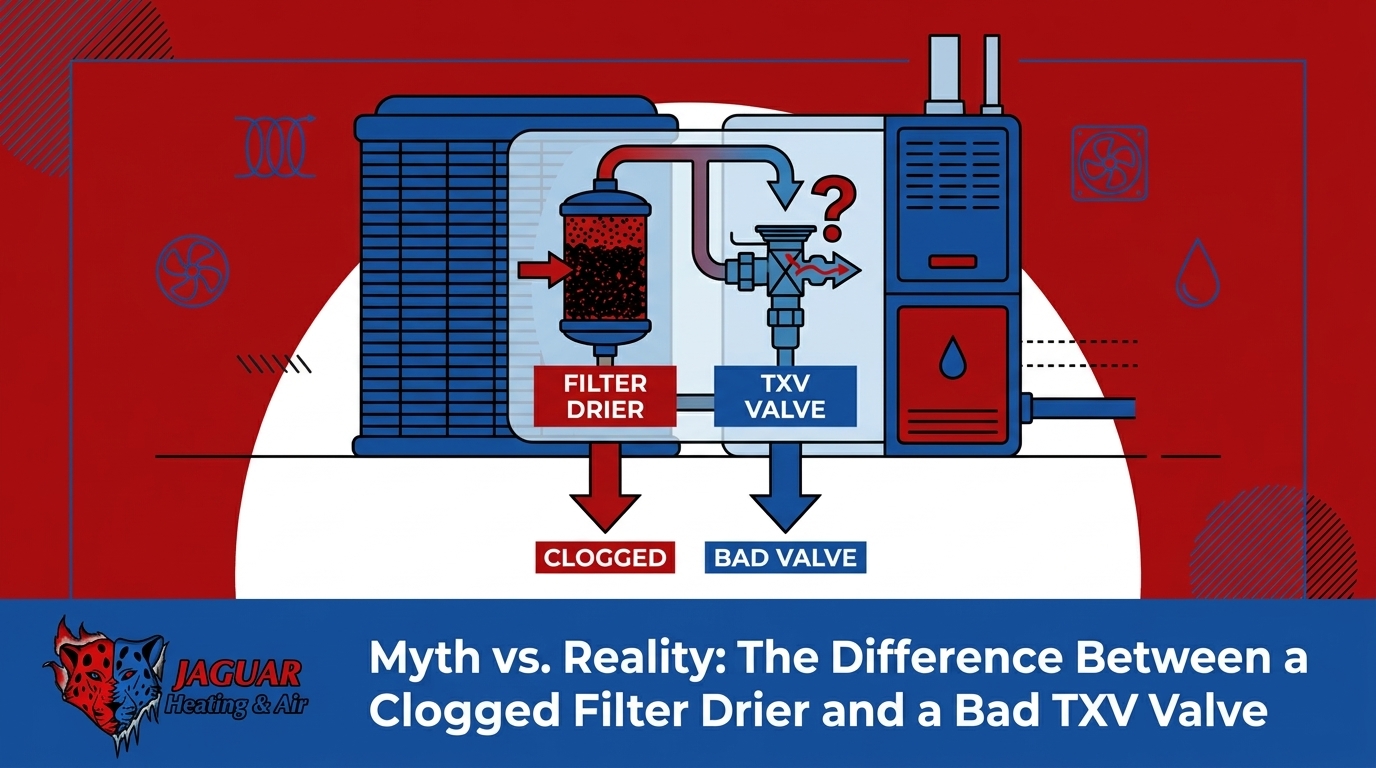
The Difference Between a Clogged Filter Drier and a Bad TXV Valve
An AC that blows warm air isn't always leaking refrigerant—it might be suffering from a flow restriction. Find out how technicians trace the bottleneck to restore your cooling.
How Sacramento's Hard Water Affects Your Evaporative Cooler Pads
By September, Sacramento's heavy mineral content often turns swamp cooler pads into rock-hard blocks. See why airflow drops drastically and weigh your end-of-season options.