.avif)
Mitsubishi Mini Split Pros and Cons: What You Need to Know
Mitsubishi Mini Split Pros and Cons: The Quick Answer for Sacramento Homeowners Understanding the mitsubishi mini split pros and cons is the first step to de…
Mitsubishi Mini Split Pros and Cons: The Quick Answer for Sacramento Homeowners Understanding the mitsubishi mini split pros and cons is the first step to de…

Mitsubishi Mini Split Pros and Cons: The Quick Answer for Sacramento Homeowners
Understanding the mitsubishi mini split pros and cons is the first step to deciding whether a ductless system is right for your home. Mitsubishi is widely regarded as the top ductless brand in the US — but like any major HVAC investment, there are real trade-offs worth knowing before you commit.
Here is a fast breakdown:
Pros
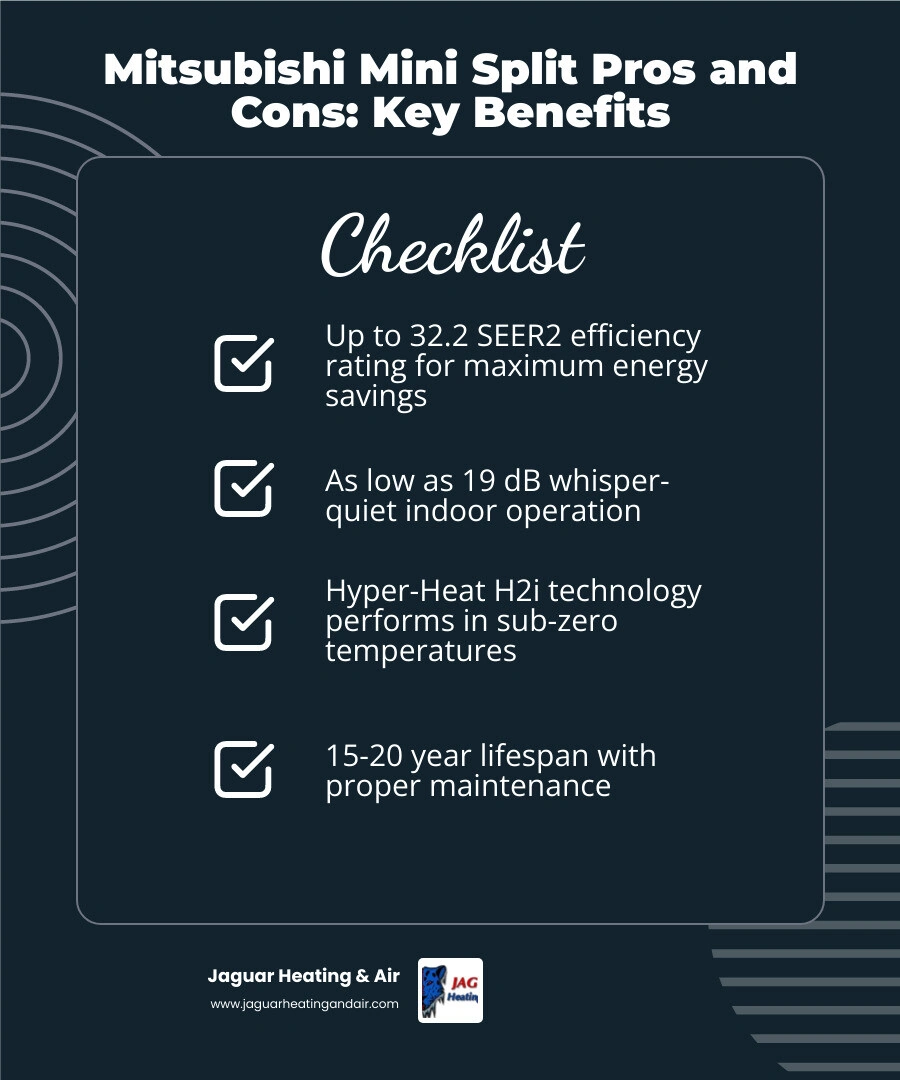
• Among the highest efficiency ratings available (up to 32.2 SEER2)
• Extremely quiet indoor operation — as low as 19 dB
• Hyper-Heat H2i technology heats reliably in very cold temperatures
• No ductwork needed — great for older homes, additions, and garages
• Precise zone-by-zone temperature control
• Long lifespan with proper maintenance (15–20 years)
Cons
• Higher upfront cost than most competing brands
• Requires professional installation to keep the warranty valid
• Visible wall-mounted indoor units affect some home aesthetics
• An active class-action investigation (opened August 2025) raises questions about real-world cold-climate performance
• R-454B refrigerant service costs have risen sharply in 2026
If you already know a Mitsubishi ductless system is the right fit, the biggest factor in long-term performance is who installs it. For Sacramento-area homeowners, that means choosing a certified local HVAC team who knows how to size and install these systems correctly.
The sections below walk through each pro and con in detail — so you can make a confident, informed decision.
The Major Advantages of Mitsubishi Ductless Systems
When evaluating the mitsubishi mini split pros and cons, the "pros" column is undeniably impressive. Mitsubishi Electric has spent decades refining its ductless technology, establishing itself as the premium standard for residential zone control and energy efficiency.
Industry-Leading Energy Efficiency
One of the most compelling reasons homeowners transition to ductless technology is the sheer drop in monthly utility bills. Traditional ducted central air conditioning systems are prone to significant energy losses. In fact, duct losses can account for more than 30% of energy consumption for space conditioning in some homes. Because mini-split systems completely bypass ductwork, they deliver conditioned air directly into the living space.
By avoiding duct losses and conditioning only occupied zones, a mini-split system can deliver 10% to 30% efficiency gains over aging central AC units. Mitsubishi systems lead the industry in this category, with flagship models like the MSZ-FS06NA achieving up to an outstanding 32.2 SEER2 (Seasonal Energy Efficiency Ratio) for cooling and up to 13.5 HSPF2 (Heating Seasonal Performance Factor) for heating.
Inverter-Driven Compressor Technology
Standard HVAC systems operate on a simple on-and-off cycle. When your home gets too warm, the compressor kicks on at 100% capacity, runs until the target temperature is met, and then shuts off completely. This constant cycling consumes massive amounts of electricity and subjects your equipment to heavy wear and tear.
Mitsubishi systems utilize advanced inverter-driven compressors. Instead of shutting down, the compressor continuously adjusts its speed to match the precise heating or cooling demands of the room. This variable-speed operation can reduce energy consumption by up to 40% compared to traditional non-inverter models, keeping your indoor climate within 0.5°F of your thermostat setting.

Advanced Comfort with the 3-D i-see-Sensor
Selected premium Mitsubishi indoor units (such as the MSZ-FS series) feature the proprietary 3-D i-see-Sensor. This sensor continuously scans the thermal profile of the room, dividing the space into 752 three-dimensional zones to detect human body heat.
If you walk into a room, the system can detect your presence and direct airflow toward or away from you, depending on your personal preference. When the room is unoccupied, the system automatically transitions into an energy-saving mode, preventing you from paying to heat or cool empty space.
True Zone Control
With a multi-zone configuration, you can connect up to eight indoor air handlers to a single outdoor condenser. This allows you to customize the temperature in individual rooms. If you prefer your bedroom at a chilly 68°F for sleeping, but want your home office at a comfortable 72°F, a multi-zone setup handles it easily. You only pay to condition the rooms you are actively using, which is why many local homeowners ask: Is a Mitsubishi Ductless System Worth the Investment.
To help visualize how these systems compare to traditional systems, consider the breakdown below:
• Energy Delivery — Mitsubishi Ductless Mini-Splits: Direct (ductless) — Traditional Central HVAC: Via ductwork (subject to leaks)
• Duct Energy Loss — Mitsubishi Ductless Mini-Splits: 0% — Traditional Central HVAC: 30% or more in typical homes
• Maximum Efficiency — Mitsubishi Ductless Mini-Splits: Up to 32.2 SEER2 / 13.5 HSPF2 — Traditional Central HVAC: Typically 14 to 22 SEER2
• Zoning Capabilities — Mitsubishi Ductless Mini-Splits: Independent room-by-room control — Traditional Central HVAC: Single-thermostat or complex dampers
• Noise Levels — Mitsubishi Ductless Mini-Splits: Extremely quiet (down to 19 dB) — Traditional Central HVAC: Moderate to loud (50+ dB)
• Average Lifespan — Mitsubishi Ductless Mini-Splits: 15 to 20 years (properly maintained) — Traditional Central HVAC: 10 to 15 years
Understanding the Mitsubishi Mini Split Pros and Cons
While the performance metrics of a Mitsubishi system are outstanding, no HVAC option is completely flawless. To make a truly balanced decision, it is essential to look at the practical drawbacks and installation requirements.
The Aesthetic Trade-Off
The most common objection homeowners have to ductless mini-splits is their visual presence. Unlike central AC systems that hide behind discrete floor or ceiling registers, a standard mini-split requires a wall-mounted indoor air handler. While modern Mitsubishi units are sleek, compact, and measure roughly 32 inches wide by 11 inches tall, they are still visible on your wall.
For homeowners who want to preserve their wall space or interior design, there are alternative air handler styles available. These include:
• Ceiling Cassettes: Recessed directly into the ceiling, leaving only a flat grille visible.
• Floor Consoles: Mounted low on the wall, similar to a traditional radiator, which is ideal for spaces with low ceilings or limited wall space.
• Concealed Ducted Units: Hidden behind walls or in crawlspaces, using tiny duct runs to condition one or more rooms without visible wall units.
The Critical Need for Professional Installation
One of the most significant "cons" of purchasing a Mitsubishi mini-split is that it is not a DIY project. While some budget-friendly brands on the market sell DIY kits with pre-charged lines, Mitsubishi systems are engineered strictly for professional installation.
Attempting to install a Mitsubishi mini-split yourself will void the manufacturer's warranty. A proper installation requires specialized trade skills and tools, including:
• Flaring copper refrigerant lines to prevent leaks.
• Creating a vacuum in the lines using a specialized pump to remove moisture and non-condensibles.
• Handling and charging refrigerant, which requires EPA Section 608 certification.
• Running dedicated electrical lines from your main panel to the outdoor disconnect box.
Because the quality of the installation directly dictates the performance and lifespan of your system, investing in professional Ductless Installation is non-negotiable.
Warranty Terms and the "Diamond Contractor" Advantage
Mitsubishi offers robust warranty protection, but the terms depend heavily on who performs the installation.
• Standard Professional Installation: If installed by a licensed, independent HVAC contractor, the system carries a standard 10-year parts and 10-year compressor warranty (provided the system is registered within 90 days of installation).
• Diamond Contractor Installation: When you work with an elite-tier Mitsubishi Diamond Contractor, the warranty is extended to an industry-leading 12-year parts and 12-year compressor warranty.
• DIY Installation: If you attempt to install the unit yourself, you lose all warranty coverage, leaving you personally responsible for the cost of any replacement parts or compressor failures.
Real-World Performance: Hyper-Heat Technology in Cold Climates
For homeowners living in areas that experience freezing winter temperatures, heating performance is just as important as summer cooling. This is where Mitsubishi's Hyper-Heat INVERTER (H2i) technology enters the conversation.
How Hyper-Heat Works
Standard heat pumps extract heat from the outdoor air and pump it indoors. However, as the outdoor temperature drops, standard heat pumps lose capacity and efficiency, often requiring a backup electric resistance heat strip to keep the home warm.
Mitsubishi's Hyper-Heat H2i systems are engineered to handle extreme cold. They can provide 100% heating capacity at 5°F and continue to operate efficiently down to -13°F. This makes them an exceptional option for homes in colder microclimates, such as the higher-elevation areas of El Dorado Hills or foothill communities near Auburn.
The August 2025 Class-Action Investigation
While Hyper-Heat has long been praised as a cold-climate champion, buyers in 2026 should be aware of an active class-action investigation. Opened in August 2025 by the law firm Migliaccio & Rathod LLP, the investigation focuses on allegations of premature compressor failures, control-board malfunctions, and real-world heating capacity drops when temperatures fall below 20°F.
What does this mean for you as a buyer?
• For Moderate Climates: If you live in Sacramento, Elk Grove, or Roseville, where winter temperatures rarely drop below freezing, standard or Hyper-Heat systems will easily keep your home warm without pushing the physical limits of the compressor.
• For Cold Climates: If you are installing a system in a location that routinely experiences sub-freezing winters, it is critical to work with an experienced installer who will perform a precise heat load calculation. Sizing the system correctly and setting realistic auxiliary heating expectations is key to preventing system strain.
To learn more about the engineering behind these systems, check out our Ultimate Mitsubishi Ductless Guide 2026.
Key Considerations Before Choosing a Ductless System in Northern California
Our local climate in the greater Sacramento region presents unique demands. We experience hot, dry summers where temperatures frequently exceed 100°F, paired with cool, damp winters. Here is how those local conditions interact with your choice of a mini-split.
Summer Cooling and Dehumidification
During our scorching summer months, a Mitsubishi mini-split shines. Its variable-speed inverter compressor allows it to run continuously at low, energy-saving speeds, providing constant cooling while aggressively pulling excess humidity out of the air. This results in a crisp, comfortable indoor environment without the drafty, noisy "blast" of a traditional central system kicking on and off.
The R-454B Refrigerant Transition
If you are purchasing a system in 2026, you must navigate the ongoing transition to environmentally friendly refrigerants. In compliance with the federal AIM Act, manufacturers have transitioned away from R-410A refrigerant in favor of lower Global Warming Potential (GWP) alternatives.
Mitsubishi launched its new residential series utilizing R-454B refrigerant. R-454B is classified as an A2L refrigerant, meaning it is "mildly flammable" compared to older refrigerants. While perfectly safe when installed by trained professionals, R-454B requires specialized leak-detection sensors on certain indoor units and carries higher service and equipment costs in 2026 due to supply chain factors. Working with a NATE-certified technician ensures your system is installed in strict compliance with these updated safety standards.
For more details on local installation standards, explore our guide on Mini Split Installation Sacramento CA.
Frequently Asked Questions About Mitsubishi Mini Split Pros and Cons
Choosing a new heating and cooling system is a major decision. Here are answers to some of the most common questions homeowners ask when weighing their options.
What are the primary mitsubishi mini split pros and cons for older homes?
Older homes in historic areas of Sacramento, Folsom, or Land Park often present a unique HVAC challenge: they lack the plaster-wall space or ceiling cavities required to install traditional sheet-metal ductwork.
Pros for Older Homes:
• Preservation of Architecture: You do not have to tear down historic plaster walls or drop ceilings to run bulky ducts.
• Easy Installation: A simple three-inch hole through an exterior wall is all that is needed to connect the indoor and outdoor units.
• Electrical Flexibility: Select 115V wall-mounted models can plug into standard electrical setups, minimizing the need for expensive panel upgrades.
Cons for Older Homes:
• Aesthetics: Some homeowners feel modern plastic wall units clash with the classic, historic charm of their home. (In these cases, floor consoles or low-profile ceiling cassettes are excellent alternatives).
• Electrical Capacity: Older homes with outdated electrical panels may still require a service upgrade to support a multi-zone outdoor condenser.
To see why many local residents find these systems to be a smart upgrade, read about why Ductless Mini Splits Good Investment Folsom CA and learn how we make Ductless AC Mini Split Installation in Folsom Made Easy.
How do I maintain my system to balance these mitsubishi mini split pros and cons?
To maximize the 15-to-20-year lifespan of your Mitsubishi mini-split and maintain its high efficiency, regular maintenance is essential. Fortunately, much of it is straightforward:
• Clean the Filters Monthly: Mini-split air handlers rely on reusable plastic mesh filters. Because they recirculate room air, they can quickly become clogged with dust and pet dander. Simply pop open the front panel, slide the filters out, rinse them in the sink, let them dry completely, and slide them back in.
• Keep the Outdoor Unit Clear: Ensure leaves, weeds, and debris do not block the airflow around your outdoor condenser.
• Schedule Professional Deep Cleanings: Over time, mold and dust can accumulate on the indoor blower wheel and evaporator coil. An annual professional service includes deep-cleaning these delicate components, checking refrigerant pressures, and ensuring the condensate drain line is clear.
If your system ever acts up, check out our Ductless Mini Splits Roseville CA Troubleshooting Guide. For professional assistance, you can rely on our expert Mini Split Repair and comprehensive Mini Split Services.
Is a mini-split system quieter than traditional central air conditioning?
Yes, by a wide margin. Traditional central air conditioners can be noisy, with indoor blower fans and outdoor compressors creating a noticeable hum or rattle.
Mitsubishi indoor mini-split units operate as quietly as 19 decibels (dB) — which is quieter than a whisper or rustling leaves. Even the outdoor condensers run quietly, typically operating between 53 and 55 dB, meaning you won't have to shout over your AC while enjoying your backyard patio.
To help determine which setup fits your lifestyle, read our analysis: Is a Mini Split Better Than Central Air for You.
Conclusion
When you weigh all the mitsubishi mini split pros and cons, it becomes clear why Mitsubishi remains a top choice for premium home comfort. While the upfront investment is higher and professional installation is required, the long-term benefits of zone control, whisper-quiet operation, and lower utility bills make it a highly rewarding upgrade for many homes.
At Jaguar Heating & Air, we are proud to serve families throughout Elk Grove, Folsom, Roseville, Sacramento, El Dorado Hills, Lincoln, Rocklin, Woodland, Carmichael, Citrus Heights, Fair Oaks, Granite Bay, Mather, Orangevale, and Rancho Cordova, CA. As a family-owned company and a Trane Comfort Specialist, our NATE-certified technicians are committed to providing dependable comfort, flat-rate pricing, and a 100% customer satisfaction guarantee.
If you are ready to explore how a high-efficiency ductless system can transform your home's comfort, we are here to help. Schedule a consultation for Mitsubishi high-efficiency systems with the local experts at Jaguar Heating & Air today!
Recent Posts

Why Does My Heater Smell Like Burning Dust? Common Homeowner Questions Answered & A Fall Guide to AC Repair in Sacramento, CA
Why does your heater smell like burning dust? With common homeowner questions answered, see what we found causes this fall odor and when to call a pro.
Decoding Fall HVAC Startups: Your Guide to Maintenance and AC Repair in Sacramento, CA
Navigating the October Shift: When Sacramento Weather Demands Both Cooling and Heating October in the Central Valley brings a sudden, sharp transition in weathe
Decoding the October Heating Startup: AC Repair and Fall Maintenance in Sacramento, CA
Burning dust smells on the first chilly night? Use this seasonal home maintenance checklist to see what is normal and when to call a pro on this startup.