.avif)
What a Hissing Sound Near Your Indoor AC Unit Really Means
That hissing noise from your air handler is a mechanical red alert indicating a high-pressure refrigerant leak. Shut down your thermostat immediately to save the compressor.
That hissing noise from your air handler is a mechanical red alert indicating a high-pressure refrigerant leak. Shut down your thermostat immediately to save the compressor.

Hearing a Hissing Sound Near Your Indoor AC Unit? Why You Must Act Fast
As Sacramento families transition into back-to-school routines, your air conditioner has been running continuously to keep up with the August late-summer peak cooling demand. But instead of a steady flow of cold air, you suddenly hear a distinct hissing sound coming from the indoor air handler. At Jaguar Heating & Air, we constantly remind our customers that what a hissing sound near your indoor AC unit really means is that your system is actively experiencing a mechanical red alert. This is not a minor nuisance or a typical operating noise that will resolve on its own. It is a critical warning sign that requires immediate action.
If you are experiencing this right now, the most important step our technicians recommend is to turn your thermostat to the "OFF" position and contact a professional for AC repair before further damage occurs.
The grueling late-summer heat makes your air conditioner work overtime. In our years of servicing local homes, we've seen how this constant operation places immense stress on internal components, particularly the delicate copper solder joints within the indoor unit. When these weakened joints finally give way under pressure, they create a sudden, high-pressure refrigerant leak. The hissing you hear is the sound of your system's lifeblood escaping into the surrounding air.
The Critical Decision Point
Many homeowners make the mistake of letting the air conditioner "limp along" while they wait for a technician, hoping it will still provide a little bit of cooling. Do not do this. We have seen countless systems destroyed this way. Allowing a system to run while it is actively bleeding refrigerant is the fastest way to cause catastrophic, irreversible damage to the equipment. By making the definitive decision to shut the system down at the thermostat immediately, you are protecting your home from a massive repair bill and preventing a minor leak from turning into a total system failure.
The Mechanical Reality: Escaping Refrigerant Under Extreme Pressure
To understand why this sound is so urgent, you have to look at the physics inside your HVAC system. Modern air conditioning refrigerants operate under extreme pressure. Depending on the type of refrigerant and the outdoor temperature, our technicians regularly measure pressure inside those copper lines ranging anywhere from 100 to over 400 PSI (pounds per square inch).
When microscopic cracks form in the copper evaporator coil—often due to a combination of vibration, age, and natural chemical corrosion—this highly pressurized gas is forced out rapidly. Because the hole is tiny and the pressure is massive, the escaping gas creates a loud, audible hiss that sounds very much like a punctured bicycle tire. The system is actively losing the vital fluid it needs to absorb heat and transfer it out of your home.
Continuous vs. Intermittent Hissing
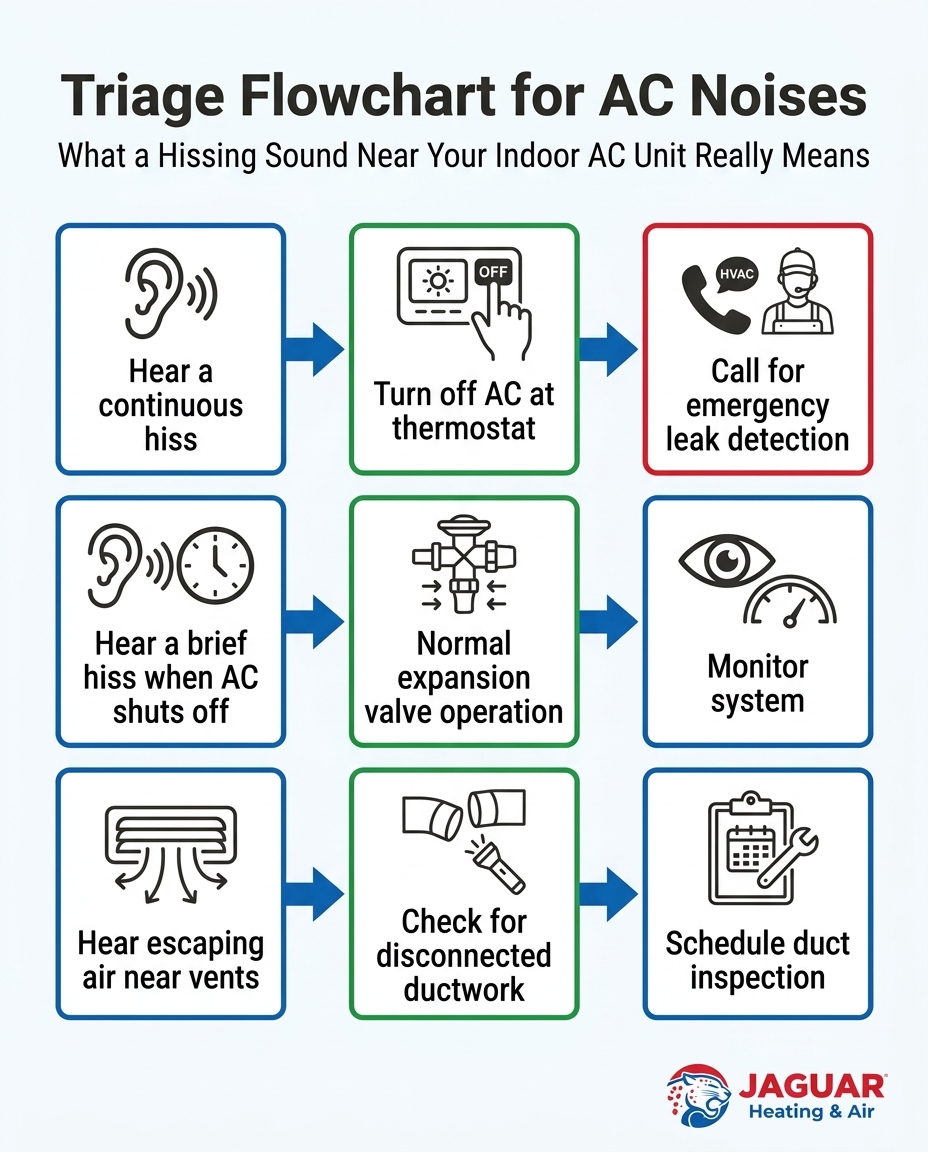
It is important to distinguish between the types of sounds your system makes. If the hiss is continuous while the system is running and is accompanied by a noticeable drop in cooling power, you have an active leak. Conversely, a brief, intermittent hiss that lasts only a few seconds when the system cycles off is usually just the normal equalization of pressure within the expansion valve.
We see this pattern frequently across the Sacramento Valley. Just recently, one local homeowner noticed a continuous hiss coming from their indoor unit during a brutal late-summer heatwave. Recognizing that the air conditioner was leaking, they followed our advice, immediately shut it down, and called for 24-hour service. A Jaguar Heating & Air technician arrived promptly, performed a quick and efficient check for leaks, and located a pinhole in the coil. Because the homeowner acted fast, the system was safely repaired without causing secondary damage to other components. If you find yourself in a similar situation, reaching out for AC repair in Sacramento right away is the safest course of action.
The Immediate Threat to Your Compressor
You might wonder why an indoor leak is such a massive threat to the outdoor unit. The answer lies in the secondary function of refrigerant. While its primary job is to cool your home, returning refrigerant gas acts as the vital coolant for the outdoor compressor motor. The compressor is the heart of your air conditioning system, pumping refrigerant in a continuous loop.
When refrigerant levels drop due to a hissing leak, the compressor loses its only source of cooling. The motor continues to run, working even harder to pump a shrinking supply of fluid. Within a very short time, the internal temperature of the compressor skyrockets.
The Danger of Limping Along
During our triple-digit heatwaves, our team has witnessed how an air conditioner losing refrigerant will overheat the outdoor compressor within a matter of hours if it is not shut down. Letting the system limp along while it hisses virtually guarantees compressor failure, which is the most expensive component of your entire HVAC system to replace.
This is why our triage protocol dictates shutting the system down instantly. During a recent stretch of peak August heat, a customer reached out because their house was no longer cooling and the system was struggling. Because the system was shut down in time, our emergency response technician was able to diagnose the low refrigerant, explain the available options, and address the root cause. The house is now cooling perfectly. Our team at Jaguar Heating & Air prides itself on rapid emergency response to safely handle these high-pressure leaks before complete compressor failure occurs. If you suspect your compressor is at risk, do not wait to schedule emergency HVAC service.
Other Potential Causes for Hissing and Air Noises
While a high-pressure refrigerant leak is the most urgent cause of a hissing sound, our diagnostic experience shows it is not the only possibility. Providing a comprehensive diagnostic overview requires comparing refrigerant leaks to other potential noise sources in and around the Sacramento Valley. Sometimes, what sounds like a chemical leak is actually an airflow issue.
Here is a breakdown of the different hissing and air noises our technicians typically encounter, and what they mean for your system:
• Continuous hiss + loss of cooling + freezing coils — Typical Location: Indoor air handler / evaporator coil — Probable Cause: Active refrigerant leak — Severity Level: High: Turn off system immediately.
• Rushing air sound + poor airflow in rooms — Typical Location: Near indoor unit or along ductwork — Probable Cause: Leaky return or supply ductwork — Severity Level: Moderate: Wastes energy, needs sealing.
• Brief hiss (3-5 seconds) when AC cycles off — Typical Location: Indoor air handler — Probable Cause: Normal expansion valve (TXV) equalization — Severity Level: Low: Normal operation, no action needed.
• Screaming or high-pitched mechanical hiss — Typical Location: Outdoor compressor unit — Probable Cause: Compressor valve failure or internal pressure relief — Severity Level: High: Turn off system immediately.
Differentiating Airflow from Refrigerant
Leaky return ductwork can sound remarkably like escaping air, but it lacks the distinct chemical smell or the freezing, ice-covered coils associated with a refrigerant leak. Ductwork leaks pull unconditioned air from your attic or crawlspace, reducing efficiency, but as we often explain to our customers, they do not pose an immediate mechanical threat to the compressor.
Similarly, compressor valve issues manifest as hissing at the outdoor unit rather than the indoor air handler. If you hear loud mechanical noises outside, it might be a different issue entirely. For example, if your AC blower motor sounds like a jet engine, you are dealing with a failing fan motor or bearing, not a refrigerant leak.
The clear distinction our team uses: If the hiss is continuous while the system is running, located indoors, and accompanied by a loss of cooling power, you must assume it is a refrigerant leak and act accordingly.
Why Refrigerant Leaks Are Never a DIY Fix
When faced with a hissing air conditioner, some homeowners are tempted to look for a quick fix or a patch kit. However, handling, recovering, and charging refrigerant is strictly regulated by law. Anyone working with these chemicals must hold an EPA Section 608 certification. At Jaguar Heating & Air, our technicians undergo rigorous training to meet this standard, which is vital for safety and environmental protection.
High-pressure refrigerant gas poses significant physical hazards. If it comes into contact with your skin as it escapes, it can cause severe frostbite instantly. Inhaling the gas in a confined space can lead to dangerous respiratory issues. Because the system operates under such intense pressure, we can assure you that attempting to seal a leak with tape or standard sealants will fail immediately.
The Myth of "Topping Off" Freon
Another common misconception we encounter in the field is that a technician can simply "top off" the system to make the hissing stop. Adding refrigerant without physically locating and repairing the microscopic hole is exactly like putting air into a punctured tire. The new refrigerant will simply hiss out again as soon as the system pressurizes.
A proper, legal repair requires a certified technician to locate the exact source of the leak using specialized electronic sniffers or UV dye. Once found, the remaining refrigerant must be safely recovered into a sealed tank. The damaged copper must be brazed with a high-temperature torch, and the entire system must be vacuum-tested to ensure it holds negative pressure before any new refrigerant is introduced.
Because these repairs are complex, we always advise that the best defense is prevention. Scheduling routine AC maintenance before the August late-summer peak cooling season allows our technicians to catch early signs of coil corrosion and address them before they turn into a high-pressure blowout.
Frequently Asked Questions About AC Hissing Noises
Is it safe to run my AC if it is hissing?
No, it is not safe for the equipment to continue running. Running a hissing air conditioner risks complete compressor burnout due to a lack of cooling refrigerant. When the system loses pressure, the outdoor motor overheats rapidly. Shutting the system off at the thermostat is the only way to prevent extensive secondary damage.
Why does my indoor AC unit sound like escaping air?
In our experience, it is likely high-pressure refrigerant gas escaping through a tiny crack in the evaporator coil, though it could occasionally be a ductwork leak. Because the refrigerant is under immense pressure (often over 100 PSI), even a microscopic pinhole will force the gas out forcefully enough to create a loud hiss. If the air is no longer blowing cold, a refrigerant leak is almost certainly the culprit.
What should I do if my AC is hissing and not cooling?
Turn the thermostat to the "OFF" position immediately and contact an emergency HVAC technician to locate the leak. Do not switch it to "Fan Only" or try to lower the temperature further. By cutting the power to the system, you stop the compressor from running dry and give a professional the chance to repair the leak safely.
Can a hissing AC unit explode?
While a residential AC will not explode like a bomb, a severely compromised compressor can suffer a catastrophic internal blowout if pressure limits are exceeded. The hissing itself is actually the system depressurizing, which prevents an explosion, but the resulting mechanical failure can violently destroy the internal valves and motor windings of the compressor.
How long does it take for a compressor to burn out after a leak?
It can happen in a matter of hours if the system runs continuously during high heat without adequate refrigerant to cool the motor. In the Sacramento Valley, where summer temperatures regularly push systems to their absolute limits, our technicians frequently see compressors overheat and seize up much faster than they would during milder weather.
Will adding Freon fix a hissing air conditioner?
No. Adding refrigerant without brazing the hole is like putting air in a punctured tire; the new refrigerant will simply hiss out again. A certified technician must locate the leak, repair the damaged copper, and test the system's pressure integrity before recharging it with the proper amount of refrigerant.
Stop the Hiss Before It Ruins Your System
A hissing sound from your indoor unit is a clear translation of a mechanical failure. It is the undeniable sound of your system losing the vital refrigerant it needs to survive the August late-summer peak cooling demand. If you heard this noise and immediately shut your system down, you made the correct, money-saving decision.
Do not let a repairable leak turn into a devastating compressor replacement. By acting quickly and trusting the certified professionals at Jaguar Heating & Air to handle the extreme pressures and hazardous chemicals involved, you ensure your home stays comfortable and safe as the summer winds down. Reach out to our local experts for a thorough diagnostic check and a permanent, EPA-certified repair.
Recent Posts
Decoding Fall HVAC Startups: Your Guide to Maintenance and AC Repair in Sacramento, CA
Navigating the October Shift: When Sacramento Weather Demands Both Cooling and Heating October in the Central Valley brings a sudden, sharp transition in weathe
Decoding the October Heating Startup: AC Repair and Fall Maintenance in Sacramento, CA
Burning dust smells on the first chilly night? Use this seasonal home maintenance checklist to see what is normal and when to call a pro on this startup.
Why Your Thermostat Blanking Out Might Just Be a Blown Low-Voltage Fuse
A completely dead thermostat screen right as fall begins often triggers panic. See why a blown 3-amp low-voltage fuse is actually protecting your furnace control board.