.avif)
How HVAC Load Calculations Work: A Beginner's Guide
Learn how HVAC load calculations work to size your Sacramento home's system right for comfort and efficiency.
Learn how HVAC load calculations work to size your Sacramento home's system right for comfort and efficiency.

Why Understanding How HVAC Load Calculations Work Can Save You Money and Comfort
How HVAC load calculations work is something every Sacramento-area homeowner should have a basic grasp of before replacing or installing a heating or cooling system.
Here is a quick answer:
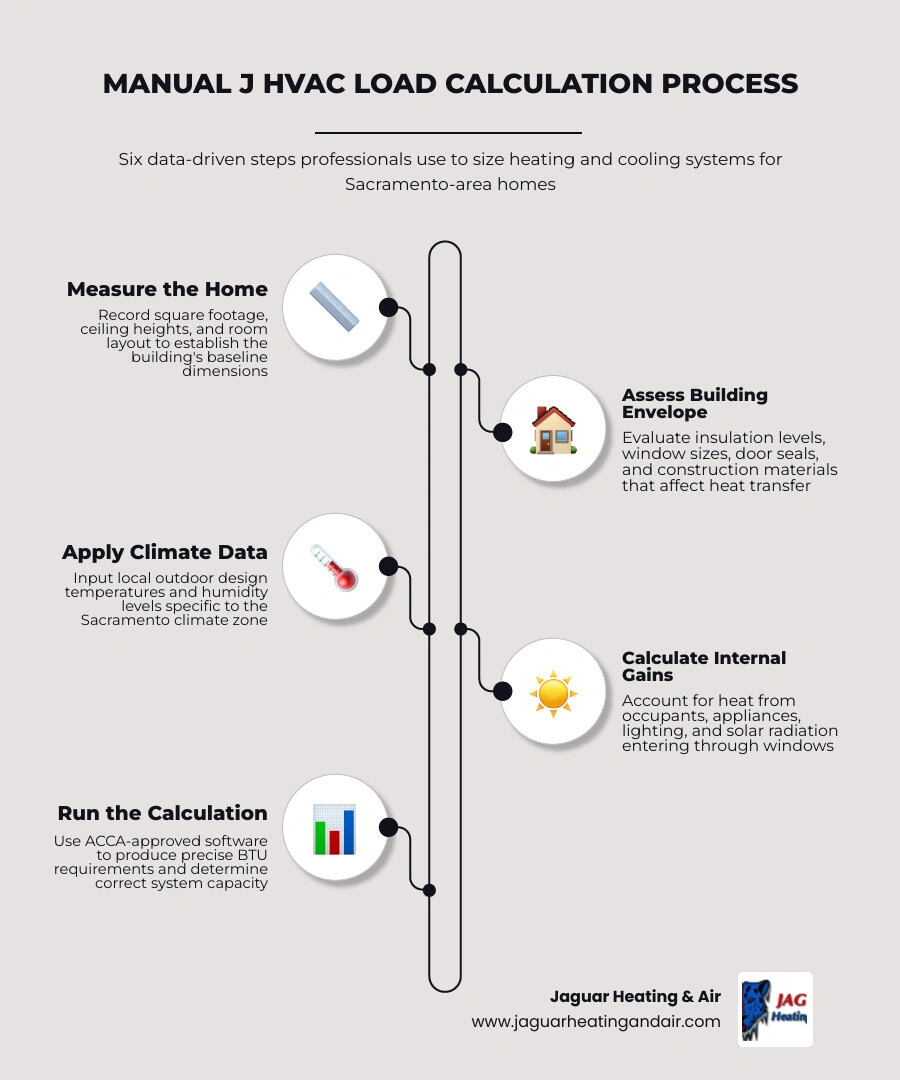
HVAC load calculations determine exactly how much heating or cooling capacity your home needs. Here is how the process works:
- Measure the home - Square footage, ceiling height, and room layout are recorded.
- Assess the building envelope - Insulation levels, window sizes, door seals, and construction materials are evaluated.
- Factor in climate data - Local outdoor design temperatures and humidity levels for your area (like Sacramento) are applied.
- Account for internal heat sources - Occupants, appliances, lighting, and solar heat gain through windows are calculated.
- Run a Manual J calculation - An ACCA-approved software tool crunches all inputs to produce the correct BTU output needed for heating and cooling.
- Size the equipment - The resulting load number determines the right system capacity in tons or BTUs.
Getting this right matters more than most homeowners realize. An oversized system short-cycles, fails to dehumidify properly, and wears out faster. An undersized system runs almost constantly, drives up energy bills, and struggles to keep up on the hottest Sacramento summer days. As one industry resource puts it, the goal is the Goldilocks system — sized just right.
A proper load calculation goes far beyond a rough square footage guess. It is a detailed, data-driven process that accounts for your specific home, your Sacramento climate zone, and how you actually use your space. The sections below break down every piece of that process in plain language.
What is an HVAC Load Calculation and Why Does Sizing Matter?

At its core, an HVAC load calculation is a mathematical assessment of how much thermal energy (heat) enters and leaves a home. By understanding exactly how much heat your home gains in the summer and loses in the winter, a professional can determine the precise heating and cooling capacity required to keep your indoor climate comfortable year-round.
Capacity in the HVAC industry is measured in British Thermal Units (BTUs). One BTU is the amount of heat required to raise or lower the temperature of one pound of water by one degree Fahrenheit. When discussing air conditioning or heat pump capacity, we often refer to "tons" of refrigeration. One ton of cooling capacity is equal to 12,000 BTUs per hour.
Historically, many contractors used simple, outdated rules of thumb to size equipment. However, because every home features unique insulation levels, window orientations, and construction materials, guessing is a recipe for disaster. This is why AC Sizing Matters in Sacramento CA is a fundamental principle of modern home comfort. Getting the size wrong means you will either pay for capacity you do not need or suffer through uncomfortable, humid afternoons.
When we perform a load calculation, we are searching for that perfect balance. We call this the "Goldilocks" approach—finding a system that is not too big, not too small, but just right. To learn more about this concept, you can read our guide on Goldilocks and the HVAC: Finding the Just Right Size.
The Science Behind How HVAC Load Calculations Work
To understand how these calculations work, we must look at the two distinct types of heat loads that exist in any indoor environment: sensible heat and latent heat.
- Sensible Heat Load: This is the dry heat you can feel. It is the thermal energy that actually changes the air temperature in your home, which is measured by a standard dry-bulb thermometer. Heating or cooling sensible load involves changing the temperature of the air.
- Latent Heat Load: This is the moisture or humidity in the air. When hot, humid air enters your home, your air conditioner must spend energy removing the moisture (condensing it into water at the cooling coil) before it can effectively lower the air temperature. Latent heat does not change the thermometer reading, but it directly impacts how sticky and uncomfortable the air feels.
| Heat Load Type | What It Measures | Sources in the Home | How HVAC Systems Address It |
|---|---|---|---|
| Sensible Heat | Dry air temperature | Sunlight, warm outdoor air, ovens, lighting, electronics | Lowering or raising the actual air temperature |
| Latent Heat | Air moisture / humidity | Breathing, sweating, cooking, showers, outdoor humidity | Condensing moisture on the cooling coil to dehumidify |
An accurate load calculation must account for both sensible and latent heat gains to ensure the system has enough total refrigeration capacity. If a contractor only calculates sensible heat, the system may struggle to dehumidify your home on muggy days.
During the winter, the focus shifts to heat loss. We calculate how quickly heat escapes through your home’s walls, ceiling, windows, and floors to determine the required heating BTU capacity. This step is critical when Buying a New Furnace Sized Correctly so you do not end up with an oversized furnace that blasts hot air and shuts down rapidly, wasting energy and wearing out components.
Understanding how hvac load calculations work for heating vs cooling
The physical science of heat transfer governs how thermal energy moves through your home. Heat naturally flows from warmer areas to cooler areas via three primary methods:
- Conduction: Heat transfer through solid materials. For example, heat from the sun conducts through your exterior stucco or siding, moving inward toward your drywall.
- Convection: Heat transfer through fluid or air movement. Warm outdoor air leaking through gaps around doors and windows carries heat directly into your living spaces.
- Radiation: Heat transfer via electromagnetic waves. Solar radiation passes directly through glass windows, heating up your carpets, furniture, and walls.
In the summer, we calculate how much heat enters your home through these three pathways (heat gain). In the winter, we calculate how quickly heat leaves your home through those same pathways (heat loss).
Understanding these dynamics is especially important when sizing modern, highly efficient systems. For instance, discovering the Heat Pump Advantages Over Traditional HVAC shows how these systems leverage heat transfer principles to move heat rather than generate it, making precise sizing even more critical for peak efficiency.
The role of thermal storage and radiant time series in how hvac load calculations work
Heat does not instantly affect your indoor air temperature the moment it hits the outside of your home. This delay is due to thermal storage. The physical mass of your home—the wood framing, drywall, concrete slab, and brick—absorbs radiant heat from the sun during the day and stores it.
To account for this delay, commercial and advanced residential load calculations use the Radiant Time Series (RTS) method. The RTS method calculates the "time delay effect" of radiant heat. For example, the sun may beat down on your west-facing wall at 2:00 PM, but because the wall materials absorb and hold that heat, the actual convective cooling load (the heat transferred from the wall into your indoor air) might not peak until 6:00 PM.
By calculating these delayed heat releases, HVAC design software ensures your cooling system is sized for the actual peak load of the indoor air, rather than an artificial, instantaneous peak that never actually materializes. This distinction is also vital when comparing convective cooling (air-based systems) to radiant cooling systems (which cool surfaces directly and react differently to radiant heat gains).
Manual J vs. Square Footage: Why Rules of Thumb Fail
For decades, many installers used a crude rule of thumb: "one ton of cooling for every 500 square feet." While this might have been acceptable in the mid-20th century when energy was cheap and home construction was uniform, it is highly inaccurate today.
Relying solely on square footage estimates completely ignores how your home is built. Two homes with the exact same 2,000-square-foot footprint can have vastly different heating and cooling needs. For example:
- Home A: Built in 1970, has single-pane windows, minimal attic insulation, leaky ductwork, and faces direct afternoon sun.
- Home B: Built in 2024, features double-pane low-E windows, spray-foam insulation, tight ductwork, and is shaded by mature trees.
If you size both homes using the same square footage rule of thumb, Home A will be severely undersized and hot, while Home B will be massively oversized, resulting in short-cycling and high indoor humidity.
To prevent these issues, the Air Conditioning Contractors of America (ACCA) established the Manual J standard. Manual J is the national recognized standard for residential load calculations. It uses precise, mathematical formulas to evaluate every thermal characteristic of a structure. By moving away from guesses and adhering to ACCA standards, you protect your investment. This is why we emphasize The Importance of Correct HVAC Installation from the very first step of the design process.
Key Factors Analyzed in a Professional Manual J Calculation
A professional Manual J calculation requires a thorough assessment of your home's physical and environmental characteristics. When we perform a calculation, we analyze several critical factors:
- Insulation Levels: We verify the R-value (thermal resistance) of the insulation in your attic, exterior walls, crawlspaces, and floors.
- Windows and Doors: We look at the number of windows, their U-values (how well they prevent heat transfer), their Solar Heat Gain Coefficient (SHGC), and whether they are single, double, or triple-pane.
- Window Orientation: The direction your windows face matters immensely. West- and east-facing windows let in massive amounts of solar radiation at the hottest parts of the day, whereas north-facing windows remain relatively cool.
- Local Climate Zones: Sacramento and its surrounding areas (like Folsom, Roseville, and Elk Grove) experience hot, dry summers and cool winters. Manual J software utilizes official weather data from local climate zones to base calculations on local extreme design temperatures.
- Occupant Density: Humans generate heat and moisture. A home with two occupants has a lower latent and sensible load than a home with a family of six.
- Appliance Heat Gains: Modern electronics, refrigerators, ovens, and lighting all emit heat that contributes to your cooling load.
- Ductwork Location and Insulation: Ducts running through a blazing-hot, unconditioned attic absorb heat, which must be factored into the overall system load.
By carefully evaluating these variables, we can also determine if your home would benefit from a multi-zone layout. If you have rooms that receive vastly different amounts of sunlight, Understanding Zoned HVAC can help you manage these localized loads with maximum efficiency.
The Consequences of Improperly Sized Heating and Cooling Systems
Sizing an HVAC system is a balancing act. If you stray too far in either direction, your comfort and your wallet will suffer.
The Risks of Oversizing
Many homeowners assume that "bigger is always better." In HVAC, this is a costly misconception. An oversized air conditioner or heat pump will cool your home incredibly fast, but this speed causes major issues:
- Short-Cycling: The system turns on, blasts cold air, satisfies the thermostat in 5 to 10 minutes, and shuts off. This constant on-and-off cycling places immense wear and tear on the compressor and fan motor, significantly shortening the equipment's lifespan.
- High Humidity: An air conditioner must run continuously for at least 15 to 20 minutes to allow moisture to condense on the cooling coil and drain away. Because oversized systems shut off too quickly, they fail to remove humidity, leaving your home feeling cool but sticky and damp.
- Wasted Energy: Starting up an HVAC system draws a massive surge of electricity. Short-cycling causes your energy bills to skyrocket.
The Risks of Undersizing
Conversely, an undersized system lacks the capacity to handle extreme weather:
- Constant Operation: On a 105°F Sacramento summer afternoon, an undersized AC will run non-stop without ever reaching your target thermostat setting.
- Accelerated Wear: Running 24/7 causes components to overheat and fail prematurely, leading to frequent, expensive repairs.
- High Energy Bills: While the system isn't cycling on and off, running continuously for hours on end consumes a massive amount of electricity.
To avoid these headaches, comparing your options is essential. You can read our Standard Efficiency vs High Efficiency HVAC Comparison to see how modern staging can mitigate minor load variations, or explore the HVAC Features Looking Today to find advanced systems that adapt their output to match your home's real-time load.
How Professionals Use Load Calculation Software and Tools
Modern HVAC professionals do not perform these incredibly complex mathematical formulas by hand on a yellow notepad. Instead, we utilize advanced, ACCA-approved software tools to ensure absolute precision.
Some of the advanced technologies and methods we use include:
- ACCA-Approved Software Platforms: Programs like Cool Calc, Wrightsoft, or Elite RHVAC allow us to input precise home details and automatically cross-reference them with local building codes and climate data.
- LiDAR Scanning and 3D Modeling: Using tablet-based tools equipped with LiDAR, we can perform a quick scan of your rooms to generate highly accurate 3D models of your home's layout, ceiling heights, and window dimensions in minutes.
- Whole-House Block Loads vs. Room-by-Room Analysis:
- A block load calculation treats the entire house as one single zone. This is useful for determining the overall size of a replacement furnace or heat pump.
- A room-by-room analysis calculates the exact heating and cooling needs of every individual room. This is absolutely critical for designing ductwork, sizing registers, and setting up zoned comfort systems.
By using these advanced tools and avoiding default software assumptions, we ensure your new system is tailored specifically to your home’s unique footprint.
Frequently Asked Questions About HVAC Sizing
What is the difference between a space cooling load and a cooling coil load?
The space cooling load is the rate at which heat must be removed from the indoor air to maintain a constant temperature and humidity level. The cooling coil load, however, is the actual amount of heat the air conditioner's indoor coil must remove.
The cooling coil load is almost always larger because it includes the space cooling load plus the extra heat and moisture introduced by outdoor ventilation air, as well as any heat gained by the ductwork as it travels through unconditioned spaces like your attic.
How many BTUs are in one ton of refrigeration?
There are exactly 12,000 BTUs per hour in one ton of refrigeration. The term "ton" dates back to the days of ice-harvesting, representing the amount of cooling power delivered by melting a one-ton block of ice over a 24-hour period.
To distribute this cooling capacity evenly throughout your home, a standard split-system air conditioner or heat pump is designed to move approximately 400 CFM (Cubic Feet per Minute) of airflow per ton of capacity.
Can I use a simple online calculator to size my new heat pump?
While a free online calculator can give you a very rough estimate for planning purposes, you should never use one to purchase equipment. Online calculators rely on generic rules of thumb and do not account for your home's specific insulation quality, window ratings, duct integrity, or local climate design parameters.
Skipping a professional Manual J calculation risks installing an incorrectly sized heat pump, which can lead to poor performance, high energy bills, and an uncomfortable home.
Conclusion
Understanding how HVAC load calculations work reveals why professional system design is so important. Your home is a complex system of heat gains, heat losses, air currents, and moisture levels. Guessing your equipment size based on square footage is a gamble that often results in high utility bills, frequent repairs, and a home that is either too humid or drafty.
At Jaguar Heating & Air, we take pride in being a family-owned company serving Sacramento, CA, and surrounding communities including Elk Grove, Folsom, Roseville, El Dorado Hills, Lincoln, Rocklin, Woodland, Carmichael, Citrus Heights, Fair Oaks, Granite Bay, Mather, Orangevale, and Rancho Cordova.
As a Trane Comfort Specialist with NATE-certified technicians, we never rely on shortcuts or rules of thumb. We perform precise, software-driven load calculations to ensure your new heating, cooling, or heat pump system is sized perfectly for your home.
Ready to experience reliable, energy-efficient comfort backed by our 100% customer satisfaction guarantee? Schedule professional HVAC services today with the team at Jaguar Heating & Air!
Recent Posts

How Sacramento's Hard Water Affects Your Evaporative Cooler Pads
By September, Sacramento's heavy mineral content often turns swamp cooler pads into rock-hard blocks. See why airflow drops drastically and weigh your end-of-season options.
Why Your Dual-Zone System Fails to Cool the Master Bedroom
Persistent temperature imbalances in your master suite are rarely a main AC capacity issue. Discover how stuck motorized zone dampers disrupt airflow and why a pre-season diagnostic is crucial.

The Truth About Chemical Coil Cleaners and Your AC's Longevity
While a sparkling clean condenser unit looks great, acidic sprays might be secretly destroying your equipment. See why we refuse to use them during fall tune-ups.