.avif)
The Difference Between a Bad Thermostat Wire and a Dead AC Unit
A completely silent AC during a late-summer heatwave is terrifying, but it doesn't always mean a catastrophic failure. See how a severed communication line mimics a broken compressor.
A completely silent AC during a late-summer heatwave is terrifying, but it doesn't always mean a catastrophic failure. See how a severed communication line mimics a broken compressor.

The Panic of an Unresponsive Cooling System
If your thermostat is set to 72°F but the indoor temperature is rapidly climbing past 85°F, knowing The Difference Between a Bad Thermostat Wire and a Dead AC Unit can save you from immediate panic. You press the buttons on the wall, but nothing happens. The screen might be blank, or it might say "cooling," yet the vents remain completely silent. During an August late-summer heatwave, an unresponsive cooling system creates intense stress. The house is getting dangerously hot, and your mind likely jumps straight to the worst-case scenario: a catastrophic, total system failure.
When your house is rapidly heating up, understanding the root cause of the failure becomes your top priority. Most homeowners face a stressful decision point in this exact moment. Do you panic and assume you need a massive, full-system replacement, or do you seek a professional diagnosis to rule out a minor electrical fault? The truth is, a system that appears entirely "dead" is very often just suffering from a severed line of communication.
Before you write off your equipment, it helps to understand how your Air Conditioning system actually operates. The heavy mechanical parts outside rely entirely on a tiny, fragile wire inside to tell them what to do. If that wire fails, the heavy machinery simply sits idle. By learning to recognize the subtle symptoms of a communication error versus a true mechanical breakdown, you can approach the situation with clarity rather than fear.
What Does a Truly 'Dead' Air Conditioner Look Like?
To understand why a bad wire can trick you, you first need to know what an actual mechanical failure looks and sounds like. When an air conditioner truly dies, the failure usually lies in the major, heavy-duty components: the outdoor compressor, the condenser fan motor, or the indoor blower motor. These parts handle high voltage and endure massive physical stress every time the system cycles on.
The Sounds of Mechanical Failure
Unlike a simple wiring issue, a failing mechanical component rarely goes quietly. If your compressor is seizing up or your motors are dying, you will usually notice distinct, alarming noises before the system shuts down completely. Loud grinding sounds often indicate that motor bearings have worn out entirely, causing metal to scrape against metal. A harsh, vibrating hum coming from the outdoor unit usually means the system is receiving high-voltage power and trying to start, but a failed component—like a bad capacitor or a locked compressor—is preventing it from turning over.
The Warning Signs You Might Have Missed
A true mechanical failure often gives you warning signs over several weeks. You might notice the system struggling to keep up with the thermostat setting, blowing lukewarm air, or engaging in rapid short-cycling. Short-cycling happens when the unit turns on for just a minute or two, shuts off abruptly, and then tries to start again. This puts immense strain on the compressor and is a classic sign of an underlying mechanical or airflow crisis.
In contrast, a wiring issue is almost always sudden and completely silent. One minute the system works perfectly; the next, it is completely unresponsive. For many Sacramento area homes our team services with attic-run thermostat wires, a sudden lack of operation without any prior grinding, humming, or short-cycling is a strong indicator that the heavy machinery is actually fine, but the command signal is simply not reaching the equipment.
Your System's Communication Lifeline: The Low-Voltage Wire
Your air conditioning system is essentially divided into two distinct electrical worlds: the high-voltage muscle and the low-voltage brain. The outdoor compressor and indoor blower motor use heavy, high-voltage electricity to physically move refrigerant and push air through your ductwork. However, these powerful components do not have a mind of their own. They rely entirely on your thermostat to tell them when to turn on and when to shut off.
How the 24-Volt Signal Works
The bridge between the brain and the muscle is the thermostat wire. This is a thin, low-voltage line—typically carrying just 24 volts of electricity—that runs from the back of your thermostat, up through your walls, and into the main control board of your HVAC system. Inside this wire casing are several smaller, color-coded strands. One strand carries power to the thermostat, another signals the indoor fan to blow, and another commands the outdoor AC unit to start cooling.
The Vulnerable Journey Through Your Home
Because this wire only carries a harmless 24 volts, it does not require the thick, heavy-duty armor that high-voltage lines use. It is thin, flexible, and wrapped in a relatively soft insulation. In many typical layouts—especially in Sacramento area homes with attic-run thermostat wires—this fragile lifeline is routed through some of the most hostile environments in the house. It snakes up inside the drywall, stretches across unconditioned attic spaces, and eventually connects to the equipment.
If just one of those tiny internal strands is severed, the entire heavy-duty mechanical system becomes completely unresponsive. The outdoor unit could be in perfect, pristine condition, but without that 24-volt command signal arriving from the thermostat, it will never turn on. This total lack of response perfectly mimics a dead, catastrophic system failure, leading many homeowners to assume the worst.
How Environmental Stress and Pests Sever the Connection
You might wonder how a wire safely hidden inside your walls or attic could suddenly break. The answer usually comes down to the harsh realities of your home's hidden microclimates and the local wildlife. Thermostat wires do not usually snap on their own; they are degraded by environmental stress or actively destroyed by pests.
The Impact of Extreme Attic Temperatures
Sacramento's extreme late-summer heatwaves drive attic temperatures up significantly, often exceeding outdoor temperatures by 40 to 50 degrees. When it is 100°F outside, your dark, unventilated attic can easily reach 140°F or more. Over years of exposure to this intense, baking heat, the thin plastic insulation around low-voltage wiring begins to suffer thermal degradation. It becomes brittle, cracks, and eventually exposes the delicate copper strands inside. Once exposed, these wires can easily short out against surrounding metal or simply degrade until the connection is lost.
The Threat of Attic-Dwelling Pests
Beyond the heat, local wildlife poses a massive threat to low-voltage wiring. During an August late-summer heatwave, the brutal outdoor temperatures push rodents and pests indoors in search of cooler shelter and water. Your HVAC system provides both. The air handler in the attic generates condensation, offering a reliable water source, and the ductwork provides cool drafts.
Rodents have a biological need to constantly chew on things to file down their growing teeth, and the soft, pliable insulation of a thermostat wire is a favorite target. A mouse or rat can chew through a 24-volt communication line in seconds. When this happens, the connection is instantly cut. At Jaguar Heating & Air, our team sees this pattern frequently. In fact, one homeowner reached out to us late on a Friday night during a back-to-school heatwave because their AC blower fan simply would not turn on. One of our technicians arrived the following morning, quickly traced the failure up into the attic, and discovered that pests had chewed through the fan control wire. The fan was repaired quickly without replacing any major equipment.
This "false alarm" effect—where a chewed wire creates a completely blank screen or a dead system—is one of the most common diagnostic calls we handle during the peak cooling season.
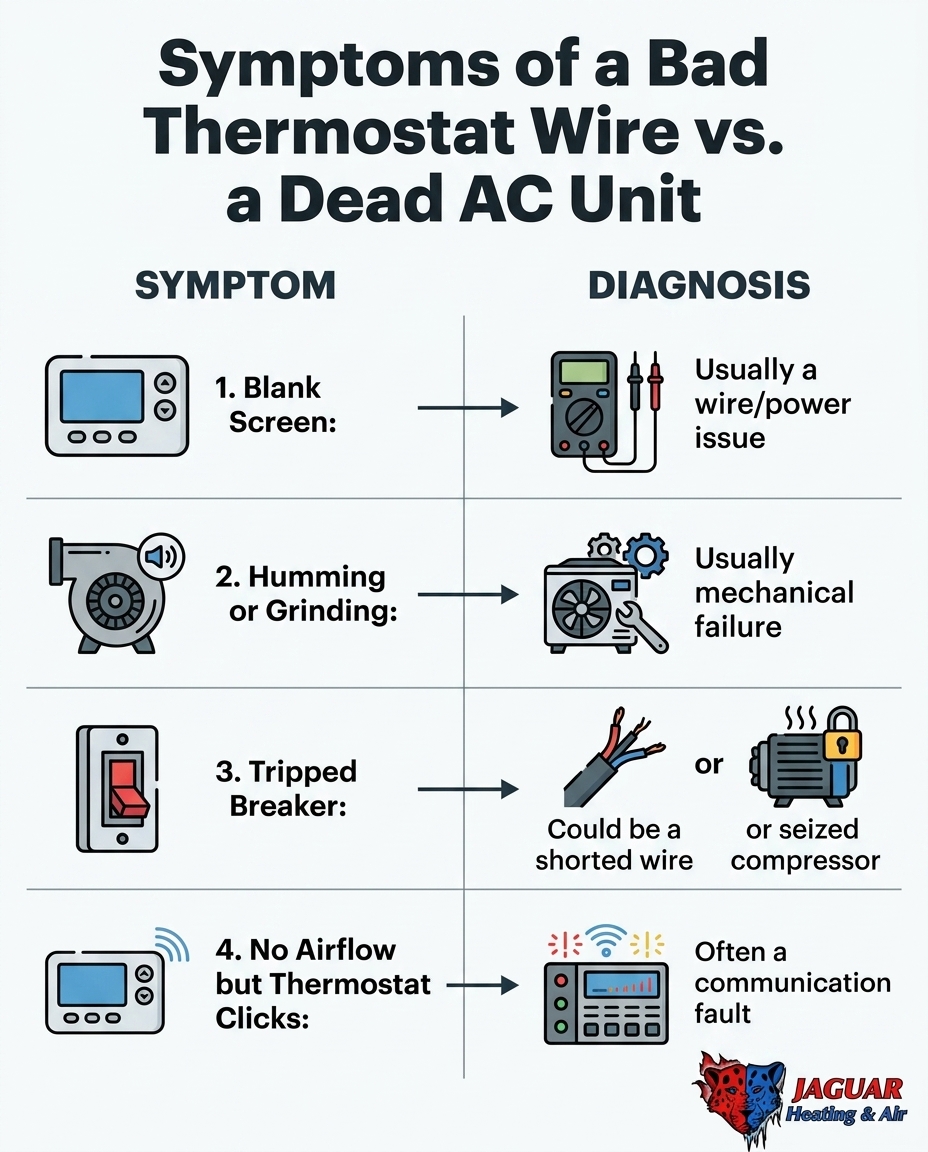
Comparing Symptoms: Bad Wire vs. Dead Unit
When your house is uncomfortably hot, it can be difficult to think clearly about what exactly your system is doing. By stepping back and observing the specific symptoms, you can often narrow down whether you are dealing with a communication failure or a mechanical breakdown. While you should always rely on a professional for a final diagnosis, recognizing the common signs your AC needs a pro can give you peace of mind.
Here is a breakdown of what different symptoms typically mean for Sacramento area homes with attic-run thermostat wires:
• Blank Thermostat Screen — Most Likely Cause: Bad Wire / Power Loss — What It Means: The thermostat has lost its 24V power supply. This usually means a wire is severed, a low-voltage fuse has blown, or the main breaker is off.
• System Trips Breaker Instantly — Most Likely Cause: Mechanical / Short Circuit — What It Means: The system is drawing too much high-voltage power. This could be a shorted wire touching metal, or a seized compressor pulling massive amps trying to start.
• Thermostat Clicks, But No Airflow — Most Likely Cause: Communication Fault — What It Means: The thermostat is trying to send the signal, but the wire commanding the indoor blower motor is broken or disconnected.
• Loud Buzzing at Outdoor Unit — Most Likely Cause: Mechanical / Capacitor — What It Means: The signal is reaching the unit, but a mechanical part has failed. The buzzing is the sound of electricity trying to force a stuck motor to turn.
• Rapid Short-Cycling — Most Likely Cause: Mechanical / Airflow — What It Means: The system turns on but shuts off immediately to protect itself. Often caused by severe overheating, refrigerant issues, or failing motors.
Why Honest Diagnostics Prevent Unnecessary Replacements
There is a massive sense of psychological relief when you discover that a completely "dead" air conditioner is actually just suffering from a minor wiring fault. However, getting to that point requires a technician who is committed to finding the actual root cause of the problem. Jumping to conclusions is incredibly dangerous in the HVAC industry. If a technician sees an unresponsive outdoor unit and immediately assumes the compressor is dead without testing the low-voltage communication lines, you could end up paying for a massive, unnecessary replacement.
The Value of Diagnostic Integrity
At Jaguar Heating & Air, we prioritize diagnostic integrity. In our years of working on Sacramento area homes with attic-run thermostat wires, our team typically sees that a severed connection is highly probable. Rather than exploiting a homeowner's fear of a dead unit to push a full replacement, a trusted technician will pull out their tools and trace the communication fault step by step. They will check the voltage at the thermostat, test the continuity of the wires running through the attic, and inspect the main control board for blown low-voltage fuses.
We frequently see homeowners fearing the worst when their system acts up. For instance, another summer customer appreciated our 24-hour availability when they needed their air conditioner checked for potential leaks. By performing a comprehensive, honest check of the entire system rather than jumping to conclusions, we addressed the actual issue and restored their comfort. Finding a simple chewed wire in the attic and repairing it saves the homeowner from an unnecessary major investment, and that level of honesty is the foundation of our service.
Safe Steps to Take When Your AC Won't Turn On
If you find yourself sweating through an August / late-summer heatwave with an unresponsive system, there are a few safe, non-technical steps you can take to troubleshoot the issue before calling in the professionals. However, it is vital to know where to draw the line to protect yourself and your equipment.
1. Check the thermostat batteries and screen: If your thermostat has a blank screen, try replacing the batteries if it uses them. If it is hardwired, a blank screen confirms a loss of 24V power.
2. Verify the main electrical breaker: Check your home's main electrical panel. If the breaker labeled for the AC has tripped, you can try resetting it once. If it trips again immediately, leave it off—this indicates a serious electrical short.
3. Look for obvious signs of damage: Walk outside and visually inspect the outdoor unit. Look for heavy debris, ice on the refrigerant lines, or obvious physical damage. Do the same near your indoor air handler if it is safely accessible.
4. Avoid touching electrical components: CRITICAL: Do not attempt to use a multimeter to test voltage, and do not attempt to splice low-voltage wires yourself. Modern HVAC control boards are highly sensitive. Touching the wrong terminals together can instantly short out the circuit board, turning a minor wire repair into a major, expensive component replacement.
5. Call for professional diagnostics: If the breaker is on, the batteries are fresh, and the system is still unresponsive, it is time to call for emergency HVAC service. A professional has the specialized tools to safely trace the electrical fault without risking damage to the control board.
Of course, there are times when a unit genuinely has reached the end of its lifespan. For example, a Vacaville customer called us in the spring facing a failing system; after a proper, thorough diagnosis confirmed the mechanical components were truly exhausted, our owner recommended and installed an upgraded AC unit and coil. But that conclusion should only come after a complete diagnostic check.
Frequently Asked Questions About Unresponsive AC Systems
Will a bad thermostat cause the AC not to turn on?
Yes, if the thermostat cannot send the 24V signal, the AC will not activate. The thermostat acts as the command center for your entire HVAC system. Even if every mechanical part is in perfect working order, a bad thermostat will leave the system completely unresponsive.
What happens when a thermostat wire shorts out?
A short can blow the low-voltage fuse on the control board, instantly cutting power to the thermostat and shutting down the system. When the exposed copper of a damaged wire touches metal or another wire, it creates a surge that the protective fuse catches. This is why a shorted wire usually results in a completely blank thermostat screen.
How do I know if my thermostat wire is bad?
Symptoms include a blank screen, unresponsive controls, or the system failing to respond to temperature adjustments. Because these symptoms look exactly like a dead control board or a tripped breaker, confirming a bad wire requires a professional continuity test using a specialized multimeter.
Can a bad thermostat kill an AC unit?
While it won't typically "kill" the mechanical parts instantly, a malfunctioning thermostat can cause rapid short-cycling, which puts excessive wear on the compressor over time. If the thermostat sends erratic signals, forcing the heavy compressor to turn on and off every two minutes, the motor will eventually overheat and fail prematurely.
Why do pests chew on low-voltage AC wiring?
Rodents chew on wires to file their teeth, and they are often drawn to the condensation or cooler air near HVAC components in hot spaces. In a sweltering attic, the area around your indoor air handler offers a rare source of moisture and cooler temperatures, making the nearby low-voltage wires an easy and appealing target for mice and rats.
Restoring Your Comfort with Professional Clarity
An unresponsive cooling system during an August / late-summer heatwave is always stressful, but it doesn't automatically mean you are facing a catastrophic equipment failure. As we have seen, the delicate 24-volt communication lines running through your home are highly susceptible to heat degradation and pest damage. When these lines fail, they perfectly mimic a completely dead AC unit, tricking many homeowners into panicking about a major replacement.
The key to resolving the issue is relying on a professional who will take the time to trace the communication lines before assuming the worst. By pinpointing the exact location of a severed wire, a trusted technician can restore your cooling quickly and efficiently. If your system is currently unresponsive, don't panic—schedule an expert AC repair diagnostic visit today to get the honest answers and peace of mind you deserve.
Recent Posts
Why We Inspect Your Ductwork's Mastic Seal During Cooling Diagnostics
Before transitioning to fall heating, checking the 1990s-era mastic tape on your ductwork is crucial. Degraded attic seals waste expensive conditioned air long before your AC unit fails.
What a Rattling Outdoor Fan Blade Means for Your AC's Lifespan
A vibrating condenser fan creates micro-vibrations that act as a ticking time bomb for delicate copper lines. Find out why you shouldn't ignore this fall noise.
Why We Test Your AC's Amp Draw During Late Summer Maintenance
Even if your vents are blowing cold air, months of intense heat can push your compressor to the brink. We measure invisible electrical fatigue to catch stressed parts before a total breakdown.