.avif)
Don't Leave Money on the Table with These Federal HVAC Credits
Claim federal tax credits for heat pump upgrades: up to $2,000 back! Maximize 25C savings, stack rebates & boost efficiency in 2026.
Claim federal tax credits for heat pump upgrades: up to $2,000 back! Maximize 25C savings, stack rebates & boost efficiency in 2026.

What Are the Federal Tax Credits for Heat Pump Upgrades?
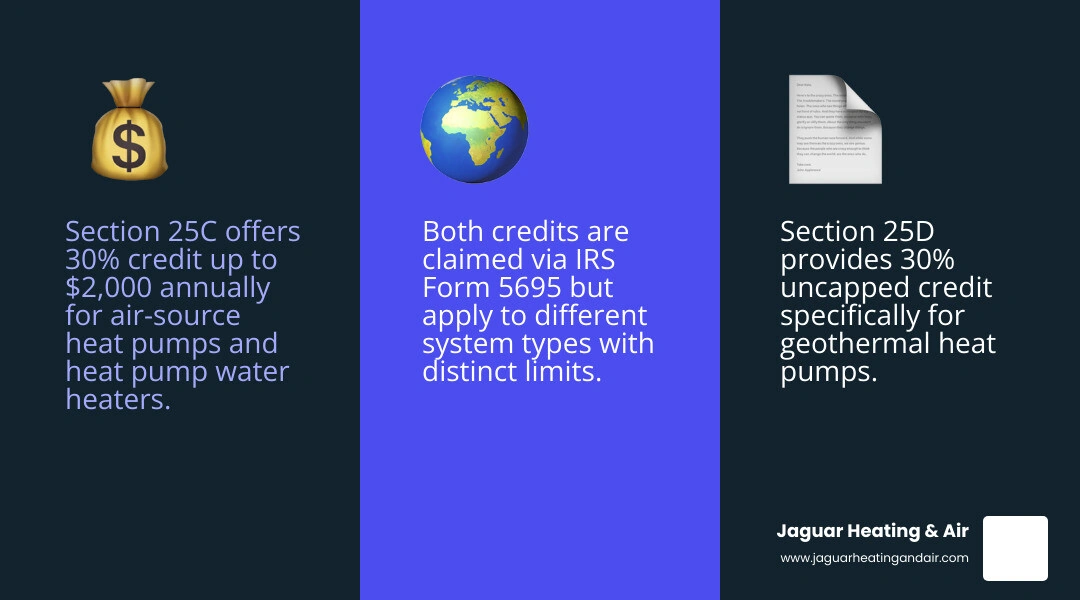
Federal tax credits for heat pump upgrades are available to homeowners through the Energy Efficient Home Improvement Credit (Section 25C), which gives you back 30% of your installation costs — up to $2,000 per year — for qualifying heat pump systems installed by December 31, 2025.
Here's a quick summary of what you need to know:
| Credit Detail | Amount |
|---|---|
| Credit rate | 30% of installation costs |
| Maximum heat pump credit | $2,000 per year |
| Combined annual maximum (all upgrades) | $3,200 per year |
| Qualifying system types | Air-source heat pumps, heat pump water heaters |
| Geothermal heat pumps (Section 25D) | 30%, no annual cap |
| Deadline for installations | December 31, 2025 |
| Form required | IRS Form 5695 |
| Refundable? | No — reduces taxes owed |
If you installed a qualifying heat pump in 2025, you can claim this credit when you file your 2025 taxes in 2026.
Heating and cooling your home accounts for the largest share of your home's energy use — and for Sacramento-area homeowners, the costs add up fast. The good news is that the federal government set aside real, meaningful money to help offset the cost of upgrading to a modern heat pump system. Under the Inflation Reduction Act, the 25C credit has made it more affordable than ever to ditch older, less efficient equipment.
But here's the thing: many homeowners either don't know this credit exists, don't realize they qualify, or leave money on the table by not planning their upgrades strategically. The credit expired on December 31, 2025 — so if you installed a qualifying system last year, now is the time to make sure you claim every dollar you're owed when you file your 2025 return this spring.
This guide walks you through exactly how these credits work, what qualifies, and how to make the most of them.
Understanding Federal Tax Credits for Heat Pump Upgrades (25C)

Navigating the tax code can feel like a full-time job, but for those of us in the Sacramento valley looking to stay comfortable, Section 25C is the gold standard. Formally known as the Energy Efficient Home Improvement Credit, this provision was significantly expanded by the Inflation Reduction Act to encourage homeowners to transition away from fossil fuel heating.
The benefits of investing in heat pump installation extend far beyond just the immediate tax break. You are looking at a system that is 3 to 5 times more efficient than traditional furnaces. For the 2025 tax year (filing in 2026), you can claim 30% of the total project cost. While other energy upgrades like windows or doors have lower caps, heat pumps enjoy a generous $2,000 annual limit.
It is important to note that this credit applies to existing homes. Whether it’s your primary residence or a second home you use as a residence, you can likely qualify. However, new construction projects are generally excluded from 25C, as those homes are expected to meet modern efficiency standards from the start.
Maximizing the 30% Federal Tax Credit for Heat Pump Upgrades
To get the full $2,000, your total project cost (including labor) should be at least $6,667. Since the credit is 30%, that hits the $2,000 ceiling perfectly. We often see homeowners install both heat pumps for climate control and heat pump water heaters. While both fall under the same $2,000 category, they provide a dual punch of energy savings that can slash your electricity consumption by up to 50% compared to electric resistance heating.
This is a non-refundable credit. This means it can reduce the amount of tax you owe to zero, but the IRS won't cut you a check for any "leftover" credit. It’s all about lowering your tax liability for the year the system was installed.
Eligibility for Homeowners and Renters
A common misconception is that you must own a massive estate to qualify. In reality, the credit is quite inclusive. If you are a renter in Sacramento or Elk Grove and you pay for an eligible upgrade to your principal residence (with the landlord's permission, of course), you may be able to claim the credit.
However, if you are a landlord who does not live in the property, you cannot claim these credits for your rental units. The government designed this specifically for those occupying the home. If you've decided to upgrade your Sacramento home, ensuring the property is used as a residence is the first step toward eligibility.
Technical Standards and Efficiency Ratings for 2026
Not every heat pump you find at a big-box store will qualify for the tax credit. The IRS has strict technical standards. For the 2025 tax year, equipment must meet or exceed the highest efficiency tier established by the Consortium for Energy Efficiency (CEE), specifically excluding the "advanced" tiers.
Understanding things that determine heat pump efficiency in Folsom, CA is crucial because these ratings—SEER2, EER2, and HSPF2—are what the IRS looks at.
| Metric | Description | Why It Matters for 2026 |
|---|---|---|
| SEER2 | Seasonal Energy Efficiency Ratio | Measures cooling efficiency over a typical season. |
| EER2 | Energy Efficiency Ratio | Measures instantaneous efficiency at a specific temperature. |
| HSPF2 | Heating Seasonal Performance Factor | Measures heating efficiency; vital for Northern California winters. |
SEER2 and HSPF2 Requirements
For 2025 installations, split-system ducted heat pumps generally need a SEER2 rating of 15.2 or higher. For non-ducted (mini-split) systems, the requirement often jumps to SEER2 16. These standards ensure that the federal tax credits for heat pump upgrades are only applied to systems that truly reduce the national energy load.
In our region, we also look closely at HSPF2. Since we do experience chilly nights in Folsom and Roseville, having a high heating efficiency rating ensures you're using heat pumps efficiently during cooler months without a spike in your utility bill.
Cold-Climate Heat Pump Performance
While Sacramento isn't exactly the North Pole, we do have "Cold-Climate" heat pumps available that are recognized as ENERGY STAR Most Efficient. These units are engineered to perform efficiently even when temperatures drop below -10°F.
Choosing a cold-climate model is perfect for Californian homeowners because it eliminates the need for a backup gas furnace in almost every scenario. This drastically reduces your home's greenhouse gas emissions—estimated at a reduction equivalent to taking several cars off the road over the life of the system.
How to Claim Your Credits and Required Documentation
Claiming your credit isn't automatic; you have to ask for it. This is done by filing IRS Form 5695, Residential Energy Credits, with your federal tax return. Even if you are a beginner, our guide to heat pumps for Sacramento homeowners emphasizes that keeping a "paper trail" is the most important part of the process.
You will need:
- The purchase receipt showing the total cost.
- The installation date (the credit is claimed for the year it was installed, not just purchased).
- The Manufacturer's Certification Statement, which confirms the model meets the CEE efficiency tiers.
Federal Tax Credits for Heat Pump Upgrades: Documentation and PINs
Starting with the 2025 tax year, the IRS introduced a new requirement: the Qualified Manufacturer Identification Number (QMID) or a specific PIN. When you are looking for affordable heat pump repair or installation in Sacramento, make sure your contractor provides you with the four-digit Qualified Manufacturer (QM) code.
This code must be entered on your tax return to verify that the product actually qualifies. Without this PIN or QM code, the IRS may reject the credit claim, so don't leave the HVAC shop without it!
Navigating IRS Form 5695
Form 5695 is divided into parts. Heat pumps fall under Part II, "Energy Efficient Home Improvement Credit." You'll list your qualified expenses and calculate the 30% amount, ensuring you don't exceed the $2,000 limit for that category.
Having this paperwork in order is as vital as having a go-to guide for heat pump repair; it protects your investment and ensures you aren't leaving money on the table when April 15th rolls around.
Stacking Federal Credits with State Rebates and HEEHRA
This is where the savings get really exciting. Federal tax credits are just one piece of the puzzle. In California, we have access to the High-Efficiency Electric Home Rebate Act (HEEHRA), which provides point-of-sale rebates that can be "stacked" with your federal tax credit.
You can literally get more for less with rebates in Sacramento by combining these programs. While the tax credit reduces what you owe the IRS later, HEEHRA rebates reduce what you pay the contractor upfront.
Understanding HEEHRA vs. 25C
The biggest difference is how you receive the money.
- 25C Tax Credit: A 30% reduction in your tax liability (up to $2,000).
- HEEHRA Rebate: An instant discount based on household income.
Low-income households (less than 80% of the Area Median Income) can receive up to $8,000 for a heat pump system. Moderate-income households (80% to 150% of AMI) can receive up to 50% of the cost. When you combine an $8,000 rebate with a $2,000 tax credit, the cost of heat pumps in Elk Grove becomes incredibly manageable.
Combining Local Utility Incentives
On top of federal and state programs, local utilities like SMUD often offer their own incentives. Programs like TECH Clean California have historically provided thousands of dollars in additional rebates. By stacking these, some homeowners have seen the majority of their installation costs covered.
Choosing a new heat pump for its efficiency is a smart financial move when you play the "stacking" game correctly.
Strategic Planning for Multi-Year Savings
If you have multiple projects planned—like a heat pump, new windows, and attic insulation—don't do them all in the same calendar year if you can help it. The total annual limit for all 25C credits combined is $3,200.
By following a guide to heat pump installation in Roseville, you can learn to sequence your upgrades. For example:
- Year 1: Install a heat pump ($2,000 credit) and upgrade your electric panel ($600 credit).
- Year 2: Install a heat pump water heater ($2,000 credit) and replace exterior doors ($500 credit).
Spreading Upgrades Across Tax Years
This "multi-year" strategy allows you to bypass the $3,200 annual aggregate limit. Since there is no lifetime limit on the 25C credit through 2025, you can claim the maximum every single year you make eligible improvements. This is one of the best tips for adding years of value to your home while keeping your out-of-pocket costs low.
Related Energy Efficiency Improvements
Don't overlook the smaller credits that contribute to the $1,200 "envelope" portion of the annual limit:
- Home Energy Audits: Up to $150.
- Exterior Windows/Skylights: Up to $600.
- Exterior Doors: Up to $250 per door ($500 total).
- Insulation and Air Sealing: 30% of costs (within the $1,200 limit).
Planning these alongside your Roseville heat pump installation ensures your home is sealed tight before the new HVAC system starts running, maximizing your ROI.
Frequently Asked Questions
Do heat pumps work in cold climates like Northern California?
Absolutely. Modern cold-climate heat pumps are designed to extract heat even in sub-zero temperatures. In Sacramento, where we rarely dip below freezing, they are incredibly efficient. They keep you comfortable year-round and actually outperform gas furnaces in terms of energy delivery per unit of fuel.
Can I claim the credit for a geothermal heat pump?
Yes, but it's a different bucket of money. Geothermal systems fall under Section 25D (the Residential Clean Energy Credit). This credit is also 30%, but unlike the 25C air-source credit, it has no annual dollar limit. If a geothermal installation costs $30,000, your tax credit is a straight $9,000.
Is there a separate credit for heat pump water heaters?
Heat pump water heaters are also eligible for the 30% credit up to $2,000. However, they share that $2,000 cap with air-source heat pumps. This is why we recommend Elk Grove heat pump services to help you decide whether to install both in one year or split them up to maximize your tax savings.
Conclusion
At Jaguar Heating & Air, we’ve spent years helping Sacramento families navigate the technical and financial hurdles of home comfort. As a family-owned company and a Trane Comfort Specialist, we take pride in our NATE-certified technicians who stay up-to-date on both the latest equipment and the latest tax requirements.
Whether you are in Folsom, Elk Grove, or right here in Sacramento, we are committed to ensuring you don't leave money on the table. From providing the necessary QM codes for your tax return to ensuring your system meets the CEE highest efficiency tiers, we handle the details so you can enjoy the savings. With our 100% customer satisfaction guarantee and flat-rate pricing, you can trust us to make your transition to a heat pump seamless and rewarding.
Don't let the 2025 tax season catch you unprepared. Schedule your expert heat pump installation today and start keeping more of your hard-earned money!
Recent Posts
Fall Home Maintenance Tips and Troubleshooting
Smelling burning dust during your first fall heating cycle? See what is normal versus a safety risk with our home maintenance tips and troubleshooting.

Navigating the October Heating Startup: A Guide to Fall HVAC Maintenance
Is your first fall heating startup causing strange odors? Rely on our local service expertise and area tips to know when to call a pro on this in Sacramento.

Why Your Furnace Smells Like Burning Dust: Essential HVAC Maintenance Questions Answered
Smelling burning dust this fall? Have common homeowner questions answered about your furnace. Decide with confidence on when to call a pro before winter.