.avif)
How to Know When to Replace Your Air Filter in 5 Steps
Learn the signs your air filter needs changing in 5 simple steps to boost HVAC efficiency and indoor air quality.
Learn the signs your air filter needs changing in 5 simple steps to boost HVAC efficiency and indoor air quality.

Why Knowing the Signs Your Air Filter Needs Changing Protects Your Home and Wallet
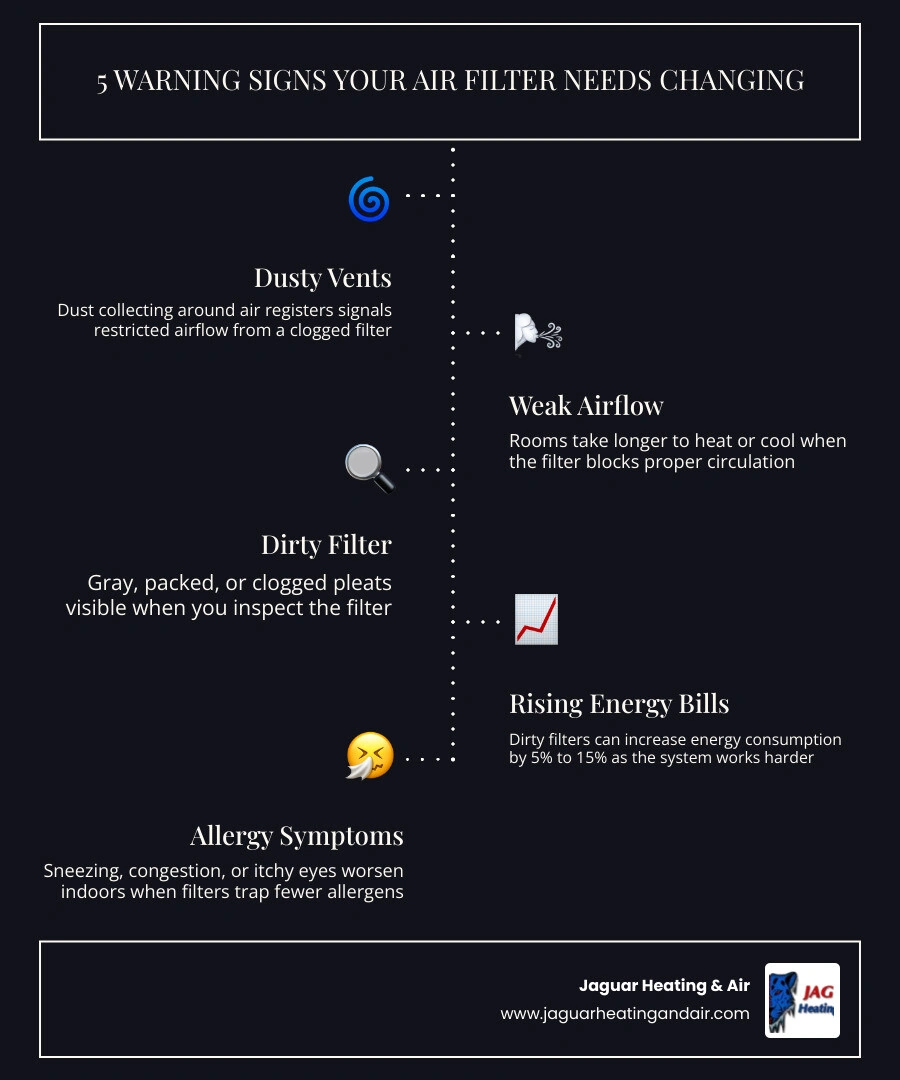
The signs your air filter needs changing are often easy to spot — if you know what to look for. Here's a quick overview:
Common signs your air filter needs changing:
- Dusty or dirty vents — Dust collecting around your air registers
- Weak airflow — Rooms that take longer to heat or cool
- Visibly dirty filter — Gray, packed, or clogged pleats you can see
- Rising energy bills — Your HVAC working harder than it should
- Allergy or respiratory symptoms — Sneezing, congestion, or itchy eyes indoors
- Unusual noises — Whistling, rattling, or hissing from vents
- Musty or dusty smells — Odors when the system kicks on
- It's been over 90 days — Time alone is a reliable cue
Most Sacramento-area homeowners don't think about their air filter until something already feels off — a room that won't cool down, a spike in the energy bill, or allergy symptoms that seem worse indoors than outside. By that point, a clogged filter may have already been straining your HVAC system for weeks. According to the U.S. Department of Energy, a dirty filter can increase your system's energy consumption by 5% to 15%, and research shows indoor air can be two to five times more polluted than outdoor air when filters go unchanged. For homeowners in the Sacramento Valley — where wildfire smoke, high pollen counts, and dry seasonal winds add extra pressure on your system — staying ahead of filter changes matters even more.
Related content about signs your air filter needs changing:
- how hot dry valley affects filter replacement frequency
- how often should you change your hvac air filter
5 Steps to Identify the Signs Your Air Filter Needs Changing
To keep your heating and cooling system operating at peak performance, you do not need to be a technical expert. By establishing a simple, proactive routine, you can catch airflow restriction issues before they turn into costly mechanical failures or trigger severe household allergens.
At Jaguar Heating & Air, we want to empower our neighbors in Elk Grove, Folsom, Roseville, and across the Sacramento area to maintain their comfort easily. We have broken down the process into five straightforward steps you can perform at home.
Step 1: Watch for Dusty Vents and Signs Your Air Filter Needs Changing
Have you noticed that you are dusting your living room tables every two days instead of once a week? When an air filter is past its prime, it loses its ability to trap airborne particulate matter. As a result, the dust, dirt, and pet dander that should be safely trapped in the filter’s fibers are blown directly back into your living spaces.
Over time, this excess dust accumulates heavily around your supply and return air vents. If you notice a dark, fuzzy ring of dust forming on the drywall around your ceiling registers, or if the metal grates of your vents are visibly covered in gray lint, your filter is telling you it is full. Ignoring this symptom doesn't just lower your indoor air quality; it also forces your ductwork to accumulate heavy debris. To learn more about how dirty pathways impact your overall system, read our guide on how to Stop Choking Your AC: Signs Your Ducts Need Help. Furthermore, if you are located in Placer County, you can explore How Dirty Ductwork Decreases HVAC Efficiency in Rocklin, CA to see how regional dust worsens this cycle.
Step 2: Monitor Weak Airflow and Other Signs Your Air Filter Needs Changing
When your HVAC filter becomes clogged with a thick blanket of dust, it acts like a wall blocking the air. Your system’s blower motor has to work twice as hard to pull air through this barrier. As a result, you will notice that the weak airflow coming out of your vents feels more like a gentle sigh than a strong breeze.
This restricted airflow directly leads to uneven cooling and heating throughout your home. You might find that your master bedroom remains uncomfortably warm during a hot Folsom summer afternoon, while the hallway closest to the return vent is freezing. If your system is running constantly but struggling to push air to the furthest corners of your home, check the filter first. If the filter is clean and the airflow is still virtually nonexistent, it may point to a deeper mechanical issue. For help diagnosing these symptoms, check our article on Signs Your AC Needs Repair.
Step 3: Perform a Visual Inspection and the Light Test
The most definitive way to know if your filter has reached the end of its life is to pull it out and look at it. Before doing this, always make sure to turn off your HVAC system at the thermostat to prevent raw, unfiltered air from being pulled directly into your system's fan.
Once you have removed the filter, look for these physical signs of wear:
- Gray Pleats: A fresh filter is typically bright white. If yours has turned a dark, solid gray or black, it is saturated with dirt.
- Dust Clumps: If there are visible clumps of hair, lint, or pet dander bridging the gaps between the pleats, it is past its prime.
- Damaged Seals: Check the cardboard frame. If it is warped, damp, or has broken seals, air is bypassing the filter entirely.
The Light Test: Hold the filter up to a bright light source, like the sun or a strong ceiling light. Can you see light passing through the pleated material? If the light shines through clearly, the filter still has some life left. If the light is completely blocked by a dense layer of grime, the filter is choked and needs immediate replacement.
Step 4: Track the Time Since Your Last Replacement
Relying purely on memory is a common pitfall. With our busy schedules in Northern California, it is incredibly easy to lose track of when you last swapped out your filter. The optimal replacement frequency depends heavily on the thickness of your filter, as thicker pleated filters have more surface area to trap debris.
| Filter Thickness | Recommended Replacement Frequency | Key Factors Affecting Lifespan |
|---|---|---|
| 1-inch pleated filters | Every 30 to 60 days | High pet dander, active allergies, high seasonal pollen |
| 2-inch pleated filters | Every 90 days (3 months) | Average household use, moderate pet presence |
| 4-inch media filters | Every 6 months | Large homes, less frequent system usage |
| 5 to 6-inch media filters | Every 9 to 12 months | Low-dust environments, high-efficiency systems |
To dive deeper into setting up a reliable schedule for your specific home, check out Don't Let It Clog: Your Ultimate Guide to HVAC Filter Timing. Additionally, local weather plays a major role. Our hot, dry summers in the Sacramento Valley stir up immense amounts of dust and agricultural pollen. You can learn more about managing these regional challenges by reading How Hot, Dry Valley Affects Filter Replacement Frequency.
Step 5: Listen for Unusual HVAC Noises
Your heating and cooling system should run with a predictable, low hum. If you start hearing new, strange noises whenever the system cycles on, it could be a cry for help from a choked system.
Common noises associated with a clogged filter include:
- Whistling or Hissing Sounds: When the blower motor tries to pull air through a severely restricted filter, it creates a high-velocity vacuum effect. Air is forced through tiny gaps around the edges of the filter frame, resulting in a high-pitched whistling sound.
- Rattling or Flapping: If the filter is heavily clogged, the immense pressure can bend or warp the cardboard frame. This causes the filter to rattle or flap violently against its metal housing every time the blower turns on or off.
These noises are direct indicators of system strain. Overlooking them can lead to premature motor burnout. To keep your equipment running smoothly and quietly, check out our comprehensive guide on How to Maintain Your Heating and Cooling System.
How Clogged Filters Impact HVAC Performance and Energy Bills
Many homeowners view changing the air filter as a minor cosmetic chore, but its impact on your household finances is substantial. When you ignore the signs your air filter needs changing, your pocketbook takes a direct hit in two ways: monthly utility costs and unexpected system breakdowns.
First, consider your monthly energy bills. When a filter is clogged, your blower motor must draw more electrical current to pull air through the blockage. Because the restricted airflow prevents your home from reaching the target temperature quickly, the system must run for longer cycles. This combination of higher electrical draw and extended run times causes your energy consumption to skyrocket. Replacing a dirty filter with a fresh one can reduce your HVAC system’s energy consumption by 5% to 15%, which translates directly into lower monthly utility bills.
Second, a dirty filter can cause severe mechanical issues, such as short cycling and frozen evaporator coils:
- Short Cycling: This occurs when your HVAC system turns on and off rapidly in short, inefficient bursts. Because heat cannot escape or be absorbed properly due to restricted airflow, safety sensors inside your furnace or AC trip to prevent overheating, shutting the system down prematurely.
- Frozen Evaporator Coils: During the cooling season, your air conditioner relies on a steady stream of warm indoor air passing over the cold evaporator coils to absorb heat. If a dirty filter blocks this airflow, the temperature of the coils drops below freezing. The condensation on the coils turns to ice, completely insulating the coils and stopping the cooling process. This can eventually lead to liquid refrigerant flooding back into your compressor, causing catastrophic system failure.
To learn more about how regular upkeep prevents these expensive headaches, read about the Key Benefits of AC Maintenance.
Understanding the Differences Between HVAC, Engine, and Cabin Filters
Because the term "air filter" is used in several different contexts, it is easy to get them confused. However, your home HVAC system, your vehicle's engine, and your vehicle's interior cabin use entirely different filters that serve distinct purposes.
To help clarify these differences, we have outlined their functions below:
HVAC / Home Air Filters
These filters are located inside your home's return air grilles or within the indoor air handler cabinet. Their primary job is to protect your heating and cooling equipment from dust buildup while cleaning the air you breathe inside your home. They are rated using the MERV (Minimum Efficiency Reporting Value) scale, which ranges from 1 to 16 for residential systems. Higher MERV ratings indicate tighter filtration. For exceptionally high-efficiency filtration, some homes utilize HEPA filters, which capture 99.97% of microscopic particles down to 0.3 microns. To explore this topic in detail, read our complete guide, Everything You Need to Know About HVAC Filters.
Engine Air Filters
Located under the hood of your vehicle, the engine air filter ensures that the air entering the combustion chamber is free of abrasive dirt, grit, bugs, and road debris. Your car's engine requires an immense amount of air to burn fuel efficiently — approximately 10,000 gallons of air for every single gallon of gasoline. If this filter becomes clogged, it can reduce engine horsepower by up to 11%, lead to rough idling, cause spark plugs to misfire, and even result in dark, sooty smoke exiting the exhaust.
Cabin Air Filters
Unlike the engine filter, the cabin air filter has nothing to do with how your car runs. Instead, it is typically located behind your glove box or under the dashboard, and its sole purpose is to clean the air that enters your vehicle's passenger cabin through the heating, ventilation, and air conditioning vents. It traps pollen, exhaust soot, and dust so you don't breathe them in while driving.
Frequently Asked Questions About Air Filter Maintenance
We receive many questions from homeowners in Sacramento and Placer counties regarding proper filter maintenance. Here are a few of the most common inquiries we address:
Can a dirty air filter cause my AC to freeze up?
Yes, absolutely. A dirty filter is the number one cause of frozen evaporator coils. When airflow is heavily restricted, there isn't enough warm air passing over the cold coils to keep them above freezing. Ice quickly forms on the metal fins, blocking all remaining airflow and eventually causing a complete system shutdown. If you notice ice forming on your indoor unit or outdoor refrigerant lines, turn off your AC immediately to let it thaw, and check your filter.
How often should I change my air filter if I have pets?
If you have furry family members, you will need to inspect your filter much more frequently. Pet hair and dander are highly effective at clogging the pleats of a standard filter.
- One Pet: We recommend checking the filter monthly and replacing it every 60 days.
- Two or More Pets (or heavy shedders): You should inspect your filter every 30 days and replace it as soon as it appears gray or packed with fur.
Can I clean and reuse a disposable HVAC air filter?
No. Disposable filters — including standard fiberglass filters and pleated polyester models — are designed for one-time use. Attempting to wash them with water will destroy the delicate fibers, ruin the electrostatic charge that traps small particles, and can lead to mold growth. Running a damp or structurally compromised filter in your system can lead to severe system damage. Only washable filters specifically labeled as "reusable" should be cleaned, and they must be completely dry before reinstallation.
Conclusion
Staying mindful of the signs your air filter needs changing is one of the simplest and most effective ways to protect your home's indoor air quality, keep your monthly utility bills low, and prevent sudden system breakdowns. By taking just a few minutes each month to inspect your filter, perform the light test, and replace it when necessary, you can ensure your family enjoys dependable comfort all year round.
If you are experiencing persistent airflow issues, rising energy bills, or need help finding the perfect filtration solution for your home, our team at Jaguar Heating & Air is here to help. As a family-owned, NATE-certified Trane Comfort Specialist, we serve communities throughout the Sacramento area — including Elk Grove, Folsom, Roseville, Rocklin, and El Dorado Hills — with flat-rate pricing and a 100% customer satisfaction guarantee.
Schedule professional HVAC services in Sacramento with Jaguar Heating & Air today to keep your home comfort system running at its best!
Recent Posts
The Financial Math of Repairing vs. Replacing a Failed Compressor
A dead compressor on an aging AC system forces a tough choice. We break down the percentage-based lifespan math so you can confidently decide between a heavy repair and a full replacement.

How We Trace Elusive Refrigerant Leaks in Sacramento Attics
A slow summer leak can cause your AC to blow warm air when you need it most. We stop the cycle of endless top-offs by pinpointing the true root cause.
Deciding When to Stop Repairing a 15-Year-Old Air Conditioner
If your aging cooling system barely survived summer, you might wonder if another patch is worth it. We break down the sunk costs of ongoing repairs versus the reliability of a new system.