.avif)
Stop Choking Your AC: Signs Your Ducts Need Help
Why How Dirty Ducts Affect Your HVAC Performance Is Something Every Sacramento Homeowner Should Know How dirty ducts affect your HVAC performance comes down …
Why How Dirty Ducts Affect Your HVAC Performance Is Something Every Sacramento Homeowner Should Know How dirty ducts affect your HVAC performance comes down …

Why How Dirty Ducts Affect Your HVAC Performance Is Something Every Sacramento Homeowner Should Know
How dirty ducts affect your HVAC performance comes down to one core problem: restricted airflow forces your system to work harder than it should, driving up energy bills and wearing out components faster.
Here's a quick breakdown of the main impacts:
• Airflow gets restricted — What It Means for You: Your system runs longer cycles to reach your set temperature
• Blower motor works overtime — What It Means for You: Parts wear out faster, leading to earlier breakdowns
• Energy consumption rises — What It Means for You: Bills can increase by 20–40% compared to a clean system
• Contaminants recirculate — What It Means for You: Dust, allergens, and mold spores spread through your home
• Uneven temperatures appear — What It Means for You: Some rooms stay warm or stuffy while others feel fine
• HVAC lifespan shortens — What It Means for You: Components designed to last 15–20 years may fail in 10–12
Most homeowners in Sacramento never think about their ducts. They're hidden behind walls and tucked into crawl spaces, so it's easy to forget they exist — until the energy bills creep up, the air feels stale, or the system starts struggling to keep up on a hot July afternoon.
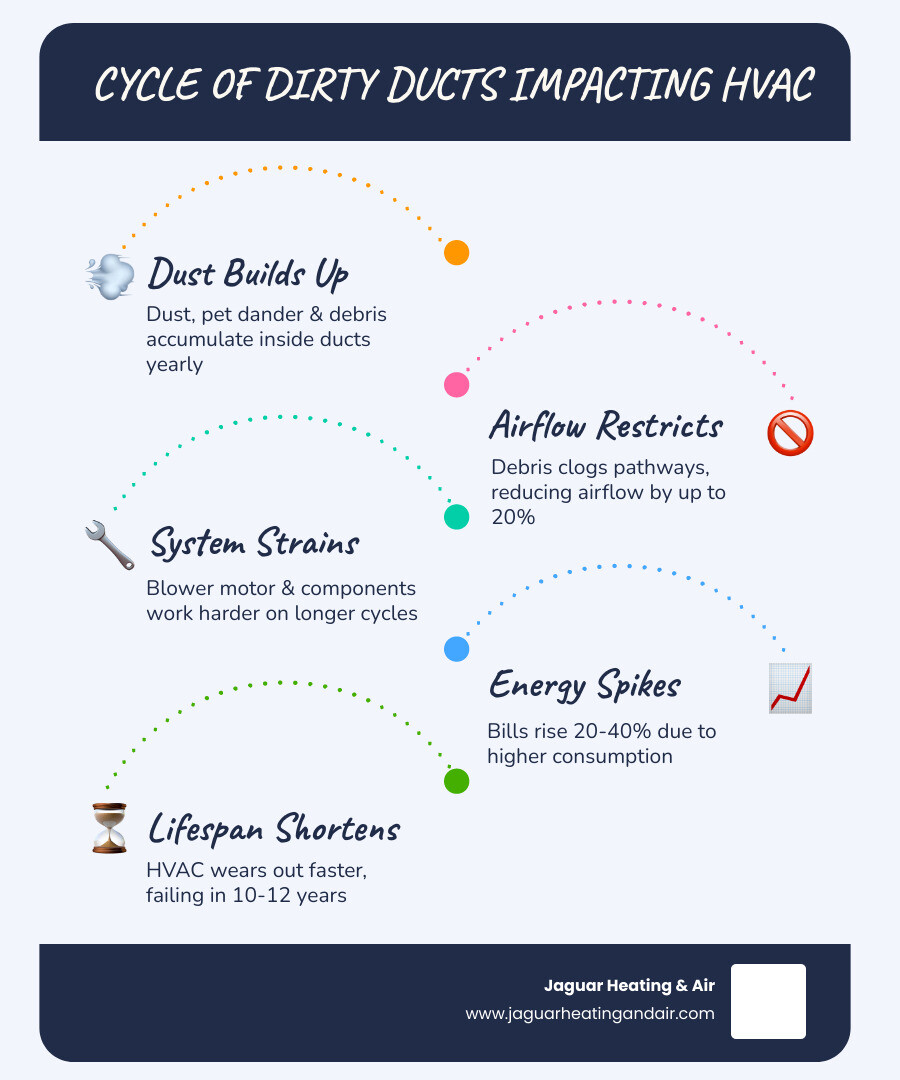
The truth is, your ductwork is the delivery network for every bit of conditioned air your HVAC system produces. When that network gets clogged with dust, debris, pet dander, and other buildup, the whole system pays the price. According to industry data, even a thin layer of dust inside ducts can reduce airflow by up to 20% — and that's just the beginning.
This guide walks you through exactly what's happening inside your ducts, how to spot the warning signs, and what you can do to protect your system and your home's comfort.
How Dirty Ducts Affect Your HVAC Performance and Efficiency
When we talk about how dirty ducts affect your HVAC performance, we have to look at the physics of your home’s breathing. Think of your ductwork as the lungs of your house. If those lungs are filled with dust, the heart (your HVAC unit) has to beat faster and harder to get oxygen to the rest of the body.
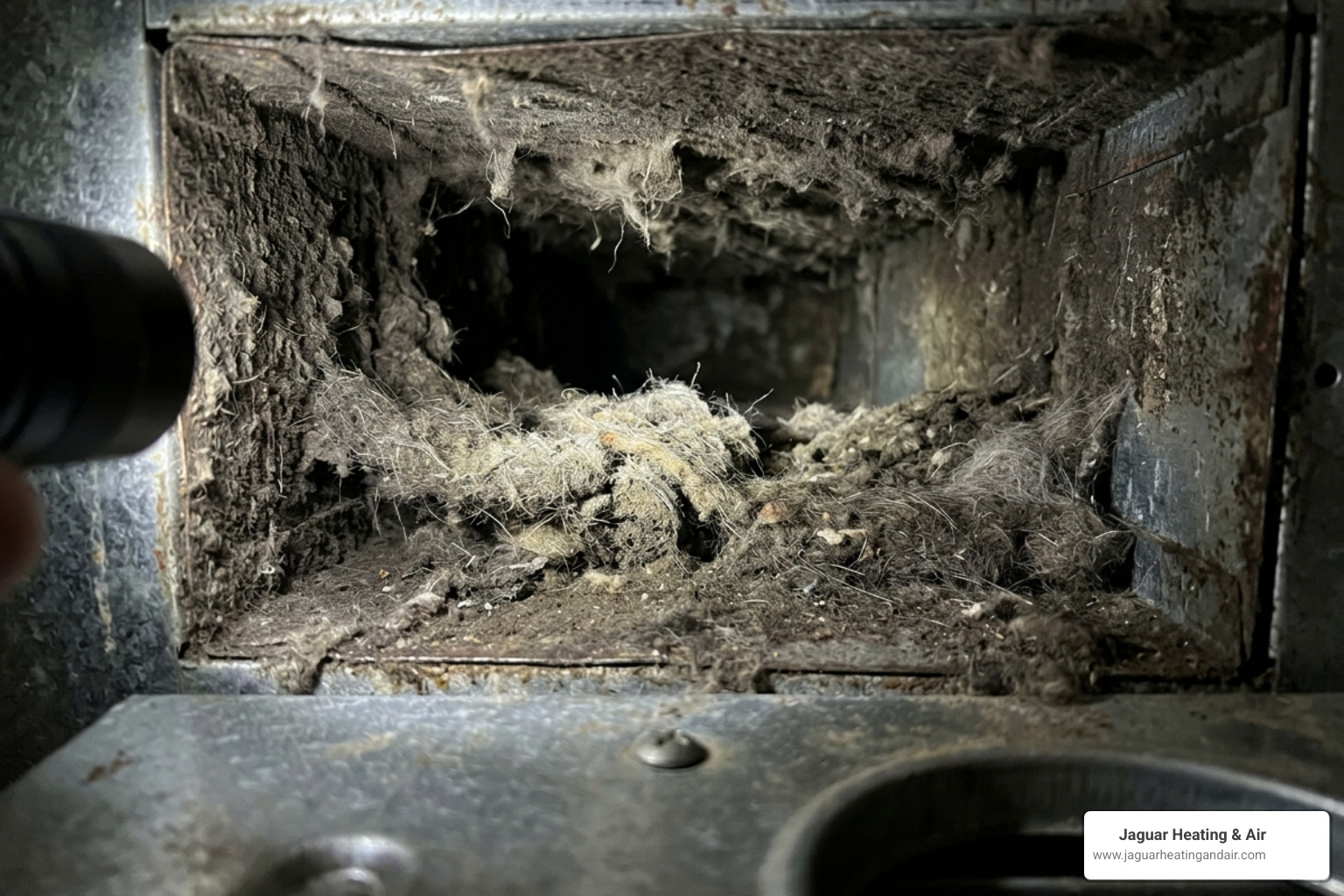
In a typical Sacramento home, dust, pet hair, and skin cells accumulate at a staggering rate. Research shows that the average home can accumulate up to 40 pounds of dust annually. Much of this ends up settled inside your vents. As this debris builds up, it creates "friction" for the air moving through the pipes. Instead of a smooth, high-speed highway, your air is now navigating a cluttered backroad filled with potholes.
This friction leads to a massive drop in efficiency. According to the National Air Duct Cleaners Association (NADCA), unclean ducts can reduce HVAC efficiency by up to 30%. When your system isn't efficient, it doesn't just work slower; it works longer. This is why many homeowners notice a 20-40% energy spike in their monthly utility costs. If your system has to run for 45 minutes to do a job it used to finish in 30, that extra 15 minutes of electricity usage adds up quickly.
Restricted Airflow and Component Wear
The most immediate casualty of dirty ducts is the blower motor. This fan is responsible for pushing air through the entire network of your home. When ducts are clogged, the "static pressure" increases. In simple terms, the fan is trying to push air into a space that is resisting it.
This resistance causes the blower motor to draw more amperage and run hotter. Over time, this heat degrades the motor's bearings and windings. We often see blower motors fail years before they should simply because they were "choked" by poor airflow. Furthermore, restricted airflow can cause the evaporator coils in your air conditioner to freeze over. If the air can't move across the coils fast enough, the refrigerant inside gets too cold, turning condensation into ice and potentially slugging the compressor—one of the most expensive parts to replace.
Restricted airflow also impacts the heat exchanger in your furnace during our chilly Sacramento winters. Without enough air to carry the heat away, the heat exchanger can overheat and eventually crack, which is a major safety hazard. Understanding how duct cleaning impacts HVAC system life expectancy is key to avoiding these premature and costly failures.
The Financial Impact of How Dirty Ducts Affect Your HVAC Performance
The financial drain of dirty ducts is often hidden, but it is substantial. It’s not just about the monthly bill; it’s about the "hidden tax" of neglected maintenance. When ducts are dirty, heating costs can increase by 20-30% because the furnace has to run longer cycles to compensate for the heat lost to slow-moving air and debris-coated surfaces.
Think of professional cleaning as a form of equipment insurance. By investing in a Duct Cleaning Service, you are effectively lowering the "operating cost" of your home. When the air moves freely, the system reaches the thermostat's set point faster, shuts down sooner, and experiences less mechanical stress. Over the course of a year, the energy savings alone can often pay for a significant portion of the maintenance cost, not to mention the thousands of dollars saved by delaying a full system replacement.
Recognizing the Signs Your Ducts Need Professional Help
Since you can’t easily see inside your walls, you have to look for the "breadcrumbs" your HVAC system leaves behind. One of the most common signs we see in Folsom and Elk Grove homes is visible dust around the supply vents. If you find yourself dusting your coffee table on Tuesday and seeing a fresh layer by Thursday, your ducts are likely recirculating years of accumulated debris.
Another major red flag is uneven temperatures. If your living room is a meat locker but the back bedrooms feel like a sauna, it’s often because dust blockages or "traffic jams" in the ductwork are preventing conditioned air from reaching the furthest points of the house. You might also notice musty or "stale" odors whenever the fan kicks on. This is a sign that moisture has mixed with the dust in your ducts, creating a breeding ground for bacteria.
To help you self-diagnose, we’ve put together this comparison:
• Dust Levels — Clean Duct Performance: Surfaces stay clean for a week or more — Dirty Duct Performance: Visible dust returns within 24-48 hours
• Airflow Strength — Clean Duct Performance: Strong, consistent breeze from all vents — Dirty Duct Performance: Weak or "wheezing" air from certain registers
• System Noise — Clean Duct Performance: Quiet, steady hum — Dirty Duct Performance: Whistling, rattling, or strained motor sounds
• Energy Bills — Clean Duct Performance: Consistent with seasonal averages — Dirty Duct Performance: Unexplained 20%+ increases
• Health — Clean Duct Performance: Normal breathing and sleep — Dirty Duct Performance: Increased sneezing, coughing, or dry eyes
If you are noticing these issues, it is time to check out the signs to schedule duct cleaning in Sacramento, CA before the problem worsens.
Health Risks and Indoor Air Quality
Beyond how dirty ducts affect your HVAC performance, there is the human element: your health. The EPA ranks indoor air pollution among the top five environmental health risks. Since we spend roughly 90% of our time indoors—especially during those triple-digit Sacramento summers—the quality of the air we breathe is paramount.
Dirty ducts are essentially a "reservoir" for allergens. Every time the AC turns on, it picks up pet dander, pollen, and dust mites and sprays them into your bedroom. For families in Lincoln or Rocklin dealing with asthma or severe allergies, this can lead to constant respiratory irritation, headaches, and fatigue.
Microbial growth is another serious concern. In our climate, humidity can sometimes get trapped in the ductwork, especially if there are leaks. This moisture allows mold spores to thrive. Once mold takes hold in your ductwork, it can spread throughout the entire home in minutes. Learning how to make your home's air cleaner through duct cleaning is one of the best ways to protect your family from the health risks associated with dirty ductwork.
When to Schedule Service According to EPA Guidelines
The Environmental Protection Agency (EPA) suggests that homeowners should consider professional duct cleaning under specific circumstances. It isn't always a "set it and forget it" schedule; sometimes, your home's environment dictates the timing.
The "Big Three" reasons the EPA recommends immediate action are:
1. Visible Mold: If you see mold growing on the inside of hard surfaces (like vents or the cooling coils), it needs to be addressed immediately.
2. Vermin Infestation: If rodents or insects have made a home in your ducts, they leave behind droppings and nesting materials that are toxic when pulverized and blown into your living space.
3. Excessive Debris: If your ducts are so clogged with dust that debris is actually blowing out of the vents, a deep clean is overdue.
However, waiting for these extreme signs isn't always the best strategy for maintaining efficiency. There are many reasons to get ductwork cleaned every year or at least every few years, depending on your lifestyle. A proactive approach ensures you never reach the point of "system choking" that leads to a breakdown. Understanding the importance of residential duct cleaning helps you stay ahead of the curve.
Frequency Factors: How Dirty Ducts Affect Your HVAC Performance Over Time
While the standard recommendation is to have your ducts inspected every 2 to 3 years and cleaned every 3 to 5 years, several factors can speed up that timeline:
• Pets: If you have "fur babies" in Roseville or Granite Bay, their dander and hair are constantly being sucked into the return vents.
• Recent Renovations: Construction dust is incredibly fine and heavy. If you’ve recently remodeled a kitchen or bathroom, your ducts are likely filled with drywall dust and sawdust.
• Local Climate: In Sacramento, our "pollen season" is legendary. High outdoor pollen counts mean more particles entering your home and settling in your vents.
• Smoking: Tobacco or wood smoke leaves a sticky residue that acts like "glue" for dust, causing it to build up much faster.
It’s often a great idea to schedule duct cleaning service in the spring to clear out the winter's accumulation before the heavy AC season hits. Conversely, ignoring the dangers of dirty ducts in the winter can lead to poor heating performance and higher gas bills.
Preventing Contamination Through Proactive Maintenance
You don't have to be a helpless bystander while dust takes over your home. There are several steps we recommend to our neighbors in Rancho Cordova and Citrus Heights to keep their systems running smoothly between professional cleanings.
The most important task is changing your air filters. We recommend checking them monthly and replacing them at least every 90 days—more often if you have pets. Using a high-efficiency filter (look for a MERV rating between 8 and 12) can trap significantly more particles before they ever enter your ductwork.
Here is a simple checklist for monthly maintenance:
• Check the Filter: Is it grey or "fuzzy"? Replace it.
• Vacuum Registers: Use a brush attachment to clear away any dust sitting on the outside of your vent covers.
• Monitor Moisture: Look for condensation on the outside of your ducts in the attic or crawl space. Moisture is the enemy of clean ducts.
• Clear the Area: Ensure no furniture or drapes are blocking the return air grilles. Your system needs to "inhale" just as much as it "exhales."
• Seal the Leaks: Up to 20% of the air in your ducts can be lost through leaks. Sealing these gaps prevents dirty attic air from being sucked into the system.
Frequently Asked Questions about Duct Cleaning
How often should I have my air ducts cleaned?
For most homes in the Sacramento area, a professional cleaning every 3 to 5 years is the sweet spot. However, if you have multiple pets, family members with allergies, or have recently completed a home renovation, you may want to move that up to every 2 years. Regular inspections every 2 years can help you determine the exact state of your system.
Can dirty ducts really increase my energy bills by 40%?
Yes, absolutely. When your ducts are severely restricted, your HVAC system may have to work twice as hard to move air. This leads to longer run times and higher electrical consumption. When you combine dirty ducts with a dirty evaporator coil (which usually happens together), a 40% spike in energy usage is a very real—and very expensive—possibility.
Does duct cleaning help with seasonal allergies?
It is one of the most effective ways to manage indoor triggers. While it won't stop the pollen from coming in through the front door, it prevents your HVAC system from acting as a "pollen sprayer" that recirculates those allergens over and over again. Many of our clients in Fair Oaks and Orangevale report significant relief from sneezing and sinus pressure immediately following a professional cleaning.
Conclusion
At Jaguar Heating & Air, we’ve seen how dirty ducts affect your HVAC performance across the Sacramento Valley. From Folsom to Woodland, homeowners are often shocked at how much better their system runs—and how much lower their bills are—after a thorough cleaning.
As a family-owned company and a Trane Comfort Specialist, we take pride in helping our community breathe easier. Our NATE-certified technicians use professional-grade equipment to ensure your ducts are truly clean, not just "surface dusted." We are committed to 100% customer satisfaction and offer same-day service to keep your home comfortable year-round.
Don't let a hidden layer of dust "choke" your air conditioner and drain your wallet. If you’re noticing dust buildup, uneven cooling, or rising energy costs, it’s time to take action. Contact us today to schedule your Duct Cleaning Service and give your HVAC system the breath of fresh air it deserves. Whether you're in Elk Grove, Roseville, or anywhere in between, we're here to help you reclaim your home's efficiency and comfort.
Recent Posts

A Proactive Seasonal Home Maintenance Checklist for HVAC Systems
Why we prioritize October heating inspections. Use this seasonal home maintenance checklist to prevent sudden furnace failures. Schedule your checkup today.

HVAC Maintenance & Replacement Options: Heat Pumps vs. Gas Furnaces in Sacramento
Deciding on a new heater? Review these options comparisons for homeowners to evaluate heat pumps vs. gas furnaces. Compare your system options before winter.

Troubleshooting HVAC Maintenance: Why Your Heater Smells Like Burning on Startup
Why we check the exact odor on fall startups. Use our home maintenance tips and troubleshooting criteria to safely tell harmless dust from a real fire hazard.