.avif)
How Sun Exposure on Your Outdoor AC Unit Impacts Cooling Speed
If your Sacramento home feels uncomfortably warm by late afternoon, a west-facing condenser might be to blame. Explore why solar radiation slows down your system and your options for safe shading.
If your Sacramento home feels uncomfortably warm by late afternoon, a west-facing condenser might be to blame. Explore why solar radiation slows down your system and your options for safe shading.

Fighting the Late Afternoon Heat: Why Your System Can't Keep Up
Your air conditioner has been running nonstop since noon, but as the afternoon wears on, you might be wondering exactly how sun exposure on your outdoor AC unit impacts cooling speed and why your house still feels uncomfortably warm. The thermostat is set to a comfortable 72 degrees, yet the indoor temperature steadily climbs as the day progresses. The vents are blowing air, but it simply lacks the icy punch needed to combat the late afternoon heat. This is a common and incredibly frustrating scenario for many homeowners, especially those living in Sacramento homes with west-facing exterior walls.
When your outdoor condenser unit is positioned on the west side of your property, it faces the absolute harshest solar radiation during the hottest part of the day. As the sun dips lower in the sky, those rays hit the unit head-on. The metal casing absorbs the heat, the surrounding air temperature spikes, and the system is forced to work exponentially harder just to maintain a baseline level of performance. You are ultimately left facing a difficult decision point: finding safe shading strategies to protect the equipment, investing in relocating the unit to a cooler side of the house, or simply enduring the ambient heat penalty and the resulting discomfort during peak afternoon hours.
Before you assume that your system is completely broken and requires a massive overhaul, it is important to understand that your equipment might just be fighting severe environmental factors. If you need help evaluating your specific situation, you can learn more about our comprehensive air conditioning systems and discover how professional AC repair can restore your home's comfort.
The Thermodynamics of Heat Rejection in Extreme Summer Weather
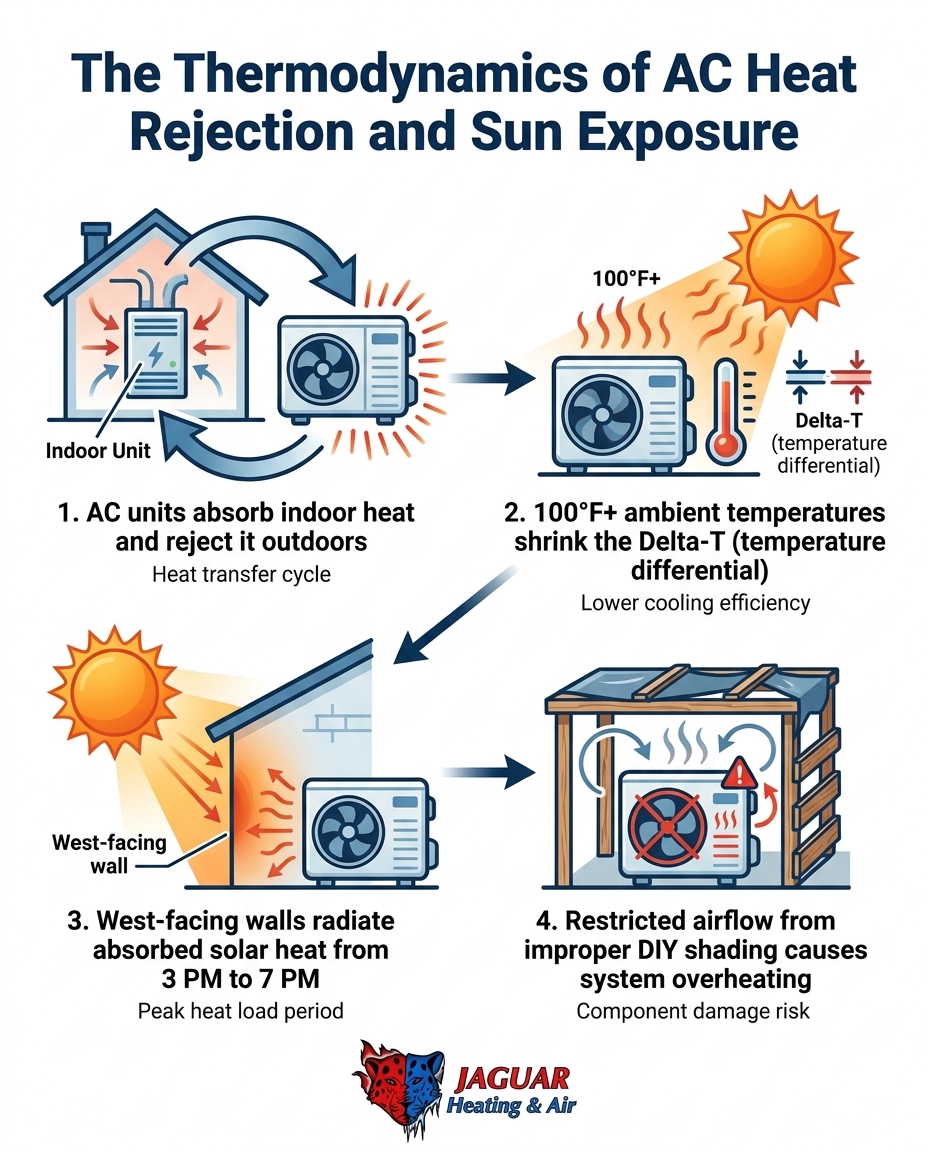
To understand why a sun-baked unit struggles so much, we first have to look at the underlying physics of how an air conditioner actually cools your home. Air conditioners do not magically create cold air out of nothing. Instead, they act as heat transfer machines. They absorb the unwanted thermal energy from inside your living spaces and pump it outside, rejecting it into the outdoor air. This entire process relies heavily on the temperature of the air surrounding the outdoor condenser unit.
The Role of Delta-T: In the HVAC industry, the efficiency of this heat transfer is governed by a concept known as "Delta-T," which refers to the temperature differential between the hot refrigerant coils inside the outdoor unit and the ambient air outside. For the system to release heat effectively, the outdoor air must be significantly cooler than the refrigerant running through the condenser coils. Heat naturally flows from a warmer source to a cooler destination.
When the Differential Shrinks: Sacramento's intense, dry heat pushes the limits of standard heat rejection physics. When the ambient air temperature climbs into the 100°F+ range, the Delta-T shrinks dramatically. The outdoor air is no longer a cool, welcoming destination for the heat your system is trying to expel. It becomes a dense, hot barrier. Because the temperature gap is so narrow, the heat rejection process severely slows down.
The Impact on Cooling Speed: When the outdoor unit cannot release heat efficiently, the indoor cooling speed drops off a cliff. The refrigerant returning to your house is still holding onto residual heat, meaning the indoor evaporator coil cannot absorb as much warmth from your rooms. The blower fan continues to push air through your ducts, but the air simply isn't as cold. Your compressor has to run longer and harder, consuming more electricity, just to achieve a fraction of its normal cooling power.
The West-Facing Wall Effect: Understanding the 3 PM to 7 PM Cooling Lag
While high ambient temperatures affect every air conditioner, units positioned on the west side of a property face a unique and punishing set of circumstances. This specific regional edge case is responsible for what industry professionals call the afternoon cooling lag. The problem goes far beyond just the direct sunlight hitting the top of the unit; it involves the entire thermal mass of your home's exterior.
Throughout the morning and early afternoon, your home's west-facing exterior walls—whether they are made of brick, stucco, or siding—absorb massive amounts of solar radiation. By the time the July afternoon peak heat arrives, those walls have essentially become giant thermal batteries. Starting around 3 PM, as the sun begins to lower and hits the wall directly, the exterior surface temperature skyrockets. The wall then begins to radiate all of that stored and active heat back out into the surrounding air.
This creates a localized microclimate immediately around your AC condenser. While the official weather report might say it is 102°F at the airport, the radiant heat bouncing off a west-facing wall can easily push the air temperature right next to your AC unit to 115°F or higher. This microclimate traps the system in an envelope of super-heated air exactly when your home needs maximum cooling power.
The 3 PM to 7 PM window is the peak vulnerability period. The indoor heat load is at its highest, and the outdoor heat rejection capability is at its lowest. This compounded heat forces the compressor to run continuously without a break, dramatically increasing wear and tear on the internal components. One local homeowner reached out during a stretch of triple-digit heat because their system was completely overwhelmed and failing to cool their house in the late afternoon. After a thorough assessment, the technician explained that while the equipment was structurally sound, it was fighting these severe environmental factors. Once the underlying problem and available options were clearly laid out, the homeowner was able to make an informed decision, and their house is now cooling down significantly.
Is Your AC Failing, or Just Trapped in a Sun-Baked Microclimate?
When your home feels uncomfortably warm in the late afternoon, the immediate assumption is often that the air conditioner is broken or low on refrigerant. However, it is entirely possible that the system is mechanically sound but simply overwhelmed by its environment. Distinguishing between a genuine mechanical failure and an environmental limitation is crucial for determining the right solution.
At Jaguar Heating & Air, our deep local expertise means we know exactly how to diagnose whether an AC is truly failing internally or simply fighting Sacramento's extreme sun exposure angles. We look for distinct patterns in how and when the system struggles to keep up.
• Time of Day — Signs of Mechanical Failure: Struggles to cool at all hours, including early morning and late at night. — Signs of Environmental Overload (Sun-Baked): Cools perfectly in the morning and evening, but loses ground exclusively between 3 PM and 7 PM.
• Vent Temperature — Signs of Mechanical Failure: Air blowing from vents feels room-temperature or slightly warm constantly. — Signs of Environmental Overload (Sun-Baked): Air is icy cold in the morning, but feels noticeably less crisp during the late afternoon peak.
• System Sounds — Signs of Mechanical Failure: Grinding, squealing, or harsh rattling noises coming from the compressor. — Signs of Environmental Overload (Sun-Baked): Unit sounds normal, but simply runs constantly without cycling off during the afternoon.
• Airflow Strength — Signs of Mechanical Failure: Weak airflow from vents, potentially indicating a frozen coil or blower motor issue. — Signs of Environmental Overload (Sun-Baked): Airflow remains strong and consistent, but the air itself cannot absorb enough heat.
If your system exhibits signs of a mechanical failure, it requires immediate professional intervention to prevent total breakdown. However, even if the issue is purely environmental, having a professional evaluate the system under load is highly recommended. A technician can measure the exact temperature drop across the coils and confirm whether the efficiency drop is due to the microclimate or a hidden issue. Routine AC maintenance ensures that your system's coils are spotless and its refrigerant levels are optimized, making the unit as resilient as possible against environmental extremes.
Why DIY Shading Often Restricts Airflow and Worsens the Problem
Once homeowners realize that the afternoon sun is crippling their air conditioner, the natural instinct is to block the sun. Unfortunately, well-intentioned DIY shading projects are one of the leading causes of premature compressor failure. The desire to provide shade often overrides the critical need for proper airflow.
The Problem: Homeowners frequently attempt to shade their units by throwing a canvas tarp over the top, building a tight wooden fence around the perimeter, or installing dense lattice panels right up against the metal casing. The goal is to keep the direct sunlight off the unit, which seems entirely logical on the surface.
The Cause of Failure: Air conditioners require massive, unobstructed volumes of airflow to function. The large fan on the top of the outdoor unit is designed to exhaust the hot air pulled from your house, shooting it straight up into the sky. When you place a tarp over the unit or build a tight structure around it, you block that exhaust path. The hot air hits the obstruction, bounces back down, and is immediately sucked right back into the side fins of the condenser. This phenomenon is known as recirculation. Instead of pulling in fresh ambient air, the unit is forced to breathe its own super-heated exhaust.
The Ultimate Result: Recirculation creates a catastrophic heat trap. The temperature inside the unit spikes rapidly, pushing the compressor far past its safe operating limits. Rather than helping the unit cool faster, restrictive DIY shading causes the compressor to overheat. This usually triggers the system's internal thermal overload switch, causing the entire air conditioner to shut down completely on the hottest day of the year. If the thermal overload switch fails to protect the system, the compressor can burn out entirely, resulting in a massive repair bill.
Permanent Solutions: Safe Clearances and Strategic Condenser Relocation
Protecting your air conditioner from the harsh afternoon sun requires a balance between providing shade and maintaining absolute airflow freedom. There are professional-grade solutions that can mitigate sun exposure without compromising the system's ability to breathe.
If you are planning to introduce shading, you must adhere strictly to Department of Energy (DOE) guidelines and manufacturer specifications. Proper airflow is non-negotiable for system health.
1. Maintain Strict Clearances: The general rule for any outdoor condenser is to maintain a minimum of 2 to 3 feet of completely clear space on all sides of the unit. Furthermore, there must be at least 5 feet of unobstructed vertical clearance above the unit to allow the exhaust fan to push hot air away from the home.
2. Utilize Natural Landscaping: Planting trees or tall shrubs is often the safest way to provide shade. A strategically placed tree can cast a shadow over the unit during the late afternoon without trapping hot air. However, you must ensure the plants are kept trimmed back to respect the 2-to-3-foot clearance zone. Additionally, you will need to monitor the unit for falling leaves or debris, which can clog the condenser fins over time.
3. Install a Breathable Awning: If landscaping is not an option, a high, breathable awning attached to the side of the house can provide shade. The awning must be installed high enough to exceed the 5-foot vertical clearance rule, ensuring that the exhaust air can easily escape and dissipate.
When to Consider Relocating Your Outdoor Unit
In some cases, a west-facing sun trap is simply too severe, and the property layout offers zero viable shading options. When the microclimate is actively damaging the equipment and driving up utility bills, condenser relocation becomes the ultimate solution. Moving the unit to the north or east side of the house can fundamentally change its operating environment, allowing it to run efficiently in the shade during the hottest parts of the day.
Relocating an air conditioner is a major undertaking that requires professional AC installation expertise. It is never a DIY project. The process involves safely pumping down and recovering the refrigerant, cutting and extending the copper line sets, rerouting the high-voltage electrical connections, and properly leveling a new equipment pad. If your current unit is nearing the end of its lifespan, investing in a new system placed in a better location is often the most cost-effective long-term strategy. Understanding the importance of a correct HVAC installation ensures that your relocated unit will perform reliably for years to come.
Frequently Asked Questions About AC Sun Exposure
Does direct sunlight affect an AC unit?
Yes, direct sunlight significantly affects an AC unit by heating the metal casing and the surrounding air. This increases the ambient temperature immediately around the condenser, forcing the system to work harder to reject heat from your home, which slows down the overall cooling process.
Should I shade my outside AC unit?
Shading your outside unit can be beneficial, but only if it is done correctly. You must use methods like planting tall trees or installing high awnings that cast a shadow without restricting the airflow around or above the equipment. Improper shading can trap heat and cause severe damage.
Does the sun make my AC work harder?
Absolutely. When the sun beats down on your outdoor unit, it shrinks the temperature differential between the refrigerant coils and the outside air. Because heat naturally moves to cooler areas, a hotter outdoor environment makes it much more difficult for the system to push the indoor heat out.
How can I protect my AC unit from the sun without restricting airflow?
The safest way to protect your unit is by utilizing natural landscaping, such as planting shrubs or trees at a safe distance. Always maintain a minimum of 2 to 3 feet of clearance on all sides and at least 5 feet of open space directly above the unit to allow the hot exhaust air to escape.
Why does my AC only struggle to cool between 3 PM and 7 PM?
If your system only struggles during the late afternoon, it is likely fighting the intense radiant heat from a west-facing exterior wall. During this time, the sun is at its lowest and hottest angle, creating a localized microclimate around the unit that overwhelms its heat rejection capabilities.
Restore Your Home's Comfort During Peak Afternoon Hours
Understanding exactly why the late afternoon sun cripples your system's heat rejection is the critical first step to restoring your home's comfort. When your condenser is trapped in a west-facing sun trap, the resulting microclimate forces the equipment to work overtime while delivering diminishing returns. Recognizing this dynamic allows you to move past the frustration and focus on real, effective solutions.
It is vital to prioritize safe, professional solutions over risky DIY shading projects that can easily suffocate your equipment and lead to catastrophic compressor failure. Whether the answer lies in strategic landscaping, routine upkeep to maximize efficiency, or relocating the unit entirely, you do not have to settle for a hot house at 4 PM. We encourage you to have your system evaluated to determine the best path forward. Reach out for professional AC repair and diagnostics to ensure your system is prepared to handle the peak afternoon heat safely and efficiently.
Recent Posts

Is a Burning Smell Normal During Fall Heating Startup? HVAC Maintenance FAQs Answered
Get clear answers on why your furnace smells like burning dust. We have common homeowner questions answered so you know when to wait and when to call a pro.
HVAC Maintenance and Replacement Options: Comparing Heat Pumps vs. Gas Furnaces
Decide with confidence this fall. We break down heating options comparisons for homeowners choosing between a heat pump and gas furnace. See which is best.

Fall HVAC Startup Checklist: Diagnosing Burning Smells and System Red Flags
Deciding if that burning dust smell is normal? See why this seasonal home maintenance checklist is critical for catching heating failures before winter hits.