.avif)
The Ultimate Guide to Best Air Filter for Your Home
Discover how to choose the best air filter for your home with our complete guide to ratings, sizing, and maintenance tips.
Discover how to choose the best air filter for your home with our complete guide to ratings, sizing, and maintenance tips.

Why Finding the Best Air Filter for Your Home Matters More Than You Think
Choosing the best air filter for your home is one of the simplest ways to protect your family's health and keep your HVAC system running strong. Yet most homeowners in Sacramento and the surrounding area rarely think about it — until something goes wrong.
Here's a quick look at the top-performing filter options to match your needs:
| Filter Type | MERV Rating | Best For |
|---|---|---|
| Basic fiberglass | MERV 1-4 | Large dust and lint only |
| Pleated 1-inch | MERV 8-11 | Dust, pollen, pet dander |
| High-efficiency pleated | MERV 13 | Bacteria, smoke, fine particles |
| 4- or 5-inch media | MERV 11-16 | Whole-home filtration, longer life |
| HEPA (standalone unit) | MERV 15-20 | Allergens, viruses, ultra-fine particles |
Here's something worth knowing: the EPA estimates that indoor air can be two to five times more polluted than the air outside. That's not a small difference. Dust, pollen, pet dander, mold spores, bacteria, and even virus carriers can all circulate through your home's air every single day — and most of it is invisible.
Your HVAC system's air filter is the first line of defense. Pick the wrong one, and you're either letting contaminants pass through or choking your system's airflow with a filter that's too dense for it to handle. Either way, your home's comfort and your equipment's lifespan take the hit.
In this guide, we break down every filter type, rating system, size consideration, and replacement schedule so you can make a confident, informed choice.
Relevant articles related to best air filter for your home:
- how hot dry valley affects filter replacement frequency
- how often should you change your hvac air filter
Understanding HVAC Filter Ratings: MERV, MPR, and FPR
If you have ever stood in the home improvement aisle looking at a wall of air filters, you know how incredibly confusing the labels can be. One brand uses a scale that goes up to 20, another uses a scale in the thousands, and a third uses a color-coded system from 1 to 12.
To choose the best air filter for your home, you need to understand how these rating systems compare. They are all measuring the same basic thing: how well the filter captures airborne particles. However, they use different testing methodologies and terminology to explain it.
- MERV (Minimum Efficiency Reporting Value): This is the industry standard developed by the American Society of Heating, Refrigerating and Air-Conditioning Engineers (ASHRAE). The scale ranges from 1 to 20. A higher number means the filter can trap smaller, more microscopic particles. Most residential HVAC systems in areas like Roseville and Elk Grove are designed to perform best with filters in the MERV 8 to 13 range.
- MPR (Microparticle Performance Rating): This is a proprietary rating system developed by 3M for its Filtrete brand. It measures the filter’s ability to capture tiny particles between 0.3 and 1.0 microns in size (like bacteria and smoke). For example, a Filtrete MPR 1900 rating corresponds to a MERV 13 rating, while an MPR 1600 is roughly a MERV 12.
- FPR (Filter Performance Rating): This is a 1-to-12 scale used by Home Depot for brands like Honeywell. It weights the overall performance by allocating 60% of the score to large particle capture, 30% to small particle capture, and 10% to weight gain (how much dust the filter can hold before losing efficiency). An FPR of 10 is considered premium and is comparable to a MERV 13.
Having a solid grasp of these ratings is crucial for managing your home's overall Indoor Air Quality, as it allows you to balance clean air with proper system airflow.
How to Choose the Best Air Filter for Your Home Based on Ratings
When selecting the perfect rating, you have to look at what you are trying to clean out of your air. If you choose a rating that is too low, you won't capture the fine particles that cause allergies. If you choose a rating that is too high for a standard 1-inch filter slot, you risk starving your system of air.
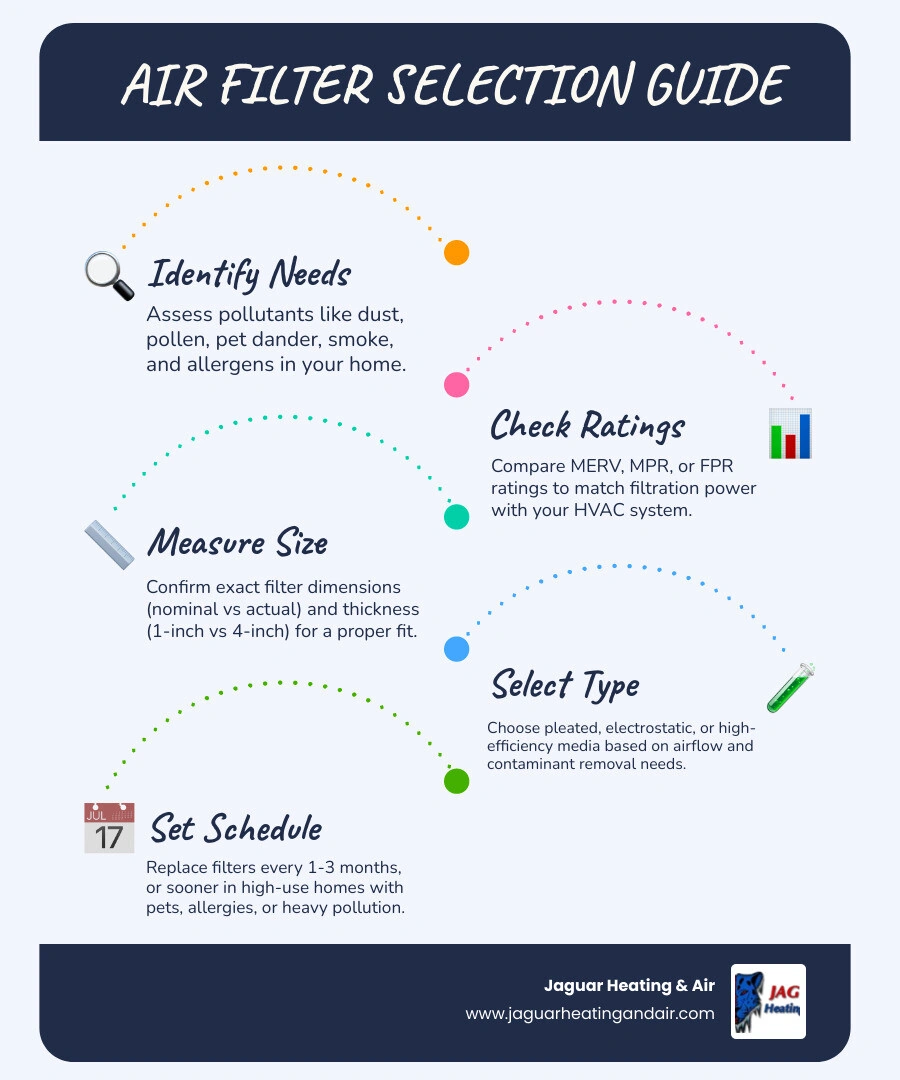
For maximum health benefits without sacrificing system performance, we generally recommend aiming for a MERV 11 to MERV 13 filter (or the equivalent MPR 1500–1900 / FPR 8–10). This range is highly effective at capturing:
- Pollen, mold spores, and dust mites
- Pet dander and fine dust
- Bacteria and virus carriers
- Smoke and smog particulates
If you have family members with severe respiratory conditions, upgrading your filtration is one of the best moves you can make. If you reside in Northern California, speaking with an expert about Indoor Air Quality Sacramento CA can help you determine if your ductwork and blower motor are robust enough to handle high-efficiency pleated filters without causing performance issues.
Comparing Filter Types: Pleated, Electrostatic, Washable, and Fiberglass
Not all filters are constructed the same way. The materials used to build them determine how much dust they can hold, how often they need to be replaced, and how much they restrict your system's airflow.
Fiberglass Filters
These are the extremely thin, cheap, and often green or blue see-through filters you find at any grocery store. They are designed almost entirely to keep large debris—like pet hair and giant dust bunnies—from damaging your HVAC system's mechanical components. They do virtually nothing to clean your breathing air, typically carrying a MERV rating of only 1 to 4. We generally recommend avoiding these if you care about your indoor air quality.
Pleated Media Filters
Pleated filters are made of folded synthetic or cotton fibers, which vastly increases the overall surface area of the filter. Because the air has more surface area to pass through, these filters can capture much smaller particles (like pollen and mold) without severely restricting airflow. They typically range from MERV 8 to MERV 13. High-quality pleated filters represent the best balance of price, protection, and performance for most homes.
Electrostatic Filters
These filters use self-charging electrostatic fibers to attract airborne particles like a magnet. As air flows through the filter, the friction generates a static charge that pulls small dust and allergen particles out of the air stream and holds them tight. They are highly efficient at capturing fine microparticles. You can find both disposable and washable electrostatic options.
Washable/Reusable Filters
Washable filters are built with heavy-duty aluminum or plastic frames and woven synthetic fibers. Instead of throwing them away, you spray them down with a hose, let them dry completely, and slide them back in. While they save money on replacements over time, they have some notable drawbacks. They typically have lower MERV ratings (usually around MERV 1 to 4) and can easily grow mold or mildew if you reinstall them while they are still slightly damp.
For a deeper dive into these materials, check out our guide on Everything You Need to Know About HVAC Filters.
Finding the Best Air Filter for Your Home: Thickness and Sizing Guide

Even the most advanced, high-tech air filter is completely useless if it does not fit snugly in your filter slot. If there are gaps around the edges, air will take the path of least resistance. This is known as "air bypass," and it allows dirty, unfiltered air to slip right past the filter and straight into your heating and cooling equipment.
When selecting an Air Filtration solution, you must pay close attention to both the physical dimensions and the thickness of the filter.
Nominal vs. Actual Sizing for Your HVAC System
If you look at the cardboard edge of an air filter, you will see dimensions printed in bold numbers, such as 16x25x1 or 20x20x1. This is the nominal size, which is a rounded-up measurement used for easy shopping.
However, if you measure the filter with a tape measure, you will find the actual size is slightly smaller—usually by about a quarter to a half of an inch. For example, a 20x25x1 nominal filter might actually measure 19.5 x 24.5 x 0.75 inches.
To ensure a perfect fit:
- Look at the size printed on your current filter.
- If there is no filter, measure the physical metal slot or return grille where the filter sits.
- Choose the nominal size that matches those measurements. If you use a filter that is too small, it will rattle and let dirty air bypass the media. If it is too large, it will bend and buckle, ruining its filtration efficiency.
If you are having trouble finding an exact fit, seeking professional guidance for Air Filtration Sacramento CA can help you source custom-sized filters or modify your existing filter rack.
Why Filter Thickness Matters for Airflow and System Protection
Most standard homes are built to use 1-inch thick filters. However, many modern HVAC setups are designed to accommodate thicker media filters that are 4 or 5 inches deep.
Thicker filters are vastly superior for several reasons:
- Greater Surface Area: A 4-inch pleated filter has far more surface area than a 1-inch filter. This allows it to capture more dust and microscopic particles without creating a bottleneck for your airflow.
- Longer Lifespan: Because they have more holding capacity, 4-inch filters only need to be replaced every 6 to 9 months, compared to every 1 to 3 months for 1-inch filters.
- Better HVAC Protection: Thicker filters do a much better job of keeping dust off your system's delicate evaporator coils and heat exchanger. This prevents system strain and improves energy efficiency.
However, do not try to force a 4-inch filter into a 1-inch slot. It will completely block your airflow, leading to frozen coils, overheating, and potentially a cracked heat exchanger. If you want the benefits of a thicker media filter, you will need an HVAC professional to perform a quick ductwork retrofit to install a wider filter cabinet. Neglecting this balance can lead to severe Consequences Neglecting Home Air Quality, including premature system failure.
Maintenance and Alternatives: Replacement Frequency and Portable Purifiers
Once you have found the best air filter for your home, your job isn't quite finished. Even the highest-rated filter will eventually fill up with dirt and debris, turning from a helpful air cleaner into a major airflow restriction.
How Often to Replace the Best Air Filter for Your Home
The old rule of thumb is to change your filter every 90 days. While that works for a single person living in a mild climate with no pets, real-world factors can change that timeline dramatically.
You should plan to replace your filter more frequently if you have:
- Pets: Cat and dog hair, along with dander, will clog up a pleated filter incredibly fast. Homes with multiple pets often need filter changes every 30 to 45 days.
- Allergies or Asthma: If anyone in your home suffers from respiratory issues, changing the filter every 30 to 60 days keeps the air fresh and prevents allergen buildup.
- Heavy System Use: During hot dry summers or cold winter spells, your HVAC system runs constantly, pulling more air—and more dust—through the filter.
For a comprehensive breakdown of filter timing, read Don't Let It Clog Your Ultimate Guide to HVAC Filter Timing.
Additionally, living in Northern California presents unique environmental challenges. Our hot, dry summers and regional wildfire seasons can quickly overload filters with fine ash and dust. You can learn more about how our local climate impacts your system in our article on How Hot Dry Valley Affects Filter Replacement Frequency. If you share your home with furry companions, you should also consider How Pets Impact Indoor Air Quality Rocklin CA to keep your indoor air clean and healthy.
Frequently Asked Questions About Home Air Filtration
Navigating home filtration can raise a lot of questions. Here are some of the most common things homeowners ask us when trying to find the best air filter for your home.
What are the top-rated air filters according to independent testing?
According to independent consumer testing organizations like Consumer Reports, high-efficiency pleated filters consistently outperform basic fiberglass models. Brands like Filtrete (specifically the MPR 1900 and MPR 1500 series) are highly rated because they successfully capture over 90% of fine particles, bacteria, and virus-carrying droplets while maintaining excellent airflow.
For homeowners looking for advanced whole-home solutions, integrating Top Technologies Help Improve Air Quality Home can provide commercial-grade filtration throughout your entire living space.
Can a high-MERV filter damage my HVAC system?
Yes, if it is a standard 1-inch filter that is too dense. A 1-inch filter with a MERV rating of 14 or higher can act like a brick wall to your blower motor. It increases the static pressure inside your ductwork, forcing the motor to work much harder to push air. This can lead to:
- Increased energy bills
- Uneven heating and cooling
- A burnt-out blower motor
To avoid this, stick to a MERV 8 to 11 for standard 1-inch filters, or upgrade to a 4-inch media filter cabinet if you want to use a MERV 13 to 16 filter safely. You can also explore 3 Innovative Products That Help Improve Indoor Air Quality to find alternative ways to sanitize your air without straining your furnace.
Do I need to change my filter if it doesn't look dirty?
Yes, absolutely. Many of the most harmful indoor air pollutants—such as bacteria, virus carriers, mold spores, and fine pollen—are completely invisible to the naked eye. A filter can be completely saturated with these microscopic particles and still look relatively white and clean.
Replacing your filter on a strict schedule ensures consistent airflow and protects your system. To learn more about daily routines that can compromise your home's air, read about Habits Result Poor Indoor Air Quality Rocklin CA. If you notice persistent dust or musty smells, keep an eye out for the Warning Signs Poor Indoor Air Quality.
Conclusion
Finding the best air filter for your home doesn't have to be a guessing game. By matching the right MERV rating to your family's health needs and ensuring your filter fits perfectly without restricting airflow, you can enjoy cleaner air and a more efficient HVAC system all year long.
At Jaguar Heating & Air, we are proud to be your local Trane Comfort Specialists serving Sacramento, Elk Grove, Folsom, Roseville, and the surrounding communities. Our NATE-certified technicians are committed to keeping your home comfortable, healthy, and energy-efficient.
Whether you need a custom filter rack installation, duct cleaning, or a complete indoor air quality assessment, we are here to help with honest, flat-rate pricing and same-day service.
Ready to breathe easier and protect your home's heating and cooling system? Contact us today to schedule your professional Indoor Air Quality Services!
Recent Posts

Decoding the October Heating Startup: AC Repair and Fall Maintenance in Sacramento, CA
Burning dust smells on the first chilly night? Use this seasonal home maintenance checklist to see what is normal and when to call a pro on this startup.

Why Your Thermostat Blanking Out Might Just Be a Blown Low-Voltage Fuse
A completely dead thermostat screen right as fall begins often triggers panic. See why a blown 3-amp low-voltage fuse is actually protecting your furnace control board.
How to Tell If Your AC Contactor is Pitted and Failing
After thousands of high-load cycles this summer, your AC's electrical components are exhausted. Catching a failing contactor early prevents a catastrophic compressor breakdown this fall.