.avif)
How Delta Breeze Patterns Should Influence Your Evening Thermostat Settings
Sacramento's natural evening cool-down offers a perfect opportunity to give your AC a mechanical break. Syncing your schedule with this weather pattern stops pointless end-of-season wear.
Sacramento's natural evening cool-down offers a perfect opportunity to give your AC a mechanical break. Syncing your schedule with this weather pattern stops pointless end-of-season wear.

The Hidden Cost of Ignoring Evening Temperature Drops
Your air conditioner is running nonstop into the late evening, but the outside air has already cooled down significantly. Understanding exactly how Delta Breeze patterns should influence your evening thermostat settings is the key to stopping this pointless mechanical wear and tear. During the intense daytime heat of a local summer, your system works relentlessly to keep the indoors comfortable. However, when the sudden evening cool-down arrives, leaving your thermostat on a static schedule means your equipment continues to grind away unnecessarily while the outdoors offers free, natural relief.
At Jaguar Heating & Air, our technicians see this mismatch as a primary driver of end-of-season breakdowns, particularly during the August late-summer cooling transition when evening temperatures begin shifting and families are preparing for the back-to-school rush. Homeowners often leave their thermostats programmed for peak July heat, completely missing the natural cooling window provided by our regional marine layer. Running the compressor during a rapid outdoor temperature drop causes your system to fight against a falling ambient temperature, wasting energy and accelerating mechanical degradation. By syncing your indoor climate control with outdoor weather patterns, you protect your investment in modern air conditioning systems and give your equipment the daily mechanical rest it requires to survive the season.
Understanding the Mechanics of the Local Marine Layer
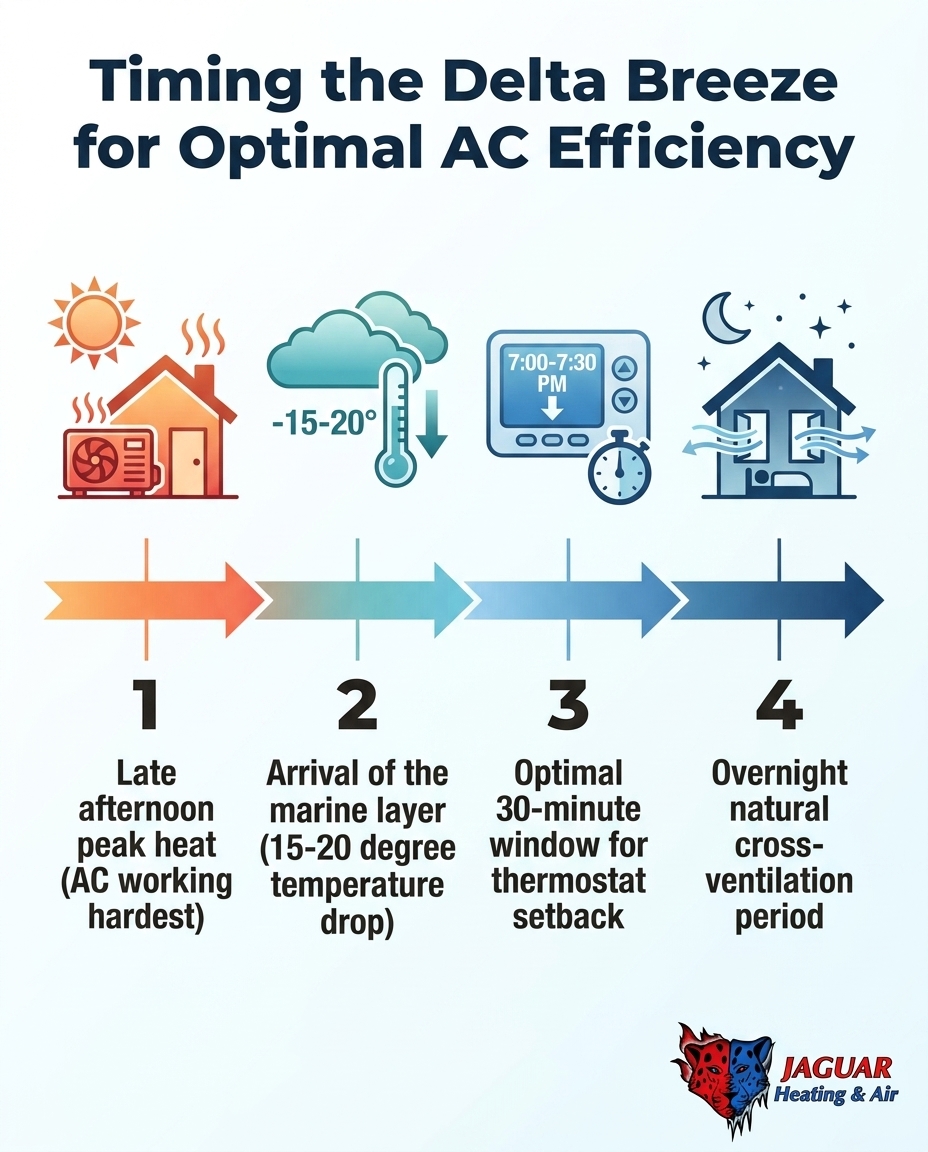
To truly optimize your home's cooling strategy, you have to understand the meteorological phenomenon that provides our region with such unique evening relief. The Delta Breeze is a natural air conditioning system for the region, pulling cool, dense marine air through the Carquinez Strait and funneling it directly into the Sacramento Valley. On days when the afternoon temperatures exceed 100 degrees, this marine layer can rapidly drop evening temperatures by 15 to 20 degrees or more within just a few hours.
As deep local experts who have spent years servicing Sacramento Valley HVAC systems, our team understands the exact mechanical interaction between our region's unique evening weather patterns and your AC compressor's cooling load. The "cooling load" refers to the amount of heat energy your air conditioner must remove from the home to maintain your desired indoor temperature. When the ambient outdoor temperature is high, the cooling load is immense. When the Delta Breeze arrives and the outdoor temperature plummets, the cooling load drops dramatically. If your thermostat is programmed to recognize this shift, the natural temperature drop provides a vital mechanical break for your entire HVAC system.
Local utilities consistently recommend reducing air conditioning usage in the late afternoon and early evening to align with this natural atmospheric shift. Failing to do so means your system is working overtime when it doesn't need to be, drawing peak power while the environment outside is already perfectly comfortable.
How Rapid Temperature Drops Affect Your AC Compressor
The compressor is the heart of your air conditioning system, functioning by moving heat from the inside of your home to the outside. This heat transfer process is heavily dependent on the outdoor ambient temperature. When the outside air is scorching, the compressor has to work incredibly hard to dissipate the heat it has absorbed from your indoor spaces.
However, when the Delta Breeze rolls in and outside temperatures drop rapidly, the mechanical effort required to transfer heat changes. If you fail to adjust your thermostat, the system continues to cool against a falling ambient temperature, wasting cycles. The compressor ends up running to lower the indoor temperature by a few degrees when simply opening a window would achieve the exact same result with zero mechanical effort.
Adjusting Schedules for Shifting Late-Summer Sunsets
Static thermostat schedules are the enemy of HVAC efficiency. A schedule that kept your home perfectly comfortable in late June will become highly inefficient by the time the August late-summer cooling transition arrives. As summer winds down, sunset times shift earlier, meaning the evening cooling transition arrives at different times. If your thermostat does not adapt to these shifting sunsets, your system will inevitably run longer than necessary.
Anticipating seasonal shifts is critical for system reliability. Our dispatch team at Jaguar Heating & Air recently took a call during a seasonal transition when a customer's system was not coming on; they called for service, and our technician arrived the next day, restoring their comfort in under 30 minutes. This kind of sudden failure often traces back to systems struggling to adapt to shifting seasonal demands without adequate calibration. The same principle applies to your air conditioner in late summer. Identifying the optimal time window to raise your indoor set point allows the AC to pause, preventing the system from struggling during extreme heat waves earlier in the day.
Step-by-Step Evening Thermostat Programming
Taking advantage of the marine layer requires deliberate timing. Follow these steps to program your thermostat for optimal mechanical rest:
1. Track the breeze arrival: Monitor the average time the marine breeze arrives in your specific neighborhood over a three-day period. The timing can vary slightly depending on your exact elevation and proximity to the river.
2. Program a proactive setback: Set your thermostat to raise the target indoor temperature by 2 to 4 degrees approximately 30 minutes before the anticipated temperature drop. This stops the compressor from kicking on right as the outside air begins to cool.
3. Enable natural ventilation: Once the outside temperature drops below your indoor temperature, allow the system to rest while utilizing natural cross-ventilation to flush the trapped heat out of your living spaces.
4. Pre-cool during off-peak hours: Shift your heavy cooling load to the morning or early afternoon when the system operates more efficiently, allowing it to coast through the late afternoon until the breeze arrives.
5. Adjust weekly: Shift your programmed setback time earlier by 10 to 15 minutes every couple of weeks as August progresses into September to match the changing sunset.
Smart Thermostat Automation vs. Manual Adjustments
While manually adjusting your thermostat every evening is entirely possible, it is also easily forgotten. Forgetting to bump up the temperature just once can lead to unnecessary overnight cooling cycles that put miles on your compressor while you sleep. Upgrading to technological solutions that anticipate the breeze automatically is one of the smartest investments a homeowner can make in the Sacramento Valley.
Smart thermostats can utilize local weather data via Wi-Fi to anticipate the marine layer drop automatically. By setting up geofencing and weather-responsive schedules, you maximize mechanical rest for the system without having to remember to push a button every evening at 6:00 PM. If you ever run into technical hurdles—for example, if your smart thermostat screen is blank or unresponsive when trying to update these late-summer schedules—it is usually a sign of a tripped breaker, a blown low-voltage fuse, or a wiring issue that requires a quick professional diagnostic from our team.
• Response to Delta Breeze — Manual Thermostat: Requires daily physical adjustment based on the clock. — Smart Thermostat: Can automatically adjust based on real-time local weather data.
• Wear and Tear Impact — Manual Thermostat: High risk of unnecessary overnight running if forgotten. — Smart Thermostat: Minimizes compressor load by anticipating temperature drops.
• Ease of Use — Manual Thermostat: Relies entirely on homeowner memory and shifting sunset times. — Smart Thermostat: Set-it-and-forget-it automation with smartphone control.
Transitioning from Mechanical Cooling to Natural Airflow
The exact moment the air conditioner shuts down for the evening is the time to optimize your indoor airflow. Relying on the natural environment requires a bit of strategy to ensure the cool air actually penetrates the living spaces. During the August late-summer cooling transition, the goal is to detail how the 60-degree marine air can be utilized to pre-cool the home's thermal mass overnight.
Strategic Cross-Ventilation: Opening a single window will not effectively cool your home. You need to create a pressure differential. Open windows on the windward side of the house (where the breeze hits) slightly, and open windows on the leeward side (the opposite side) much wider. This creates a vacuum effect that pulls the cool marine air rapidly through the hallways and living areas, displacing the hot, stale indoor air.
Whole-House Fans: If your home is equipped with a whole-house fan, this is the perfect time to use it. These fans pull massive volumes of cool outdoor air through the open windows and exhaust the hot indoor air out through the attic vents. This not only cools the ambient air in the rooms but also pulls heat out of the drywall, flooring, and furniture.
Blower Fan Maintenance: Even when the compressor is off, you can use your HVAC system's blower fan to circulate the fresh air evenly throughout the house. Setting the thermostat fan setting from "Auto" to "On" keeps the air moving. However, this highlights the importance of keeping the AC blower fan maintained so it can circulate air reliably without overheating.
Balancing Indoor Humidity: While the evening breeze brings cooler temperatures, it can sometimes carry higher moisture levels. If the indoor air begins to feel clammy, you may need to close the windows and let the air conditioner run a short dehumidification cycle, as the AC naturally removes moisture from the air as it cools.
Mitigating End-of-Season Wear and Tear
Systems that run continuously without leveraging natural cooling windows are highly prone to late-season failures. The cumulative effect of a heavy summer workload can leave units blowing warm ambient air if neglected. When an air conditioner is forced to run 14 hours a day without a break, the internal components—specifically the capacitors, contactors, and blower motors—absorb massive amounts of thermal stress.
A pattern we see often at Jaguar Heating & Air involves late-summer blower motor failures. Just recently, a Sacramento Valley homeowner called us late on a Friday night during the end-of-summer heat because their AC blower fan would not turn on. Our technician arrived the following morning and fixed the fan quickly. This type of breakdown is incredibly common in August and is almost always the result of a system that has been overworked without adequate mechanical rest periods. Giving your system a break every evening drastically reduces the likelihood of these emergency failures.
To truly understand how your home handles the transition between mechanical cooling and natural airflow, consider utilizing an energy savings audit. An audit can identify how effectively your home retains the cool air generated overnight, pinpointing areas where poor insulation or leaky ductwork might be allowing the afternoon heat to intrude too quickly.
Proactive Steps Before the Season Ends
Before the cooling season wraps up entirely, take a few proactive steps to ensure your system finishes strong:
• Check thermostat calibration: Ensure your thermostat accurately reads indoor temperatures. A miscalibrated sensor can cause the system to run long after the house has reached the desired temperature.
• Evaluate system performance: Pay attention to how the system sounds and performs during the hottest part of the day versus the evening. Unusual grinding or squealing noises during the afternoon peak demand immediate professional attention.
• Inspect the outdoor unit: Make sure the condenser coils haven't been clogged by summer dust, grass clippings, or debris. A clogged coil forces the compressor to work harder, negating the benefits of your careful evening scheduling.
Frequently Asked Questions About Evening Thermostat Settings
Keeping your system ready to handle shifting weather patterns is much easier when you have proactive, professional support. Many homeowners find that an ongoing HVAC maintenance membership ensures their sensors, blowers, and compressors are perfectly calibrated to maximize these natural cooling windows. Here are the most common questions we hear regarding evening temperature management.
What time does the Delta breeze come in?
The arrival time varies depending on your exact location and the specific weather patterns of the day, but it typically reaches the valley between 4:00 PM and 7:00 PM. During the August late-summer cooling transition, the breeze often arrives slightly later as the days shorten. Tracking the temperature drop on a weather app for a few days will give you the most accurate window for your specific neighborhood.
Should I turn off my AC at night in Sacramento?
Yes, if the outdoor temperature drops below your desired indoor temperature, turning off the AC at night is highly recommended. Continuing to run the compressor when the outside air is 65 degrees wastes energy and puts unnecessary wear on the equipment. Instead, open your windows to allow natural cross-ventilation to cool the home's thermal mass overnight.
What is the best thermostat setting for summer in Sacramento?
The Department of Energy generally recommends setting your thermostat to 78 degrees when you are home and awake during the summer. However, the best setting is one that dynamically adjusts: keeping it slightly higher during the peak afternoon heat, and then allowing the system to rest entirely once the evening marine layer arrives to naturally cool the living space.
How do I program my thermostat for the Sacramento Delta breeze?
You should program your thermostat to raise the target indoor temperature by a few degrees about 30 minutes before the breeze typically arrives in your area. This prevents the air conditioner from starting a cooling cycle right as the outdoor temperatures are naturally falling. Once the outside air is cooler than the inside air, you can switch the system off or to "fan only" mode.
Should I turn off my air conditioner at night in California?
In regions that experience a significant evening temperature drop, such as areas affected by coastal marine layers or valley breezes, turning off the air conditioner at night is a smart strategy. It provides your HVAC equipment with essential mechanical rest. Just be sure to close your windows and turn the system back on in the morning before the outdoor temperatures begin to climb again.
Does the Delta breeze affect indoor humidity?
Yes, the marine air pulled inland is often cooler but carries higher moisture content than the dry afternoon heat. While this provides excellent temperature relief, it can occasionally make the indoor air feel slightly humid. If the humidity becomes uncomfortable, running the air conditioner for a short cycle will help dehumidify the space.
How do shifting August sunset times change my evening AC schedule?
As sunset times shift earlier in late summer, the outdoor temperature begins to drop sooner in the evening. This means a thermostat schedule configured for the late sunsets of June or July will keep your AC running longer than necessary in August. You need to adjust your programmed evening setback earlier to align with these changing daylight patterns.
Optimize Your System for the Rest of the Season
Syncing your thermostat with the natural evening cool-down is one of the most effective ways to save wear and tear on your equipment. By understanding how Delta Breeze patterns should influence your evening thermostat settings, you give your compressor a crucial mechanical break, reducing the risk of a late-season breakdown. A properly calibrated system provides consistent comfort while operating with maximum efficiency.
If your system has been running hard all summer and you want to ensure it finishes the season strong, now is the time to have it evaluated by a professional. Don't wait for a breakdown to occur on the hottest day of the year. Take proactive control of your home's comfort and schedule AC maintenance in Sacramento to keep your system running smoothly through the Sacramento Valley's shifting seasonal demands.
Recent Posts

How Sacramento's Hard Water Affects Your Evaporative Cooler Pads
By September, Sacramento's heavy mineral content often turns swamp cooler pads into rock-hard blocks. See why airflow drops drastically and weigh your end-of-season options.
Why Your Dual-Zone System Fails to Cool the Master Bedroom
Persistent temperature imbalances in your master suite are rarely a main AC capacity issue. Discover how stuck motorized zone dampers disrupt airflow and why a pre-season diagnostic is crucial.

The Truth About Chemical Coil Cleaners and Your AC's Longevity
While a sparkling clean condenser unit looks great, acidic sprays might be secretly destroying your equipment. See why we refuse to use them during fall tune-ups.