.avif)
Why Your AC Contractor Needs to Check Static Pressure Before Recommending a Repair
When your AC blower motor dies in the late August heat, a quick replacement seems ideal. But if your technician skips testing airflow, that expensive new motor could burn out too.
When your AC blower motor dies in the late August heat, a quick replacement seems ideal. But if your technician skips testing airflow, that expensive new motor could burn out too.

The Late-Summer Blower Motor Breakdown
When the vents suddenly go quiet and the house starts baking, understanding why your AC contractor needs to check static pressure before recommending a repair is the only way to protect your investment from a repeat blower motor failure. A sudden breakdown is incredibly frustrating, especially as we transition into the busy back-to-school season. You call a technician, they inspect the unit, and they hand you a quote for a brand-new motor. Your first instinct is to simply sign the paperwork to get the cold air flowing again.
If you are facing an unexpected breakdown and need professional guidance right now, explore our Air Conditioning services to get your system diagnosed correctly.
Approving a replacement without knowing exactly why the original motor failed is a massive financial risk. In our years of servicing Sacramento homes at Jaguar Heating & Air, our team typically sees that the missing piece in most rushed, incomplete diagnostic visits is a crucial airflow measurement. By the time we reach late August end-of-season cooling, your blower motor has endured months of heavy lifting. If it suddenly burns out, it is rarely due to old age alone. More often than not, the motor was pushed to its breaking point by an invisible force inside your ductwork. Without measuring that force, replacing the broken part is just putting a bandage on a much larger problem.
Many homeowners assume that a dead motor is simply a stroke of bad luck. The truth is that motors are designed to last for years under normal conditions. When they die prematurely, they leave behind clues. A thorough professional knows how to read those clues rather than just swapping out the broken machinery and hoping for the best.
Understanding the 'Misaligned Car' Analogy of HVAC
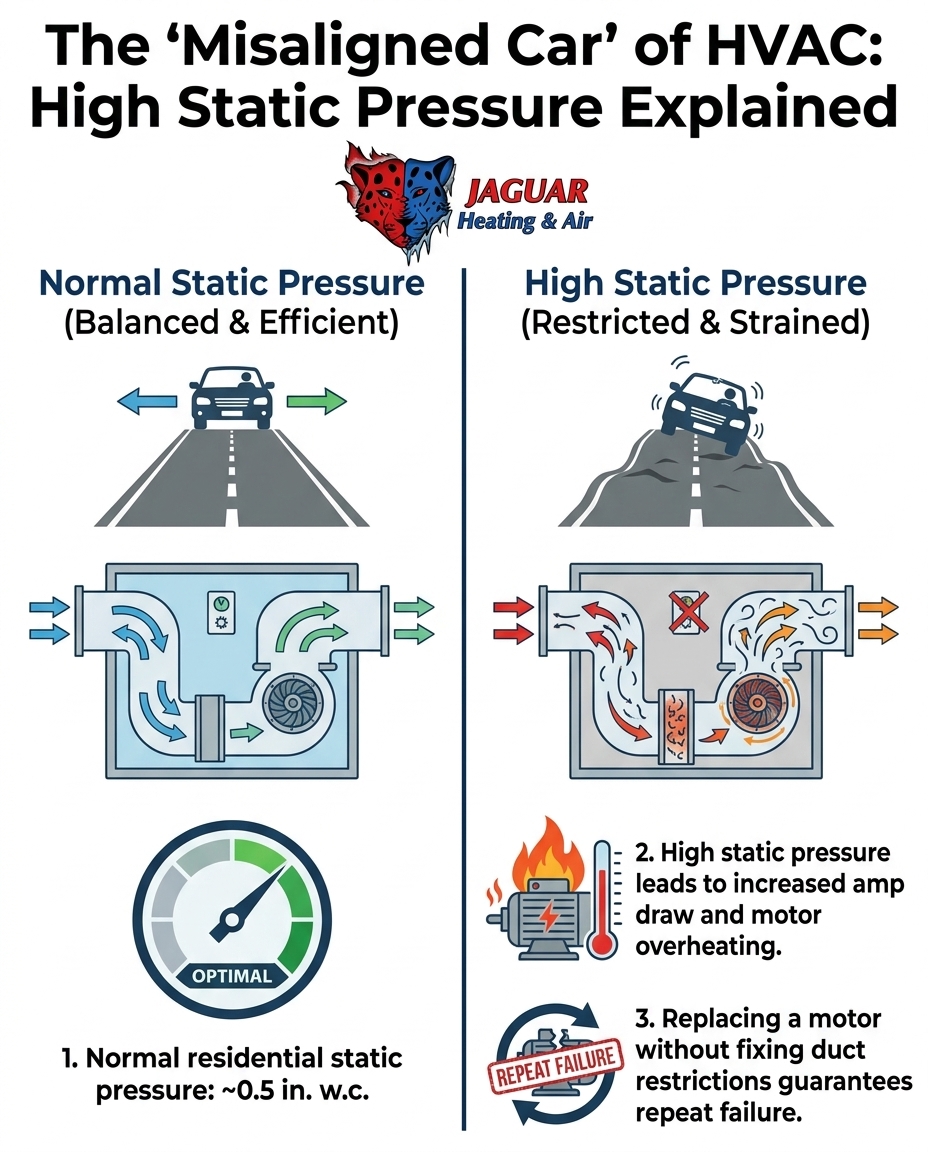
To understand why your motor failed, you have to understand a concept called static pressure. In simple terms, static pressure is the resistance to airflow within your ductwork. Your air conditioner's blower motor has to push cold air through your home's supply ducts and pull warm air back through the return ducts. If those ducts are too small, clogged, or poorly designed, the motor has to fight against immense resistance just to circulate the air.
Think of it like putting brand-new tires on a severely misaligned car. You can buy the most expensive, high-quality tires on the market, but if the car's alignment is completely off, those new tires are going to wear down and get destroyed in a matter of months. The same logic applies to AC Repair. If a technician replaces a burned-out blower motor without addressing the high static pressure in your ductwork, the brand-new motor will be subjected to the exact same destructive forces. It is guaranteed to fail again.
Another helpful way to picture this is breathing through a straw. If you try to run a marathon while breathing through a tiny cocktail straw, your heart is going to work dangerously hard to get enough oxygen. High static pressure is like forcing your HVAC system to breathe through a straw. It acts as the "blood pressure" of your heating and cooling system. A proper static pressure test measured in inches of water column gives professionals a quantifiable number to gauge system health.
What High Resistance Does to Your Equipment
When your system operates under high static pressure, a chain reaction of mechanical stress begins inside the unit. The consequences are severe and often hidden until the system completely shuts down.
• Increased Amp Draw: The blower motor has to work significantly harder to move the same amount of air, forcing it to draw more electrical current (amps) than it was designed to handle.
• Internal Overheating: As the motor draws more electricity, the internal components generate excessive heat. Without enough smooth airflow to cool the motor housing, it literally bakes from the inside out.
• Shortened Lifespan: A motor that should last over a decade can be destroyed in just a few seasons when forced to fight against severe duct resistance.
• Normal Operation — Airflow Resistance: Low (Healthy Ducts) — Motor Amp Draw: Within Factory Specs — Expected Component Lifespan: Maximum Design Life
• High Static Pressure — Airflow Resistance: High (Restricted Ducts) — Motor Amp Draw: Dangerously High — Expected Component Lifespan: Severely Shortened
Why Extreme Summer Heat Accelerates Motor Burnout
The local climate plays a massive role in how and when these mechanical failures happen. During prolonged heatwaves, air conditioners run almost continuously without a cooling-off period. With summer temperatures regularly exceeding 90 and 100 degrees in the Sacramento valley, your system is forced into marathon operation just to keep the indoor temperature bearable.
This continuous operation compounds the friction and heat generated by restricted ductwork. If your system has high static pressure, the blower motor is already running hotter than it should. When you add relentless environmental heat and eliminate the motor's downtime, the internal temperature of the equipment spikes to dangerous levels. The equipment never gets a chance to rest and cool down.
By the time late August end-of-season cooling arrives, a motor fighting high static pressure has endured months of compounded stress. The insulation around the motor windings begins to break down, the bearings dry out, and eventually, the motor seizes up or shorts out entirely. Proper local HVAC repair in Sacramento must account for this intense environmental workload. A technician who ignores the climate's impact on a restricted system is doing you a disservice.
Understanding this seasonal timing explains why so many major breakdowns happen at the worst possible moment. The motor didn't suddenly break on a random Tuesday in August; it was slowly dying since May, suffocated by high static pressure, until the continuous summer heat finally pushed it over the edge.
The Danger of the 'Quick Fix' Part Swap
Many contractors default to replacing the broken part without investigating the underlying cause of the failure. This is often referred to as being a "parts changer" rather than a true diagnostician. If a technician simply unbolts the dead motor, wires in a new one, and hands you an invoice, they have only treated the symptom. The disease—high static pressure—is still alive and well inside your ductwork.
If the ductwork is severely restricted, the brand-new blower motor is doomed to fail in the exact same way. True diagnostics require looking at the entire system, including the ductwork, to ensure the new equipment will survive. A proper inspection often reveals that modifying or repairing the ductwork is the actual solution needed to save the equipment.
At Jaguar Heating & Air, our commitment is to thorough, honest diagnostics. We focus on finding the root cause to protect your investment rather than performing a quick-fix part swap that leaves you vulnerable. One local homeowner reached out in the morning because their AC unit was not functioning correctly during a severe heatwave. A technician arrived before noon, but rather than just throwing a new part at the problem, they took the time to properly test the system, fixed the underlying unit issue, and explained exactly how a proactive servicing plan prevents these invisible stressors from destroying equipment. That level of transparency is what separates a permanent fix from a temporary patch.
Never accept a rushed diagnosis. A proper static pressure test measured in inches of water column is the only way to prove that the environment inside the HVAC cabinet is safe for a new motor. If that test isn't performed, the quoted repair is nothing more than a very expensive gamble.
Common Culprits Behind High Airflow Resistance
If a technician does find that your static pressure is too high, the next step is identifying the bottleneck. High airflow resistance doesn't happen by magic; it is usually caused by tangible, physical issues within the home's infrastructure. Educating yourself on these culprits helps you understand exactly what the professional should be looking for during their inspection.
1. Undersized ductwork: Many homes were built with ductwork that is simply too small to handle the volume of air the modern AC system is trying to push. If a previous homeowner upgraded to a larger, more powerful AC unit but left the original, small ducts in place, the system will constantly choke on its own air.
2. Overly restrictive air filters: Homeowners often buy the highest-MERV-rated filters available, hoping to improve indoor air quality. However, if your system isn't designed to pull air through such a dense, thick filter, it acts like a brick wall in the return duct, skyrocketing the static pressure.
3. Crushed or disconnected ducts: Over time, flexible ductwork in attics or crawlspaces can get crushed by stored boxes, stepped on by contractors, or sag due to broken straps. These pinches create massive bottlenecks in airflow.
4. Blocked return vents: Furniture, rugs, or heavy curtains placed directly over air grilles restrict the system's ability to pull in air, suffocating the blower motor.
Internal and External Restrictions
It is important to differentiate between internal blockages and structural flaws. Internal blockages are often related to maintenance. A severely dirty evaporator coil or a duct system packed with years of dust and pet hair will drastically reduce airflow. In these cases, services like professional Duct Cleaning or chemical coil washing can relieve the pressure.
Structural issues, on the other hand, require modification. If the main return plenum is physically too small, no amount of cleaning will lower the static pressure. The ductwork itself must be expanded or redesigned to allow the system to breathe freely. External factors, such as debris blocking the outdoor condenser, can also impact overall system performance and efficiency, forcing the indoor blower to work harder to compensate for poor heat transfer outside.
How Professionals Actually Measure System Pressure
You might be wondering how a technician actually proves that your system is suffocating. Reputable professionals use specialized diagnostic tools to take exact measurements, completely eliminating guesswork from the equation. The primary tool for this job is a digital manometer.
A digital manometer measures the pressure drop across the system. To get an accurate reading, the technician will typically drill small, easily sealable test ports into the ductwork at specific points—usually right before the blower motor and immediately after the evaporator coil. By inserting static pressure probes into these ports, the manometer calculates the exact resistance the air is facing as it moves through the equipment.
These readings are then compared against the manufacturer's maximum design specifications. Most residential HVAC systems are designed to operate at a maximum total external static pressure of 0.5 in. w.c. (inches of water column). If the manometer reads 0.8 or 1.0 in. w.c., the technician immediately knows the system is operating under extreme stress.
This data allows the technician to pinpoint exactly where the restriction is occurring. By taking readings at different zones, they can tell you if the bottleneck is in the return ducts, the supply ducts, or the filter housing. It is a precise, scientific approach to HVAC repair. Just as you need to know how much clearance your outdoor AC unit needs to exhaust heat properly, your indoor unit needs precise internal clearances and duct sizing to move air without destroying itself. A static pressure test measured in inches of water column provides that exact verification.
The One Question You Must Ask Before Approving a Quote
When you are standing in a hot house, looking at a quote for a major repair, you hold the power to demand diagnostic integrity. Before signing any authorization for a blower motor replacement, there is one specific question you must ask the technician: "Did you check the static pressure?"
The answer to this question will reveal the true diagnostic integrity of the contractor standing in your home. If the answer is no, or if they dismiss the question as unnecessary, consider it a major red flag regarding their diagnostic process. A technician who guesses at the cause of a failure is gambling with your money.
A reputable technician will gladly answer yes. They will be eager to explain their readings, show you the numbers on their manometer, and explain exactly how they determined the root cause of the failure. They will walk you through the static pressure test measured in inches of water column and compare your system's numbers to the healthy baseline.
Demanding this level of diagnostic integrity protects your home. It prevents recurring breakdowns, ensures your new equipment will last for its intended lifespan, and gives you total peace of mind that the money you are spending is actually solving the problem, not just delaying the next disaster.
Protecting Your Cooling Investment with Proper Diagnostics
Ultimately, a burned-out blower motor is usually a symptom of a larger airflow problem, not the root cause. When you face a major failure during late August end-of-season cooling, rushing into a replacement without the full picture is a recipe for future headaches.
Ensuring your contractor measures airflow resistance guarantees that your repairs are permanent. It shifts the focus from a temporary part swap to a holistic system restoration. If you notice signs of poor airflow, hear strange noises from your vents, or are currently facing a major repair decision, consulting with a thorough, root-cause-focused professional is the safest next step. By insisting on proper diagnostics, you ensure your home stays comfortable, your equipment runs efficiently, and your investment is protected for years to come.
Frequently Asked Questions
What happens if HVAC static pressure is too high?
High static pressure forces your HVAC system to work much harder to circulate air, acting like a bottleneck in your ductwork. This excessive resistance causes the blower motor to draw more electricity, leading to dangerous internal overheating. Over time, this constant strain drastically shortens the lifespan of your equipment, increases your energy bills, and inevitably leads to major component failure.
Why did my AC blower motor burn out suddenly?
While blower motors can fail from old age, a sudden burnout is frequently caused by operating under severe airflow restriction. When the motor has to push against choked ductwork or a severely clogged filter, it overheats and the internal electrical windings degrade. By the end of a long, hot summer, the compounded stress finally causes the motor to short out or seize completely.
Should a technician always check static pressure during a repair?
Yes, checking static pressure is a fundamental step in diagnosing any major airflow or motor-related failure. Without this measurement, a technician is only guessing at what caused the breakdown. Verifying the pressure ensures that the environment inside the ductwork is safe for any new replacement parts they install.
What is a normal static pressure reading for a residential HVAC system?
For most standard residential heating and cooling systems, the manufacturer designs the equipment to operate at a maximum total external static pressure of around 0.5 inches of water column (in. w.c.). If a technician's manometer shows readings significantly higher than this baseline, the system is actively fighting against severe airflow restriction that must be corrected.
How can I tell if my home has poor airflow before the motor fails?
There are several early warning signs of poor airflow that you can spot before a total breakdown occurs. You might notice hot and cold spots throughout different rooms, weak air blowing from the supply registers, or a system that runs constantly without ever reaching the set temperature. Additionally, if you hear loud whistling noises from your return vents, your system is likely struggling to pull in enough air.
Recent Posts
HVAC Maintenance Guide: Comparing Heating Replacement Options Before Winter
Before winter hits, make sure your furnace can handle the cold. Compare your options with these objective heating options comparisons for homeowners.
HVAC Maintenance: Troubleshooting the Fall Heating Startup
Why does your furnace smell like burning on that first chilly morning? Use our home maintenance tips and troubleshooting to know when to call a pro this fall.
HVAC Maintenance: Home Maintenance Tips and Troubleshooting for Fall Heating Startup
Why some systems smell burning during fall startup, and how these home maintenance tips and troubleshooting steps help you decide when to call a professional.