.avif)
How to Calculate Mitsubishi Ductless System Savings
How Much Does a Mitsubishi Ductless System Save Sacramento Homeowners? How much does a Mitsubishi ductless system save depends on what you're replacing, but …
How Much Does a Mitsubishi Ductless System Save Sacramento Homeowners? How much does a Mitsubishi ductless system save depends on what you're replacing, but …

How Much Does a Mitsubishi Ductless System Save Sacramento Homeowners?
How much does a Mitsubishi ductless system save depends on what you're replacing, but most homeowners see annual energy cost reductions of 30% to 50% compared to older forced-air, electric baseboard, or boiler systems. On a typical Sacramento-area household spending around $2,400 per year on heating and cooling, that translates to roughly $720 to $1,200 saved every year — and up to $18,000 over the life of the system.
Here's a quick snapshot of what the savings look like:
• Forced-air with ducts — Typical Annual Savings: 30-40% on HVAC energy costs — Savings Over 15 Years: $10,800 - $18,000*
• Electric baseboard or radiators — Typical Annual Savings: Up to 60% less energy used — Savings Over 15 Years: Varies by usage
• Standard central system (no zoning) — Typical Annual Savings: 10-20% additional from zone control — Savings Over 15 Years: $3,600 - $7,200*
*Based on a $2,400 annual HVAC bill
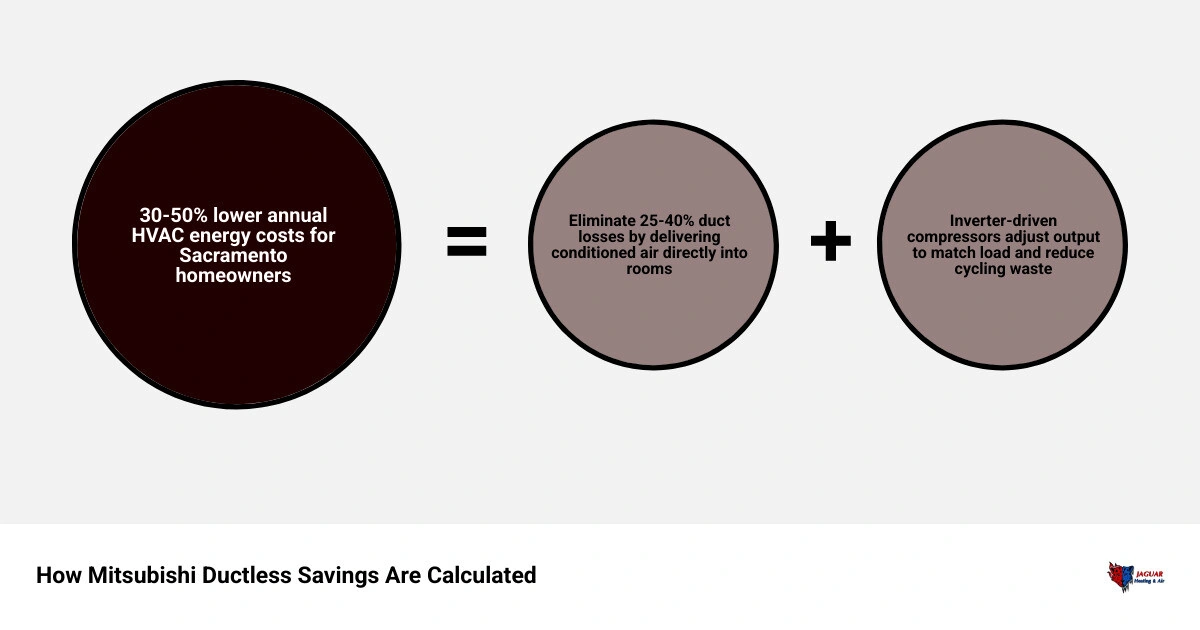
A big part of those savings comes from two places most homeowners overlook: the energy lost inside ductwork (which can reach 25-40% of your conditioned air before it ever reaches a room), and the ability to heat or cool only the spaces you're actually using. Add in Mitsubishi's inverter-driven technology — which adjusts output continuously instead of blasting on and off — and the efficiency gains add up fast.
In Northern California's climate, where summers are long and hot and winters are mild but still require reliable heating, a well-sized Mitsubishi ductless system can be one of the smartest upgrades a homeowner makes. This guide walks you through exactly how those savings are calculated, what drives them in real homes, and what to watch out for so you don't leave money on the table.
How Much Does a Mitsubishi Ductless System Save on Energy Bills?
For most homeowners, the honest answer is: it varies by home, but the savings are often significant.
Research consistently shows ductless heat pumps can reduce heating and cooling energy use by about 30% to 40% versus many traditional forced-air systems. In some homes, especially where the old system was inefficient or relied on electric resistance heat, savings can reach 50% or more. The biggest factors are:
• What system you have now
• Whether your home has leaky ducts
• How well the home is insulated and air sealed
• How many rooms you actually use every day
• Whether the new system is sized correctly
A Mitsubishi ductless heat pump saves energy by moving heat instead of generating it the hard way. That is much more efficient than electric resistance heat and often more efficient than older HVAC equipment that cycles on and off like it is training for a sprint.
How much does a Mitsubishi ductless system save compared to forced-air systems?
If your home uses a traditional ducted system, one major source of waste is the ductwork itself. The U.S. Department of Energy notes that duct losses can account for as much as 30% of the energy used for air conditioning. In real homes, especially older homes or attic duct systems, total losses can sometimes land in the 25% to 40% range.
A ductless system avoids that problem because it delivers heating and cooling directly to the room through refrigerant lines rather than pushing conditioned air through long ducts.
That creates savings in a few ways:
• No duct leakage into attics, crawlspaces, or wall cavities
• Less energy wasted overcoming static pressure
• More consistent room temperatures
• Better part-load efficiency from inverter operation
• The ability to condition only occupied rooms
For Sacramento-area homeowners replacing older forced-air equipment, a well-designed ductless system can commonly save around 30% to 40% on heating and cooling energy costs. DOE guidance also supports savings up to about 30% compared with traditional HVAC in many applications.
How much does a Mitsubishi ductless system save compared to electric baseboard or radiators?
This is where ductless heat pumps often shine brightest.
ENERGY STAR notes that certified mini-split heat pumps can use up to 60% less energy than standard home electric radiators. That is because electric baseboard and resistance heat convert electricity directly into heat, while a heat pump transfers heat instead. In simple terms, it gets more heating delivered per unit of electricity.
If a Sacramento home has older electric resistance heat, the winter savings potential can be dramatic. Even in our milder winters, heating loads still matter, especially on cold mornings and during overnight runs. Replacing straight electric heat with a high-efficiency ductless heat pump can be one of the biggest bill-cutting moves a homeowner makes.
Boiler-heated homes can also save, especially when adding cooling at the same time. For older homes that rely on boilers or radiators and do not have existing ductwork, ductless often avoids both the energy waste and the disruption of adding full duct systems.
How much does a Mitsubishi ductless system save in real dollars over time?
Let us put percentages into plain English.
If a household spends about $2,400 per year on heating and cooling:
• 30% savings = about $720 per year
• 40% savings = about $960 per year
• 50% savings = about $1,200 per year
Over 15 years, that can add up to:
• $10,800 at 30% savings
• $14,400 at 40% savings
• $18,000 at 50% savings
And that does not include the value of improved comfort, quieter operation, or reduced greenhouse gas emissions. ENERGY STAR also reports that certified mini-splits used for whole-home applications can avoid more than 4,500 pounds of greenhouse gas emissions over their lifespan compared with standard systems.
What Drives Mitsubishi Ductless Savings in Real Homes?
Not every home gets the same result from the same equipment. The system matters, but the house matters too.
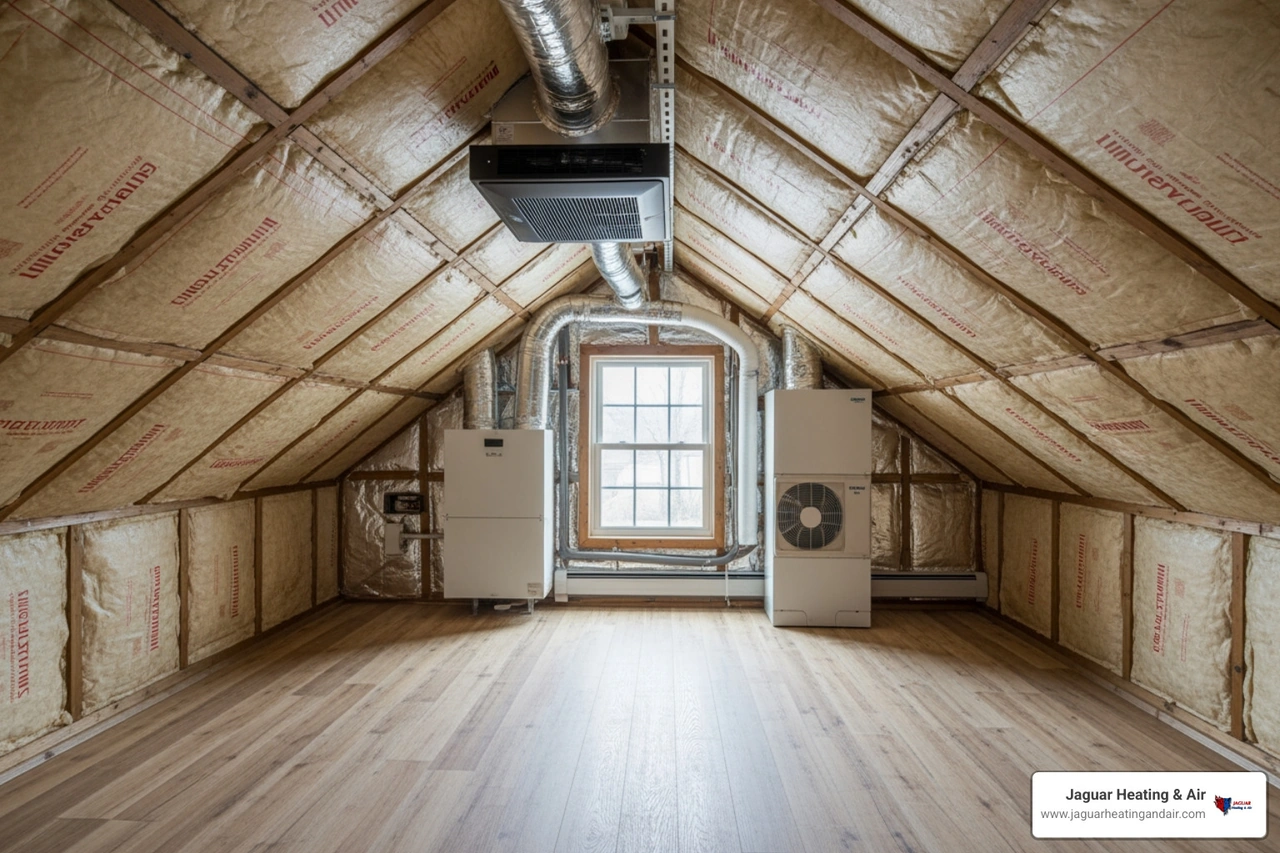
The biggest real-world savings drivers are:
• Eliminating duct losses
• Zoning by room or area
• Matching system size to the home's actual load
• Improving insulation and air sealing
• Letting inverter equipment run steadily at lower output
Why eliminating ductwork can cut wasted energy
Ductwork sounds harmless until you remember where it usually lives: hot attics, dusty crawlspaces, and other places your conditioned air would rather not vacation.
Traditional ducts can lose 25% to 40% of heating and cooling energy through leaks, poor connections, or inadequate insulation. Even when the equipment itself is efficient, the delivery system may not be.
Ductless systems avoid most of that waste because they send energy through insulated refrigerant lines and deliver heating or cooling directly where needed. That means:
• Less lost energy between the equipment and the room
• Better comfort in additions, garages, sunrooms, and older homes
• No need to retrofit bulky ducts into homes that were never designed for them
How zone control adds extra savings beyond equipment efficiency
Zoning is one of the biggest reasons homeowners choose ductless systems, and it is one of the biggest reasons they save money.
Instead of conditioning the whole house to one temperature, ductless lets you control rooms or zones individually. That means you can:
• Keep bedrooms cooler at night
• Reduce conditioning in unused guest rooms
• Avoid overcooling parts of the house no one is using
• Match comfort settings to real schedules
In many homes, zoning can reduce energy use by an additional 10% to 20% beyond the basic efficiency improvement of the equipment itself.
This matters a lot in homes with:
• Different comfort preferences from room to room
• Large sunny areas and shaded areas
• Additions or converted spaces
• Family members on different schedules
Why sizing and home prep matter as much as the equipment
A high-efficiency system in a poorly prepared home is like putting running shoes on a couch potato. Helpful, yes. Miraculous, no.
Proper sizing starts with a Manual J load calculation. That calculation looks at square footage, insulation, windows, orientation, air leakage, and more. It is far more accurate than rule-of-thumb sizing.
Why this matters:
• Oversized systems can short cycle, reducing efficiency and comfort
• Undersized systems may run too hard and rely on backup strategies
• Multi-zone systems with too much minimum output can cycle inefficiently in mild weather
• Poor insulation and air leaks can eat up expected savings
Before or during a ductless upgrade, we recommend homeowners:
• Seal air leaks around windows, doors, attic penetrations, and recessed lighting
• Improve attic and wall insulation where needed
• Keep indoor units unobstructed
• Use steady temperature settings instead of constant dramatic changes
Which Mitsubishi Features Have the Biggest Impact on Savings?
Not every feature affects your utility bill equally. A few stand out.
How SEER2 and HSPF2 affect cooling and heating costs
SEER2 and HSPF2 are the modern efficiency ratings homeowners should pay attention to.
• SEER2 measures cooling efficiency
• HSPF2 measures heating efficiency
Higher numbers generally mean the system can deliver the same comfort with less electricity. The exact dollar impact depends on:
• Local electric rates
• How many hours the system runs each year
• Whether cooling or heating is your larger load
• How efficient your old system was
In Sacramento and surrounding communities, cooling efficiency matters a lot because of long, hot summers. But heating efficiency still matters during winter mornings and overnight conditions. A higher-efficiency heat pump can lower both seasonal cooling and heating operating costs.
When Hyper-Heat improves savings in colder climates
Hyper-Heat, also called H2i on some Mitsubishi equipment, is designed for stronger heating performance in low outdoor temperatures. Cold-climate models are tested for operation down to very low temperatures, with some systems designed to perform down to around -13 degrees F and certain cold-climate standards verified down to 5 degrees F.
For the Sacramento region, Hyper-Heat is not always necessary in every application, but it can be valuable in:
• Foothill-adjacent areas with colder winter mornings
• Homes replacing legacy heating systems as the primary heat source
• Rooms that lose heat quickly
• Households that want stronger low-ambient heating performance without backup heat running often
The value here is not just comfort. Better low-temperature capacity can reduce the need for supplemental heat, which protects winter efficiency.
Single-zone vs multi-zone efficiency tradeoffs homeowners should know
Single-zone systems are often the efficiency champs because one outdoor unit serves one indoor unit, allowing excellent modulation and low minimum output.
Multi-zone systems offer flexibility and can be ideal for whole-home applications, but there is a tradeoff: some multi-zone outdoor units have higher minimum output. If the smallest active load in mild weather is far below that minimum, the system may cycle more than expected.
That does not mean multi-zone is bad. It means design matters a lot.
In practice:
• Single-zone systems often perform best for isolated rooms, additions, or targeted upgrades
• Multi-zone systems are useful for whole-home coverage and multiple occupied areas
• The best savings come from matching the outdoor unit and indoor heads closely to the home's real load profile
This is one reason Manual J and careful system design matter so much.
How to Estimate Your Own Mitsubishi Ductless ROI Without Guesswork
You do not need to guess. You just need a few real inputs.
Start with your current heating and cooling usage
Pull your last 12 months of utility bills and look for:
• Total annual electricity use
• Any separate heating fuel use
• Months with the highest cooling demand
• Rooms that are consistently uncomfortable
• Areas you rarely use
Then ask:
• Are we heating or cooling unused rooms?
• Are ducts running through a hot attic?
• Are some rooms impossible to keep comfortable?
• Is the current system short cycling or running constantly?
That gives you the baseline.
Subtract savings from incentives and lower operating waste
Once you estimate likely operating savings, also factor in available incentives for qualifying systems. Federal programs can include tax credits for eligible ENERGY STAR certified heat pumps, and California-area homeowners may also have access to utility or regional rebate opportunities depending on the program year and eligibility rules.
For Sacramento-area homeowners, these resources can help:
• More info about How to Get Paid to Upgrade Your California Homes HVAC
• More info about Sacramentos Secret to Cheaper Heat Pumps via SMUD
• More info about Navigating the California Energy Rebate Application Process
Use this simple framework:
• Duct loss reduction — What to check in your home: Existing duct leakage, attic ducts, comfort imbalance
• Equipment efficiency — What to check in your home: Old system age, SEER2/HSPF2 improvement
• Zone control — What to check in your home: Unused rooms, schedule differences, additions
• Home envelope — What to check in your home: Insulation, drafts, window and door leaks
• Incentives — What to check in your home: Federal tax credit eligibility, local utility rebates
• Maintenance savings — What to check in your home: Filter type, duct cleaning needs, repair history
Factor in maintenance, lifespan, and warranty value
Savings are not just about monthly bills.
Many Mitsubishi ductless systems are expected to last around 15 to 20 years, and with proper maintenance some homeowners see service life beyond that. That longer lifespan can improve lifetime value compared with systems that wear out sooner.
Other ownership advantages may include:
• Washable filters instead of frequent disposable replacements
• No duct cleaning needs for homes without duct systems
• Fewer comfort complaints and hot/cold spots
• Less wear from hard on/off cycling thanks to inverter operation
Of course, maintenance still matters. To protect efficiency, homeowners should clean filters regularly and schedule professional tune-ups. For a deeper look at long-term value, see More info about Benefits Investing Heat Pump Installation.
Common Reasons Homeowners Miss Out on Expected Savings
A ductless system can save a lot. It can also disappoint if the design or operation is off.
Installation and sizing mistakes that raise monthly bills
The most common issues we see include:
• Rule-of-thumb sizing instead of Manual J
• Oversized outdoor units
• Indoor head placement that does not match airflow needs
• Poor line-set routing or insulation
• Incomplete commissioning after installation
An oversized system may short cycle. A poorly placed indoor unit may read the wrong room temperature. A mismatched multi-zone setup may struggle during mild conditions when loads are small.
The fix is straightforward: insist on proper design, proper electrical work, proper refrigerant setup, and full commissioning.
Everyday habits that can reduce how much a Mitsubishi ductless system saves
Even a great system needs decent habits.
Watch out for:
• Constantly changing the setpoint
• Blocking indoor units with furniture or curtains
• Neglecting dirty filters
• Conditioning rooms no one uses
• Leaving windows open while the system runs
Mini-splits usually do best with steady settings rather than dramatic thermostat swings. Think cruise control, not stop-and-go traffic.
When a ductless setup works best for whole-home comfort
Ductless is especially strong in these homes:
• Older homes with no existing ductwork
• Additions, converted garages, and bonus rooms
• Homes with radiator or boiler heat that need AC
• Households with different comfort needs by room
• Homes with persistent hot and cold spots
For more guidance, see More info about Is a Mitsubishi Ductless System Worth the Investment and More info about Ultimate Mitsubishi Ductless Guide 2026.
Frequently Asked Questions About How Much Does a Mitsubishi Ductless System Save
How much does a Mitsubishi ductless system save in Sacramento-area homes?
In Sacramento-area homes, savings often land in the 30% to 50% range when replacing older inefficient systems, especially where duct losses, zoning problems, or electric resistance heat are involved. Our long cooling season makes high cooling efficiency valuable, and shoulder seasons make inverter technology especially effective because the system can run gently instead of blasting on and off.
How much does a Mitsubishi ductless system save if the home already has ducts?
If the existing ducts are leaky, poorly insulated, or routed through a hot attic, ductless can save a lot by bypassing those losses. If the duct system is already very tight and well insulated, savings may be more modest. In those homes, the biggest gains may come from zoning specific rooms or solving comfort issues in targeted areas.
How much does a Mitsubishi ductless system save if the house is poorly insulated?
Usually less than expected until the envelope is improved. Air sealing and insulation upgrades reduce the load on any HVAC system, including ductless. If the house leaks air like a screen door on a submarine, the system has to work harder. The best results come when envelope improvements happen first or at the same time.
Conclusion
So, how much does a Mitsubishi ductless system save? In many Sacramento-area homes, the answer is enough to make a real difference year after year. The biggest savings usually come from eliminating duct losses, taking advantage of room-by-room zoning, and using inverter-driven heating and cooling that matches output to the home's actual needs.
The key is not just choosing efficient equipment. It is making sure the system is sized correctly, installed correctly, and paired with a well-sealed, well-insulated home. When all of those pieces line up, a ductless system can deliver lower energy use, cleaner operation, and much better comfort control.
If you want help evaluating your home in Sacramento, Elk Grove, Folsom, Roseville, Rocklin, Lincoln, El Dorado Hills, Rancho Cordova, Woodland, Carmichael, Citrus Heights, Fair Oaks, Granite Bay, Mather, or Orangevale, we can help you sort through the real savings factors without the guesswork.
Learn more about Mitsubishi high efficiency systems and explore The Connection Between Energy Efficient HVAC and Your Home Value.
Recent Posts
How to Tell If Your AC Contactor is Pitted and Failing
After thousands of high-load cycles this summer, your AC's electrical components are exhausted. Catching a failing contactor early prevents a catastrophic compressor breakdown this fall.
Why We Recommend Surge Protectors for Your HVAC Equipment
A standard circuit breaker isn't enough to protect modern heating and cooling systems from grid spikes. Find out how a dedicated safeguard prevents catastrophic control board failures.
The Difference Between a Clogged Filter Drier and a Bad TXV Valve
An AC that blows warm air isn't always leaking refrigerant—it might be suffering from a flow restriction. Find out how technicians trace the bottleneck to restore your cooling.