.avif)
The Ultimate Guide to How HVAC Condition Affects Home Appraisals
Discover how HVAC condition affects home appraisals in Sacramento and learn steps to protect your property value before the appraiser arrives.
Discover how HVAC condition affects home appraisals in Sacramento and learn steps to protect your property value before the appraiser arrives.

Why How HVAC Condition Affects Home Appraisals Can Cost You Thousands
How HVAC condition affects home appraisals is one of the most financially significant factors Sacramento homeowners overlook when preparing to sell, refinance, or apply for a home equity line of credit. Before diving deep, here is a quick summary of what you need to know:
| HVAC Situation | Likely Appraisal Impact |
|---|---|
| New or high-efficiency system (under 10 years) | May add 5–7% to appraised value |
| Aging system (15–20 years old) | -$3,000 to -$6,000 adjustment |
| Failing or broken system | -$5,000 to -$10,000 or more |
| Missing central air (where expected) | -$5,000 to -$8,000 functional obsolescence penalty |
| High-efficiency upgrade (SEER2 18+, AFUE 95%+) | +$1,000 to +$2,000 above standard replacement |
Your HVAC system is not treated like a kitchen remodel or a fresh coat of paint. Appraisers classify it as a core functional system — right alongside your roof and foundation. That means its age, condition, and efficiency rating directly shape how an appraiser scores your home's overall physical condition.
In Sacramento, where summer temperatures routinely push into triple digits, a working central air system is not a luxury — it is a baseline expectation. A failing or outdated system does not just make buyers nervous. It can quietly erase thousands of dollars from your appraised value before you even sit down at the negotiating table.
This guide walks you through exactly how appraisers evaluate your HVAC system, what red flags to fix before the appraiser arrives, and how to document your system so it works in your favor.
Must-know how hvac condition affects home appraisals terms:
- how a new hvac system increases home value
- new hvac benefits beyond comfort
- why hvac replacement is a smart investment
How Appraisers Evaluate Your Heating and Cooling System
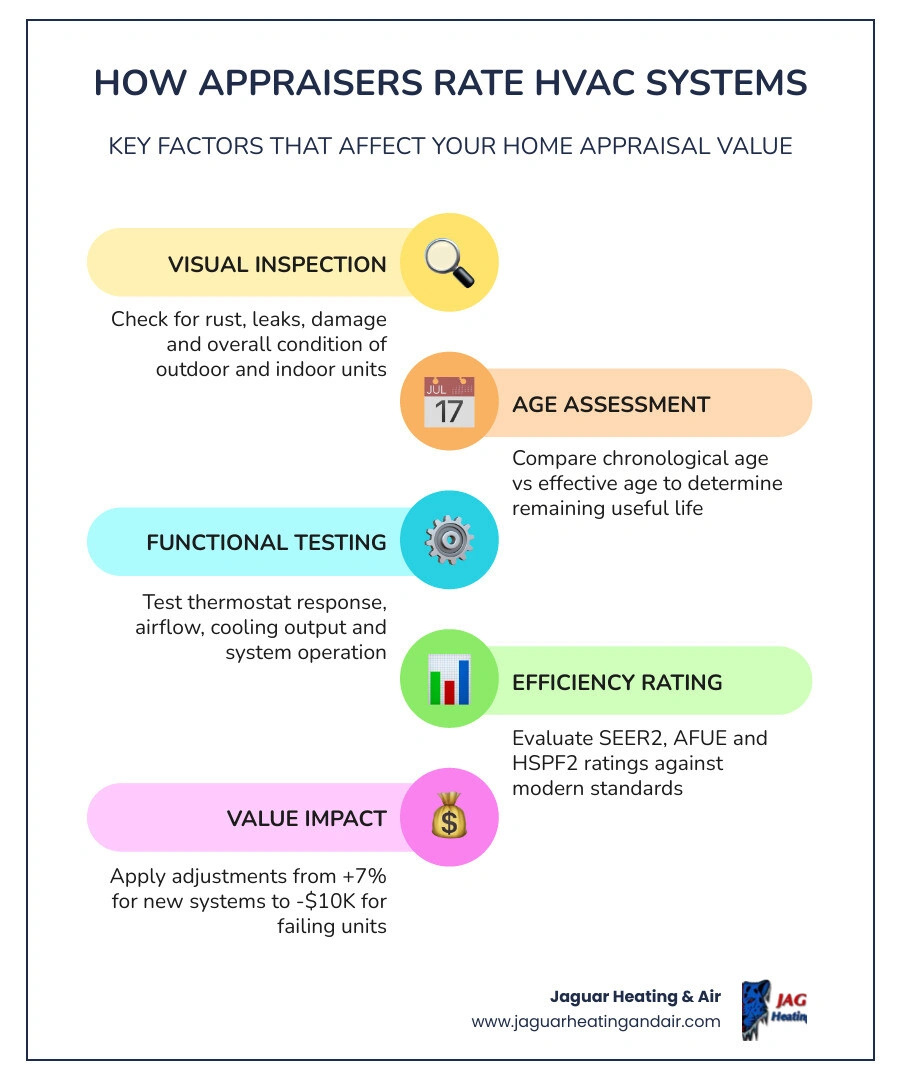
When an appraiser steps onto your property in Sacramento, Folsom, or Elk Grove, they are not there to perform a technical, multi-point diagnostic on your furnace or air conditioner. They are not HVAC technicians, and they will not be hooked up to your system with pressure gauges or electrical meters. Instead, they look at your heating and cooling equipment through the lens of real estate valuation, focusing on three major categories: physical condition, functional utility, and market expectations.
The evaluation begins with a walkthrough and visual inspection. The appraiser will locate your indoor unit (typically in a closet, garage, or attic) and your outdoor condenser. They will check the manufacturer data plates to record the brand, model number, and serial number. Back at their office, they will use these numbers to decode the exact month and year the equipment was manufactured. This chronological age is then compared against the system’s Remaining Useful Life (RUL).
Beyond chronological age, the appraiser is highly focused on "effective age." A system that is technically 12 years old but has been meticulously maintained, kept clean, and housed in a shaded, debris-free area may have an effective age of only 8 years. Conversely, a neglected 6-year-old system with bent condenser fins, a clogged filter, and rust can easily have an effective age of 12 years.
To test functional utility, the appraiser will conduct a basic thermostat response test. They will turn on the heating and cooling systems to verify that they actually respond to the thermostat and blow air at the appropriate temperatures. If you are trying to decide how to handle an older system before listing, reading about whether to Should I Repair or Replace My HVAC System can help you make a strategic choice that protects your valuation.
How hvac condition affects home appraisals during the walkthrough
The walkthrough is where the appraiser's first impressions are formed. If they walk into your hallway and see a dark, dust-caked intake grate with a bowed, dirty air filter, a mental red flag goes up. To an appraiser, a filthy air filter is the "canary in the coal mine" — it suggests that routine home maintenance has been neglected across the entire property.
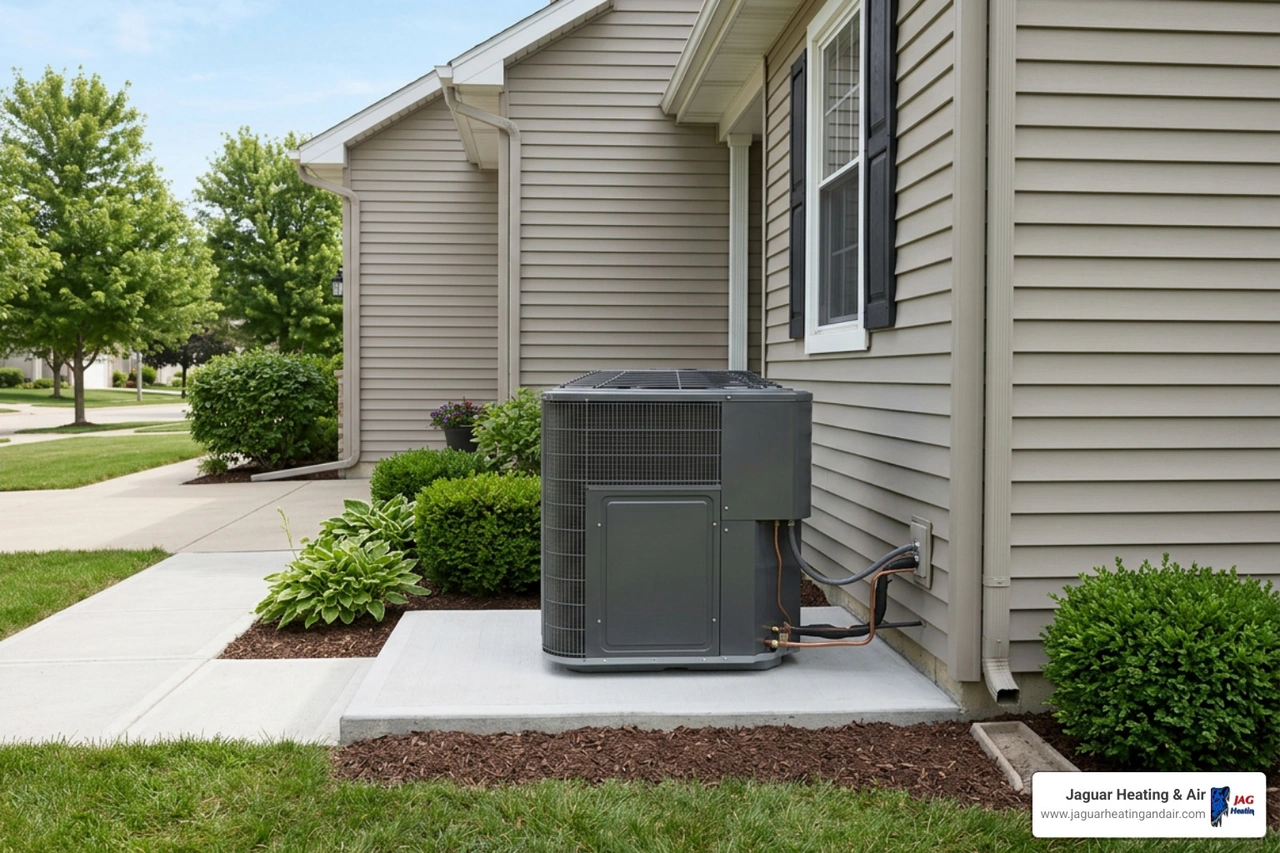
Outside, the appraiser will walk around the condenser unit. They are looking to see if the condenser pad is level, if the coil fins are crushed, and if the unit has at least a three-foot clearance from overgrown bushes, weeds, or stored items. If the system is blocked by storage or buried in dry Sacramento Valley brush, it signals a lack of care and raises concerns about premature system wear.
Ensuring easy system accessibility is crucial. If the appraiser cannot safely access your attic, crawlspace, or garage closet to inspect the heating and air conditioning units, they may write the appraisal "subject to" a secondary inspection. This delays your loan approval, refinance, or sale. To avoid these issues, it is wise to learn When to Repair vs Replace Your HVAC System well in advance of an appraiser’s visit.
Regional expectations for Sacramento climate control
In real estate appraisal, "functional obsolescence" occurs when a property lacks a feature that is considered standard and necessary for the local market. This is where regional climate plays a massive role in how hvac condition affects home appraisals.
In the Sacramento Valley — including warm communities like Roseville, Rocklin, Lincoln, and Woodland — triple-digit summer afternoons are a regular occurrence. Because of this intense heat, central air conditioning is not considered an optional luxury upgrade; it is a baseline market expectation. If a home in a standard Sacramento neighborhood relies solely on window AC units or lacks cooling altogether, the appraiser will penalize the property with a functional obsolescence deduction, typically ranging from $5,000 to $8,000.
Additionally, modern heat pumps are highly favored in Northern California due to our mild winters and the state's push toward energy-efficient electrification. An appraiser comparing your home to recent neighborhood sales (comparables) will look at whether your heating and cooling setup matches or exceeds what is standard for your specific street and price bracket.
The Financial Impact of How HVAC Condition Affects Home Appraisals
Understanding the financial math behind HVAC valuations is essential for protecting your home equity. Broadly speaking, home improvements fall into two categories: value protection and value creation.
Maintaining or replacing an aging HVAC system is primarily an act of value protection. It prevents steep, immediate downward adjustments on your appraisal report. If your system is failing, outdated, or completely broken, an appraiser will apply a deferred maintenance penalty, which can easily slash $5,000 to $10,000 or more from your home's valuation. By keeping your system in top-tier shape, you protect your home’s baseline value, which is critical when you are trying to maximize your borrowing limits for refinancing or establishing a Home Equity Line of Credit (HELOC).
On the flip side, upgrading to a modern, high-efficiency system represents value creation. A new, highly efficient HVAC system can increase your home's appraised value by 5% to 7%. While you may not always recoup 100% of the installation cost in the appraisal alone, the combination of added property value, faster sales speed (often 10% to 15% faster), and slashed monthly utility bills makes it an incredibly sound investment. For a detailed breakdown of these dynamics, look into Why HVAC Replacement is a Smart Investment.
Efficiency ratings that boost property valuation
Not all new HVAC systems are viewed equally by appraisers. A standard, builder-grade system will certainly keep your home's value neutral and prevent penalties, but a high-efficiency system can justify a positive appraisal adjustment of $1,000 to $2,000 (or more) over standard units.
Appraisers look at several key efficiency metrics when calculating adjustments:
- SEER2 (Seasonal Energy Efficiency Ratio 2): Measures cooling efficiency. While standard systems sit around 14 to 15 SEER2, premium high-efficiency systems reach 18 to 22+ SEER2.
- AFUE (Annual Fuel Utilization Efficiency): Measures gas furnace efficiency. Standard furnaces operate at 80% AFUE, while high-efficiency condensing furnaces boast ratings of 95% to 98% AFUE.
- HSPF2 (Heating Seasonal Performance Factor 2): Measures the heating efficiency of heat pumps. Higher numbers indicate significantly lower winter operating costs.
An ENERGY STAR certified system signals to the appraiser that the home is modern, energy-conscious, and cheaper to operate. To better understand these terms and prepare your talking points for the appraiser, you can read our guides on Efficiency Ratings Explained for Homeowners and see how systems stack up in our Standard Efficiency vs High Efficiency HVAC Comparison.
Comparing HVAC value to kitchen and bathroom upgrades
It is common for homeowners to pour money into cosmetic lifestyle upgrades like kitchen remodels or bathroom tiling, assuming these projects offer the best return on investment. However, appraisers look at a home’s structural and mechanical integrity before they look at its beauty.
While a gorgeous kitchen remodel can add significant visual appeal, it is highly subjective. A buyer or appraiser might not share your taste in dark quartz countertops or brass fixtures. An HVAC system, however, is a core functional system. It is objective. No buyer or appraiser will ever look at a brand-new, high-efficiency heat pump and say, "I don't really like the style of this clean air."
Furthermore, a new HVAC system often recoups 50% to 80% of its cost in added appraisal value and energy savings, whereas a major kitchen remodel typically recoups only 50% to 60%. More importantly, a gorgeous kitchen inside a home with a broken furnace will still result in a delayed loan approval or a massive value deduction. Ensuring your core systems are flawless is the foundation of all real estate value, as explained in The Connection Between Energy Efficient HVAC and Your Home Value.
Common Red Flags That Lower Appraised Value
When an appraiser conducts their physical inspection, they are trained to look for specific red flags that indicate a system is nearing the end of its useful life or has been poorly maintained. Identifying and resolving these issues before the appraisal can save you thousands of dollars in negative adjustments.
Here are the most common HVAC red flags that appraisers look for:
- Obsolete R-22 Refrigerant: If your air conditioner was manufactured before 2010, there is a high probability it uses R-22 refrigerant (commonly known as Freon). Because the EPA has completely banned the production and import of R-22, repairing these systems is incredibly expensive. Appraisers treat R-22 systems as having zero remaining useful life, flagging them as immediate liabilities.
- Visible Rust and Corrosion: Heavy rust on the outdoor condenser cabinet or the indoor evaporator coil housing indicates moisture issues, neglect, or advanced age.
- Unusual Noises: Loud screeching, rattling, or thumping when the system starts up signals mechanical distress or a failing blower motor.
- Uneven Temperatures: If the appraiser notices a stark temperature difference between rooms during their walkthrough, they will note potential ductwork issues or an improperly sized system.
- Leaky or Damaged Ductwork: According to the U.S. Department of Energy, leaky ducts can drop overall system efficiency by 20% to 30%. Visible gaps, loose tape, or collapsed flex ducts in the attic or crawlspace will be flagged.
- Unpermitted Installations: If a previous homeowner installed a new heating and cooling system or added a mini-split to a permitted home addition without pulling proper municipal permits, the appraiser cannot legally credit the upgrade, and it may trigger a code violation flag.
Addressing these mechanical and structural issues before the appraiser arrives ensures your system is viewed as an asset rather than a ticking financial timebomb. To learn more about the compounding perks of a clean, modern system, check out our guide on New HVAC Benefits Beyond Comfort.
Preparing Your HVAC Portfolio for the Appraiser
Do not leave it up to the appraiser to guess the age, efficiency, or condition of your heating and cooling system. Appraisers appreciate organized homeowners who make their job easier. The best way to secure full credit for your HVAC system is to hand the appraiser a physical "HVAC Portfolio" when they arrive at your home.
Your HVAC Portfolio should contain:
- Installation Invoices: Showing the exact date of installation, the installing contractor, and the model and serial numbers of all equipment.
- Permit Records: Proof that the system was legally installed and inspected according to local Sacramento building codes.
- Warranty Documentation: If your system has a transferable parts or compressor warranty, include this to prove added value to future buyers.
- Efficiency Labels: Manufacturer brochures or AHRI certificates showing the SEER2, AFUE, or HSPF2 ratings.
- Service History Logs: Invoices from your twice-yearly professional maintenance visits.
- Tax Credit & Rebate Receipts: Documentation of any energy efficiency upgrades, which can be cross-referenced with resource guides like Don't Leave Money on the Table with These Federal HVAC Credits.
Why maintenance history is vital to how hvac condition affects home appraisals
Having a documented history of twice-yearly professional maintenance (spring AC tune-ups and autumn heating tune-ups) is the ultimate "operational proof" you can provide to an appraiser.
When an appraiser sees a consistent log of professional service stickers and invoices from licensed NATE-certified technicians, it instantly builds confidence. It proves that the "effective age" of your system is likely much lower than its chronological age. It shows that minor issues were caught early, the coils were kept clean, and the system has been operating under optimal conditions.
Before the appraiser arrives, make sure to perform basic upkeep: replace your air filters, wipe down the indoor and outdoor cabinets, and clear away any leaves or debris around your outdoor condenser. These small steps reinforce the narrative that your home is cared for with the highest standards of homeownership.
Frequently Asked Questions About HVAC and Appraisals
To help you prepare for your upcoming home valuation, here are answers to the most common questions Sacramento homeowners ask about HVAC systems and appraisals.
Will a new HVAC system increase my HELOC credit limit?
While installing a new HVAC system will not instantly skyrocket your borrowing limit on its own, it acts as a critical equity safeguard. When applying for a HELOC, your borrowing power is directly tied to your home's Loan-to-Value (LTV) ratio.
A new, high-efficiency system prevents the steep $5,000 to $10,000 "deferred maintenance" deductions that plague older homes. By keeping your appraised value high and maintaining a healthy equity cushion, you protect your maximum borrowing capacity and ensure your loan application moves forward smoothly without unexpected delays.
How old does an HVAC system need to be before it hurts my appraisal?
Generally, the 15-year mark is where HVAC systems transition from being viewed as assets to being viewed as liabilities. Standard split-system air conditioners and heat pumps have an expected lifespan of 15 to 20 years, while well-maintained gas furnaces can last 20 to 25 years.
Once a system crosses 15 years of age, appraisers will scrutinize it heavily for signs of wear and tear. However, functionality and care matter more than age alone. A well-documented, meticulously maintained 16-year-old system with clean coils and recent service records may receive a neutral rating, whereas a neglected 9-year-old system could trigger immediate value penalties.
Is getting my HVAC serviced before an appraisal worth it?
Yes, absolutely. Scheduling a professional tune-up before your appraisal is one of the smartest, most cost-effective steps you can take.
A fresh service sticker on your furnace or air handler, a clean air filter, and a spotless condenser pad send a powerful, visual message to the appraiser that the home is actively cared for. Furthermore, a professional service ensures your system passes the appraiser's thermostat response test on the first try, avoiding any negative marks on the final appraisal report.
Conclusion
Whether you are planning to sell your home in Roseville, refinance your property in Folsom, or apply for a HELOC in Sacramento, understanding how hvac condition affects home appraisals is key to protecting your hard-earned equity. Your heating, cooling, and ventilation systems are the mechanical heart of your home, and keeping them in top-tier shape is a vital part of property value protection.
If your system is nearing the end of its useful life, showing signs of wear, or simply needs a professional tune-up to ensure it passes the appraiser's walkthrough with flying colors, we are here to help. At Jaguar Heating & Air, our NATE-certified technicians specialize in keeping Sacramento-area homes comfortable, efficient, and fully prepared for any home valuation.
Give our friendly, family-owned team a call today to schedule your professional evaluation and ensure your home is ready for a flawless appraisal! For more details on how we can help you optimize your home's heating, cooling, and air quality, explore More info about HVAC services.
Recent Posts

Troubleshooting HVAC Maintenance: Why Your Heater Smells Like Burning on Startup
Why we check the exact odor on fall startups. Use our home maintenance tips and troubleshooting criteria to safely tell harmless dust from a real fire hazard.
Fall Home Maintenance Tips and Troubleshooting
Smelling burning dust during your first fall heating cycle? See what is normal versus a safety risk with our home maintenance tips and troubleshooting.

Navigating the October Heating Startup: A Guide to Fall HVAC Maintenance
Is your first fall heating startup causing strange odors? Rely on our local service expertise and area tips to know when to call a pro on this in Sacramento.