.avif)
The Link Between Clogged Furnace Filters and Summer AC Breakdowns
Your central air system relies on the exact same filter you use for winter heating. A neglected filter chokes airflow and often triggers late-summer cooling failures.
Your central air system relies on the exact same filter you use for winter heating. A neglected filter chokes airflow and often triggers late-summer cooling failures.

Why Your System is Struggling When You Need It Most
Your air conditioner is running nonstop, but the house still feels uncomfortably warm, exposing the link between clogged furnace filters and summer AC breakdowns. The thermostat is set to 70 degrees, but the indoor temperature stubbornly hovers near 80. When the late-summer August heat pushes outdoor temperatures into the triple digits, a struggling cooling system immediately triggers homeowner panic. Most people assume the worst: a blown compressor, a catastrophic mechanical failure, or a massive refrigerant leak that will require extensive repairs.
For comprehensive air conditioning services or immediate AC repair, reach out to our local team at Jaguar Heating & Air. Over our years serving Sacramento, we've seen countless systems fail just as families are prepping for the back-to-school transition, and the culprit is often surprisingly simple.
Before you assume your entire cooling unit is failing, the solution frequently lies in a much simpler, often overlooked component. Maintaining proper airflow is the absolute foundation of reliable cooling. Your central air system operates as a carefully balanced breathing machine. It must pull in a specific volume of warm air to push out an equal volume of cold air. When that balance is disrupted, the entire mechanical process begins to unravel.
During intense heat waves, cooling systems are already operating at their absolute maximum capacity. They have no margin for error. Any underlying airflow weakness—like a physical barrier blocking the air path—forces the equipment to work exponentially harder just to maintain basic function. Understanding how air moves through your home is the first step in protecting your equipment from premature failure.
The 'Heating vs. Cooling' Misconception Explained
One of the most common reasons our team sees homeowners accidentally neglect their equipment stems from a psychological misconception. Because the barrier is commonly called a "furnace filter," many people assume it only operates during the winter heating season. They mentally separate their home's "heater" from their "air conditioner" as if they were two entirely different machines operating in isolation.
As proactive educators at Jaguar Heating & Air, our goal is to save you from having this realization when it is already too late. In a standard central HVAC setup, the heating and cooling components share the exact same ductwork, the exact same blower motor, and the exact same centralized filter location. This shared infrastructure operates 365 days a year across the Sacramento suburbs, regardless of whether you are blasting warm air in January or cold air in August.
If you leave the same filter in place after the winter season ends, your air conditioner is starting its heavy lifting with a severe handicap. The dust and debris collected during the winter months remain trapped in the system, creating an immediate bottleneck the moment you switch the thermostat to cooling mode.
How Shared Airflow Works
To understand why this shared system matters, you have to look at the blower motor. This powerful fan is responsible for pulling indoor air through your return ducts. All of that returning air must pass through a single filter location before it ever reaches the cooling coils.
If your AC blower motor sounds like a jet engine, it is often struggling against a severe restriction. The motor is attempting to pull a massive volume of air through a barrier that is no longer porous.
• The AC has its own separate filter outside. — The Mechanical Reality: The central filter is located inside, typically at the return vent or air handler, and serves both heating and cooling.
• Furnace filters only need changing in winter. — The Mechanical Reality: The blower motor pushes air through the filter year-round. Summer actually demands higher airflow volume.
• A dirty filter just means slightly dustier air. — The Mechanical Reality: A dirty filter physically chokes the system, leading to overheating, frozen coils, and mechanical breakdown.
How a Dirty Filter Chokes Your Summer Airflow
When airflow is restricted, the consequences cascade through the entire system. What begins as a minor layer of dust eventually turns into a solid wall that actively fights against your equipment's mechanical design. Upgrading your air filtration strategy is highly effective, but only if you maintain the media regularly.
Our technicians at Jaguar Heating & Air encounter this exact scenario frequently. One homeowner at a rental property called us on a busy Friday during the late-summer August heat when their cooling system completely shut down. Our technician diagnosed the problem within 10 minutes—it wasn't a catastrophic failure, but a severely restricted airflow issue that we corrected efficiently, restoring comfort while explaining the necessary preventive measures.
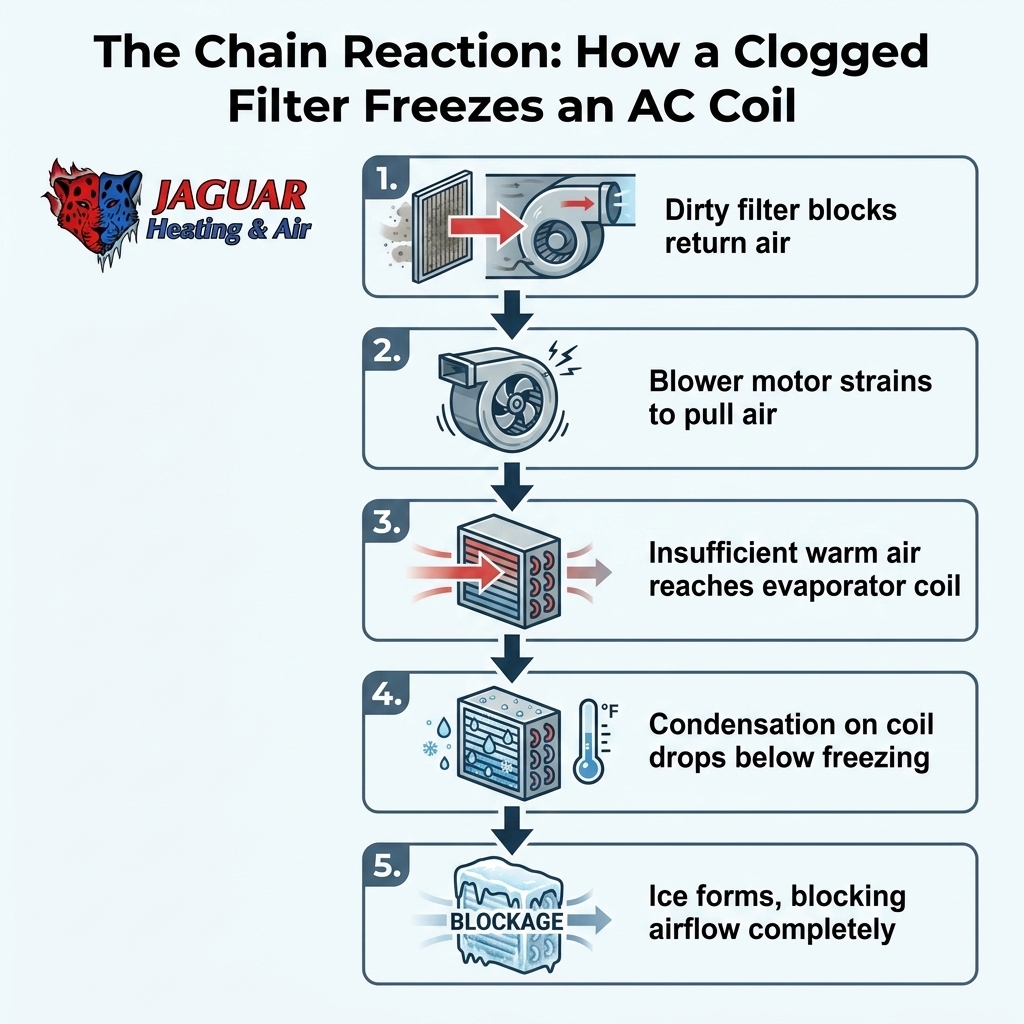
Here is the exact mechanical chain reaction that occurs when a filter is neglected:
1. The Physical Barrier Forms: Over months of operation, the filter traps pet dander, household dust, and airborne particles. The porous material slowly clogs, reducing the microscopic gaps that allow air to pass through.
2. The Blower Motor Overworks: As the barrier thickens, the blower motor has to work exponentially harder to pull the required volume of air. This excessive strain causes the motor to draw more electricity and run hotter than its design parameters allow.
3. System Overheating: Without enough air moving across the internal components to naturally cool them down, the blower motor can overheat. Modern systems have safety switches that will shut the unit down entirely if temperatures reach dangerous levels.
4. Cooling Volume Drops: Because the system cannot pull enough warm air in, it cannot push enough cold air out. The overall volume of conditioned air reaching your living spaces drops significantly, leaving distant rooms feeling stagnant and warm.
The Paradox of a Frozen AC Coil in Triple-Digit Heat
One of the most counterintuitive problems a homeowner can face is discovering a block of solid ice inside their cooling equipment while the outside temperature is scorching. This paradox happens deep inside the system at the evaporator coil, the component responsible for extracting heat from your indoor air.
The evaporator coil is filled with extremely cold refrigerant. Under normal conditions, warm, unconditioned air from your home blows across this coil. The refrigerant absorbs the heat, and the newly cooled air is pushed back into your rooms. The warm air blowing over the metal also keeps the coil's temperature regulated, preventing the natural condensation from freezing.
However, when a clogged filter chokes off the incoming air supply, that delicate balance is destroyed. Without enough warm air blowing over the metal, the temperature of the coil plummets. The condensation that naturally forms on the coil during operation drops below freezing.
This creates a dangerous snowball effect. A thin layer of ice forms on the coil, which further blocks the small gaps where air is supposed to flow. This reduces airflow even more, causing thicker ice to form. Eventually, the entire coil freezes solid. We see this severe issue regularly across the Sacramento suburbs; a frozen coil can cause liquid refrigerant to flow backward into the compressor, resulting in fatal system damage.
Cumulative Strain: Why Systems Fail at the End of the Season
Breakdowns rarely happen on the first hot day of the year. Instead, our service board spikes dramatically in late summer. This is due to the cumulative wear and tear of a system running near-continuously for months on end. A filter that was only slightly dirty in June becomes a nearly impenetrable wall by the time the late-summer August heat arrives.
During a grueling stretch of triple-digit heat right around the back-to-school transition, a local customer reached out to Jaguar Heating & Air because their house simply wasn't cooling down. Our technician explained the cumulative problem, laid out the options, and restored the system's capacity, bringing the house back to a comfortable temperature despite the extreme weather.
The Problem: The Central Valley is known for dry, dusty conditions. As summer progresses, the air fills with agricultural dust, pollen, and frequently, late-summer wildfire smoke. These fine particulates are pulled directly into your return vents.
The Cause: If the filter has not been swapped out, these environmental factors rapidly degrade its permeability. The system is forced to run longer cycles to achieve the same cooling results, meaning the blower motor and compressor are working overtime without adequate airflow.
The Solution: The system finally hits its breaking point when demand is at its absolute highest. By understanding this cumulative strain, homeowners can intervene before the mechanical components fail. Swapping the media proactively removes the bottleneck and restores the system's ability to breathe.
Recognizing the Warning Signs Before Total Breakdown
You do not have to wait for your system to freeze solid or shut down completely to know there is an airflow problem. The equipment will give you several warning signs that it is struggling. Catching these symptoms early is the key to avoiding major repairs across the Sacramento suburbs.
Scheduling routine AC maintenance is highly recommended, but you should also monitor your system's daily performance for these specific red flags:
• Short cycling: If your system turns on, runs for only a few minutes, and then abruptly shuts off before the house is cool, it is likely overheating. The internal safety switches are tripping to protect the motor from a restricted air supply.
• Weak vent airflow: Place your hand over the supply registers in your living room. If the air feels like a weak trickle rather than a strong breeze, the blower is failing to push adequate volume through the ductwork.
• Lukewarm air: If the air coming from the vents feels room-temperature instead of crisp and cold, the evaporator coil may be beginning to ice over, preventing proper heat transfer.
• Spiking energy bills: Replacing a clogged barrier with a clean one can lower an air conditioner's energy consumption by 5% to 15%. If your utility bills suddenly skyrocket compared to the same month last year, restricted airflow is a prime suspect.
We strongly encourage a visual inspection of your filter every 30 days during peak usage periods. Hold it up to a light source; if you cannot see light shining through the material, it is time for a replacement.
Frequently Asked Questions About HVAC Airflow and Filters
Does my AC use the furnace filter?
Yes, your air conditioner uses the exact same filter as your furnace. In a central HVAC system, both the heating and cooling components share a single blower motor and ductwork network. The blower pulls indoor air through the return vent, passing it through the filter before it reaches either the heat exchanger in winter or the evaporator coil in summer. Neglecting this component after winter directly impacts your summer cooling.
Can a dirty filter cause my AC to freeze up?
Absolutely. A severely clogged filter restricts the amount of warm indoor air flowing over the evaporator coil. Without that constant flow of warm air, the temperature of the coil drops rapidly, causing natural condensation to freeze into solid ice. This ice further blocks airflow, creating a dangerous cycle that can eventually damage the outdoor compressor.
Why is my AC running but not cooling in late summer?
When an AC runs continuously without lowering the indoor temperature during the late-summer August heat, it is usually starved for air. The system is mechanically functioning, but a blocked filter prevents it from pulling enough warm air in to cool and redistribute. This cumulative buildup of dust and particulate matter forces the system to run longer cycles with diminishing results.
What happens to my AC compressor if the filter is clogged?
A clogged filter can eventually lead to fatal compressor failure. If restricted airflow causes the indoor evaporator coil to freeze, the refrigerant inside the lines may not fully convert from a liquid to a gas. If liquid refrigerant flows backward down the lines and enters the outdoor compressor—a process known as liquid slugging—it can destroy the compressor's internal valves.
How often should I change my central air filter during peak summer?
During peak summer usage, you should inspect your filter every 30 days and replace it if it appears dark or completely coated in dust. Homes with multiple pets, high indoor dust, or exposure to late-summer wildfire smoke may need replacements as frequently as every three to four weeks to maintain optimal airflow and prevent system strain.
Take Control of Your Summer Comfort
The best defense against a sudden, late-season equipment breakdown is a clean, unobstructed air path. You have the power to protect your home's comfort simply by verifying that your system can breathe properly. Before you panic over a struggling unit, make checking the filter your immediate next step.
At Jaguar Heating & Air, we believe in empowering homeowners across the Sacramento suburbs with the knowledge to maintain their own equipment efficiently, saving you from unnecessary service visits. If you slide a fresh filter into place and your system still struggles to keep up with the heat, our professional diagnostic help is always available to restore your cooling capacity.
Recent Posts
HVAC Maintenance Guide: Comparing Heating Replacement Options Before Winter
Before winter hits, make sure your furnace can handle the cold. Compare your options with these objective heating options comparisons for homeowners.
HVAC Maintenance: Troubleshooting the Fall Heating Startup
Why does your furnace smell like burning on that first chilly morning? Use our home maintenance tips and troubleshooting to know when to call a pro this fall.
HVAC Maintenance: Home Maintenance Tips and Troubleshooting for Fall Heating Startup
Why some systems smell burning during fall startup, and how these home maintenance tips and troubleshooting steps help you decide when to call a professional.