.avif)
Why We Look at Duct Sizing When Your New AC Underperforms
A new HVAC unit won't guarantee comfort if connected to undersized 1980s ductwork. Discover why upgrading your equipment requires evaluating your home's hidden airflow infrastructure.
A new HVAC unit won't guarantee comfort if connected to undersized 1980s ductwork. Discover why upgrading your equipment requires evaluating your home's hidden airflow infrastructure.

The Myth of the 'Drop-In' Replacement: Why a New AC Doesn't Guarantee Comfort
It is a common misconception that a brand-new equipment upgrade will automatically cure all your home comfort issues, which is exactly why we look at duct sizing when your new AC underperforms. If you recently invested in a high-efficiency system only to experience weak airflow, hot spots, and uneven temperatures during the early fall transition, the frustration is entirely justified. You expect a modern system to deliver modern comfort. However, an air conditioner is only one half of the comfort equation. The unit itself generates the conditioned air, but your ductwork is the vital delivery system responsible for distributing it throughout your home.
Whether you are researching new Air Conditioning options or you need a diagnostic AC repair to figure out why your current unit is struggling, understanding the hidden infrastructure of your home is the first step. Homeowners eventually reach a critical decision point: continue troubleshooting the brand-new box outside, or evaluate the legacy ductwork inside. By examining the physics of airflow, it becomes clear why modern, high-efficiency equipment demands properly sized ducting to function correctly.
The Physics of Airflow: The 'New Engine, Old Highway' Analogy
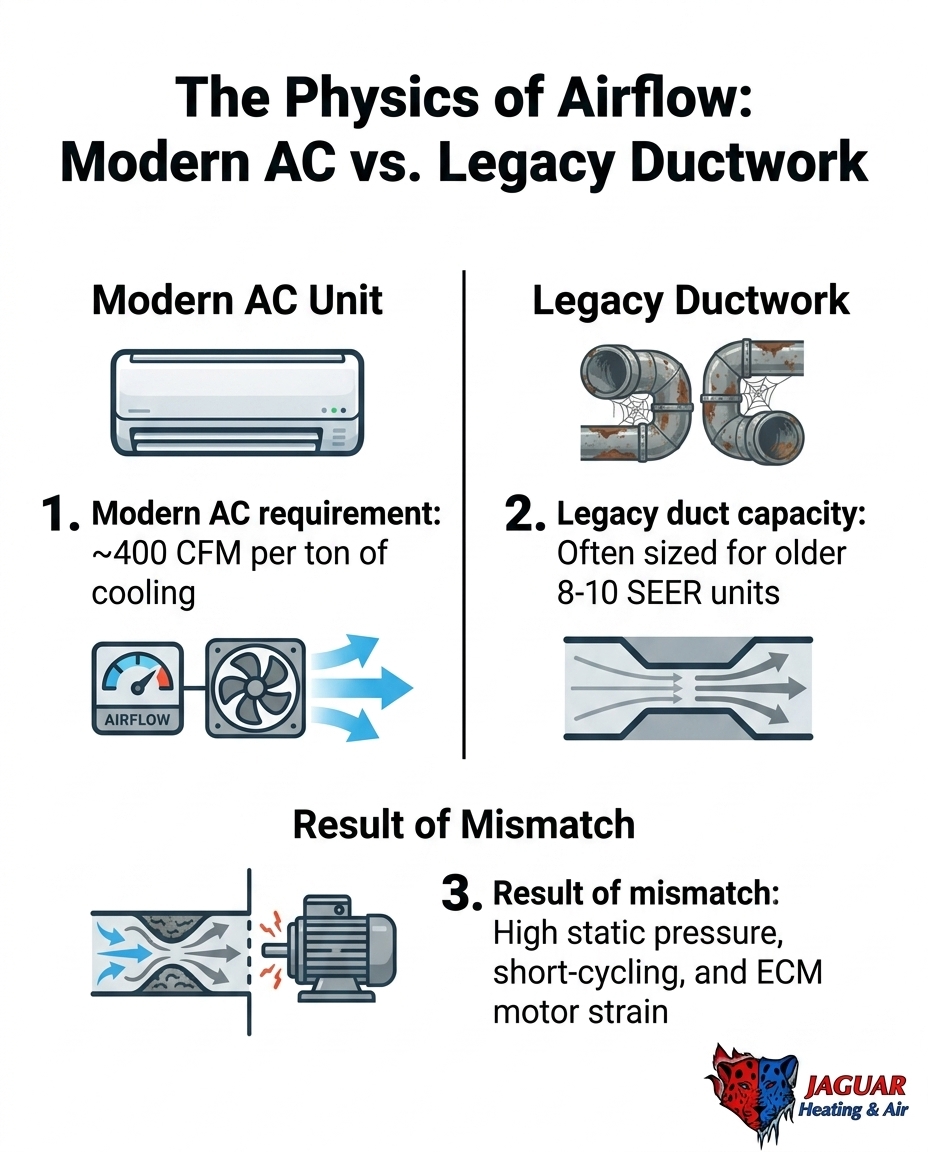
To understand why a new system might struggle in an older home, you have to look at the mechanical requirements of modern HVAC technology. Today's high-efficiency systems typically require moving about 400 CFM (Cubic Feet per Minute) of air per ton of cooling capacity. This is a massive volume of air compared to what older systems were designed to push. When you pair a modern, high-volume variable-speed blower with older, restrictive ductwork, you create a severe mechanical bottleneck.
Think of it like putting a high-performance sports car engine onto a winding, one-lane dirt highway. The engine has the power to go fast, but the road simply cannot accommodate the volume or speed of the traffic. In an HVAC system, forcing a high-volume blower to push air through a restricted space causes the system to choke, leading to poor performance, excess noise, and eventual breakdowns.
Understanding Static Pressure
In the HVAC industry, the resistance to airflow within a duct system is known as static pressure. You can think of static pressure as the HVAC equivalent of blood pressure. Just as high blood pressure forces your heart to work much harder to pump blood through restricted arteries, high static pressure forces your blower motor to work significantly harder to push air through restricted ducts. Older systems moved less air at lower velocities, which often masked these sizing issues. Modern systems, however, expose these hidden flaws immediately.
• Legacy (1980s-1990s) — Typical Efficiency: 8 - 10 SEER — Airflow Characteristics: Lower velocity, standard PSC motors — Ductwork Tolerance: Forgiving of undersized or restricted ducts
• Modern (Present Day) — Typical Efficiency: 16+ SEER2 — Airflow Characteristics: High volume (400 CFM/ton), variable ECM motors — Ductwork Tolerance: Highly sensitive; requires exact static pressure
Why Sacramento's Housing Stock Clashes with Modern HVAC Tech
This airflow mismatch is incredibly common due to regional architectural history. During the massive housing boom in the 1980s, Sacramento CA saw thousands of homes built with ducting systems designed specifically for the standard equipment of the era. Builders installed narrower ducts, smaller return chases, and tighter plenums because the 8-10 SEER air conditioners of the time simply did not require massive airflow to function.
Today, those exact same homes face extreme triple-digit summer heat that demands maximum cooling performance. When homeowners schedule a new AC installation, they naturally opt for modern 16+ SEER2 systems to combat the intense California heat efficiently. However, these modern units have significantly larger evaporator coils and much more powerful blowers. If you upgrade the outdoor equipment without assessing the physical dimensions of the indoor ductwork, you instantly create a severe bottleneck.
A proper, professional installation must evaluate the entire system as a complete breathing entity. Pushing massive volumes of cold air through original 1980s ductwork is physically impossible without increasing static pressure to dangerous levels. The ductwork must be evaluated, tested, and often modified to accommodate the high-performance standards of today's technology.
Symptoms of a Static Pressure Mismatch During the Transition Months
When a powerful new air conditioner battles undersized ducts, the system will actively tell you it is struggling. These symptoms become highly noticeable during the early fall transition in September, when systems battle fluctuating daily temperatures. As the outdoor weather swings from hot afternoons to cooler evenings, a restricted system cannot distribute conditioned air evenly, leading to distinct comfort issues.
One local homeowner experienced this exact situation during a stretch of triple-digit summer heat. Their house simply wasn't getting cool, despite the brand-new equipment running constantly. Once a technician arrived and explained the problem and options clearly—focusing on the airflow restriction rather than just the hardware—the underlying issue was identified, and the home finally achieved the expected comfort level.
If you suspect your new system is choking on old ductwork, look for these common warning signs your ducts need help:
• Rapid short-cycling: The system turns on, runs for a very short period, and shuts off rapidly because it cannot distribute the conditioned air fast enough, causing the internal safety sensors to trip.
• Poor humidity control: Because the system short-cycles, it does not run long enough to properly extract humidity from the indoor air, leaving the house feeling clammy and uncomfortable.
• Uneven temperatures: Rooms closest to the indoor blower might feel freezing cold, while bedrooms at the end of the duct run remain hot and stagnant due to a lack of air volume.
• Excessively loud operation: Auditory clues are a major red flag. If you hear loud, rushing air at the return vents or a high-pitched whistling sound at the supply registers, the blower is struggling against high static pressure.
These symptoms are almost always connected to the physical restriction of airflow, rather than a manufacturing defect in your brand-new equipment.
The Hidden Danger: How Restricted Airflow Damages Modern Equipment
Ignoring duct sizing does more than just make your living room uncomfortable; it actively destroys your new investment. Modern air conditioners utilize ECM (Electronically Commutated Motor) blowers. These are "smart" motors designed to adjust their speed to maintain a precise airflow target. When an ECM senses resistance from high static pressure, its programming tells it to ramp up and spin faster to overcome the blockage.
This creates immense mechanical strain. The motor works at maximum capacity constantly, drawing excess electricity and generating dangerous amounts of internal heat. Over time, this constant battle against restrictive ductwork causes premature wear and tear, significantly reducing the lifespan of a blower motor that should have lasted over a decade.
Furthermore, restricted airflow can cause catastrophic issues at the evaporator coil. An air conditioner cools your home by absorbing heat from the indoor air as it passes over the cold, refrigerant-filled coil. If undersized ducts prevent enough warm air from reaching the coil, the temperature of the coil drops below freezing. The natural condensation in the air then freezes directly onto the metal, turning the entire indoor unit into a solid block of ice. Operating a new system outside of the manufacturer's strict airflow specifications can even impact your warranty coverage, leaving you responsible for the resulting damages.
Honest Diagnostics: Looking Beyond the Box to Find the Root Cause
Solving these complex airflow issues requires a comprehensive diagnostic approach that looks beyond the metal box in your backyard. The national standard for residential duct design is known as ACCA Manual D. This rigorous standard dictates exactly how large ducts need to be, based on the friction rate of the materials and the specific CFM requirements of the equipment. A trustworthy diagnostic process relies on these mathematical standards, not guesswork.
Proper diagnostics involve measuring static pressure directly using specialized tools like a digital manometer. A licensed technician will insert small probes into the supply and return plenums to read the exact resistance the blower is fighting. This root-cause investigation focuses on finding the actual structural flaw—like undersized ducting—rather than just pushing for quick part replacements or blaming the new equipment.
During a routine inspection of three AC units for a local customer, a technician performed this exact type of detailed evaluation. By explaining the testing procedures, the specific airflow issues discovered, and the associated solutions clearly, the customer understood the true state of their system and felt no pressure to buy unnecessary hardware. Transparency in explaining these technical issues empowers homeowners to make informed decisions about their comfort.
Why Cleaning Isn't Always the Cure
Many homeowners assume that if airflow is weak, they simply need a professional duct cleaning. While removing built-up dust and debris is incredibly important for indoor air quality and system hygiene, it will not fix the physical dimensions of an undersized duct system. If a pipe is fundamentally too narrow to carry the required volume of air, scrubbing the inside of that pipe will not make it wider. Professional diagnostics easily differentiate between a temporary blockage of dust and a fundamental, structural sizing flaw.
Frequently Asked Questions About Duct Sizing and AC Performance
Can undersized ducts ruin an AC?
Yes, significantly undersized ducts can cause severe damage to a modern air conditioner. The restriction forces the blower motor to work overtime, leading to overheating and premature failure. Additionally, the lack of proper airflow can cause the evaporator coil to freeze solid, which can eventually damage the outdoor compressor.
How do I know if my ductwork is too small?
The most common signs include loud rushing or whistling noises at the vents, hot and cold spots throughout the house, and a system that short-cycles frequently. If your new unit runs constantly but the house never reaches the set temperature, airflow restriction is a highly likely culprit. A professional static pressure test is the only way to confirm this definitively.
Does a new AC require new ductwork?
Not always, but it does require a thorough ductwork evaluation prior to installation. If your existing ducts were sized correctly for a high-volume system and are in good condition, they can often be reused. However, if your home still has original ducting from decades ago, modifications or partial replacements are usually necessary to support modern equipment.
Why is airflow weak on my new air conditioner?
Weak airflow on a new unit usually indicates that the sophisticated variable-speed blower is fighting against high static pressure. The system is trying to push a massive volume of air through narrow, restrictive channels, causing the air velocity at the actual room vents to drop significantly. It can also be caused by crushed flex ducts or a restrictive, high-MERV air filter.
How is static pressure measured in a home HVAC system?
Static pressure is measured using a specialized diagnostic tool called a digital manometer. A licensed HVAC technician drills small, sealable test ports into the ductwork near the indoor unit and inserts pressure probes. The tool then provides an exact reading of the resistance in the system, which is compared against the manufacturer's maximum allowable limits.
What is ACCA Manual D and why does it matter for my home?
ACCA Manual D is the recognized national standard protocol for designing residential duct systems. It matters because it removes the guesswork from HVAC installations, using precise mathematical formulas to determine exactly how large your ducts need to be to deliver the right amount of air to every specific room in your house.
Stop Guessing and Start Measuring the Root Cause: Why We Look at Duct Sizing When Your New AC Underperforms
Ultimately, even the most expensive, top-of-the-line air conditioner cannot overcome the physical limitations of undersized ductwork. If you are dealing with hot spots, whistling vents, and a system that never seems to catch up, the problem likely isn't the equipment itself—it is the delivery system. Stop guessing at the symptoms and start measuring the root cause. We highly encourage homeowners to seek a professional evaluation that includes comprehensive static pressure testing. By addressing the infrastructure of your home, an honest AC repair diagnostic can finally explain why we look at duct sizing when your new AC underperforms, ensuring your system delivers the reliable comfort you actually paid for.
Recent Posts
Fall Home Maintenance Tips and Troubleshooting
Smelling burning dust during your first fall heating cycle? See what is normal versus a safety risk with our home maintenance tips and troubleshooting.

Navigating the October Heating Startup: A Guide to Fall HVAC Maintenance
Is your first fall heating startup causing strange odors? Rely on our local service expertise and area tips to know when to call a pro on this in Sacramento.

Why Your Furnace Smells Like Burning Dust: Essential HVAC Maintenance Questions Answered
Smelling burning dust this fall? Have common homeowner questions answered about your furnace. Decide with confidence on when to call a pro before winter.