.avif)
When Replacing Your HVAC Makes More Sense Than Another Patch Job
Unsure should i repair or replace my HVAC system? Discover the $5K rule, 50% rule, age thresholds, efficiency tips & Sacramento expert advice to decide wisely.
Unsure should i repair or replace my HVAC system? Discover the $5K rule, 50% rule, age thresholds, efficiency tips & Sacramento expert advice to decide wisely.

Is It Time to Stop Patching and Start Planning? Here's How to Decide
Should I repair or replace my hvac system is one of the most stressful decisions a homeowner can face — especially when your AC quits during a Sacramento summer or your furnace stops working on a cold January night.
Here's a quick answer to help you decide right now:
Repair your HVAC system if:
- The system is under 10 years old
- The repair cost is less than 50% of a new system's price
- You've had fewer than 2-3 breakdowns in the past 3 years
- No major components (compressor, heat exchanger, evaporator coil) have failed
Replace your HVAC system if:
- The system is 15+ years old (10+ years for heat pumps)
- Repair costs exceed 50% of a new system's price
- You've had 3 or more repairs in the past 3 years
- There's a cracked heat exchanger, compressor failure, or R-22 refrigerant leak
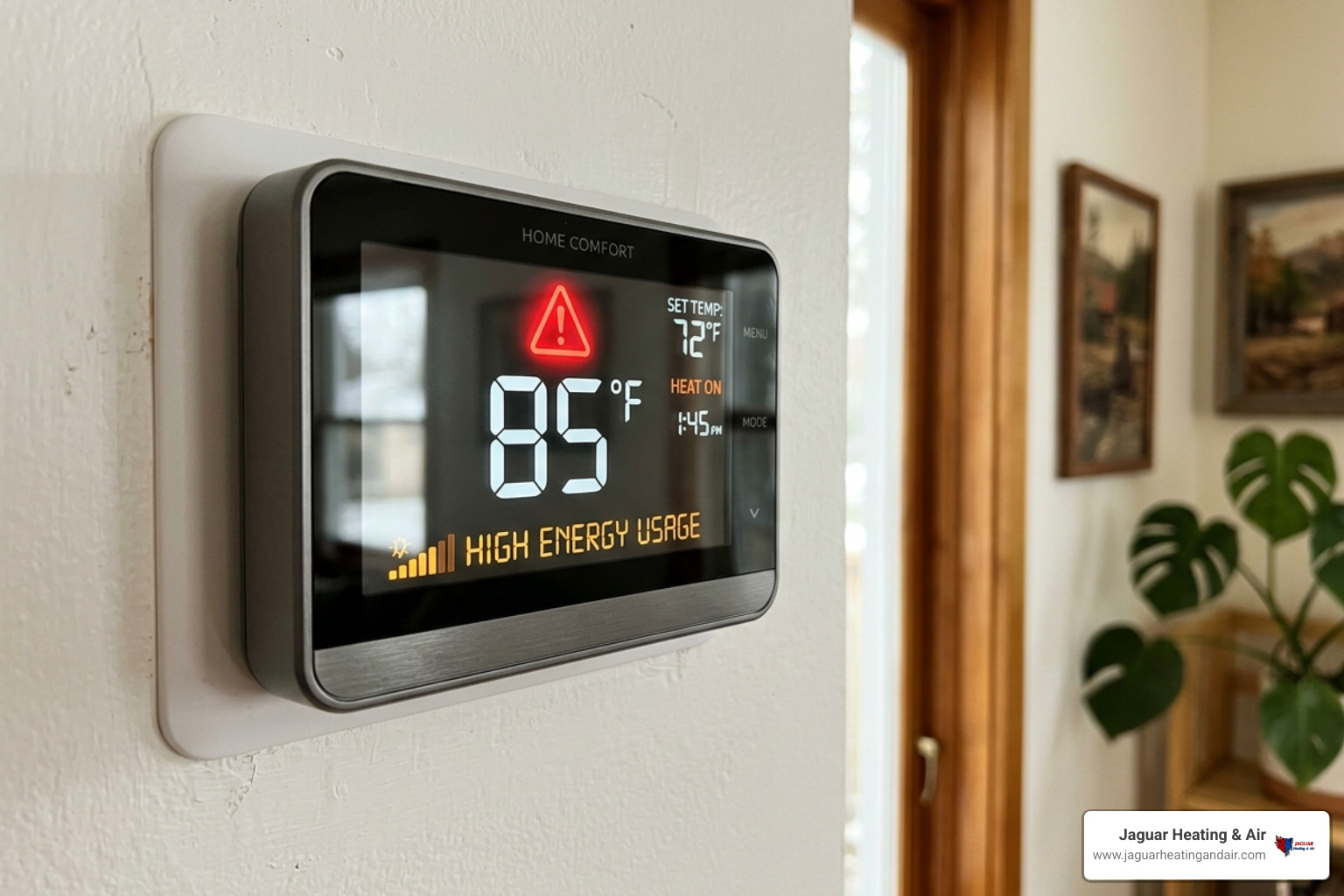
- Your energy bills keep climbing despite regular maintenance
Two rules make this decision much simpler:
- The 50% Rule — If the repair costs more than half of what a new system would cost, replacement is the smarter financial move.
- The $5,000 Rule — Multiply your system's age (in years) by the repair cost (in dollars). If the result is over $5,000, lean toward replacement.
For example: a 12-year-old system with a $500 repair = $6,000. That points toward replacement. A 5-year-old system with a $400 repair = $2,000. That's an easy repair.
These rules aren't perfect on their own, but together with your system's age, repair history, and efficiency ratings, they give you a clear starting point. The rest of this guide walks you through every factor in detail so you can make a confident, informed call.
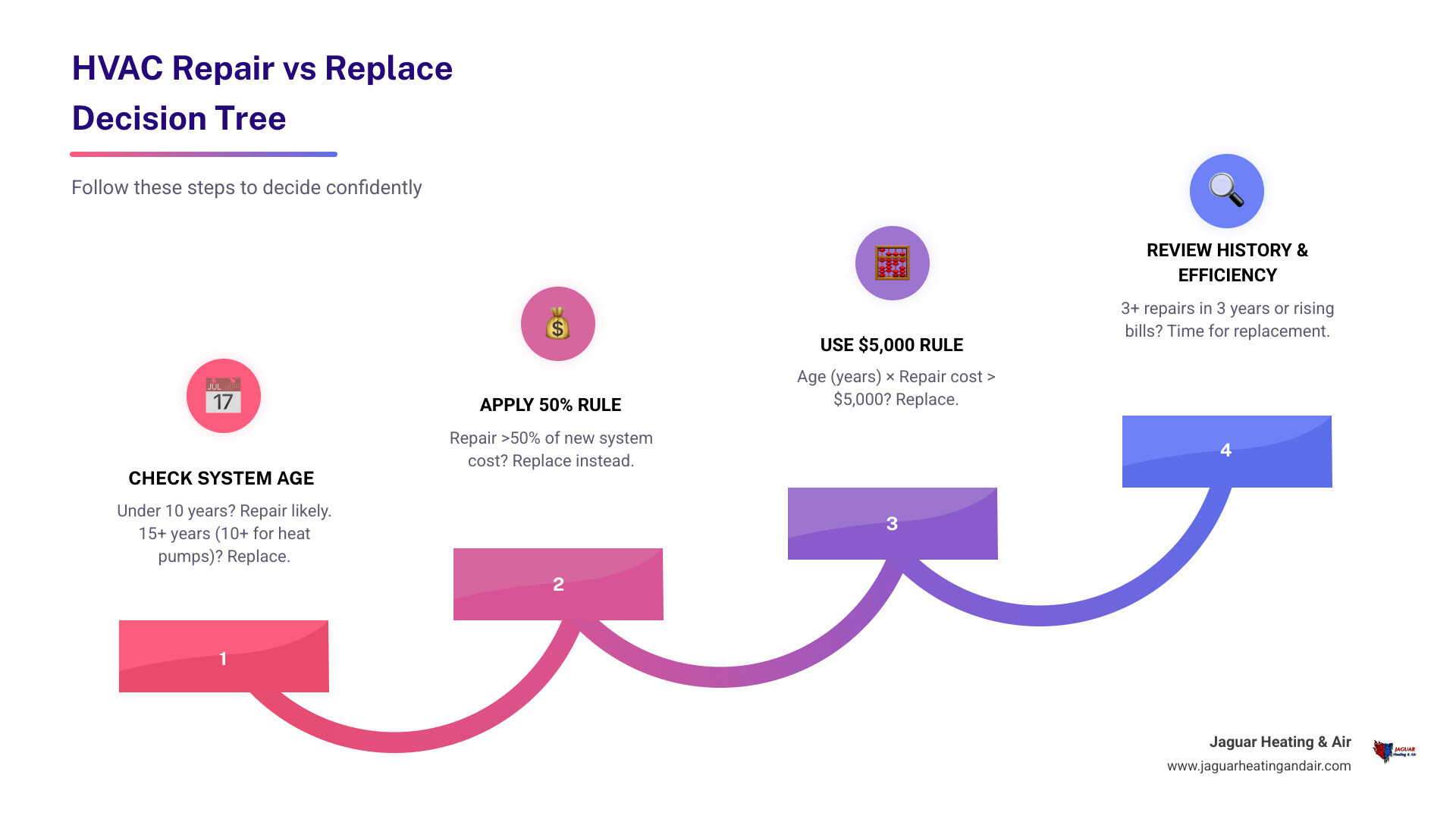
The Financial Formulas: Deciding Should I Repair or Replace My HVAC System?
When we visit homes in Sacramento or Elk Grove, the first thing homeowners ask is usually about the bottom line. We understand that HVAC systems are a significant investment, and no one wants to spend money prematurely. However, there comes a point where "just one more repair" becomes a financial sinkhole.
The $5,000 Rule
As mentioned in our intro, the $5,000 rule is a fantastic "gut check" for homeowners. It’s a simple mathematical formula that factors in the reality that older systems are more likely to break down again soon. If you have a 14-year-old furnace and the Heating Repair Sacramento CA quote is for a significant amount, multiplying 14 by that quote often pushes you well over the $5,000 threshold. In these cases, the math is telling you that the system’s remaining life isn't worth the investment.
The 50% Rule
This is a standard industry benchmark. If a single repair quote is more than 50% of the value of a brand-new system, we almost always recommend replacement. Why? Because a new system comes with a fresh 10-year parts warranty and significantly higher efficiency. Paying half the price of a new unit just to keep a 12-year-old unit limping along for another season or two rarely makes sense in the long run.
The "Repair Spiral"
Sometimes, it’s not one big repair that gets you; it’s the "death by a thousand cuts." We call this the repair spiral. If you’ve called us for three or more repairs in the last three years, your system is sending you a message. Often, when one major component starts to fail, it places extra stress on other aging parts. Replacing a blower motor today only to have the compressor fail three months later is a frustrating cycle that many of our customers in Folsom and Roseville have experienced before they finally decided to upgrade.
Comparing the Decision Rules
| Feature | The 50% Rule | The $5,000 Rule |
|---|---|---|
| Primary Focus | Repair cost vs. New system value | System age vs. Repair cost |
| Best For | Major component failures (Compressors/Coils) | General decision-making on aging units |
| When to Replace | Repair is >50% of new unit cost | Age x Repair Cost > 5,000 |
| When to Repair | Repair is <50% of new unit cost | Age x Repair Cost < 5,000 |
System Age and Component Lifespans
It is now April 2026, and HVAC technology has advanced significantly over the last decade. If your system was installed before 2011, it is officially a "senior citizen" in the HVAC world. Understanding the typical lifespan of your specific equipment helps set expectations.
- Furnaces: These are the marathon runners of the HVAC world, typically lasting 15 to 20 years. However, once they hit the 15-year mark, their efficiency often drops, and the risk of a cracked heat exchanger increases.
- Air Conditioners: In our hot Central Valley climate, AC units work hard. You can generally expect 15 to 20 years of service, though efficiency starts to take a nosedive after year 10.
- Heat Pumps: Because heat pumps provide both heating and cooling, they run year-round. This constant use means they typically have a slightly shorter lifespan of about 15 years.
If you are nearing these milestones, it might be time to look into AC Replacement West Sacramento CA before an emergency breakdown occurs.
Understanding When to Repair or Replace My HVAC System Based on Age
Age isn't just a number; it’s a direct indicator of the technology inside your cabinet.
- The 10-Year AC Threshold: ENERGY STAR recommends that homeowners start considering replacement for air conditioners once they pass the 10-year mark. By this age, the SEER (Seasonal Energy Efficiency Ratio) rating is likely much lower than modern standards, and the unit has likely lost about 1 point of SEER efficiency every few years due to wear and tear.
- The 15-Year Furnace Milestone: Once a furnace hits 15 years, it’s often more cost-effective to replace it with a high-efficiency model. Modern furnaces are 15% more efficient than conventional models from just a decade ago. If you’re dealing with a Furnace Beyond Repair Lincoln CA, the age of the unit is usually the deciding factor.
- 2026 Technology Standards: Today, we are seeing systems that integrate seamlessly with smart homes and utilize variable-speed blowers to maintain perfect humidity and temperature. A 15-year-old system simply cannot compete with the comfort levels provided by modern 2026 equipment.
Efficiency Metrics and Performance Red Flags
If you're asking yourself should i repair or replace my hvac system, your utility bill might already be giving you the answer.
SEER2, AFUE, and HSPF
These acronyms represent the efficiency of your system.
- SEER2 (Cooling): As of 2023, new standards require higher SEER2 ratings. Moving from an old SEER 10 unit to a modern SEER 16 or 18 unit can reduce your cooling electricity usage by 35% or more.
- AFUE (Heating): This measures how much fuel is converted into heat. Older furnaces might be 80% AFUE (meaning 20% of your money goes up the chimney), while new high-efficiency models reach up to 98%.
- HSPF (Heat Pump Heating): This measures the efficiency of heat pumps in heating mode. Higher numbers mean lower winter bills.
Performance Red Flags
Beyond the bills, your home’s comfort is a major indicator. Are you noticing:
- Uneven Temperatures? If the bedroom is a sauna while the living room is an icebox, your system may be struggling to move air or is improperly sized for your home’s current needs.
- Humidity Issues? A properly functioning AC should dehumidify your air. If your home feels "sticky," the system is failing.
- Noises and Smells? Grinding, squealing, or rattling sounds often point to mechanical failure. Persistent musty smells can indicate mold in the evaporator coil or ductwork issues.
If these red flags are popping up frequently, HVAC Installation Sacramento CA is often the more reliable path to comfort.
Evaluating Efficiency to Determine Should I Repair or Replace My HVAC System
One of the biggest "deal-breakers" for repairs in 2026 is the type of refrigerant your system uses.
- The R-22 Factor: If your system was built before 2010, it likely uses R-22 refrigerant (Freon). The EPA has phased this out because it depletes the ozone layer. Because it is no longer produced, the cost of "recharging" an old AC with R-22 has become astronomical. If you have an R-22 leak, we almost always recommend a full replacement to a modern R-410A or newer refrigerant system.
- Variable-Speed Technology: Older systems are either "on" or "off." Modern systems use variable-speed motors that ramp up and down slowly. This prevents the "blast" of cold or hot air and keeps the temperature within half a degree of your setting.
- Smart Home Integration: New systems communicate with your smartphone and can even alert us if they detect a problem before you notice a change in temperature. When you consider Need New AC Installation? Important Considerations, the jump in "life quality" from old tech to new tech is massive.
Critical Safety Issues and Major Component Failures
While efficiency and comfort are important, safety is non-negotiable. There are certain failures that make the should i repair or replace my hvac system decision for you.
Cracked Heat Exchangers
This is the most serious safety issue we encounter with furnaces. The heat exchanger is what separates the combustion gases (including carbon monoxide) from the air being blown into your home. If it cracks, carbon monoxide can leak into your living space. Because heat exchangers are incredibly expensive to replace and usually fail only on very old units, a crack almost always means it’s time for a new Heating Installation.
Compressor Burnout
The compressor is the "heart" of your air conditioner. If it fails on a unit that is out of warranty, the repair is very expensive. Furthermore, a compressor burnout often acidifies the refrigerant lines, meaning even if you replace the compressor, the new one might fail prematurely. On an older unit, a dead compressor is usually the final nail in the coffin.
Electrical Hazards
Frayed wiring, charred circuit boards, and frequent tripped breakers are signs of serious electrical strain. While some electrical components are easy to fix, systemic electrical issues in an old unit can pose a fire risk.
Maximizing Your Investment with Incentives and Maintenance
If you've decided that replacement is the way to go, there is good news. In 2026, there are more financial incentives than ever to help you upgrade to high-efficiency equipment.
- Inflation Reduction Act (IRA): This federal program provides significant tax credits for homeowners who install energy-efficient heat pumps and central AC systems. You could be eligible for a tax credit of 30%, up to $2,000 for heat pumps.
- Local Utility Rebates: Many utility providers in Sacramento, Roseville, and Rocklin offer instant rebates for switching to ENERGY STAR-certified equipment.
- NATE-Certified Expertise: When you do decide to replace, ensure the work is done by NATE-certified technicians. Proper installation is the single most important factor in how long your new system will last.
On the flip side, if your system is still in the "repair" zone, don't skip your AC Repair and annual maintenance. Regular tune-ups can extend the life of your system by years, delaying the need for a major capital expense. For those looking for The Best Ways to Find Affordable Heating Repair in Sacramento, preventative maintenance is actually the most affordable "repair" there is!
Frequently Asked Questions about HVAC Replacement
How do I know if my system is too old to fix?
While every system is different, the "danger zone" is typically 12 to 15 years for ACs and 18 to 20 years for furnaces. If your system is in this age range and requires a repair that costs more than a few hundred dollars, it’s likely too old to fix reliably. You have to ask: "Am I fixing this for the last time, or just the next time?"
Is it better to replace the whole system or just the broken part?
We almost always recommend replacing the full system (both the indoor and outdoor units). HVAC systems are designed to work as matched pairs. If you put a brand-new, high-efficiency outdoor AC unit with an old, dirty indoor evaporator coil, the system won't reach its rated efficiency, and the mismatched parts can lead to premature failure of the new component.
What are the signs of a failing compressor or motor?
Listen for loud screeching (often a bearing in the motor), hard starting (the unit struggles to kick on), or a loud "clunk" when the system shuts off. If you notice your lights flicker significantly when the AC turns on, that’s a sign the compressor is drawing too much "locked rotor amperage" and is likely near the end of its life.
Conclusion
Deciding whether to keep patching your old unit or invest in a new one isn't easy, but you don't have to do it alone. At Jaguar Heating & Air, we pride ourselves on being more than just technicians; we are your Sacramento HVAC experts and Trane Comfort Specialists. We serve families across Elk Grove, Folsom, Roseville, and the entire Sacramento region with a commitment to 100% customer satisfaction.
Whether you need a quick fix to get through the week or a comprehensive evaluation for a new system, we offer flat-rate pricing and same-day service to ensure your home remains a sanctuary. Don't wait for a total system failure to leave you stranded in the heat or cold. Explore our full range of Services today and let us help you find the most cost-effective, reliable path to total home comfort.
Recent Posts
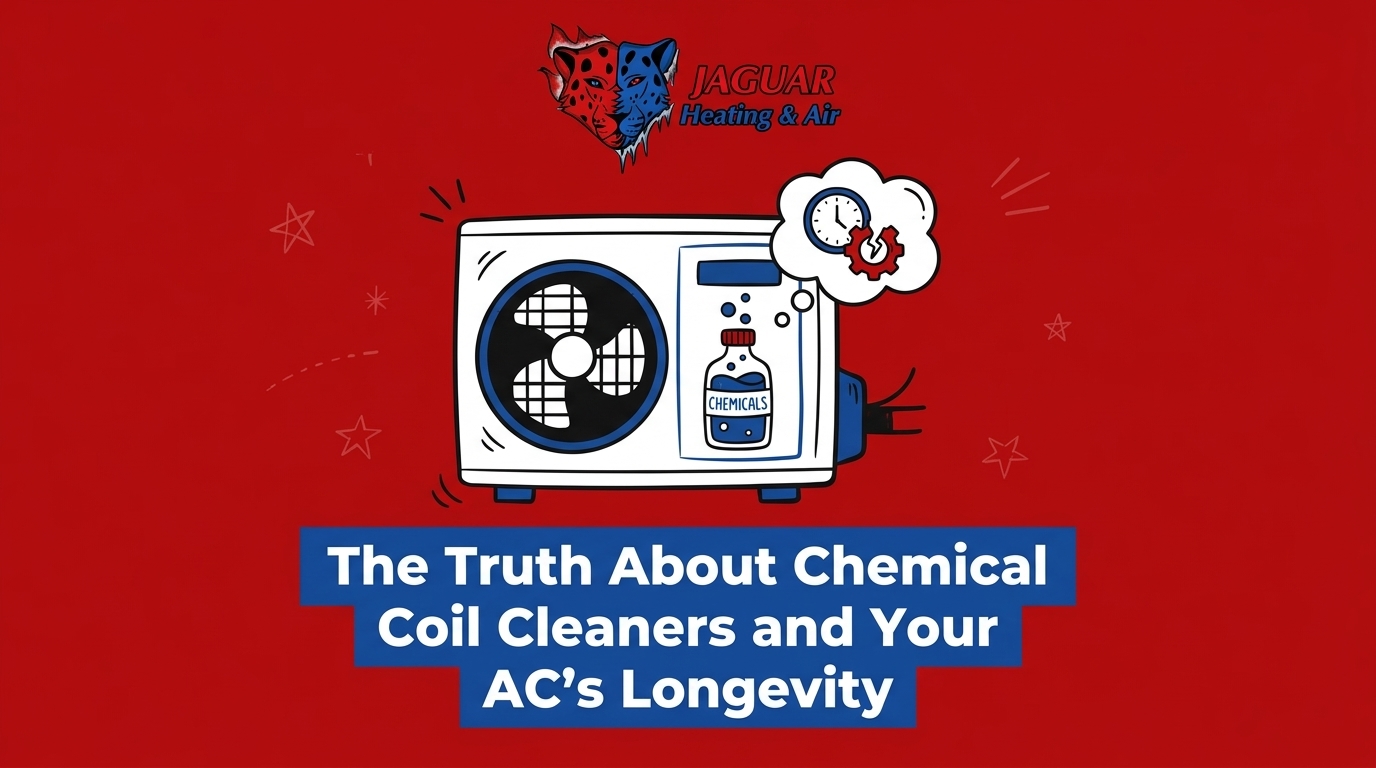
The Truth About Chemical Coil Cleaners and Your AC's Longevity
While a sparkling clean condenser unit looks great, acidic sprays might be secretly destroying your equipment. See why we refuse to use them during fall tune-ups.
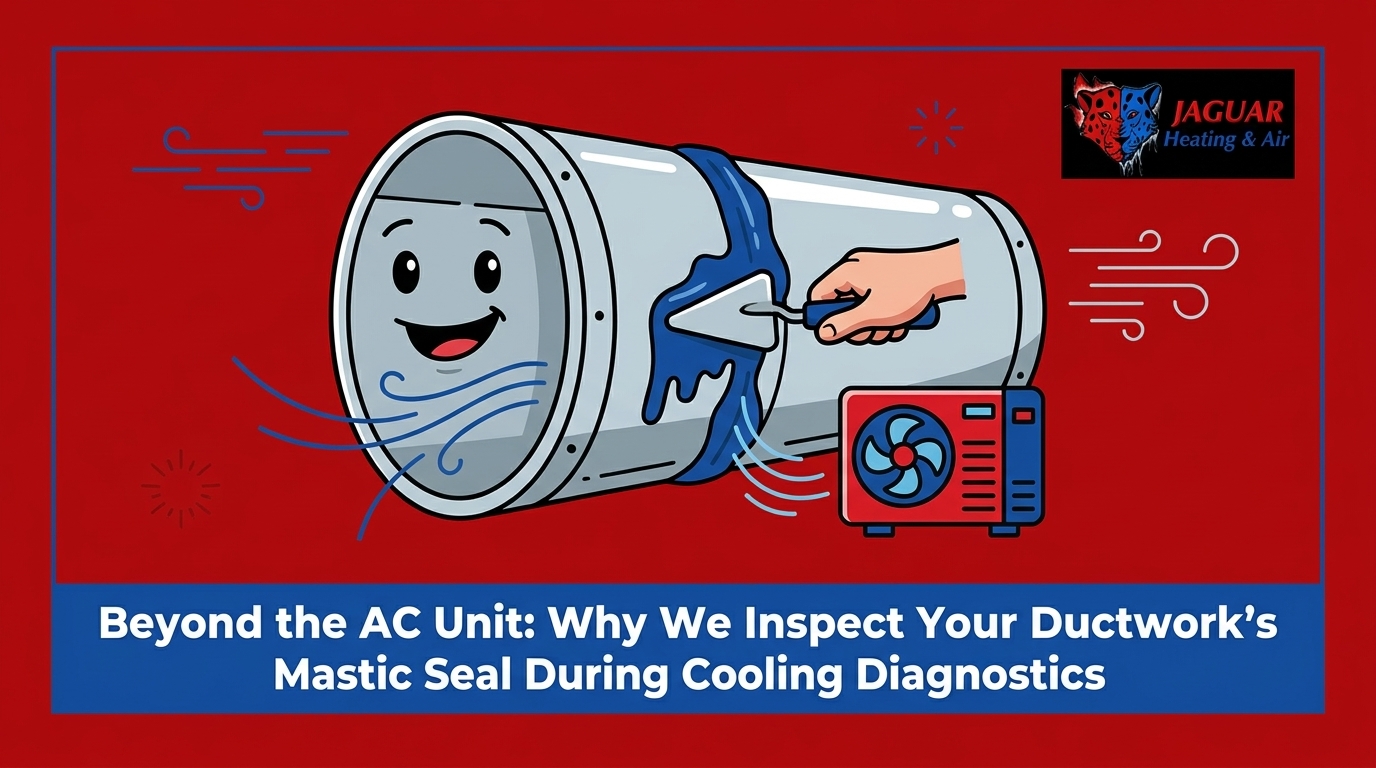
Why We Inspect Your Ductwork's Mastic Seal During Cooling Diagnostics
Before transitioning to fall heating, checking the 1990s-era mastic tape on your ductwork is crucial. Degraded attic seals waste expensive conditioned air long before your AC unit fails.
What a Rattling Outdoor Fan Blade Means for Your AC's Lifespan
A vibrating condenser fan creates micro-vibrations that act as a ticking time bomb for delicate copper lines. Find out why you shouldn't ignore this fall noise.