.avif)
Evaluating the Cost of Patching a Coil Leak vs. Replacing the Coil
A leaking evaporator coil during an August heatwave forces a tough decision. Weigh the long-term reliability of a temporary patch against a full coil replacement to restore your home's comfort.
A leaking evaporator coil during an August heatwave forces a tough decision. Weigh the long-term reliability of a temporary patch against a full coil replacement to restore your home's comfort.

Is Your AC Struggling? The Dilemma of a Leaking Evaporator Coil
Is your air conditioner running constantly, but the house still feels uncomfortably warm? Evaluating the cost of patching a coil leak vs. replacing the coil is a decision you never want to face during August late-summer heatwaves, but it is a common reality for many homeowners we serve at Jaguar Heating & Air. You walk past the thermostat and see the indoor temperature climbing while the outdoor unit works overtime. The diagnosis is often a leaking evaporator coil. Peak summer temperatures make a mid-season AC breakdown particularly urgent, forcing a tough choice when you need cooling restored immediately.
Do you opt for a quick patch to limp across the finish line of the season, or do you invest in a full replacement? In this guide, we evaluate "cost" not by upfront price tags, but by long-term reliability, energy efficiency, and peace of mind. If you are exploring your options for reliable air conditioning services, understanding the true impact of this repair is your best first step.
Why Evaporator Coils Leak Under High Heat
The evaporator coil sits inside your home, acting as the heat-absorbing sponge for your entire cooling system. Refrigerant flows through copper or aluminum tubing, pulling warmth and humidity out of the indoor air before sending it outside to be released. High temperatures put immense physical stress on these delicate components. Our technicians see this firsthand; during the intense heat of the Sacramento Valley, your system runs almost continuously to keep your living space comfortable.
The Physics of Thermal Stress
This continuous operation causes rapid thermal expansion and contraction. As warm air blows over the icy-cold refrigerant lines, the metal heats up and expands slightly. When the system cycles off, the metal cools and contracts. Over thousands of cycles, this constant thermal stress weakens the structural integrity of the coil. Micro-leaks eventually develop at the weakest points, which are usually located at the U-shaped bends, factory joints, or areas where different metals meet.
Just recently, as families were gearing up for the back-to-school transition, a local homeowner reached out to our team for 24-hour service when their air conditioner suddenly stopped blowing cold air. A Jaguar Heating & Air technician arrived on time, quickly checked the system for leaks using an electronic sniffer, and efficiently pinpointed a micro-fracture hidden deep inside the coil fins. Quick and efficient leak detection is the crucial first step before deciding on a repair path. Without knowing exactly where the leak is and how severe it has become, you cannot make an informed choice about your next steps.
The Role of Operating Pressure
Beyond temperature fluctuations, your air conditioner operates under significant pressure. Modern refrigerants flow through the evaporator coil at high pressures, constantly pushing against the inner walls of the tubing. When a micro-leak forms, this pressure forces the refrigerant out into the atmosphere. This is why a simple visual inspection rarely tells the whole story, and why you need our experts in professional AC repair to accurately diagnose the root cause of the pressure loss before discussing solutions.
The Short-Term Reality of Patching an AC Coil
When our technicians find a leak, the immediate question customers ask is whether it can simply be sealed. A coil patch usually involves applying an industrial epoxy to the exterior of the copper tubing or injecting a chemical sealant directly into the refrigerant lines. While this sounds like a straightforward fix, the reality of air conditioning physics paints a different picture.
Pros and Cons of Coil Patching
• The Appeal of Speed: Applying an epoxy patch or a sealant often seems like a faster, less invasive repair initially. It requires less disassembly of the indoor unit.
• The Drawback of Pressure: The major drawback is the physical stress of constant high-pressure operation. Refrigerant lines are highly pressurized environments. Epoxy applied to the outside of a pipe is constantly fighting against the pressure pushing from the inside.
• The Risk of Chemical Sealants: Injecting sealants into the system can sometimes cause more harm than good. These chemicals are designed to harden when they meet air, but if moisture is present in the lines, the sealant can harden inside the expansion valve or the compressor, causing catastrophic failure.
• The Inevitability of Degradation: Continuous operation to fight triple-digit heat places maximum pressure on temporary patches, accelerating their failure. Thermal expansion and contraction will eventually crack the rigid epoxy.
A patch is a temporary band-aid. During August late-summer heatwaves, your system rarely gets a break. The high risk of patch failure during continuous operation means you could find yourself with a completely empty refrigerant line and a dangerously hot house just days or weeks after the initial repair.
The Long-Term Reliability of Coil Replacement
Contrasting the temporary nature of a patch, installing a brand-new evaporator coil provides a permanent solution to the leak. A new coil restores your system to its factory-level energy efficiency and cooling capacity, ensuring that every ounce of refrigerant is utilized to cool your home rather than escaping into the atmosphere.
The Replacement Process
Replacing an evaporator coil is a comprehensive procedure that requires specialized tools and expertise. Our certified technicians will safely recover the remaining refrigerant from your system, cut out the old, failing coil, and braze a perfectly matched replacement into the ductwork. After welding the new connections, we pull a deep vacuum on the system to remove all non-condensable gases and moisture. Finally, the system is recharged with fresh refrigerant to the manufacturer's exact specifications.
Restoring Optimal Performance
During a recent stretch of late-summer triple-digit heat, a Sacramento Valley homeowner discovered their AC system was no longer cooling the house. A Jaguar Heating & Air technician arrived, diagnosed a severe coil leak, and thoroughly explained all available options. After opting for an AC replacement component, their house is now cooling effectively, and the system is running shorter cycles because it is operating at peak efficiency again.
Candidly prioritizing long-term homeowner comfort over quick, unreliable fixes is the hallmark of trustworthy service. Having our technicians explain these options clearly allows you to make informed decisions based on facts rather than panic. The ultimate benefit of a full replacement is the peace of mind that comes from knowing the system will not unexpectedly fail during the hottest weeks of the year.
Side-by-Side Comparison: Patching vs. Replacing
To help you weigh the long-term value of your options, here is a clear breakdown of how a temporary patch stacks up against a complete coil replacement.
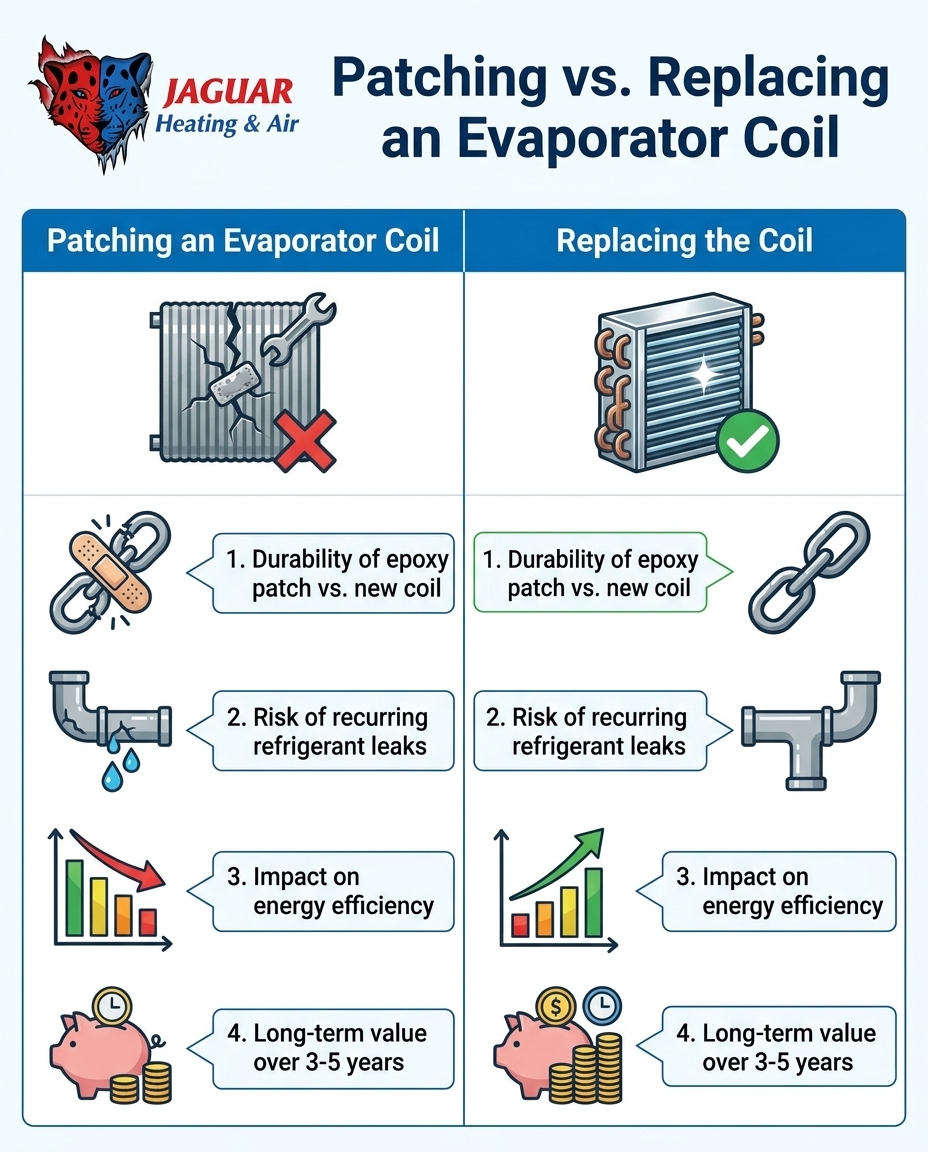
• Durability — Patching the Coil: Temporary band-aid highly susceptible to cracking under thermal stress. — Replacing the Coil: Long-term factory reliability designed to last the lifespan of the system.
• Energy Efficiency — Patching the Coil: High risk of recurring undercharged states, leading to increased energy usage. — Replacing the Coil: Restores optimal performance and factory SEER ratings.
• Repeat Service Calls — Patching the Coil: High likelihood of return visits to top-off refrigerant as the patch fails. — Replacing the Coil: One-and-done replacement with no lingering leak concerns.
• Overall Value — Patching the Coil: False economy; initial savings are erased by repeated breakdowns during August late-summer heatwaves. — Replacing the Coil: Sound financial choice over a 3-5 year horizon, protecting the compressor.
Hidden Drawbacks: Efficiency Drops and Refrigerant Issues
When a patched leak inevitably begins to fail, the consequences extend far beyond just a warm house. In our years of servicing Sacramento HVAC systems, we've seen the hidden cascade of mechanical failures that occur when an air conditioner operates with insufficient refrigerant.
The True Cost of Low Refrigerant
Air conditioning systems are completely sealed loops that require a very precise volume of refrigerant to function. When a system runs on low refrigerant—which happens gradually before a patch fails completely—it suffers significant drops in efficiency. The coil can actually drop below freezing temperatures. Condensation freezes onto the fins, turning the coil into a block of solid ice. This ice blocks airflow entirely, meaning the system runs non-stop without delivering any cold air to your vents.
Furthermore, this frozen state prevents the refrigerant from absorbing heat. Liquid refrigerant can then travel backward into the outdoor compressor. Compressors are designed to pump vapor, not liquid. This phenomenon, known as "liquid slugging," washes away the internal lubricants and causes the compressor to tear itself apart. A failing patch can quickly turn a coil issue into a total system failure.
Environmental Impact and Regulations
You must also consider the environmental impact and strict EPA regulations surrounding refrigerants. Older systems in the Sacramento Valley may still utilize R-22, a refrigerant that has been completely phased out of production due to environmental concerns. Recurring refrigerant top-offs for failing patches are highly impractical and heavily regulated. Even with modern R-410A refrigerants, intentionally topping off a known, recurring leak is poor practice. Connecting the importance of clean, intact coils to overall system health is vital. If you are researching washing your AC coils to maintain efficiency, you already understand that a compromised, leaking coil entirely defeats the purpose of routine upkeep.
Protecting Your Investment: When to Choose Which Option
Making the final decision requires looking at the broader context of your HVAC system. A transparent approach—warning homeowners about the false economy of quick fixes—is a commitment we make for your long-term comfort.
Evaluating the Cost of Patching a Coil Leak vs. Replacing the Coil: The Verdict
At Jaguar Heating & Air, we rarely recommend patching for primary cooling systems under heavy load. The sheer physical stress of August late-summer heatwaves makes temporary sealants a gamble you are likely to lose. Replacement is almost always the financially sound choice when factoring in the high probability of repeat service calls, the steep drop in energy efficiency, and the risk of catastrophic compressor damage.
When deciding, consider the following factors:
• System Age: If your air conditioner is under ten years old, replacing the coil is an excellent investment that extends the life of a healthy condenser. Energy-efficient upgrades may also qualify for general utility rebates or tax credits, so be sure to check with your local utility provider.
• Warranty Status: Check if your equipment is still under a manufacturer's parts warranty. A replacement coil might be covered, making the decision incredibly straightforward.
• Refrigerant Type: If your system uses obsolete R-22 refrigerant, replacing the coil (or the entire system) is necessary, as patching and refilling is no longer a viable long-term strategy.
To catch minor wear before it turns into a major leak, our team strongly recommends scheduling routine AC maintenance. Preventative care ensures your system is operating at the correct pressures, reducing the strain that causes coils to fail in the first place.
Frequently Asked Questions About AC Coil Leaks
Can an AC evaporator coil be patched?
Yes, technically an evaporator coil can be patched using chemical sealants or external epoxy. However, we find it is highly vulnerable to failure under the high pressures of the refrigerant lines. The constant thermal expansion and contraction during operation usually cause these patches to crack, making them a temporary band-aid rather than a permanent fix.
Is it worth replacing an AC coil?
In our experience, yes, it is almost always worth replacing an AC coil, especially if the rest of the system is in good condition. A new coil restores factory energy efficiency and completely prevents future refrigerant loss from that component. It protects the outdoor compressor from the severe damage caused by running on low refrigerant.
How long does a patched AC coil last?
The lifespan of a patched coil varies wildly, but under heavy summer usage, a patch can fail rapidly. The extreme thermal expansion caused by continuous operation can break an epoxy seal in a matter of weeks or months. It is rarely a reliable solution for a system that runs frequently.
Why do AC coils leak?
AC coils leak due to a combination of corrosion, vibration, and constant thermal stress. As the metal heats up and cools down over thousands of cycles, it weakens. Additionally, volatile organic compounds (VOCs) inside the home can interact with condensation on the coil, creating formicary corrosion that eats microscopic holes through the copper tubing.
Does a leaking coil mean I need a whole new AC unit?
Not necessarily; if the outdoor condenser is healthy, relatively young, and uses modern refrigerant, replacing just the indoor coil is often sufficient. However, if your system is over 10-15 years old, uses phased-out R-22 refrigerant, or has suffered compressor damage, upgrading the entire system is the more practical choice.
Secure Your Home's Cooling Reliability Today
Making the right choice now prevents catastrophic mid-season breakdowns when you need cooling the most. An expert evaluation from our team will provide you with clear, long-term solutions tailored to the specific age and condition of your equipment. Do not let a temporary band-aid put your entire HVAC system at risk. Schedule a professional assessment with Jaguar Heating & Air today to weigh your options, and gain the peace of mind that comes from a permanent repair. Ultimately, evaluating the cost of patching a coil leak vs. replacing the coil comes down to choosing a clear, objective solution that ensures your home stays reliably comfortable for years to come.
Recent Posts
Fall Home Maintenance Tips and Troubleshooting
Smelling burning dust during your first fall heating cycle? See what is normal versus a safety risk with our home maintenance tips and troubleshooting.

Navigating the October Heating Startup: A Guide to Fall HVAC Maintenance
Is your first fall heating startup causing strange odors? Rely on our local service expertise and area tips to know when to call a pro on this in Sacramento.

Why Your Furnace Smells Like Burning Dust: Essential HVAC Maintenance Questions Answered
Smelling burning dust this fall? Have common homeowner questions answered about your furnace. Decide with confidence on when to call a pro before winter.