.avif)
How Shade Trees Near Your Condenser Can Actually Restrict Airflow
Shading your outdoor AC unit feels like smart energy logic during late summer. But dense vegetation actually acts like a blanket, trapping hot exhaust air and forcing your system to overwork.
Shading your outdoor AC unit feels like smart energy logic during late summer. But dense vegetation actually acts like a blanket, trapping hot exhaust air and forcing your system to overwork.

Why the Popular 'Shade Your AC' Advice Might Be Costing You
Planting a thick, leafy canopy over your outdoor cooling equipment feels like practical energy-saving logic, but understanding how shade trees near your condenser can actually restrict airflow is a hard truth many homeowners learn the expensive way. The common misconception is simple: if keeping the sun off your windows keeps your house cooler, casting shade over your outdoor unit must improve its efficiency. Unfortunately, this well-intentioned advice often backfires. Homeowners end up letting shade trees and thick shrubs overgrow their outdoor condenser, inadvertently trapping hot exhaust air right where it needs to escape.
This creates a concrete problem for residents in older, established areas like Sacramento tree-lined neighborhoods. The dense vegetation acts like a suffocating blanket around the equipment. Eventually, you face a tough decision point: prioritizing exhaust airflow over direct sun protection by aggressively trimming back your beloved shade trees, or letting the system slowly cook itself to death. If you want to ensure your air conditioning system operates efficiently without unnecessary strain, clearing that airspace is step one. Proper system maintenance and strategic landscaping are required to undo the strain caused by restricted airflow before permanent damage occurs.
The Myth of the Shaded Condenser
The logic behind the shaded condenser myth is easy to understand. On a blazing afternoon in August late-summer heat, humans feel significantly cooler standing under a mature oak tree than standing on bare asphalt. Naturally, we assume the air conditioning unit must operate better in the shade, too. This leads many people to intentionally plant fast-growing shrubs, build trellises, or allow low-hanging tree branches to completely engulf their outdoor equipment.
There is also a strong psychological barrier at play. In historic or beautifully landscaped Sacramento tree-lined neighborhoods, homeowners understandably do not want to trim or remove beautiful, established vegetation. A large metal box isn't exactly the focal point you want in your garden, so hiding it behind a wall of greenery feels like a landscaping win.
However, the hard truth is that the minor benefit of keeping direct sunlight off the metal cabinet is completely negated if the unit cannot breathe. Jaguar Heating & Air provides honest, expert advice that protects homeowners from common myths, prioritizing system longevity over aesthetic landscaping. Prioritizing a hidden unit over a high-functioning unit inevitably leads to premature equipment failure and frustrating breakdowns.
Aesthetics vs. System Efficiency
When you place aesthetics above basic mechanical needs, dense foliage creates an artificial barrier around your cooling system. Your outdoor unit is essentially an exhaust pipe for your home's heat. When you build a beautiful wall of leaves around it, you block that exhaust. The trade-off between a completely hidden unit and a high-functioning unit is steep. You might not have to look at the metal cabinet, but you will certainly feel the consequences when the system struggles to keep your living room comfortable.
The Physics of Heat Transfer: Why Airflow Trumps Shade
To understand why bushes and branches are so detrimental to your system, you have to look at the physics of how your equipment actually works. Air conditioners do not "create" cold air out of nothing. Instead, they operate on the principle of heat transfer. They absorb heat from the air inside your home and physically move it to the outside air.
The outdoor unit, known as the condenser, houses a massive fan designed to rapidly push hot exhaust air upward and away from the system. When low-hanging branches or thick bushes surround the unit, they act like a heavy blanket. Instead of blowing away into the atmosphere, the hot exhaust air hits the vegetation, bounces back, and gets sucked right back into the unit's intake vents. During intense August late-summer heat, recycling artificially heated air causes heat transfer efficiency to plummet and electrical draw to spike dramatically.
How Your Condenser Actually Works
The cooling process relies heavily on the compressor and the refrigerant cycle. Warm refrigerant gas travels from your indoor coil out to the condenser. The compressor pressurizes this gas, making it extremely hot. As the gas flows through the outdoor coils, the massive fan pulls cooler ambient air across those coils to extract the heat, turning the refrigerant back into a cold liquid. Rapid heat dissipation is the single most critical part of this entire cooling process. If the heat cannot dissipate into the surrounding air, the refrigerant stays hot, and your house stays warm.
The Danger of Recycled Exhaust
When trapped hot air cannot escape, it raises the ambient temperature immediately surrounding the unit. If it is 95 degrees outside, but your unit is trapped in a bubble of its own 120-degree exhaust, the compressor has to fight against its own expelled heat. This resulting strain forces the compressor to run hotter and longer, breaking down internal lubricants and accelerating mechanical wear in Sacramento tree-lined neighborhoods where overgrown foliage is common.
The Threat of Late-Summer Microclimates
By the time late summer arrives, trees, bushes, and vines have reached their maximum seasonal growth. That small shrub you planted in April can easily turn into a dense wall of leaves by August, severely encroaching on your unit's critical airspace. This unchecked growth creates a dangerous, high-temperature microclimate right exactly where your equipment needs cool, fresh air the most.
Sacramento experiences intense triple-digit summer heat, making optimal AC airflow and heat exhaust critical. When those August heatwaves hit, units are already operating at their maximum capacity. Adding trapped exhaust heat to that equation is disastrous. The compounding wear leaves the system highly susceptible to overheating, electrical shorts, and sudden breakdowns just when you need relief the most.
One local homeowner reached out when their house simply wasn't getting cool during a recent bout of triple-digit heat. Our technician arrived quickly, explained the problem and the available options—which included addressing severe airflow restrictions—and fixed the system so their home could finally cool down. Clear communication from an expert helps identify this hidden airflow issue before it causes a total compressor failure. Addressing the microclimate around your condenser during the peak of August late-summer heat is essential for uninterrupted comfort.
Recognizing the Symptoms of a Suffocating AC Unit
Most homeowners don't realize their landscaping is suffocating their cooling system until the damage is already done. However, your equipment will usually give you warning signs that it is struggling to breathe. If you live in one of the many beautiful Sacramento tree-lined neighborhoods, keep a close eye out for these specific symptoms of restricted airflow.
1. Longer, continuous cooling cycles: If your system runs for hours on end without ever reaching the temperature set on your thermostat, it is struggling to transfer heat effectively.
2. Spikes in monthly energy bills: A suffocating unit draws significantly more electrical power to compensate for poor heat transfer. If your utility bill jumps unexpectedly during the summer, poor airflow is a prime suspect.
3. Excessive heat radiating from the cabinet: Carefully place your hand near (but not inside) the outdoor unit. If the metal cabinet feels excessively hot to the touch, or if the surrounding air feels like an oven, the exhaust is trapped.
4. Unusually loud fan noises: When the fan motor has to fight against high pressure and dense air pockets, it often sounds louder, whinier, or more strained than usual.
When these symptoms appear, professional intervention is necessary to assess the damage and restore proper function. Ignoring the signs will only lead to a burnt-out compressor. If you notice your system exhibiting these warning signs, looking into professional AC repair services is the safest way to evaluate the mechanical toll the restricted airflow has taken.
Clearance Rules: Giving Your Equipment Room to Breathe
To prevent your system from suffocating in the August late-summer heat, you must follow strict clearance guidelines. The Department of Energy (DOE) and all major equipment manufacturers have established specific measurements to ensure optimal heat dissipation. These rules dictate exactly how much empty space must exist around the metal cabinet.
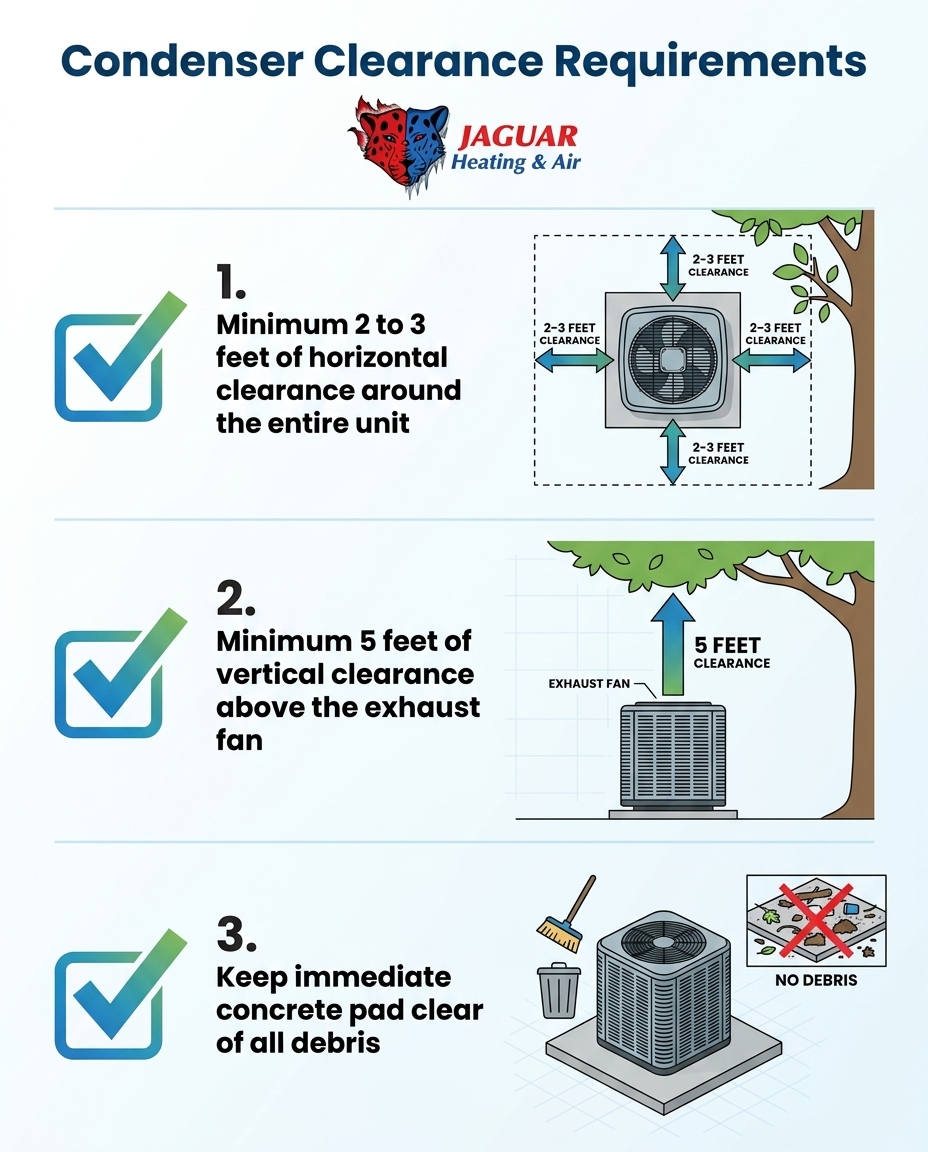
The standard guideline requires a minimum of 2 to 3 feet of horizontal clearance around the entire perimeter of the unit. This means no bushes, no tall grass, no fencing, and no low walls within a 36-inch radius. Even more importantly, there is a critical need for at least 5 feet of vertical clearance directly above the unit. The exhaust fan pushes hot air straight up; if a tree branch hangs 3 feet above the fan, the hot air hits the branch and mushrooms back down over the equipment.
These measurements are non-negotiable for optimal efficiency and warranty compliance. If a compressor fails and the manufacturer determines it was suffocated by vegetation, they may void the warranty entirely. Understanding exactly how much space is required helps homeowners make informed landscaping decisions in Sacramento tree-lined neighborhoods. For a deeper dive into these measurements, you can read more about how much clearance your outdoor AC unit actually needs.
Horizontal vs. Vertical Clearance
Both horizontal and vertical clearances serve different, but equally vital, functions for your system's health. Here is a breakdown of why each zone matters:
• Horizontal (Sides) — Minimum Distance: 2 to 3 Feet — Why It Matters: Protects the intake fins and allows fresh ambient air to enter the system freely. — Risk if Ignored: Clogged coils, dirt buildup, and restricted intake air causing high internal pressure.
• Vertical (Above) — Minimum Distance: 5 Feet (Minimum) — Why It Matters: Vital for the exhaust plume to carry intense heat up and away from the property. — Risk if Ignored: Hot exhaust air bounces off branches, recycling back into the unit and overheating the compressor.
Balancing Beautiful Landscaping with System Efficiency
You do not have to choose between a barren yard and a functional cooling system. It is entirely possible to maintain a beautiful landscape while keeping your equipment safe from the August late-summer heat. The key is strategic planning and consistent yard maintenance.
Another local customer recently reached out needing their air conditioner checked for leaks. They appreciated our 24-hour service availability, noting that our technician was on time, quick, and efficient. During visits like these, we often find that the "leak" or performance drop is actually tied to overgrown vegetation restricting the unit's ability to function.
To strike the perfect balance between landscaping and efficiency, follow this maintenance checklist:
• Commit to aggressive late-summer pruning: Schedule time in July and August to aggressively trim back any vegetation near the condenser that has experienced explosive summer growth.
• Keep the concrete pad clear: Regularly sweep the area immediately surrounding the equipment pad. Clear away fallen leaves, twigs, grass clippings, and dense ground cover that can get sucked into the condenser fins.
• Choose the right plants: If you are planting new shrubs, choose varieties that do not shed heavily. Avoid flowering bushes that drop petals, and always plant them well outside the 3-foot horizontal clearance zone.
• Clean the exterior gently: Sometimes, simply clearing overgrown debris and thoroughly cleaning the exterior of the unit with a gentle stream of water can restore efficiency and prevent the need for costly replacements.
Protect Your Investment with Professional Guidance
Prioritizing proper airflow and clearance over aesthetic shade will undeniably extend the lifespan of your cooling equipment. While planting trees in Sacramento tree-lined neighborhoods offers wonderful shade for your actual home, your outdoor condenser requires wide-open spaces to breathe. Reiterating the physics of heat transfer empowers you to make better maintenance decisions—knowing that trapped exhaust air is far more damaging than direct sunlight.
We highly encourage readers to schedule routine check-ups to ensure their system hasn't suffered premature wear from past airflow restrictions. A technician can measure the electrical draw of your compressor to see if it has been working too hard. To keep your equipment running smoothly and to verify your clearance zones are adequate, explore comprehensive professional AC maintenance. By understanding how shade trees near your condenser can actually restrict airflow, you can take proactive steps to protect your investment and enjoy reliable comfort all season long.
Recent Posts
Fall Home Maintenance Tips and Troubleshooting
Smelling burning dust during your first fall heating cycle? See what is normal versus a safety risk with our home maintenance tips and troubleshooting.

Navigating the October Heating Startup: A Guide to Fall HVAC Maintenance
Is your first fall heating startup causing strange odors? Rely on our local service expertise and area tips to know when to call a pro on this in Sacramento.

Why Your Furnace Smells Like Burning Dust: Essential HVAC Maintenance Questions Answered
Smelling burning dust this fall? Have common homeowner questions answered about your furnace. Decide with confidence on when to call a pro before winter.