.avif)
The Risk of Running Your AC with Mismatched Indoor and Outdoor Units
House flippers often replace the outdoor AC but leave the old indoor coil hidden away. Understand why this mismatch destroys efficiency and threatens your new condenser.
House flippers often replace the outdoor AC but leave the old indoor coil hidden away. Understand why this mismatch destroys efficiency and threatens your new condenser.

The Hidden Danger in Your 'New' Flipped House AC
You just moved into a beautifully updated home, complete with a shiny new condenser sitting in the side yard, but you are quickly discovering the risk of running your AC with mismatched indoor and outdoor units. The house looks perfect on the surface—fresh paint, new floors, and modern fixtures. However, as the afternoon sun beats down, the indoor air feels clammy, the vents are barely pushing out cool air, and the system seems to run for hours without ever reaching the temperature set on the thermostat. This is a classic symptom of the flipped house trap.
We see this specific pattern constantly across Sacramento neighborhoods with high volumes of recently flipped homes. To maximize curb appeal and list the property with a "new AC," real estate investors will often replace the highly visible outdoor unit while quietly leaving the old, incompatible indoor evaporator coil hidden away in the attic or utility closet to save money. On paper, you have a brand-new air conditioner. In reality, you have two halves of different machines trying to work together, fighting against each other with every cooling cycle. As you settle into the home and the early fall transition approaches, you are faced with a critical decision: proactively address this hidden mismatch, or risk severe damage to the only new part of the system.
For more information on keeping your home comfortable, learn about our comprehensive Air Conditioning services.
What Makes an HVAC System 'Mismatched'?
To understand why this flipped house shortcut is so destructive, you have to look at how an air conditioning system actually works. Your central AC is not a single appliance that generates cold air; it is a split system designed to move heat from inside your house to the outside. This requires two primary components working in perfect harmony: the indoor evaporator coil (which absorbs heat and humidity from your indoor air) and the outdoor condenser (which compresses the refrigerant and releases that heat into the outdoor air).
These two halves are meticulously engineered by manufacturers to operate as a matched set. They must share the exact same refrigerant type, operate at corresponding pressures, and have matching physical capacities to balance the flow of heat. A mismatch occurs anytime the outdoor unit and the indoor unit are not certified by the manufacturer to work together.
The most dangerous and frequent mismatch we encounter is a newer R-410A outdoor condenser paired with an older R-22 rated indoor coil. R-410A refrigerant operates at significantly higher pressures than the older R-22 standard. When a new condenser tries to push high-pressure R-410A through an old coil designed for lower pressures, the entire system chokes. The metering device cannot properly regulate the flow, the heat transfer breaks down, and the advertised SEER (Seasonal Energy Efficiency Ratio) rating on the side of your new outdoor unit becomes completely meaningless.
Matched vs. Mismatched Systems
• Refrigerant Pressure — Properly Matched System: Balanced and regulated perfectly between units. — Mismatched System (New Condenser, Old Coil): Severe pressure bottlenecks; high risk of coil leaks.
• Energy Efficiency — Properly Matched System: Achieves the advertised SEER rating on the sticker. — Mismatched System (New Condenser, Old Coil): Plummets dramatically; consumes excess electricity.
• Moisture Removal — Properly Matched System: Effectively dehumidifies the indoor air. — Mismatched System (New Condenser, Old Coil): Poor humidity control; leaves the home feeling sticky.
• Lifespan — Properly Matched System: Standard 10 to 15-year operational life. — Mismatched System (New Condenser, Old Coil): Often fails within the first few years of operation.
If you suspect your system components do not match, it is highly recommended to look into professional AC Installation options to correct the imbalance before irreversible damage occurs.
Top 4 Risks of Running Incompatible HVAC Components
Operating a split system with incompatible parts is not just a minor inefficiency—it is a mechanical disaster waiting to happen. The components are simply not speaking the same language, and the resulting strain affects every part of the cooling cycle. A typical pattern we see often involves homes where a mismatched system finally fails after months of hidden strain. For example, during a recent spring replacement project, a local homeowner realized they needed to replace both the outdoor unit and the indoor unit after a mismatch caused severe compressor damage. The technicians replaced the units on time and worked quietly to get a properly matched system running right.
Here are the four primary risks of leaving an old coil attached to a new condenser:
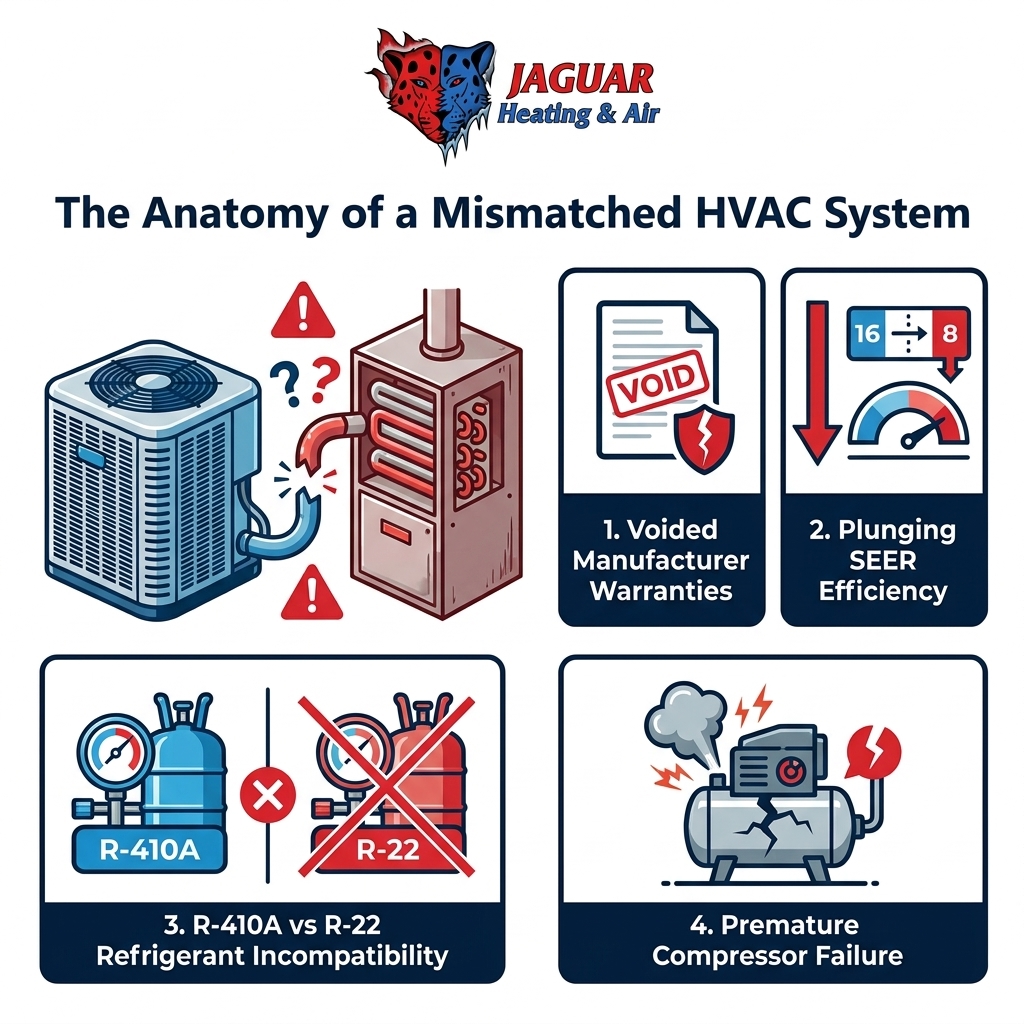
1. Voided Manufacturer Warranties: Major HVAC manufacturers are very clear in their documentation. If an outdoor unit is installed without a matching, AHRI-certified indoor coil, the equipment warranty is immediately voided. If the compressor fails because it was choked by an old coil, the manufacturer will not cover the replacement cost.
2. Plunging Efficiency and High Bills: An air conditioner is only as efficient as its weakest link. You could have a premium 18-SEER outdoor unit, but if it is connected to a 20-year-old, 10-SEER indoor coil, the system will perform at or below the 10-SEER level. The new condenser will run continuously trying to hit the target temperature, causing your monthly utility bills to skyrocket.
3. Refrigerant Incompatibility and Leaks: As mentioned earlier, mixing older R-22 components with new R-410A systems introduces massive pressure differentials. Furthermore, the oils used in these two refrigerants are entirely different. Mineral oil (used with R-22) and synthetic POE oil (used with R-410A) do not mix. If the old coil was not meticulously flushed—which is almost impossible to do perfectly—the mixed oils will turn into a thick sludge that clogs the system.
4. Premature Compressor Failure: The compressor is the heart of your outdoor unit and the most expensive part to replace. If the indoor coil is too small or inefficient to boil off all the liquid refrigerant into a gas, liquid refrigerant can travel back down the suction line into the compressor. Compressors are designed to pump gas, not liquid. This liquid slugging will quickly destroy the compressor valves, requiring expensive AC Repair or a total system replacement.
Why Sacramento's Climate Accelerates System Failure
While a mismatched system might limp along for a few years in a mild coastal climate, the specific weather patterns in our region act as a brutal stress test for HVAC equipment. Sacramento's intense, triple-digit summer heat requires HVAC systems to operate at absolute peak efficiency. When the outside temperature hits 105 degrees, the temperature differential between the hot outdoor air and your desired 72-degree indoor air is massive. Your system has to work incredibly hard to bridge that gap.
The Impact of Continuous Operation
Under these extreme conditions, mismatched indoor and outdoor units will struggle to remove heat and humidity effectively. Because the old indoor coil cannot absorb heat fast enough to satisfy the thermostat, the new outdoor condenser is forced to run continuously. It never gets a chance to cycle off and cool down. This relentless runtime not only leads to astronomical energy bills but also bakes the internal components of the outdoor unit. The fan motor, the capacitor, and the compressor are all pushed far beyond their intended duty cycles.
Surviving the Summer, Failing in the Fall
Often, a mismatched system will technically survive the peak summer heat, but the damage is already done. The internal wear and tear accumulate rapidly. As the weather begins to shift, the weakened compressor is left hanging by a thread. This regional climate stress is exactly why proper HVAC Installation in Sacramento requires precise load calculations and matched equipment. Cutting corners on the indoor coil might save a house flipper a few dollars upfront, but the extreme summer heat guarantees the new homeowner will pay the price shortly after moving in.
Spotting the Mismatch During Your Early Fall Tune-Up
Because these mismatched systems often run continuously through the summer just to keep the house somewhat bearable, the hidden damage usually reveals itself as the seasons begin to change. Performance drops become glaringly obvious during late-summer and early-fall operation. You might notice that even on a mild 80-degree September afternoon, the system is still struggling to dehumidify the house, leaving the air feeling heavy and stagnant.
September and early fall pre-heating season tune-ups are the exact times our technicians uncover these flipped house traps. Homeowners call for a routine seasonal check before winter, only to discover that their "new" air conditioner is actually a Frankenstein system on the brink of failure.
Signs your system might be mismatched:
• Unusual operational noises: Gurgling or hissing from the indoor unit, or a loud, harsh rattling from the outdoor compressor.
• Weak or warm airflow: The vents blow air, but it lacks the crisp, cold bite of a properly functioning AC.
• Excessive indoor humidity: The house feels sticky, and condensation may form on windows or near vents.
• Unexpectedly high utility bills: Your electricity usage remains stubbornly high despite having a "new" energy-efficient condenser outside.
If you recently purchased a flipped home and experience any of these symptoms, it is absolutely vital to have the indoor coil inspected immediately. Catching the mismatch during an early fall tune-up allows you to address the coil replacement before the heating season begins, protecting your investment from total failure.
The Value of Comprehensive System Assessments
The core issue with the flipped house AC trap is a fundamental lack of proper HVAC engineering. House flippers often engage in "box-swapping"—simply looking at the size of the old outdoor unit and dropping a new box of the same size in its place without ever evaluating the rest of the home. Jaguar Heating & Air emphasizes honest, comprehensive system assessments and proper load calculations over quick-fix replacements, protecting homeowners from the costly mismatched system trap.
Why Proper Load Calculations Matter
A true comprehensive assessment goes far beyond just reading the label on the old condenser. It involves a detailed load calculation (often called a Manual J calculation) that measures the home's square footage, window placement, insulation levels, and ductwork condition. This ensures that the system capacity perfectly matches the home's actual cooling and heating demands.
Ensuring AHRI Certification
Furthermore, a professional assessment guarantees that any new equipment installed is an AHRI-matched set. The Air-Conditioning, Heating, and Refrigeration Institute (AHRI) tests and certifies specific combinations of indoor and outdoor units to verify they achieve their stated efficiency ratings. Having an AHRI reference number is also frequently required if you plan to apply for general energy rebates or tax credits for high-efficiency upgrades. A thorough evaluation protects you from investing in equipment that is doomed to fail, and gives you a clear roadmap if you are deciding between a single-stage and variable-speed AC to replace the mismatched components.
Frequently Asked Questions About AC Component Matching
Can you replace just the outside AC unit?
The short answer is that while it is technically possible, it is highly discouraged. Replacing just the outside unit is only safe if your existing indoor coil is an exact, AHRI-certified match for the brand-new outdoor condenser. Because technology and refrigerant standards change rapidly, an older indoor coil will almost never match a modern outdoor unit, leading to severe performance issues and voided warranties.
What happens if indoor and outdoor AC units are different sizes?
If the indoor and outdoor units have different capacities, the system will constantly fight itself. A larger outdoor unit paired with a smaller indoor coil will cause the evaporator coil to freeze over, leading to short-cycling, poor humidity control, and severe strain on the compressor. Conversely, a larger indoor coil with a smaller outdoor unit will struggle to remove heat effectively, causing the system to run nonstop.
Do both AC units need to be replaced at the same time?
Yes, replacing both the indoor coil and the outdoor condenser at the same time is the only way to ensure optimal efficiency and longevity. Installing them as a matched set guarantees proper refrigerant compatibility, balanced system pressures, and a valid manufacturer warranty. It is the most cost-effective decision over the lifespan of the equipment.
Can you mix and match AC brands?
Mixing different brands of indoor and outdoor equipment is a major risk. Different manufacturers use proprietary communication protocols, specific metering devices, and unique coil designs. Mixing brands often results in incompatible capacities, poor energy efficiency, and immediately voided warranties, as the manufacturers cannot guarantee the units will operate safely together.
How can I tell if my system is an AHRI matched set?
The easiest way to verify compatibility is to have a licensed HVAC professional look up the exact model numbers of both your indoor coil and outdoor condenser. They can cross-reference these numbers in the official AHRI directory to confirm if the combination has been tested and certified to work together efficiently.
Protect Your Home Before the Heating Season Begins
Ignoring a mismatched HVAC system is a gamble that homeowners rarely win. The extreme strain placed on the new outdoor unit by an old, incompatible indoor coil will inevitably lead to plunging efficiency, skyrocketing utility bills, and eventual compressor failure. If you suspect your recently purchased home is hiding a flipped house AC trap, the time to act is now, before the weather shifts entirely and the heating season places new demands on your equipment.
Having your entire system thoroughly evaluated during the early fall transition gives you the clear, expert explanation you need to make an informed choice. By understanding the mechanics of SEER ratings and refrigerant compatibility, you can take the logical next steps to correct the issue. Schedule a comprehensive assessment today to ensure your home remains comfortable, efficient, and protected all year long.
Recent Posts
Fall Home Maintenance Tips and Troubleshooting
Smelling burning dust during your first fall heating cycle? See what is normal versus a safety risk with our home maintenance tips and troubleshooting.

Navigating the October Heating Startup: A Guide to Fall HVAC Maintenance
Is your first fall heating startup causing strange odors? Rely on our local service expertise and area tips to know when to call a pro on this in Sacramento.

Why Your Furnace Smells Like Burning Dust: Essential HVAC Maintenance Questions Answered
Smelling burning dust this fall? Have common homeowner questions answered about your furnace. Decide with confidence on when to call a pro before winter.