
Managing Indoor Dryness in Late Fall: Why Whole-House Humidifiers Outperform Portable Units
Tired of refilling room humidifiers? When managing indoor dryness in late fall, a whole-house system provides superior comfort. Compare your options today.
Tired of refilling room humidifiers? When managing indoor dryness in late fall, a whole-house system provides superior comfort. Compare your options today.

The Hidden Impact of the Heating Season on Your Home's Air
The transition into the November late-fall heating season brings welcome relief from the summer heat, but it also introduces an invisible challenge inside your home. In our years of preparing Sacramento homes for winter, our team at Jaguar Heating & Air frequently sees how managing indoor dryness in late fall becomes a frustrating daily battle the moment the thermostat switches from cooling to heating. You might notice the shift when you wake up with a scratchy throat, or when static electricity starts snapping every time you touch a doorknob. These are the early warning signs that your indoor environment is rapidly losing its essential moisture.
True home comfort requires much more than just hitting a target temperature on a thermostat. When you turn on your central heating system to combat the chill, you are immediately altering the delicate balance of your indoor air quality. The process of heating air naturally strips ambient moisture from your living spaces, leaving the environment parched. Rather than waiting for cracked skin and warped floorboards to force your hand, taking a proactive approach to your indoor air quality solutions ensures your home remains a comfortable sanctuary all winter long.
Many homeowners mistakenly believe that dry air is simply an unavoidable part of the colder months. However, the severe drop in humidity you experience indoors is a mechanical problem created by your HVAC system, not just a weather phenomenon. Understanding exactly how your furnace interacts with the air in your home is the first step toward reclaiming your comfort and protecting your property from the hidden impacts of severe moisture loss.
Why Running Your Furnace Creates a Severe Moisture Deficit
To understand why your house feels like a desert by late November, you have to look at the mechanical relationship between your central heating system and the air circulating through your ductwork. When the chilly weather arrives in the Sacramento / Central Valley region, our technicians routinely see the same pattern: your furnace begins drawing in cold air, heating it over a heat exchanger, and pushing it back into your living spaces.
The problem: Cold air naturally holds very little moisture. When your furnace heats that cold air, the air expands. Because the volume of the air increases but no new moisture is added during the heating process, the relative humidity plummets.
The cause: This constant cycle of pulling in air, heating it, and redistributing it acts almost like a giant sponge, absorbing whatever residual moisture is left in your home's air, furniture, and even your skin. The specific transition into consistent central heating during dry Valley winters exacerbates this moisture deficit rapidly. Without intervention, a continuously heated home can easily see its relative humidity drop below 20%. To put that in perspective, the average humidity in the Sahara Desert is around 25%.
The solution: The Environmental Protection Agency (EPA) strongly recommends maintaining indoor humidity levels between 30% and 50% for optimal human health and structural safety. Because the moisture deficit is being actively created and distributed by your central ductwork, it affects every single room simultaneously. Treating this requires a whole-home approach rather than localized band-aids. If your system is struggling to maintain a comfortable environment, scheduling a professional heating service can help ensure your equipment is operating efficiently, but you will still need a dedicated strategy to replace the missing moisture your furnace naturally removes.
The Hidden Frustrations and Limitations of Portable Humidifiers
When the November late-fall heating season kicks in and the dry air becomes unbearable, the most common instinct is to rush out and purchase a portable room humidifier. While these standalone units seem like a quick, inexpensive fix for a dry bedroom, the reality of living with them quickly turns into an exhausting series of daily chores.
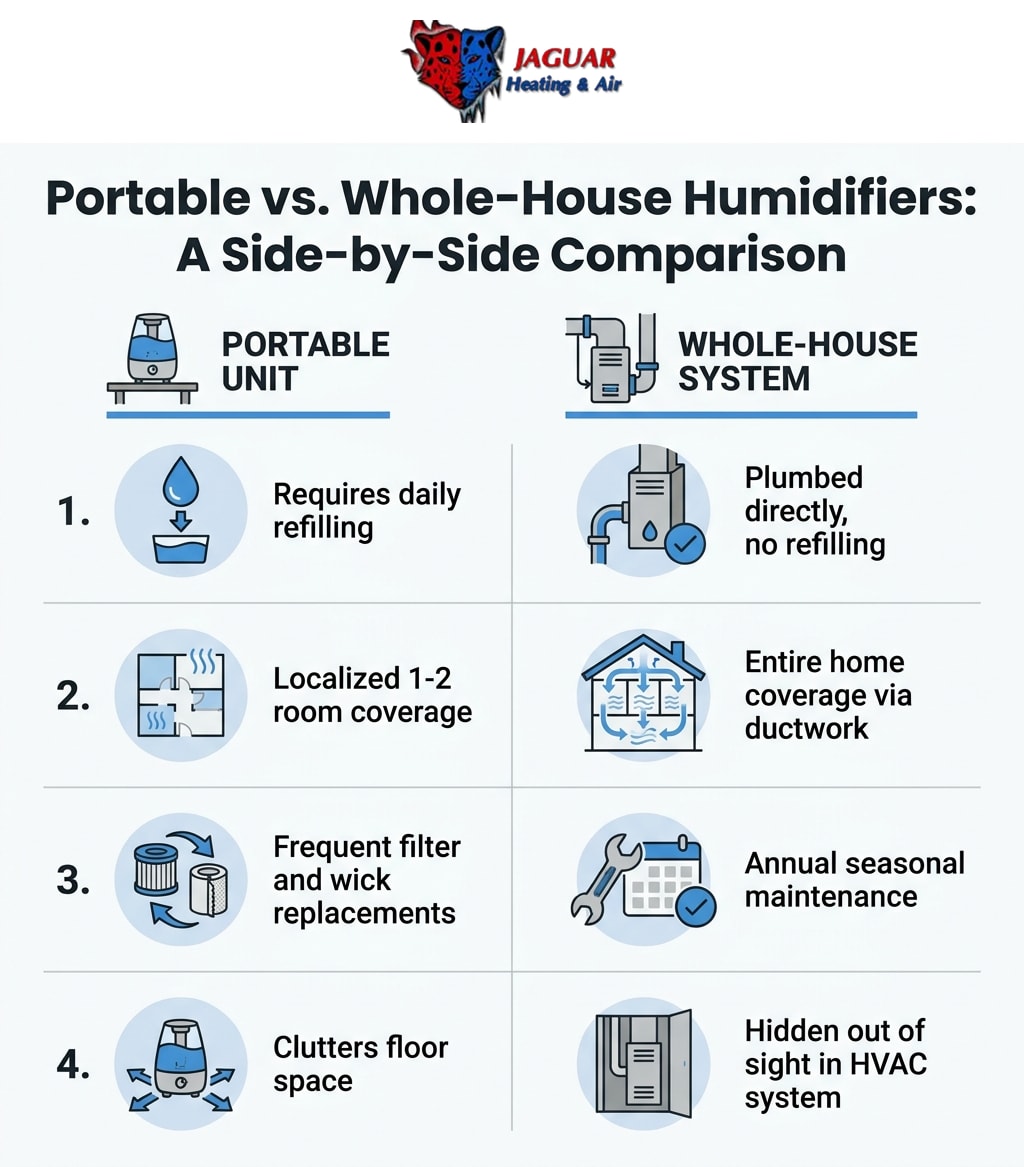
The hidden frustrations of relying on portable humidifiers include:
• The endless refilling cycle: Most portable units hold only a gallon or two of water. On a cold day when your furnace is running constantly, a single room humidifier will run dry in a matter of hours, forcing you to lug heavy, dripping water tanks from the sink to the bedroom multiple times a day.
• Constant cleaning and sanitizing: Stagnant water in a warm room is a breeding ground for mold, mildew, and bacteria. Portable humidifiers require rigorous, frequent cleaning with vinegar or bleach solutions to prevent them from actively spraying harmful microbes into your breathing air.
• Ongoing replacement costs: The hidden cost of portable units lies in the consumables. Evaporative models require specialized wicks and filters that must be replaced every few weeks, turning a one-time purchase into a recurring seasonal subscription.
• Severe coverage limitations: A portable humidifier is physically incapable of overcoming the moisture deficit created by a central HVAC system. While it might slightly raise the humidity within a few feet of the machine, the moment you open the bedroom door, your central heating system will push that dry air right back in, neutralizing the humidifier's efforts.
Attempting to properly humidify an entire house using portable units means buying, placing, powering, and maintaining half a dozen separate machines scattered across your floor plan. It is a highly inefficient, labor-intensive approach to a problem that originates at the central system level.
How Whole-House Humidification Transforms Indoor Comfort
The definitive answer to the seasonal moisture deficit is a whole-house humidifier. Unlike portable units that try to fight the dry air after it has already entered the room, a whole-house system tackles the problem at the source. These sophisticated units are installed directly into your existing HVAC ductwork and connected straight to your home's plumbing system.
When your furnace activates to warm the Sacramento / Central Valley air, the whole-house humidifier introduces a precise amount of water vapor into the heated air before it ever reaches your living spaces. The result is a seamless, invisible blanket of comfortable, perfectly balanced air delivered through every vent in your home simultaneously.
One of the greatest advantages of this approach is the true set-and-forget convenience. Because the system draws water directly from your plumbing, there are no tanks to carry or refill. A built-in humidistat constantly monitors the moisture levels in your home and automatically adjusts the output to maintain that ideal 30% to 50% range. You never have to guess if the air is too dry or too damp; the system handles the calculations for you.
At Jaguar Heating & Air, our comprehensive approach to home health is built on years of hands-on experience. We've found that true comfort involves managing indoor air quality at the system level, not just adjusting the temperature. Integrating a humidifier into your central ductwork requires specialized knowledge of airflow dynamics, plumbing connections, and electrical relays. Because our installation crews have seen firsthand how improper setup can lead to ductwork damage or water leaks, we always stress that this is strictly a professional integration, never a DIY weekend project. When properly installed, this system operates silently in the background, making it an essential part of optimizing HVAC for holiday guests and ensuring a welcoming environment all season long.
Beyond Dry Skin: Protecting Your Home's Structure and Health
When the November late-fall heating season arrives, most people immediately associate dry air with personal discomfort—chapped lips, itchy skin, and waking up with a painfully dry throat. However, the impact of severely low humidity extends far beyond personal irritation. Chronic dry air acts like a sponge, pulling moisture out of everything inside your home, which can lead to surprising structural damage and holistic health challenges.
Protecting your home involves understanding how moisture interacts with your environment. Here are the primary ways balanced humidity safeguards your household:
1. Preventing structural shrinking: Wood is a hygroscopic material, meaning it constantly absorbs and releases moisture based on the surrounding air. When humidity plummets, wood shrinks.
2. Reducing airborne transmission: Dry air allows dust, dander, and other lightweight particles to stay airborne much longer, reducing the effectiveness of your whole-home air filtration systems.
3. Eliminating static electricity: That annoying shock you get when touching a light switch is a direct result of dry air failing to dissipate natural electrical charges.
4. Protecting musical instruments and art: Pianos fall out of tune rapidly in dry conditions, and sensitive artwork or antique furniture can become brittle and degraded.
Preserving Wood and Finishes
Consistent moisture prevents expensive damage to flooring and cabinetry. When the air drops below 20% relative humidity, hardwood floors begin to contract, leading to unsightly gaps between the planks. Wooden door frames can warp, making doors difficult to close, and expensive wooden furniture or cabinetry can develop permanent, unrepairable cracks. A whole-house humidifier acts as an invisible preserver, keeping the structural moisture content of your wood finishes stable year-round.
Supporting Respiratory Health
Balanced humidity keeps nasal passages hydrated, acting as a natural defense against seasonal irritants. Your respiratory system relies on a thin layer of moisture to trap dust and airborne particles before they reach your lungs. When you breathe excessively dry air all night, those mucous membranes dry out and crack, leaving you highly susceptible to throat irritation and respiratory discomfort. Maintaining a steady 40% humidity level soothes the respiratory system and helps everyone in the house breathe easier.
Energy Efficiency: How Humidity Helps You Save on Heating
One of the most overlooked benefits of proper whole-house humidification is its direct impact on your home's energy efficiency. It comes down to a simple scientific principle: properly humidified air actually feels warmer to the human body than dry air at the exact same temperature.
When the air in your Sacramento / Central Valley home is bone-dry, moisture evaporates from your skin at a highly accelerated rate. This rapid evaporation creates a cooling effect on your body—the exact same mechanism that makes you feel freezing cold when you step out of a swimming pool into a dry breeze. Because you feel colder in a dry house, your natural reaction is to walk over to the thermostat and crank the heat up several degrees higher than you actually need.
By introducing the correct amount of moisture back into the air, you eliminate that evaporative cooling effect. A home sitting at 68 degrees with 45% humidity will feel noticeably warmer and more comfortable than a home sitting at 72 degrees with 15% humidity.
• 15% (Very Dry) — Thermostat Setting: 72°F — How the Air Actually Feels: 68°F (Chilly & Drafty) — Furnace Workload: High / Constant Cycling
• 30% (Moderate) — Thermostat Setting: 70°F — How the Air Actually Feels: 69°F (Neutral) — Furnace Workload: Normal
• 45% (Ideal) — Thermostat Setting: 68°F — How the Air Actually Feels: 70°F (Warm & Cozy) — Furnace Workload: Reduced / Efficient
This thermodynamic advantage allows you to comfortably lower your thermostat by two to three degrees without sacrificing any warmth. Lowering the thermostat reduces the operational strain on your furnace, which means it runs for shorter cycles and consumes less energy over the course of the winter. Our service team always reminds homeowners that when paired with routine seasonal heating maintenance, a whole-house humidifier ensures these efficiency gains last all season long, protecting both your comfort and your heating equipment's lifespan.
Common Questions About Managing Winter Air Quality
Why is my house so dry when the heat is on?
Your house becomes dry because heating cold air significantly lowers its relative humidity. Cold air brought in from outside holds very little moisture to begin with. When your furnace heats that air, it expands, but no new moisture is added to the system. This creates a severe moisture deficit, causing the heated air to pull moisture from your skin, furniture, and woodwork like a sponge.
How do you fix a dry house in the winter?
The most effective way to fix a dry house is by adding moisture directly into the HVAC system using a whole-house humidifier. While portable room humidifiers can provide temporary relief in small, enclosed spaces, they cannot compete with the volume of dry air pushed by a central furnace. Integrating a humidification system into your ductwork ensures every room receives perfectly balanced, moisturized air automatically.
What is the ideal indoor humidity in late fall and winter?
During the November late-fall heating season and throughout the winter, the ideal indoor humidity should be maintained between 30% and 50%. Dropping below 30% leads to dry skin, static shocks, and respiratory irritation. Going above 50% during the cold months can cause condensation on cold windows and potentially encourage mold growth, which is why a system with an automatic humidistat is highly recommended.
Are whole house humidifiers worth it?
Yes, whole-house humidifiers are widely considered a worthwhile investment for homes with central forced-air heating. They eliminate the daily chores of refilling and cleaning multiple portable units, protect expensive hardwood floors and furniture from cracking, and improve overall respiratory health. Furthermore, because humidified air feels warmer, they can help improve your heating system's energy efficiency by allowing you to lower the thermostat.
Can a whole-home humidifier operate without constant refilling?
Absolutely. Unlike portable units that rely on small plastic water tanks, a whole-home humidifier is plumbed directly into your home's main water supply. The system draws exactly the amount of water it needs to moisturize the air passing through your ductwork, completely eliminating the need for manual refilling. It provides a true set-and-forget experience for the homeowner.
Take Control of Your Home's Comfort Before Winter Arrives
Managing the severe drop in indoor moisture doesn't have to be a daily struggle of refilling tanks and battling static shocks. As the temperatures in the Sacramento / Central Valley continue to drop, your furnace will only work harder, pulling more and more essential moisture out of your living spaces. Whole-house humidification is the definitive, low-maintenance answer to this seasonal moisture deficit, working seamlessly behind the scenes to protect your structural finishes, improve your respiratory health, and maximize your heating efficiency.
Having helped countless Sacramento families prepare their homes for the holidays, we know that proactive preparation is always better than dealing with ongoing discomfort once the deepest cold sets in. Take control of your indoor environment now and explore professional indoor air quality and heating options to ensure a healthy, perfectly balanced home environment. Schedule your consultation with our team before the heavy winter weather hits, and experience the difference that true, system-level comfort can make for your family.
Recent Posts
How to Optimize HVAC for Holiday Guests & Avoid Hot Spots
Why we recommend safe airflow adjustments for crowded homes. See how to optimize hvac for holiday guests to balance freezing bedrooms and hot kitchens.
Why Upgrading Your Heating Won't Fix the Chill: How Drafty Windows Affect HVAC Efficiency
Think you need a new furnace? Find out how drafty windows affect hvac efficiency first. Why we check your home's envelope before replacing equipment.

Why a Mini Split for a Detached Garage is the Ultimate Pre-Winter Upgrade
Why we recommend a mini split for detached garage heating. See how a ductless system transforms your chilly workspace before winter. Decide with confidence.