.avif)
How Sacramento's Hard Water Affects Your Evaporative Cooler Pads
By September, Sacramento's heavy mineral content often turns swamp cooler pads into rock-hard blocks. See why airflow drops drastically and weigh your end-of-season options.
By September, Sacramento's heavy mineral content often turns swamp cooler pads into rock-hard blocks. See why airflow drops drastically and weigh your end-of-season options.

The September Airflow Drop: When Mineral Buildup Takes Its Toll
Your evaporative cooler has been running nonstop, but as the late-season heat bears down, the house still feels uncomfortably warm. If you are wondering exactly how Sacramento's hard water affects your evaporative cooler pads, the answer usually reveals itself right around the September transition. You walk past the vents and notice a drastic drop in airflow, accompanied by a system that sounds like it is working twice as hard to push half as much air. This is the frustrating reality of relying on water-based cooling in a region known for its heavy mineral content.
When you reach this point in the season, you face an immediate decision. At Jaguar Heating & Air, we see this exact scenario play out in Sacramento homes every September. You can try to limp through the final warm weeks of early fall, swap the heavily scaled pads for a temporary fix, or begin planning a permanent transition to modern air conditioning services. If you are tired of this annual end-of-summer airflow drop, scheduling professional AC maintenance in Sacramento is the best way for our team to properly diagnose your equipment before the heating season begins.
The late-summer reality: By the time September arrives, a swamp cooler has processed thousands of gallons of water. While the pure water evaporates to cool your home, the heavy minerals do not. They remain trapped in the cooling media, slowly accumulating over the months. What started in June as a highly porous, breathable pad has transformed into a solid, calcified wall by early fall. This physical barrier chokes off the air supply, rendering the system highly inefficient just as the final heat waves of the year roll through.
Most homeowners do not realize that this is a cumulative problem. A pattern we see often is that the sudden drop in performance isn't a mechanical failure, but rather the inevitable climax of a summer's worth of mineral accumulation solidifying on the cooling media.
The Chemistry of the Sacramento Region's Water Supply
To understand why local cooler pads fail so predictably, you have to look at what flows through the pipes. In our years of servicing HVAC systems across the area, we've learned firsthand how heavily the Sacramento region relies on a conjunctive use water system. This means the local water districts blend surface water—drawn from the relatively soft American and Sacramento rivers—with groundwater pumped from deep municipal wells. It is this groundwater that introduces the complications for water-based HVAC equipment.
Groundwater is naturally hard, meaning it contains high concentrations of dissolved minerals, primarily calcium and magnesium. When this mineral-heavy water is fed into an evaporative cooler, the intensely hot, dry local summers accelerate the evaporation rate. The intense heat causes the system to consume up to 15 gallons of water per hour, causing scaling to happen much faster than it would in milder, more humid climates.
The evaporation equation:
• High water usage: During peak afternoon heat, the cooler demands a constant flow of water to keep the pads saturated.
• Rapid evaporation: The dry ambient air absorbs the pure water vapor rapidly, providing the cooling effect.
• Mineral abandonment: The heavy calcium and magnesium molecules cannot evaporate. They are left behind, clinging to the fibers of the cooling pads.
• Critical mass: By early fall, these leftover minerals have reached a highly concentrated mass, forming a rigid crust.
This rapid concentration process means that the water sitting in the bottom of your cooler's pan becomes harder and harder as the summer progresses. Unless the system is constantly flushing this concentrated water out, the pump simply recirculates an increasingly thick mineral soup over the pads.
• Surface Water (Rivers) — Mineral Content Level: Low to Moderate — Impact on Evaporative Cooler Pads: Slow, manageable scale buildup over a full season.
• Groundwater (Wells) — Mineral Content Level: High (Calcium/Magnesium) — Impact on Evaporative Cooler Pads: Rapid calcification, often requiring mid-season intervention.
• Conjunctive Blend (Sacramento) — Mineral Content Level: Fluctuating / High — Impact on Evaporative Cooler Pads: Cumulative scaling that reaches critical mass by September.
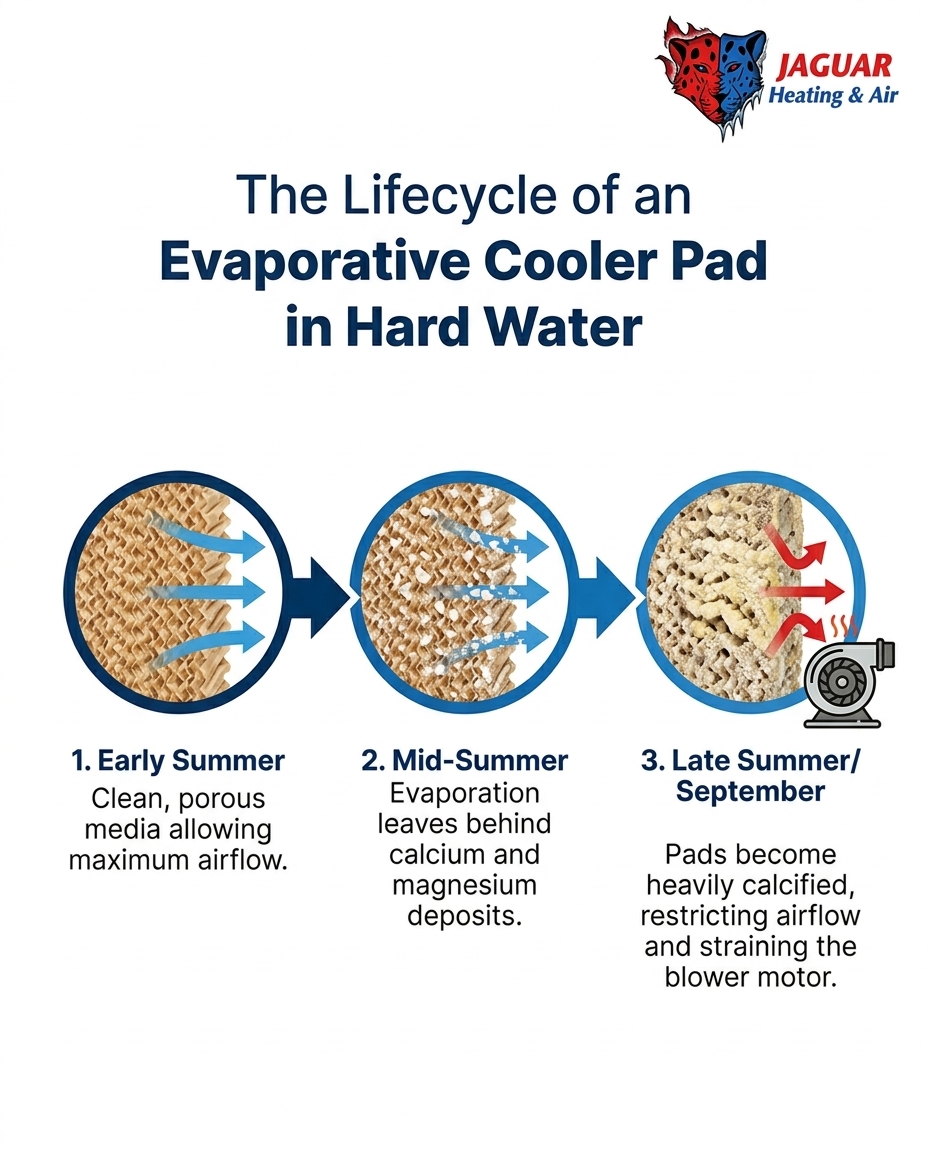
How Calcification Chokes Your System's Airflow
The transition from a functioning cooler pad to a rock-hard barrier does not happen overnight. It is a slow physical transformation that severely impacts the mechanical components of your system. Our technicians frequently meet homeowners searching for solutions to how Sacramento's hard water affects your evaporative cooler pads, only to find they have misdiagnosed this severe scaling as a failing blower motor, simply because the symptoms look and sound identical.
Here is the exact process of how hard water scale systematically chokes your system's airflow:
1. Initial Seeding: As water evaporates, microscopic calcium crystals attach to the edges of the cooling media fibers. At this stage, airflow remains normal.
2. Bridging and Solidification: Over weeks of continuous operation, these crystals grow and bridge the gaps between the fibers. The pad changes from a spongy, water-absorbent material into a rigid, brittle structure.
3. Airflow Blockage: Once the gaps are bridged with scale, the blower motor attempts to pull air through a solid wall. The volume of air entering the home drops significantly, reducing the cooling capacity to near zero.
4. Mechanical Strain: Forced to operate against extreme static pressure, the blower motor works significantly harder with diminishing results. It draws more electrical current and runs hotter than designed.
This extreme restriction can strain electrical components to their breaking point. If the motor overheats and fails due to this excess static pressure, you will likely need professional Sacramento AC repair to get the system running again. Jaguar Heating & Air's hands-on diagnostic expertise is vital here; our technicians can physically distinguish between a dying motor that needs replacement and a system that is simply choked by regional hard water scale and needs extensive cleaning.
The warning signs: If you notice the system running constantly but the air coming from the vents feels weak or smells slightly earthy and stale, calcification has likely taken over. Continuing to run the system in this state only accelerates the wear and tear on the electrical components.
Descaling vs. Replacement: End-of-Season Maintenance Decisions
When September arrives and the pads are fully calcified, homeowners often look for quick fixes to get through the final weeks of the cooling season. The internet is full of DIY descaling advice, but our team typically sees that the reality of local hard water renders these short-term solutions ineffective.
Chemical descalers and water treatment tablets are designed as preventative measures. They work by keeping minerals suspended in the water so they can be drained away. However, once calcification has fully set in by early fall, dropping a treatment tablet into the pan will not dissolve the rock-hard crust on the pads. The damage is already done.
Attempting to aggressively wash or scrape calcified pads usually destroys the media entirely rather than restoring airflow. The calcium bonds directly to the fibers. If you try to power-wash or scrape the scale away, you will simply tear holes in the pad, which ruins its ability to hold water and allows uncooled, dirty air to bypass the media completely.
This principle of careful maintenance applies to all cooling equipment. Proper cleaning techniques are vital, which is exactly why we never recommend hose-washing your AC coils or aggressively power-washing fragile HVAC components. Just last season, our Jaguar Heating & Air technicians responded to a local customer who reached out during a late-summer heatwave seeking a full A/C replacement estimate because their outdoor unit was failing to cool the house. Instead of pushing an expensive new installation, our team performed a careful, professional cleaning of the heavily fouled equipment. No new system was needed after the cleaning service, proving that proper maintenance techniques save money and restore performance.
For a swamp cooler in late summer, we recommend simply swapping the pads for new ones as the most reliable short-term fix, even if you plan to shut the system down a few weeks later. It is a small investment that immediately restores airflow and removes the strain from your blower motor before the winter shutdown.
The Limits of Purge Pumps
Many modern evaporative coolers are equipped with purge pumps, which automatically drain a portion of the water from the pan every few hours. These pumps are highly effective at diluting the mineral concentration during the peak summer months.
However, purge pumps have limits. While they significantly slow down scale buildup, they cannot completely prevent the cumulative calcification that peaks before the fall transition. The sheer volume of water evaporated in the local climate means that some calcium will always be left behind. Purge pumps buy you time, but they do not eliminate the eventual need for pad replacement.
Breaking the Cycle: Transitioning Away from Evaporative Cooling
Battling local water hardness year after year creates a very real sense of cumulative maintenance fatigue. Scraping scale out of metal pans, replacing rusted components, and swapping expensive pads multiple times a season requires significant time and effort. For many homeowners, the September airflow drop is the final push needed to seek a better alternative.
Modern refrigerated central AC and high-efficiency heat pumps offer a permanent solution to water-scale issues. Because these systems use closed-loop refrigerants to transfer heat rather than evaporating municipal water, they are completely immune to the effects of local water hardness. You never have to worry about calcium buildup, rusted pans, or calcified media again.
Beyond escaping the hard water trap, upgrading provides substantial secondary benefits. Swamp coolers actively add moisture to the air, which can make the house feel clammy and uncomfortable during late-summer monsoonal moisture surges. Refrigerated systems do the opposite—they pull excess humidity out of the home, creating a crisp, comfortable environment. Furthermore, closed-loop systems allow you to integrate advanced indoor air quality solutions like HEPA filtration and UV purifiers that swamp coolers simply cannot support.
Our team recently helped a local homeowner during a stretch of triple-digit heat when their house was not cooling effectively with their aging setup. A Jaguar Heating & Air technician evaluated the property, explained the underlying airflow and capacity problems, and clearly detailed all available options. By understanding the limitations of their current system, the homeowner was able to make an informed upgrade that successfully cooled the house without the constant burden of manual maintenance.
If you are considering breaking the cycle, it is worth noting that generic energy rebates and federal tax credits may be available for high-efficiency heat pump upgrades. These incentives can help offset the initial installation costs. We always advise our customers to verify current programs with their local utility provider or a tax professional to see what generic benefits apply to their specific situation.
Frequently Asked Questions About Local Swamp Cooler Maintenance
How does hard water affect evaporative coolers?
Hard water severely impacts evaporative coolers by leaving behind heavy mineral deposits as the pure water evaporates. Over a single summer season, the high concentrations of calcium and magnesium in the water supply accumulate on the cooling pads, forming a rock-hard crust. This calcification restricts airflow, reduces cooling efficiency, and forces the blower motor to work much harder, often leading to premature component failure.
Should I replace or descale calcified cooler pads?
We almost always recommend replacing calcified cooler pads rather than attempting to descale them. By the time heavy scale has formed in late summer, the calcium is deeply bonded to the pad fibers. Aggressive washing or scraping will tear the media, destroying its ability to hold water evenly, while chemical descalers are generally too weak to dissolve a fully hardened crust.
Why does my swamp cooler lose airflow at the end of summer?
Your swamp cooler loses airflow at the end of summer because a season's worth of mineral scale has finally reached critical mass on the cooling pads. The accumulated calcium bridges the gaps in the porous media, creating a solid physical barrier. The blower motor struggles to pull air through this crust, resulting in a drastic drop in the volume of air reaching your living spaces.
How often should you change evaporative cooler pads with hard water?
In areas with high mineral content like Sacramento, our team typically sees that you need to change evaporative cooler pads at least once per season, and sometimes twice. If you run the system heavily during a hot, dry summer without a purge pump, the pads may become completely choked with scale by August or September, requiring a late-season replacement to maintain airflow.
Are modern heat pumps better for areas with hard water?
Yes, modern heat pumps are vastly superior for areas with hard water because they do not use water to cool the home. They rely on a closed-loop refrigerant cycle to transfer heat, meaning they are completely immune to calcium buildup, scaling, and rusted components. Upgrading to a heat pump permanently eliminates the maintenance fatigue associated with swamp coolers.
Get an Honest Assessment Before Next Summer
Struggling with severely reduced airflow at the end of the season does not have to be an annual tradition. The September performance drop is a clear signal that the local water supply has taken its toll on your equipment. Whether you want to address the immediate airflow restriction or explore long-term alternatives, getting professional eyes on your system is the right next step.
We encourage you to schedule a professional evaluation to discuss pad replacement, deep-cleaning maintenance, or system upgrade options. Our expert team at Jaguar Heating & Air can provide a clear explanation of how local hard water causes this late-season calcification and offer honest guidance on the best path forward. Let us help you find a reliable, comfortable solution before the next cooling season begins.
Recent Posts
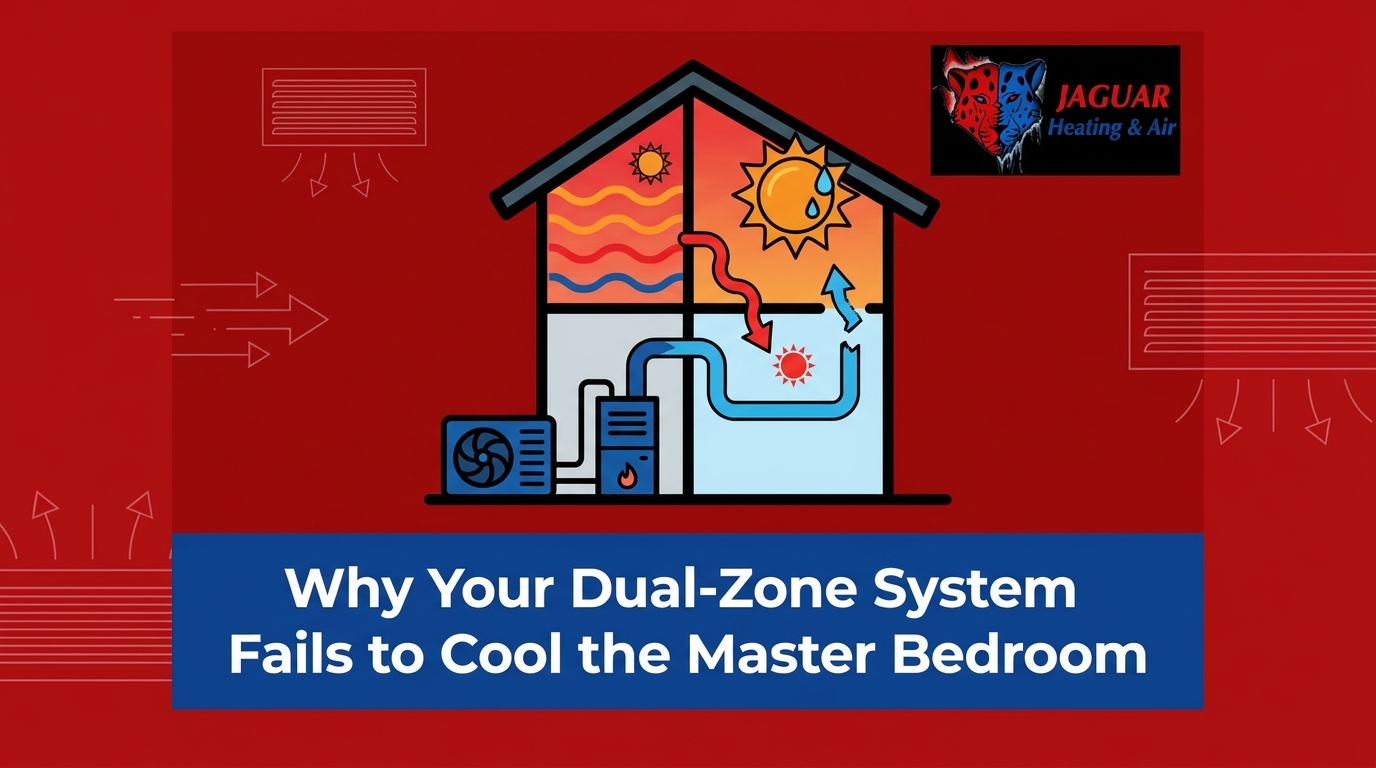
Why Your Dual-Zone System Fails to Cool the Master Bedroom
Persistent temperature imbalances in your master suite are rarely a main AC capacity issue. Discover how stuck motorized zone dampers disrupt airflow and why a pre-season diagnostic is crucial.
The Truth About Chemical Coil Cleaners and Your AC's Longevity
While a sparkling clean condenser unit looks great, acidic sprays might be secretly destroying your equipment. See why we refuse to use them during fall tune-ups.
Why We Inspect Your Ductwork's Mastic Seal During Cooling Diagnostics
Before transitioning to fall heating, checking the 1990s-era mastic tape on your ductwork is crucial. Degraded attic seals waste expensive conditioned air long before your AC unit fails.