.avif)
Why We Inspect Your Ductwork's Mastic Seal During Cooling Diagnostics
Before transitioning to fall heating, checking the 1990s-era mastic tape on your ductwork is crucial. Degraded attic seals waste expensive conditioned air long before your AC unit fails.
Before transitioning to fall heating, checking the 1990s-era mastic tape on your ductwork is crucial. Degraded attic seals waste expensive conditioned air long before your AC unit fails.

The Hidden Culprit Behind Wasted Energy in Older Homes
Your air conditioner is running nonstop, but certain rooms in your house still feel uncomfortably warm and stuffy. When you find yourself asking why we inspect your ductwork's mastic seal during cooling diagnostics, the answer usually comes down to this exact frustration. Many homeowners assume that poor cooling performance always points to a broken compressor or a failing mechanical part. However, our technicians at Jaguar Heating & Air consistently find that the root cause of wasted energy and poor indoor comfort often lies hidden away in the dark corners of your attic or crawlspace.
Whether you are looking to upgrade your Air Conditioning system or need immediate AC repair, addressing the delivery system is just as vital as checking the mechanical unit.
As homes age, the original materials used to seal their air delivery systems begin to fail. In our years of servicing Sacramento neighborhoods, we see this pattern constantly in houses built during the housing booms of the 1990s. During that era, contractors relied heavily on specific formulas of mastic sealant and mesh tape to connect sections of sheet metal and flex duct. While these materials were industry standard at the time, they were never designed to last forever under extreme conditions. Today, those original seals are over thirty years old, and they are quietly giving way.
This hidden degradation is exactly why an early fall transition tune-up must evaluate the entire air delivery infrastructure, not just the mechanical unit sitting in your side yard. If a technician only checks the refrigerant levels and the electrical contactors, they are only looking at half of the equation. A cooling system cannot effectively cool your living spaces if the infrastructure meant to deliver that air is severely compromised.
Common symptoms of hidden ductwork failure include:
• Uneven temperatures: One room feels like a freezer while another feels like an oven.
• Excessive dust: Surfaces require constant cleaning despite regular filter changes.
• Extended run times: The system struggles to satisfy the thermostat settings, running for hours on end.
• Whistling sounds: Audible air movement near registers indicating pressure imbalances.
How Decades of Attic Heat Destroys Original Duct Seals
To understand why duct seals fail, you have to look at the environment they live in. Our team has spent countless hours inspecting Sacramento attics, and we see firsthand how extreme, triple-digit summer heat turns these spaces into roasting ovens that bake and accelerate the deterioration of 1990s-era mastic formulas. Mastic is a thick, paste-like sealant that was painted over duct joints, often reinforced with fiberglass mesh tape. When freshly applied, it forms a flexible, airtight bond. But over three decades of seasonal temperature swings, the chemistry of that bond fundamentally changes.
The Chemistry of Mastic Failure
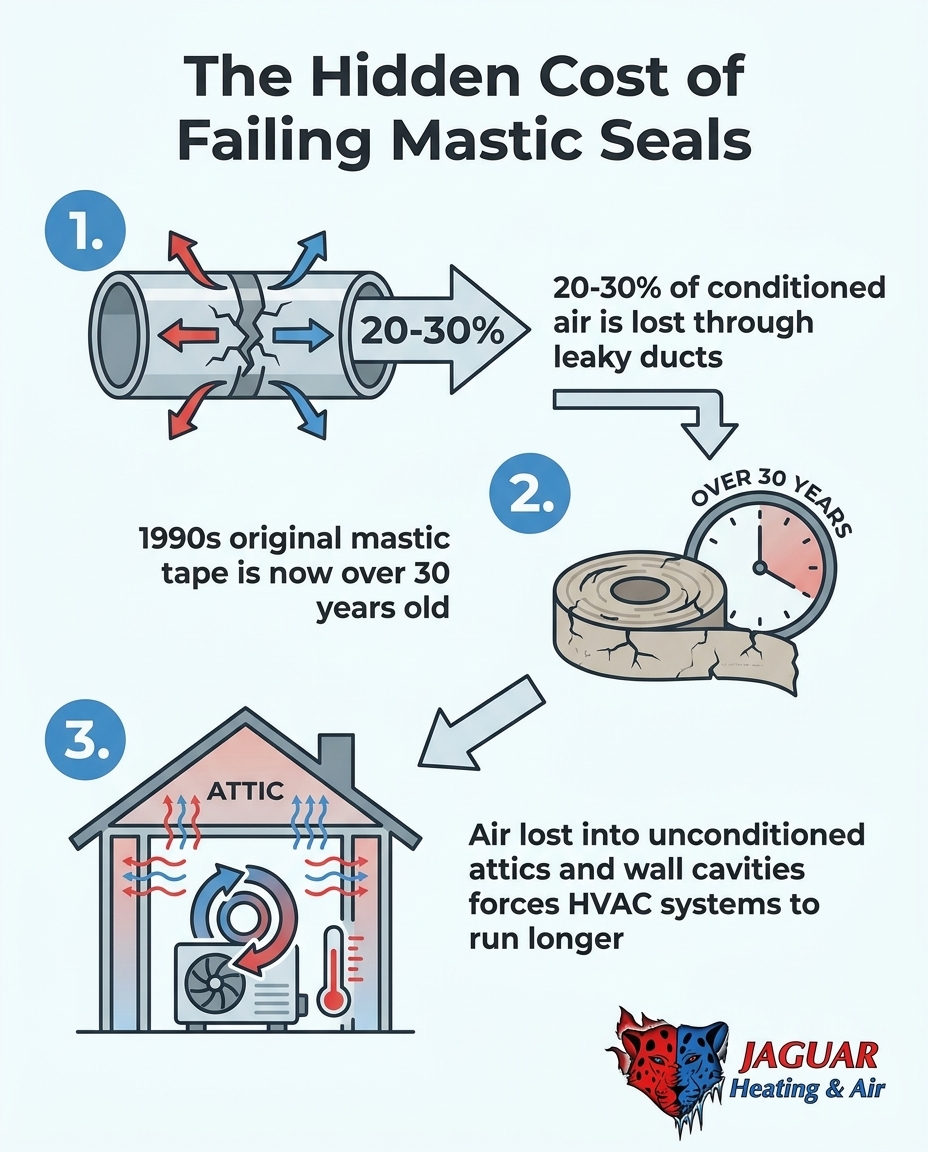
The physics of prolonged heat exposure are unforgiving. As the temperature in an unconditioned attic routinely climbs above 130 degrees Fahrenheit during peak summer months, the moisture and plasticizers within the mastic formula slowly evaporate. Over a 30-year period, this continuous baking causes the once-flexible paste to dry out completely. The material becomes brittle, rigid, and chalky.
Once the mastic loses its elasticity, it cannot expand and contract alongside the metal ductwork as the system turns on and off. The resulting stress causes the brittle sealant to crack, creating hundreds of tiny fissures across the duct system's joints.
Visual Signs of Deterioration
During a comprehensive inspection, our trained technicians look for specific visual signs that the mastic has reached the end of its functional lifespan. These signs include:
• Spiderweb cracking: Fine, intersecting lines across the surface of the dried paste.
• Flaking and peeling: Chunks of mastic falling away from the sheet metal collars.
• Exposed fiberglass mesh: The underlying tape becoming visible as the top layer of paste disintegrates.
• Dirt trails: Dark streaks radiating outward from joints, indicating where pressurized air is escaping and blowing attic dust around.
The immediate consequence: Once the seal breaks, your ductwork is essentially pumping expensive conditioned air directly into unconditioned spaces. You are paying to cool the rafters, the insulation, and the spiders, while the living areas below remain uncomfortable.
When Duct Leaks Disguise Themselves as Equipment Failures
One of the most frustrating aspects of failing mastic seals is how convincingly they mimic major mechanical breakdowns. When conditioned air escapes through cracks in the ductwork and into wall cavities, the volume of air actually reaching your living room drops dramatically. To compensate for this loss, the thermostat forces the air conditioning unit to run continuously in a desperate attempt to reach the target temperature.
This constant, strained operation looks and sounds exactly like a failing compressor, a clogged metering device, or a system running low on refrigerant. It is incredibly common for these symptoms to be misdiagnosed if the technician fails to look past the mechanical equipment. For example, our team recently helped a local Sacramento homeowner during a late-summer heat wave after they were told their entire air conditioner needed replacement. However, when our technician arrived and inspected both the unit and the attic ductwork, we found the mechanical system was completely fine—the actual issue was severely compromised ducts leaking all the cooled air before it reached the living spaces. Once the ducts were properly sealed and replaced where necessary, the system worked perfectly, saving the homeowner from an unnecessary and massive equipment expense.
This scenario underscores the danger of replacing mechanical components without first verifying the integrity of the air delivery system. You could install the most efficient, top-of-the-line air conditioner on the market, but if the ductwork is leaking, the new system will underperform just like the old one.
Proper diagnostics during the early fall transition can prevent these costly missteps. By identifying the true source of the air loss, professionals can restore system efficiency without recommending unnecessary hardware replacements. This holistic approach is exactly why we never recommend hose-washing your AC coils without a proper understanding of the system's overall health—treating a symptom without diagnosing the root cause rarely solves the underlying problem.
The 20 to 30 Percent Rule: Where Your Conditioned Air Actually Goes
The impact of degraded mastic seals is not a minor inconvenience; it is a massive drain on your home's energy efficiency. According to ENERGY STAR data, in a typical house, about 20 to 30 percent of the air that moves through the duct system is lost due to leaks, holes, and poorly connected ducts. In the Sacramento homes we evaluate with original 1990s ductwork, we often see that percentage skew significantly higher.
To understand the severity of this loss, you have to trace the path of the escaped air. When the blower motor pushes air through the system, it creates positive pressure inside the supply ducts. If the mastic seals are broken, that positive pressure forces the freshly cooled air out into the attic or between the floor joists.
But the physics of air loss create a compounding effect. As air escapes the supply side, it creates a pressure imbalance inside the home. This negative pressure acts like a vacuum, pulling unfiltered, dusty, and humid air from outside, from the crawlspace, or from the attic back into the living space through tiny gaps around windows, doors, and light fixtures. Not only are you losing the air you paid to cool, but you are actively drawing dirty air into your home.
• Supply Plenum — Immediate Consequence: Massive loss of freshly cooled air before it reaches branch ducts — Long-Term Impact on the Home: Forces the AC to run continuous cycles, accelerating wear and tear
• Return Ducts — Immediate Consequence: Pulls hot, dusty attic air directly into the HVAC equipment — Long-Term Impact on the Home: Clogs the evaporator coil, reduces efficiency, and ruins indoor air quality
• Branch Connections — Immediate Consequence: Specific rooms receive little to no airflow — Long-Term Impact on the Home: Creates permanent hot and cold spots throughout the floorplan
Framing this massive energy waste as a critical issue is vital, especially right before the seasons change. Resolving a 30 percent air loss now means you won't be pumping expensive heated air into the attic when winter arrives.
Why September is the Critical Window for Ductwork Inspections
Timing matters when it comes to HVAC diagnostics. September presents a unique set of weather patterns that make it the ideal time to evaluate your home's air delivery infrastructure. During this early fall transition, our region frequently experiences late, intense heat waves during the day, followed by rapidly cooling temperatures at night. Your system is being asked to perform at its maximum capacity one afternoon, and then sit idle the next.
Our technicians highly recommend addressing leaky mastic seals during this specific window because it offers dual benefits. First, it prepares the home for the final, brutal days of late-summer AC usage, ensuring that every ounce of cooling power actually makes it into your living room. Second, and perhaps more importantly, it secures the infrastructure for the upcoming winter months.
Many homeowners forget that the exact same ductwork responsible for delivering chilled air in August will soon be responsible for delivering heated air in December. A leak that wastes cooling energy today will waste heating energy tomorrow. By scheduling comprehensive AC maintenance that includes a deep dive into the ductwork during the early fall transition, you are effectively preparing both sides of your HVAC system for the months ahead.
Proactive sealing reduces the operational strain on both the air conditioner and the furnace. When the ductwork is airtight, the system reaches the target temperature faster, cycles off sooner, and preserves the lifespan of the expensive mechanical components.
The Anatomy of a Holistic HVAC Diagnostic
A proper, professional diagnostic looks very different from a superficial mechanical check. At Jaguar Heating & Air, we insist on performing comprehensive diagnostics that go beyond just checking the AC unit. By inspecting the ductwork and mastic seals, our team ensures the entire cooling system is actually delivering air to the living spaces efficiently.
This holistic approach requires evaluating two distinct halves of the HVAC equation: the "creation system" (the mechanical equipment that cools or heats the air) and the "delivery system" (the network of ducts that transports that air).
Here is how our technicians evaluate the delivery system during a comprehensive visit:
1. Visual assessment of the plenum: The technician begins at the indoor air handler, inspecting the main supply and return plenums where the highest air pressure exists. This is where 1990s mastic failure causes the most significant energy loss.
2. Tracing the branch lines: The inspection moves into the attic or crawlspace to follow the flexible or rigid ductwork to each room, checking the connections at every junction box and collar.
3. Testing the mastic integrity: The technician physically checks the condition of the sealant, looking for the telltale signs of drying, cracking, and peeling that indicate a broken bond.
4. Evaluating register airflow: Back inside the living space, airflow is measured at the vents. A significant drop in pressure between the unit and the farthest register confirms the integrity of the hidden ductwork has been compromised.
5. Inspecting for internal debris: If the return ducts have been leaking, they have likely pulled attic dust into the system, which may necessitate professional duct cleaning to restore indoor air quality.
A true diagnostic leaves no stone unturned. By evaluating the entire infrastructure, we provide homeowners with an accurate picture of their system's health, rather than just a checklist of mechanical parts.
Frequently Asked Questions About Ductwork and Mastic Seals
How long does mastic sealant last on ductwork?
High-quality mastic sealant typically lasts between 20 to 30 years depending on the environmental conditions. In attics that experience extreme summer heat, the paste dries out and becomes brittle much faster. Homes built in the 1990s are currently seeing widespread failure of their original duct seals and require professional evaluation.
Why does duct mastic crack over time?
Duct mastic cracks because prolonged exposure to high temperatures causes the moisture and plasticizers in the formula to evaporate. As the material loses its elasticity, it can no longer flex with the metal ductwork as the system pressurizes and depressurizes. This constant mechanical stress eventually fractures the rigid, dried-out paste.
How much air is lost through leaky ducts?
According to energy authorities, a typical home loses roughly 20 to 30 percent of its conditioned air through leaks, holes, and poorly sealed connections. When the main plenum seals fail entirely, that percentage can spike even higher, resulting in massive energy waste and severely reduced indoor comfort.
Why is my AC running constantly but the house isn't cooling?
When an AC runs continuously without cooling the house, it often means the conditioned air is escaping into the attic or walls before reaching the vents. The thermostat registers that the room is still warm and forces the equipment to keep running. This symptom is frequently misdiagnosed as a failing compressor or low refrigerant.
What is included in a comprehensive HVAC diagnostic?
A comprehensive diagnostic evaluates both the mechanical equipment (the creation system) and the ductwork (the delivery system). It includes checking refrigerant levels, testing electrical components, measuring airflow, and visually inspecting the mastic seals and joints in the attic or crawlspace for signs of degradation.
Can leaky ductwork affect my indoor air quality?
Yes, compromised ductwork severely impacts indoor air quality. When return ducts leak, the negative pressure pulls unfiltered, dusty, and humid air from the attic or crawlspace directly into your HVAC system. This bypasses your air filter and blows contaminants straight into your living spaces.
Secure Your Home's Air Delivery System Today
Having a clear, technical understanding of how mastic sealants degrade over decades is the first step toward reclaiming your home's energy efficiency. When you realize that the original tape holding your 1990s ductwork together has dried out, cracked, and failed, it becomes obvious why a superficial mechanical check is never enough to guarantee indoor comfort.
Addressing these hidden leaks during the early fall transition ensures that your system is fully prepared for the final heat waves of the year, as well as the heavy heating demands of the upcoming winter. The next time you schedule a tune-up, make sure your diagnostic includes a thorough, professional evaluation of your entire air delivery infrastructure by our dedicated team.
Recent Posts
What a Rattling Outdoor Fan Blade Means for Your AC's Lifespan
A vibrating condenser fan creates micro-vibrations that act as a ticking time bomb for delicate copper lines. Find out why you shouldn't ignore this fall noise.

Why We Test Your AC's Amp Draw During Late Summer Maintenance
Even if your vents are blowing cold air, months of intense heat can push your compressor to the brink. We measure invisible electrical fatigue to catch stressed parts before a total breakdown.
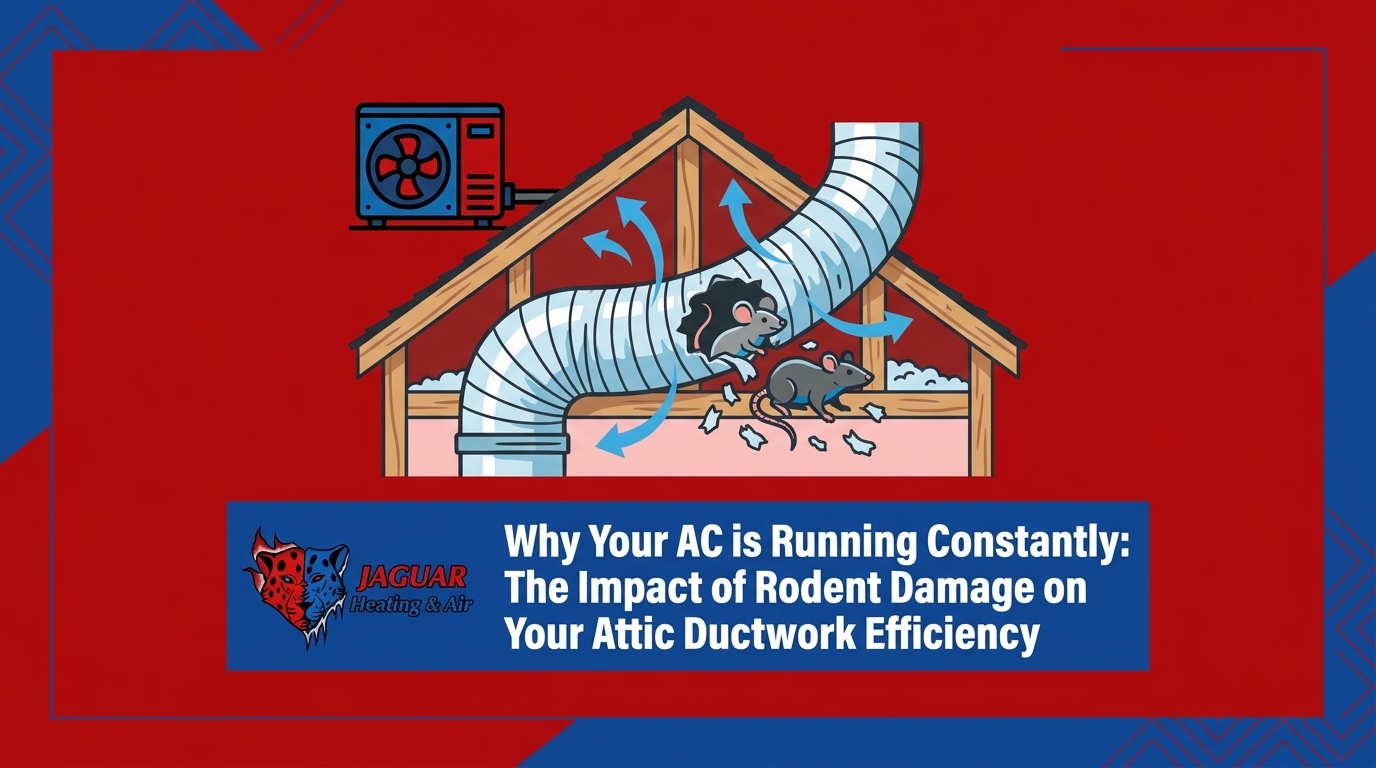
The Impact of Rodent Damage on Your Attic Ductwork Efficiency
If your cooling system runs constantly but your home stays warm, roof rats may have chewed through your flex ducts. See why a tape patch isn't enough to safely restore your system's airflow.