.avif)
Why Your Dual-Zone System Fails to Cool the Master Bedroom
Persistent temperature imbalances in your master suite are rarely a main AC capacity issue. Discover how stuck motorized zone dampers disrupt airflow and why a pre-season diagnostic is crucial.
Persistent temperature imbalances in your master suite are rarely a main AC capacity issue. Discover how stuck motorized zone dampers disrupt airflow and why a pre-season diagnostic is crucial.

Is Your Master Bedroom Always Hotter Than the Rest of the House?
Are you wondering why your dual-zone system fails to cool the master bedroom while the rest of the house feels like an icebox? It is incredibly frustrating to invest in a zoned climate control system only to spend your evenings tossing and turning in a stuffy, uncomfortably warm room. If your downstairs living area is perfectly chilled but your upstairs retreat remains stubbornly hot, you are experiencing one of the most common HVAC distribution problems. If you need reliable air conditioning services or are looking for professional AC repair in Sacramento, the team at Jaguar Heating & Air can help you pinpoint the exact cause of your uneven cooling based on our extensive local experience.
Most homeowners immediately assume that their central air conditioning unit is undersized or failing. However, in our years of troubleshooting Sacramento homes, we find that when one specific zone struggles while another thrives, it is rarely a capacity issue with the main HVAC equipment. Instead, it is almost always a localized distribution problem. The conditioned air is being generated at the indoor coil, but it is simply not reaching its intended destination.
When troubleshooting a master bedroom that remains hot, our investigation usually narrows down to two main suspects: mechanical airflow failures and sensor miscommunications. Either the physical gates inside your ductwork are failing to open, or the electronic brains of the system are misreading the temperature. Understanding how these components interact is the first step toward resolving the issue. By securing a professional diagnostic before winter weather sets in, you can identify the exact point of failure and restore total comfort to your home.
How Motorized Zone Dampers Control Your Home's Airflow
To understand why your master bedroom is not cooling, it helps to establish a technical baseline of how a dual-zone system operates. A zoned HVAC system separates a larger home into distinct climate areas, allowing you to control the temperature of the upstairs independently from the downstairs. This is achieved through a combination of thermostats, a central control panel, and specialized mechanical components inside the ductwork.
The central control panel acts as the brain of the operation. It receives signals from the thermostats located in each zone and communicates those demands to the main HVAC equipment. When the master bedroom thermostat calls for cooling, the control panel turns on the air conditioning compressor and the indoor blower motor. Simultaneously, it sends a voltage signal to direct the airflow precisely where it is needed.
This direction is handled by motorized zone dampers. These are physical, mechanical valves installed inside the main supply trunks of your ductwork. When a zone requires conditioning, the control board signals the damper motor to open the metal blades, allowing cold air to flow freely into that specific area. If another zone does not need cooling at that moment, its respective damper is signaled to close, blocking the airflow and redirecting the system's full capacity to the active zone.
Because motorized zone dampers are mechanical devices subjected to continuous movement, they experience significant wear and tear. Every time your system cycles on and off, these internal gates are opening and closing. Over years of operation, the continuous friction and electrical demand can cause the internal motors to fatigue, leading to the most common cause of isolated cooling failures.
The Most Common Culprit: Stuck or Failing Zone Dampers
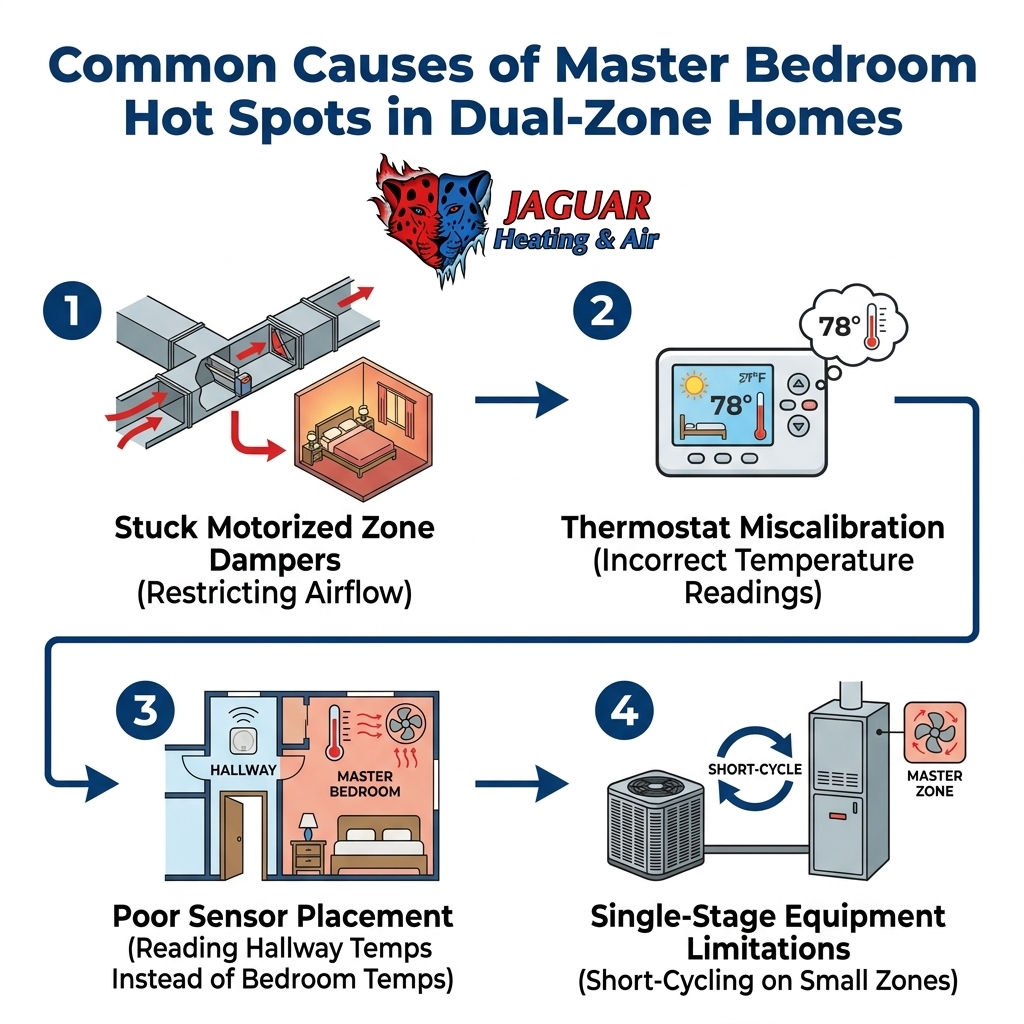
When a specific zone fails to cool, a stuck or burned-out motorized zone damper is frequently the primary mechanical reason. If the damper motor burns out while the blades are in the closed position, the ductwork leading to your master bedroom is essentially capped off. The blower motor will push cold air through the system, but it will hit a physical wall at the closed damper, preventing any conditioned air from reaching your vents.
Sacramento's intense triple-digit summer heat puts maximum strain on residential cooling systems, forcing dampers to cycle constantly. This relentless demand frequently leads to mechanical fatigue by late summer. Just last September, a local homeowner reached out to our team at Jaguar Heating & Air during a stretch of triple-digit heat when their AC system was simply not cooling the upstairs. One of our lead technicians arrived, evaluated the zoning, and found a burned-out damper actuator. By explaining the exact mechanical problem and replacing the failed component, we ensured the house was cooling effectively again.
It is important to note that diagnosing and replacing a zone damper is not a DIY project. Testing the voltage at the control board, verifying the 24-volt signal at the damper motor, and physically replacing the component requires a licensed HVAC professional. Attempting to force a damper open or altering the wiring can short out the entire zone control board, turning a localized repair into a major system failure.
Signs Your Damper is Stuck Closed
Recognizing the symptoms of a failed damper can help you communicate the problem effectively to your technician. Look for these specific indicators:
• Lack of air pressure: Place your hand over the master bedroom registers while the system is running. If you feel zero or barely any airflow, the duct pathway is likely blocked by a closed damper.
• Increased air noise: If the master bedroom damper is stuck closed, all the air is forced into the other working zone. You might notice a loud whistling or rushing sound from the downstairs vents due to the increased static pressure.
• Thermostat mismatch: The thermostat clearly indicates that cooling is active, and you can hear the main unit running outside, but absolutely no temperature change occurs in the room.
Thermostat Miscalibration and Poor Sensor Placement
The Problem: Sometimes the mechanical dampers are functioning perfectly, but the master bedroom still feels like a sauna. In these cases, our technicians typically find that the secondary cause of zoning failures is related to control and communication. The system is physically capable of delivering cold air, but it is receiving the wrong instructions.
The Cause: A thermostat can only react to the air immediately surrounding it. If the master bedroom thermostat is located in a shaded, interior hallway, it will read a much cooler temperature than the sun-facing bedroom it is supposed to control. The hallway might reach the target temperature of 72 degrees quickly, prompting the thermostat to shut the zone down. Meanwhile, the actual bedroom, taking on radiant heat from large windows and exterior walls, might still be sitting at 78 degrees. This localized temperature discrepancy of 5 degrees or more is a direct result of sensor misplacement. Additionally, modern dual-zone setups often use remote temperature sensors. If the batteries die or the sensor loses its wireless connection to the main thermostat, the system defaults to inaccurate localized readings.
The Solution: A professional technician from our team will test the thermostat communication with the zone control board to verify that the signals are accurate. We can recalibrate the unit, relocate the thermostat to an interior wall within the actual bedroom, or install new remote sensors to ensure the system reads the true heat load of the space. While homeowners sometimes seek duct cleaning services believing a blockage is causing the hot spot, a thorough diagnostic often reveals that a simple sensor correction is all that is needed.
The Hidden Challenge: Single-Stage Equipment on Dual Zones
Even if the dampers and thermostats are communicating flawlessly, a pattern we see often in Sacramento homes is an advanced technical limitation that causes a master bedroom to struggle: pairing a single-stage AC compressor with a dual-zone duct system. A single-stage compressor only has one speed—100% capacity. When it turns on, it delivers the maximum amount of cooling your home was designed to handle.
This creates a significant challenge when only one small zone—like just the master bedroom—calls for cooling. The system is trying to force 100% of its air volume into a duct pathway designed to handle only 30% to 40% of the total airflow. This excessive static pressure can lead to two major problems. First, the system may short-cycle, turning on and off rapidly because the small zone cools down too fast without properly dehumidifying the air. Second, the restricted airflow over the indoor evaporator coil can cause the coil to freeze solid, shutting down the entire system.
To combat this, dual-zone systems with single-stage equipment utilize a bypass damper. This specialized damper connects the supply ductwork directly back into the return ductwork. When pressure builds up because only one zone is open, the bypass damper is pushed open, allowing the excess cold air to loop back into the system, relieving the pressure. However, bypass dampers can fail, stick closed, or be improperly sized during the initial installation. If the bypass system is not relieving pressure correctly, the master bedroom will never achieve consistent, comfortable cooling. While minor duct blockages are a separate issue, ensuring all pathways and bypass routes are clear is a critical part of a comprehensive airflow evaluation.
Why the Early Fall Transition Exacerbates Master Bedroom Hot Spots
The timing of your master bedroom comfort issues is often a major clue to the underlying mechanical failure. Here in Sacramento, the fluctuating temperatures of the early fall transition require dual-zone systems to work harder than usual, frequently switching between heating and cooling demands within the same 24-hour period. You might need air conditioning during a hot September afternoon, but require heating when the temperature drops overnight.
This transition period frequently masks or exacerbates stuck damper issues. If a motorized zone damper gets mechanically stuck in the "cooling" position (open to the bedroom) during the late summer, you might not notice a problem until the weather suddenly turns. When the system switches to heating mode, that same damper may fail to move, delivering unwanted heat to a room that doesn't need it, or conversely, remaining closed when the bedroom is freezing.
Because these mechanical failures become highly disruptive when the seasons change, our team strongly recommends testing both the heating and cooling cycles before winter weather fully arrives. Validating the performance of your zone control board and damper motors through a pre-heating-season diagnostic ensures that all mechanical zoning components are fully operational. Do not wait until a freezing night to discover that your master bedroom damper is permanently locked in the summer cooling position.
Diagnostic-First Approach: Finding the True Root Cause
When faced with a master bedroom that won't cool, some contractors are quick to suggest that the entire central air system is undersized and needs to be replaced. At Jaguar Heating & Air, we prioritize a diagnostic-first approach. From our extensive field experience, we know that meticulous, component-level troubleshooting is the only way to find the true root cause of airflow and zoning issues, rather than pushing unnecessary equipment sales.
The diagnostic process involves systematically testing the zone control board for proper voltage output, evaluating the damper motors for mechanical binding, and checking the thermostat wiring for continuity. By isolating the fault to a specific component, we can often resolve the issue without a major system overhaul. Reassuringly, many persistent master bedroom cooling issues can be completely resolved by replacing a single failed damper motor or relocating a sensor.
Another customer recently called us seeking a full replacement estimate because they believed their unit was completely failing to cool their upper floor. Instead of pushing for a replacement, our technician performed a thorough diagnostic, cleaned the AC unit, and evaluated the zoning controls. It turned out that a targeted repair restored full functionality, proving that no new AC unit was needed. Working with technicians who prioritize restoring functionality over upselling ensures you get an honest assessment of your home's comfort needs.
Targeted Solutions: When to Consider a Ductless Mini-Split
Sometimes, a thorough diagnostic reveals an uncomfortable truth: the home's original ductwork design is fundamentally inadequate for the master bedroom's heat load. If the ductwork is too small, poorly routed, or unable to be modified without major demolition, repairing the dual-zone system might not be enough to achieve total comfort. In these specific scenarios, ductless systems offer a highly effective alternative.
A ductless mini-split provides a targeted, cost-effective solution for stubborn hot spots. Because it operates completely independently of the central dual-zone system, it guarantees precise temperature control for that specific room. Modern ductless units are highly energy-efficient and can provide both powerful supplemental cooling in the summer and reliable heating in the winter.
If you are tired of battling a fundamentally flawed central duct system, our team often recommends exploring a ductless mini-split installation as the permanent fix you need. Understanding when a ductless system is a better solution for specific rooms can save you years of frustration and wasted energy. (Additionally, generic federal tax credits may apply to qualifying heat pump installations, making this upgrade even more accessible—be sure to verify current programs with a tax professional).
• Primary Benefit — Central Dual-Zone Repair: Restores original system functionality using existing ductwork. — Ductless Mini-Split Addition: Provides independent, guaranteed temperature control for one room.
• Installation Impact — Central Dual-Zone Repair: Minimal; usually involves replacing parts at the unit or in the attic. — Ductless Mini-Split Addition: Requires mounting an indoor head unit and an outdoor compressor.
• Energy Efficiency — Central Dual-Zone Repair: Improves efficiency by stopping air leakage, but relies on central unit. — Ductless Mini-Split Addition: Extremely high efficiency; only conditions the room you are using.
• Best Use Case — Central Dual-Zone Repair: When ductwork is properly sized and the issue is purely mechanical. — Ductless Mini-Split Addition: When original ductwork is undersized or unable to handle the heat load.
Frequently Asked Questions About Dual-Zone AC Failures
Why is my upstairs zone not cooling?
If your upstairs zone is not cooling, the most common cause is a motorized zone damper that is stuck in the closed position. This mechanical failure blocks cold air from traveling through the ductwork to the upper floor. Other potential causes include a malfunctioning zone control board, a miscalibrated upstairs thermostat, or a failing bypass damper that is short-cycling the system.
How do I know if my HVAC zone damper is bad?
You can tell an HVAC zone damper is bad if you feel little to no air pressure coming from the vents in that specific zone, even when the thermostat is calling for cooling. You might also hear a loud whistling or rushing air sound from the vents in the working zone, as the system forces all its air capacity into a smaller area. Testing the electrical voltage at the damper motor requires a licensed professional.
Why is my master bedroom hotter than the rest of the house?
Your master bedroom is hotter than the rest of the house because it is likely suffering from restricted airflow or inaccurate temperature sensing. Sun-facing windows, vaulted ceilings, and long duct runs make master bedrooms harder to cool. If a zone damper fails or a thermostat is poorly placed in a shaded hallway, the system will shut off before the bedroom reaches a comfortable temperature.
Can you fix a stuck HVAC damper?
Yes, a stuck HVAC damper can be fixed, but it usually requires replacing the motorized actuator rather than repairing the physical metal blades. Over time, the small electrical motors that open and close the dampers burn out from continuous use. A licensed HVAC technician can test the motor, verify the control board is sending the correct signal, and install a replacement motor to restore airflow.
Does a dual-zone system require two separate AC units?
No, a dual-zone system does not require two separate AC units. It utilizes a single central air conditioning compressor and a single indoor air handler. The zoning is achieved by using a central control panel and motorized dampers installed inside the ductwork, which direct the conditioned air to the specific areas of the home that need it.
How often should motorized zone dampers be inspected?
Motorized zone dampers should be inspected annually as part of your comprehensive pre-season HVAC maintenance. Because they are moving mechanical parts hidden inside your ductwork, wear and tear goes unnoticed until a complete failure occurs. Testing their operation before the extreme heat of summer or the early fall transition ensures they are opening and closing smoothly.
Restore Total Comfort to Your Master Bedroom
Dealing with a hot master bedroom can disrupt your sleep and diminish your overall comfort, but it is usually a solvable mechanical issue rather than a permanent flaw in your home. By understanding how thermostats and motorized zone dampers interact, you can see why persistent temperature imbalances occur and why they require expert attention.
Whether the solution involves replacing a worn-out damper motor, recalibrating a poorly placed sensor, or exploring targeted ductless options, professional troubleshooting is the key to lasting relief. We encourage you to schedule a professional diagnostic with Jaguar Heating & Air to pinpoint the exact failure before the heating season begins, ensuring your master bedroom remains perfectly comfortable all year long.
Recent Posts

The Truth About Chemical Coil Cleaners and Your AC's Longevity
While a sparkling clean condenser unit looks great, acidic sprays might be secretly destroying your equipment. See why we refuse to use them during fall tune-ups.

Why We Inspect Your Ductwork's Mastic Seal During Cooling Diagnostics
Before transitioning to fall heating, checking the 1990s-era mastic tape on your ductwork is crucial. Degraded attic seals waste expensive conditioned air long before your AC unit fails.
What a Rattling Outdoor Fan Blade Means for Your AC's Lifespan
A vibrating condenser fan creates micro-vibrations that act as a ticking time bomb for delicate copper lines. Find out why you shouldn't ignore this fall noise.