.avif)
Why Your AC Vents Are Dripping Condensation Onto the Floor
Water pooling under your ceiling registers is a stressful surprise. Understand the physics behind sweating duct boots and know when to call a professional before drywall damage occurs.
Water pooling under your ceiling registers is a stressful surprise. Understand the physics behind sweating duct boots and know when to call a professional before drywall damage occurs.

The Sudden Surprise of Water Dripping From Your Ceiling
You look up and notice a growing, dark water stain spreading across your ceiling, or worse, you step into a puddle in the middle of your hallway. Understanding why your AC vents are dripping condensation onto the floor is the first step to stopping the damage before it ruins your drywall. Waking up to water forming directly beneath a ceiling register triggers immediate panic for most homeowners. In our years serving Sacramento, the team at Jaguar Heating & Air has seen this exact scenario play out countless times. Your first thought might be a sudden roof leak, a burst plumbing pipe, or a catastrophic HVAC failure.
When you are facing unexpected indoor leaks, securing reliable air conditioning services and scheduling professional AC repair is the smartest way to protect your home's interior.
The urgency of addressing this moisture cannot be overstated. Water pooling around your ceiling registers does not just create an unsightly mess; it actively degrades the structural integrity of your ceiling materials. As we move into the September transition toward early fall—a time when our team highly recommends scheduling your pre-heating-season tune-up—your air conditioning system is still working hard, but the environmental conditions inside your attic are shifting. This specific combination of lingering heat and constant AC usage creates the perfect storm for moisture problems. Setting the stage for proper diagnostics means determining if this dripping is a simple airflow restriction, degraded insulation, or a sign that your system requires immediate professional intervention.
The Panic of Misdiagnosis
The first reaction: Most homeowners immediately assume the worst when water drips from above. If it hasn't rained recently, a roof leak is quickly ruled out. If there are no bathrooms directly above the dripping vent, plumbing is unlikely to be the culprit. By process of elimination, the HVAC system becomes the primary suspect. However, as our technicians often explain to customers, not all HVAC leaks are the same. A system leaking from the main indoor unit requires a completely different troubleshooting approach than a system that is actively sweating at the ceiling vents. Identifying exactly where the water originates dictates how quickly the problem can be resolved.
The Physics Behind Sweating Vents: Hot Attics Meet Cold Air
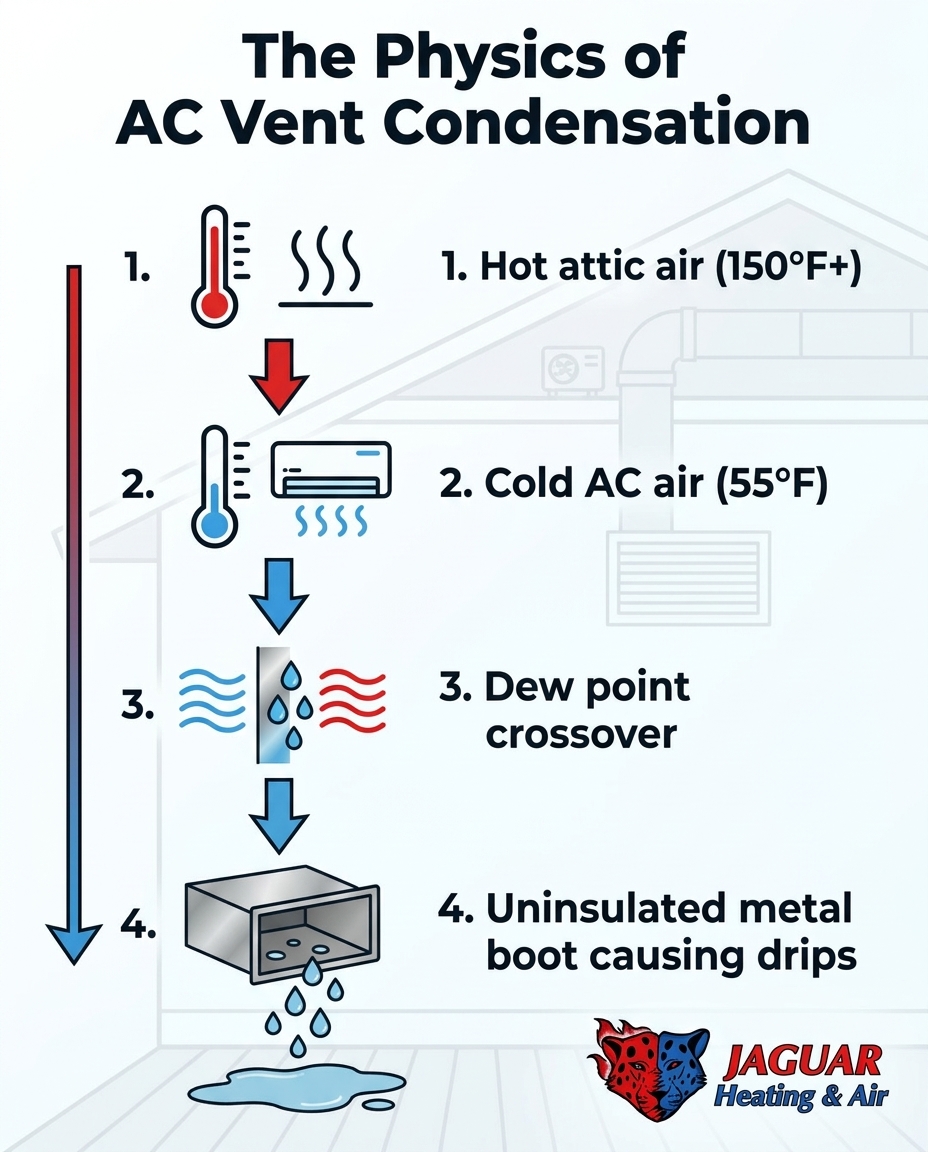
Water drips from AC ceiling vents when hot, humid attic air comes into contact with cold, uninsulated metal vent boots. This extreme temperature difference causes condensation to form rapidly on the conductive metal surface, which eventually pools and drips down through the register onto your floor.
To understand exactly why this happens, you have to look at the basic physics of the dew point. The dew point is the temperature at which air becomes completely saturated with moisture and can no longer hold it in vapor form. When warm air touches a surface that is cooler than its dew point, the moisture in that air instantly turns into liquid water. You see this exact same scientific principle in action when you take a freezing cold glass of iced tea outside on a hot afternoon—the outside of the glass immediately begins to sweat.
The Journey of Conditioned Air
Your air conditioning system is designed to produce cold, crisp air, typically chilling it down to around 55 degrees Fahrenheit before pushing it through your ductwork. As this icy air travels through the flexible ducts in your attic, it eventually reaches the metal "boot"—the structural transition piece that connects the ductwork to the louvered register in your ceiling.
The reaction point: Sheet metal is highly conductive. If that metal boot is uninsulated, its surface temperature drops drastically as the 55-degree air rushes past it. When the sweltering, humid air inside your attic makes contact with that freezing metal boot, rapid condensation occurs. Droplets form on the outside of the metal, run down the sides, saturate the surrounding drywall, and eventually drip straight through the vent louvers into your living space.
Why Uninsulated Duct Boots Fail During Late-Season Heatwaves
The reality of enclosed attic environments is that they act like massive solar ovens. Even when the outside temperature is a manageable 90 degrees, the radiant heat beating down on your roof can drive the internal attic temperature well past 150 degrees Fahrenheit. This creates a highly hostile environment for any HVAC equipment tasked with delivering cold air.
For Sacramento area homes with attic ductwork, our technicians frequently notice this problem becomes particularly pronounced during late-season heatwaves. While the calendar might say early fall, the intense regional heat continues to bake the roof. Because the days are getting slightly shorter, homeowners might assume the cooling season is ending, but the attic retains massive amounts of thermal energy. The massive temperature differential between the 150-degree attic oven and the 55-degree AC air accelerates condensation at an alarming rate.
The Degradation of Duct Insulation
Even if your home was built to code, the materials protecting your ductwork do not last forever. Older or poorly installed duct systems are highly vulnerable to insulation failure. Over years of enduring extreme heat and cold cycles, the specialized insulation wraps around the metal duct boots can degrade, shrink, or fall away completely.
What our team checks often: In many cases, we find the insulation was never applied correctly in the first place, leaving small gaps of exposed metal. It only takes a tiny patch of bare sheet metal to create enough condensation to cause a noticeable drip. This phenomenon frequently occurs even as the calendar shifts away from peak summer, simply because the attic retains trapped humidity and heat while the AC continues to run long cycles to keep the living space comfortable.
Sweating Vents vs. Clogged Condensate Drains: Spotting the Difference
Accurately identifying the source of your ceiling leak saves critical time during professional diagnostics and prevents unnecessary damage to your home. A pattern we see often on our service calls is homeowners confusing a sweating vent with a plumbing-style backup. While sweating vents are caused by surface condensation, a clogged drain line is an entirely different issue. Understanding the difference between these two is vital.
Your air conditioning system removes gallons of humidity from your indoor air every single day. This water drips off the indoor evaporator coil into a dedicated condensate drain pan, which then funnels the water outside through a PVC pipe. When dirt, algae, or debris clogs that pipe, the pan overflows. This overflow usually causes water damage directly beneath the indoor air handler, which is entirely different from localized dripping at a specific ceiling register.
If you suspect your primary drain is backed up, you are likely dealing with AC drain line clogs and flooding, which requires immediate clearing to prevent major water damage to ceilings or floors.
Comparing AC Leak Symptoms
• Location of the Leak — Sweating Vent Boots (Condensation): Dripping from specific ceiling registers in various rooms. — Clogged Condensate Drain Line: Pooling water directly beneath the main indoor air handler unit.
• Primary Cause — Sweating Vent Boots (Condensation): Uninsulated metal reacting to hot attic air and cold AC air. — Clogged Condensate Drain Line: Algae, dust, or sludge blocking the PVC exit pipe.
• Volume of Water — Sweating Vent Boots (Condensation): Slow, consistent dripping or localized water stains. — Clogged Condensate Drain Line: Large, sudden volumes of water overflowing from a drain pan.
• System Behavior — Sweating Vent Boots (Condensation): System generally continues to blow cold air normally. — Clogged Condensate Drain Line: System may shut down entirely if equipped with a float switch.
Other Common Culprits Behind Ceiling AC Leaks
While uninsulated vent boots are the primary cause of dripping registers, they aren't the only reason you might see water forming on your ceiling. Several other HVAC issues can mimic or exacerbate sweating vents, altering the temperature and airflow dynamics of your entire system.
1. Severely dirty air filters: A clogged filter chokes off the air supply to your system. When airflow is restricted, the cold air lingers in the ductwork longer than it should, dropping the temperature of the metal components even further and accelerating the condensation process.
2. Frozen evaporator coils: If airflow drops too low, or if the system is low on refrigerant, the indoor evaporator coil can literally freeze into a solid block of ice. When the system shuts off, that massive chunk of ice thaws rapidly. The sudden influx of water overwhelms the drip pan, leading to overflows that can run down ductwork and mimic a sweating vent.
3. High indoor humidity levels: If your home's overall humidity is excessively high due to poor ventilation or outdoor weather conditions, your AC has to work twice as hard to dehumidify the air. Excess moisture in the system increases the likelihood of condensation forming on any cold surface, including the vents.
4. Unrelated roof leaks masquerading as HVAC issues: Sometimes, water travels along the outside of ductwork from a completely different source. A small roof leak can drip onto a duct run, travel down the exterior of the flexible tubing, and pool at the ceiling register, making it look exactly like an HVAC failure.
Keeping up with routine AC maintenance, particularly as a pre-heating-season tune-up, is the most effective way to ensure filters are clean, coils are clear, and airflow remains optimal, preventing these secondary issues from causing water damage.
The Hidden Dangers of Ignoring Dripping Condensation
Placing a bucket under a dripping ceiling vent might solve the immediate mess on your floor, but ignoring the root cause of the condensation leads to severe, compounding damage hidden just out of sight. The water you see dripping is only a fraction of the moisture accumulating above the ceiling.
The silent progression of water damage to ceiling drywall often begins weeks before a drip is even noticed. Drywall acts like a sponge, absorbing condensation until it is completely saturated. By the time the water breaks through the paint and drips into your room, the structural integrity of the ceiling material is already compromised. If left unchecked, the heavy, waterlogged drywall can sag, crumble, or even collapse entirely, taking the metal register with it.
Mold, Mildew, and Insulation Damage
Beyond the drywall, persistent moisture in a dark, warm attic creates the ultimate breeding ground for biological growth. As we transition into fall and indoor air quality (IAQ) becomes a top priority, the rapid growth of mold and mildew in trapped, humid attic spaces can severely impact your home's environment. As spores multiply around the duct boot, they can easily be drawn into the airstream or seep into the living space. If your system has been exposed to prolonged moisture, professional duct cleaning may be necessary to restore a healthy environment once the leak is fixed.
Furthermore, surrounding attic insulation is highly susceptible to water damage. Fiberglass and blown-in cellulose insulation rely on trapped air pockets to resist heat transfer. When this insulation gets wet from dripping condensation, it compresses and entirely loses its R-value (its insulating power). Ruined insulation forces your AC to work harder, driving up energy costs and putting unnecessary strain on the compressor.
Why Proper Diagnostics Beat Temporary Patches
When faced with a sweating vent, some homeowners are tempted to climb into the attic with a roll of tape to attempt a quick fix. However, the dangers and code-compliance issues of attempting DIY duct insulation in a scorching attic cannot be ignored. Working in an environment that can easily exceed 150 degrees poses severe heat exhaustion risks, and improper handling of duct materials can violate local building codes or disrupt system airflow.
For Sacramento area homes with attic ductwork, slapping tape or temporary wraps on a metal boot fails to address the underlying temperature differential. If the vapor barrier is not sealed perfectly, humid air will still reach the cold metal, and condensation will continue to form underneath your temporary patch, rotting the new tape and worsening the problem.
The Value of Professional Inspection
We recently helped a local homeowner who reached out during the late summer heat when their air conditioner started leaking through the ceiling. Our technicians arrived on time, quickly and efficiently checked the AC in the attic, and addressed the underlying insulation issues before major drywall damage could occur. This is the difference our professional experience makes.
Jaguar Heating & Air performs thorough attic and ductwork inspections to identify the root cause of the condensation, ensuring homeowners get a permanent fix rather than a temporary patch. A comprehensive inspection of the entire duct system and attic environment reveals exactly where the insulation has degraded. Professional diagnostics pinpoint the exact failure point, allowing technicians to apply proper, code-compliant mastic and specialized insulation wraps that permanently stop the hot air from reaching the cold metal. As an added benefit, properly sealing ductwork improves overall efficiency; depending on your system, federal tax credits or local utility incentive programs may even apply to qualifying high-efficiency HVAC upgrades. We always advise readers to verify current programs with their utility provider or a tax professional.
Comprehensive FAQ: Understanding Your Sweating AC Vents
When water starts falling from the ceiling, you need answers quickly. Here are direct, authoritative answers to the most common homeowner questions our team receives regarding AC condensation and ceiling drips.
Why is water dripping from my AC vent in the ceiling?
Water drips from AC ceiling vents when hot, humid attic air comes into contact with cold, uninsulated metal vent boots. This extreme temperature difference causes condensation to form on the metal, which eventually drips through the register onto your floor. In our experience, it is a clear sign that the insulation surrounding the ductwork connection has failed or was never installed properly.
How do I stop condensation on my AC vents?
Stopping condensation requires properly insulating and sealing the metal duct boots in the attic to prevent hot air from touching the cold metal. You can also help reduce the risk by ensuring adequate airflow through the system, which means changing dirty air filters regularly and keeping vents open. However, the permanent fix requires a professional to apply proper vapor barriers and insulation wraps.
Is it normal for AC vents to sweat?
A tiny amount of moisture on extremely humid days can occasionally happen, but active, continuous dripping is never normal. Active dripping indicates a significant insulation failure, a severe airflow restriction, or a refrigerant issue that is causing the ductwork to run unnaturally cold. If water is pooling on the floor, you need to have the system inspected immediately.
Can sweating AC vents cause mold?
Yes, persistent moisture on drywall and in ductwork creates an ideal environment for mold spores to multiply rapidly. Trapped attic humidity exacerbates this risk, turning the area around the uninsulated vent boot into a breeding ground for biological growth. Addressing the condensation quickly is vital to protecting your home's indoor air quality and structural integrity.
How much condensation from an AC is normal?
An air conditioning system naturally produces gallons of water daily as it dehumidifies your home, but all of that water should drain safely outside via the primary condensate line. None of that normal condensation should ever exit through your ceiling vents. If you see water anywhere other than the outdoor drain pipe, the system is malfunctioning.
Should I insulate my AC vent boots myself?
Working in 150-degree attics is incredibly dangerous and poses severe risks of heatstroke and injury. Proper insulation requires specific materials, mastics, and techniques to ensure a perfect vapor barrier that meets local building codes. We highly recommend leaving this type of ductwork repair to licensed professionals who can guarantee a permanent, safe, and code-compliant solution.
Stop the Dripping and Protect Your Home
Ignoring a dripping ceiling vent is a guaranteed way to invite severe water damage, mold growth, and costly drywall repairs into your home. Because this is a physics-based problem rooted in extreme temperature differentials and failing insulation, it requires a professional, permanent solution rather than a quick DIY patch. Don't wait for a ruined ceiling to take action. Schedule a thorough professional inspection with Jaguar Heating & Air today to secure your home's comfort, stop the condensation in its tracks, and ensure your system runs safely and efficiently all season long.
Recent Posts
The Financial Math of Repairing vs. Replacing a Failed Compressor
A dead compressor on an aging AC system forces a tough choice. We break down the percentage-based lifespan math so you can confidently decide between a heavy repair and a full replacement.

How We Trace Elusive Refrigerant Leaks in Sacramento Attics
A slow summer leak can cause your AC to blow warm air when you need it most. We stop the cycle of endless top-offs by pinpointing the true root cause.
Deciding When to Stop Repairing a 15-Year-Old Air Conditioner
If your aging cooling system barely survived summer, you might wonder if another patch is worth it. We break down the sunk costs of ongoing repairs versus the reliability of a new system.